Château Frontenac

Consigli e tour per esploratori e viaggiatori

Guida della città di Québec City

Québec unisce i vicoli di Haute-Ville e Basse-Ville, collegati da ripide scalinate, alla vita dei suoi quartieri, a grandi festival e a inverni rigidi. Il francese è la lingua ufficiale; per esplorarla l'ideale è alternare camminate panoramiche ai bus della rete RTC.

Paese
Canada
Lingua
francese
Valuta
dollaro canadese (CAD)
Presa
tipo A/B
Fuso orario
America/Toronto
Emergenze
911
Acqua del rubinetto
Potabile
Prefisso
+1

Le tappe

Cosa fare a Québec City

Esplorare Québec significa fare i conti con continui dislivelli tra Haute-Ville e Basse-Ville, bastioni storici e quartieri dalla forte identità, uniti tra loro da scalinate pubbliche e linee di autobus RTC.

Prima di camminare: un'introduzione a Québec City

<p>Before you set off, know this: Québec City isn’t a museum piece—it’s a negotiation between centuries. Perched on a cliff above the St. Lawrence River, it remains the only fortified city north of Mexico still intact, which tells you everything about its temperament. Stone walls, copper roofs, and French street names coexist with espresso machines and Wi-Fi, and somehow none of it feels forced. The city doesn’t perform history; it inhabits it.</p> <p>This tour follows that layered rhythm—from the modern heights of the <strong>Observatoire de la Capitale</strong> down to the waterfront markets of the <strong>Old Port</strong>. Along the way you’ll encounter fortresses that never fought, churches that refused to die, prisons turned libraries, and murals that turned history into architecture. Think of it less as sightseeing and more as time travel without the paradoxes.</p> <p><strong>Distance:</strong> about 4.5 kilometers (roughly 2 hours).<br><strong>Terrain:</strong> steep in places—Upper Town is confident in its elevation.<br><strong>Pace:</strong> unhurried. Every leg is under 10 minutes; linger freely.<br><strong>Essentials:</strong> good shoes, layered clothing, and curiosity. You won’t need to enter any buildings; every story can be read from the street.</p> <p>Québec’s weather changes its mind often—sun, mist, drizzle, sometimes all before lunch. Treat it as part of the narrative. The same sky that once watched over Champlain’s wooden settlement now shades buskers, bureaucrats, and the odd ghost tour.</p> <p>You’re about to walk through a city fluent in time, where survival doubles as an art form. Open the app near the <strong>Observatoire de la Capitale</strong>, take in the skyline, and let the city begin its argument with eternity.</p>
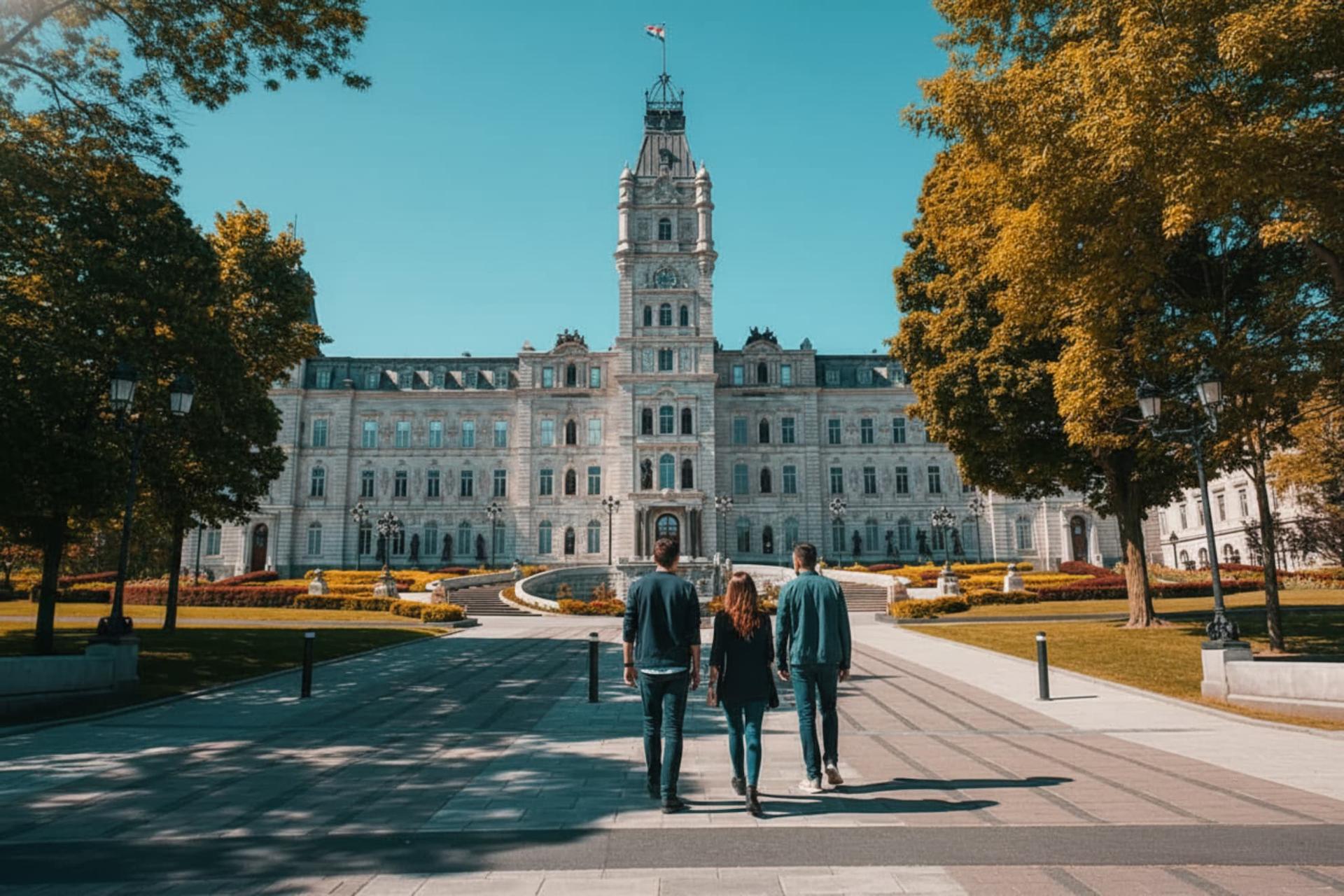
Politica scolpita nella pietra

La fortezza che non ha mai visto una battaglia

<p>Don’t be fooled by the quiet. The Citadelle was built for a war that refused to arrive. Between 1820 and 1850, British engineers carved this star-shaped fortress into Cap Diamant, a cliff so steep that Samuel de Champlain once mistook its glittering quartz for diamonds. When the stones proved worthless, the French coined a proverb: <em>“false as a Canadian diamond.”</em> The fortress inherited both the sparkle and the irony.</p> <p>After the War of 1812, Britain feared the Americans might try again, so the Duke of Wellington ordered a stronghold “to discourage ambition.” Lieutenant-Colonel Elias Walker Durnford obliged, hauling stone by barge and horse hoist up 360 feet of cliff to form what became North America’s largest British-built fortress. It was designed as a “last refuge” during siege or uprising—complete with rainwater reservoirs, barracks, and paranoia in five-point symmetry. The rebellion never came, but the bills did.</p> <p>History compensated with theatrics. In 1943 and 1944, Winston Churchill and Franklin D. Roosevelt met here to plan the Allied invasions of Europe and Asia. The D-Day calendar was finalized in rooms meant for musket drills. The same bastions that once braced for cannon fire now hosted secretaries, interpreters, and the faint smell of pipe tobacco. Not bad for a fort that never saw a battle.</p> <p>Today, the Citadelle serves three masters: Canada’s Governor General, the Royal 22e Régiment (the “Van Doos”), and two hundred thousand annual visitors. At 10 a.m. sharp in summer, the Changing of the Guard fills the parade ground with scarlet uniforms, bear-fur hats, and Batisse the goat—descendant of a Persian gift to Queen Victoria. When the noon gun fires, car alarms across town respond like an unplanned salute.</p> <p>At night, guides whisper of phantom footsteps on the ramparts—soldiers who died of duty or frost, or maybe just echoes of all that discipline. Either way, the ghosts are punctual; you could set your watch by them.</p> <p>Wind needles your skin along these granite walls, cold as empire. Look down at the river, glittering where Champlain’s “diamonds” once fooled a dreamer. For four centuries, Cap Diamant has defended many things—some real, some imagined. Mostly, it defends the idea that vigilance itself is a kind of heritage.</p> <p>Next stop: the Morrin Centre — where the fortress walls turn inward, and Québec trades gunpowder for grammar.</p>

Dove i muri cambiano idea

<p>From the outside, the Morrin Centre looks polite—Victorian stone symmetry, wrought-iron balconies, and a library’s hush. You’d never guess it began as Québec’s most notorious jail. Architect François Baillairgé built it in 1812 on the new model of “moral reform”: thick limestone walls, solitary cells, and the belief that silence could civilize. The windows you see now once opened onto isolation. Between 1812 and 1867, thieves, rebels, and debtors were confined behind them; sixteen left by way of the gallows that once stood above the front door. In 1823, half the city crowded these streets to watch a public hanging—a civic ritual that passed for justice.</p> <p>When the last prisoners were transferred to a newer facility, the building reinvented itself as Morrin College. The new purpose came courtesy of Dr. Joseph Morrin, a Scottish-born physician and twice mayor who believed education could rescue what punishment couldn’t. The façade you’re facing hides an improbable metamorphosis: prison cells converted into lecture halls, and gallows replaced by Greek Revival trim. Behind those windows, Québec’s first English-language degrees were earned—including one by a woman in the 1880s, proof that the walls were learning too.</p> <p>Look closely and you’ll spot the contrast between the original stone blocks and later Victorian masonry—architectural layers of repentance. The balcony railings where guards once paced now frame the library windows of the Literary and Historical Society of Québec, the province’s oldest English cultural institution. Inside those shelves rest volumes older than the city itself, rescued from two fires and a century of bilingual politics.</p> <p>Locals still claim that on quiet evenings, the sound of footsteps drifts from the basement vents—a faint echo of chains or maybe applause from a poetry reading. From out here, it’s hard to tell which would be stranger.</p> <p>The building stands as proof that walls, like people, can outgrow their original sentence. A place once designed to suppress voices now preserves them in ink and memory.</p> <p>Next stop: Château Frontenac — where penitence gives way to opulence, and the ghosts finally get room service.</p>

La fede ricostruita, ancora e ancora

L'hotel che ha venduto il Canada a se stesso

<p>Stand here and look up: this isn’t just a hotel; it’s Canada’s most successful sales pitch in stone. The Château Frontenac was born in 1893 from the Canadian Pacific Railway’s belief that tourism could be industrialized. If Europe had castles, Canada would simply build better ones. Architect Bruce Price borrowed his blueprints from the Loire Valley, added turrets for theatrical effect, and let the whole structure loom over the St. Lawrence like a medieval fortress that accidentally joined a marketing campaign.</p> <p>The result was a fairytale built on capitalism. CPR president William Van Horne—who quipped, “If we can’t export the scenery, we’ll import the tourists”—named it after Louis de Buade, Comte de Frontenac, the 17th-century governor who once ruled New France and refused to surrender to the British. Fittingly, the hotel now rules every postcard rack in the country.</p> <p>The site beneath those copper roofs has hosted four centuries of authority. The Château Frontenac replaced a line of vanished powerhouses: the French Château Saint-Louis, the British Château Haldimand, then, finally, this baronial hybrid where empire met expense account. Each rebuild erased the previous occupant while pretending to preserve it—a tradition Québec has perfected.</p> <p>During the Second World War, the hotel briefly doubled as Allied headquarters. Inside, Churchill and Roosevelt drafted the plans for D-Day while Canada’s own Prime Minister Mackenzie King played the role of polite host, excluded from most conversations. Outside, locals simply noted that the lights stayed on past curfew.</p> <p>The copper roof above you—replaced entirely between 2011 and 2014—still wears its green patina like aged armor. In winter, the air carries a hint of metal and salt from the river; in summer, the turrets flare orange at sunset, as if the building remembers its 1926 fire. Rumor has it that Frontenac’s ghost still patrols his namesake tower, not out of torment but because he refuses to give up the view.</p> <p>The Château’s silhouette tells you everything about Québec’s self-esteem: half fortress, half fantasy, always photogenic. You don’t need to stay the night to feel its pull—the façade already performs hospitality on a civic scale.</p> <p>Next stop: Dufferin Terrace — the wooden promenade that turned defense into leisure and keeps the river company year-round.</p>

Dove la fortezza è diventata una passerella

<p>If you ever needed proof that history can loosen its collar, this is it. Dufferin Terrace began as the governor’s private patio—an off-limits platform for lords to admire the river in solitude. Today, it’s 430 meters of democracy on timber, where anyone with shoes can walk the same edge once reserved for aristocracy.</p> <p>Look down through the glass skylights and you’ll see the bones of the old Château Saint-Louis, the 17th-century seat of New France. That château burned in 1834, leaving a literal power vacuum. Five years later, Lord Durham—British governor, reformist, and part-time controversy magnet—ordered the ruins turned into a public promenade. It was a radical idea: let commoners enjoy the governor’s view. The result was Durham Terrace, a short wooden platform with a railing and a message—“authority can afford transparency.”</p> <p>Four decades later, Lord Dufferin took the concept personally. In the 1870s he arrived in Québec, fell hopelessly in love with the city, and stopped municipal engineers from demolishing the fortifications. Instead, he doubled down on preservation and spectacle. Between 1878 and 1879, the terrace stretched to its current length, with six green-and-white gazebos named after the usual suspects—Frontenac, Victoria, Princess Louise, Dufferin himself. On June 28, 1879, Princess Louise cut the ribbon. The British Empire had just inaugurated Canada’s most photogenic boardwalk.</p> <p>Then came 1885, when 34 arc lamps flickered on along this very railing—electric light beamed 30 kilometers from Montmorency Falls. For one week, Dufferin Terrace was North America’s most modern boulevard, glowing over a 200-year-old cliff. Québec had officially entered the future without leaving its past.</p> <p>In winter, this place belongs to the toboggan slide, a 140-year-old wooden rocket run where riders hit 70 kilometers an hour screaming patriotic nonsense into the wind. In summer, street performers juggle and mimes mime while tourists photograph the Champlain monument—whose sculptor, Paul Chevré, later survived the Titanic. Québec never wastes a good plot twist.</p> <p>Listen for the whistle of river wind around Château Frontenac’s turrets, the wood creaking under millions of footsteps, the faint smell of cedar and brine. This boardwalk is more than a viewpoint; it’s a declaration that history doesn’t have to hide behind walls.</p> <p>Next stop: Rue du Petit-Champlain — where the view descends to street level, and commerce becomes the city’s native language again.</p>

La strada più antica che si rifiuta di invecchiare

Il muro che ricorda tutto

La tua guida privata, in tasca

Pronto a percorrerle a piedi?

  • Autoguidato, parti quando vuoi
  • Audio offline, 7 lingue
  • Soddisfatti o rimborsati
  • eSIM da 500 MB inclusa

da

5,00 €

1 tour autoguidato a Québec City

Vedi i tour

Organizza i giorni

Quanti giorni a Québec City? L'itinerario perfetto di 1 giorni

Giorno 1

A spasso tra Haute-Ville e Basse-Ville a Québec

Collega la storica Haute-Ville alla Basse-Ville tra vicoli ripidi, piazze iconiche e scalinate a cielo aperto, poi salta su un autobus RTC per gli spostamenti più lunghi.

5,00 €

Clima e affluenza

Quando visitare

Luglio è il mese più caldo a Québec, con medie di 25 °C, ma il periodo tra giugno e ottobre è anche il più piovoso. Maggio e settembre offrono il compromesso ideale; tra gennaio e marzo il gelo si fa sentire davvero, mentre l'estate e il calendario di eventi a dicembre attirano folle di visitatori.

Consigliato

Pieno inverno

gen–mar

-17–0°C/ 2–33°F

AffollatoPiovoso
  • Carnevale invernale a Québec
  • A gennaio la media minima è di -16,7 °C.

Da non perdere

  • Carnevale invernale di Québec

Disgelo primaverile

apr–mag

-1–18°C/ 30–64°F

Si riempiePiovoso
  • A maggio 17,5 °C di giorno
  • Ad aprile le precipitazioni medie sono di 94,4 mm.

Stagione dei festival

giu–set

8–25°C/ 47–77°F

Alta stagionePiovoso
  • Festival d’été de Québec
  • A luglio le precipitazioni medie sono di 118,7 mm.

Da non perdere

  • Festival d’été de Québec

Colori di tardo autunno

ott–dic

-11–11°C/ 11–52°F

AffollatoPiovoso
  • Mercatino di Natale tedesco
  • A dicembre la media massima è di -3,3 °C.

Da non perdere

  • Mercatino di Natale tedesco di Québec

Trasporti

Come arrivare e muoversi a Québec City

Aeroporto di Québec

Come arrivare e muoversi a Québec City
Linea RTC 80 verso il centroNon disponibile3,85 CA$
Linea RTC 76 verso Sainte-FoyMeno di 30 min3,85 CA$

Autobus RTC

Scelta migliore

Nel 2026 la corsa RTC costa 3,85 CAD con biglietto o 4,00 CAD in contanti; il pass giornaliero costa 10,50 CAD e quello da 5 giorni 34,75 CAD. Le linee 800 e 801 sono le più frequenti e comode.

A piedi

Perfetto in centro

Vieux-Québec e i quartieri centrali si girano al meglio a piedi, ma Québec conta molte scalinate, ripide salite tra Haute-Ville e Basse-Ville, oltre a ghiaccio e neve sul terreno in inverno.

Bicicletta

Solo in estate

Pedalare sulle piste segnalate è piacevole d'estate; colline, gradini, neve e traffico la sconsigliano d'inverno. Il Comune non specifica tariffe ufficiali per il noleggio di bici turistiche.

Taxi o corse condivise

Notte e periferia

Usa taxi o corse condivise per l'aeroporto Jean Lesage fuori orario o per la periferia. Il sito dello scalo conferma taxi e app, ma non riporta una tariffa fissa ufficiale per i trasporti pubblici.

Gira a piedi Vieux-Québec e il centro, usando i bus RTC 800, 801, 76 e 80 per i tragitti lunghi. Il pass giornaliero conviene dalla quarta corsa, quello da 5 giorni se prevedi almeno dieci viaggi.

Budget

Quanto costa visitare Québec City?

Le tariffe ufficiali del trasporto pubblico a Québec sono ragionevoli: il pass giornaliero costa 10,50 CAD e quello da 5 giorni 34,75 CAD. I prezzi medi attuali di caffè, pranzi, birre e taxi non compaiono in fonti ufficiali verificate, perciò non considerare questa stima un budget completo per i pasti.

Quanto costa visitare Québec City?
Biglietto RTC, digitale o cartaceo3,85 CA$
Corsa singola RTC, contanti4,00 CA$
Pass giornaliero RTC10,50 CA$
Pass 5 giorni RTC34,75 CA$
Pass weekend illimitato RTC19,00 CA$

Cash or card?

Le emettitrici RTC nel terminal dell'aeroporto accettano le principali carte e pagamenti contactless. Le tariffe comunali distinguono tra costo con biglietto e in contanti: tieni a portata qualche dollaro canadese se ti sposti fuori dai circuiti di pagamento elettronico dello scalo.

Dove dormire

Dove dormire a Québec City

Vieux-Québec

Prima visita

Il centro storico è ideale per esplorare a piedi Haute-Ville e Basse-Ville e avere i bus vicini. Metti in conto scalinate, acciottolato, folla durante gli eventi e un'atmosfera poco residenziale.

Saint-Jean-Baptiste

Caffè, serate in centro

Saint-Jean-Baptiste si sviluppa appena fuori dalle mura storiche, con strade vivaci e a due passi da Vieux-Québec. Le pendenze e le scalinate restano però una bella sfida durante i mesi invernali.

Saint-Roch

Vita notturna e autenticità

Saint-Roch è un quartiere pianeggiante di Basse-Ville, ricco di servizi e ben servito dai bus. Meno da cartolina ed eclettico rispetto a Vieux-Québec, è perfetto per soggiorni prolungati.

Montcalm

Più tranquillo, cultura

Montcalm è un'area residenziale centrale con bei parchi, caffè accoglienti e ritmi più rilassati del centro. Metti in conto solo una camminata più lunga o un tragitto in bus verso Vieux-Québec.

Sainte-Foy

Aeroporto, spazi, collegamenti

Sainte-Foy è una base pratica a ovest, vicina all'aeroporto e ai principali snodi bus, inclusa la linea 76. Non è ideale se pensi di trascorrere ogni serata nella città vecchia.

I tour

Québec City, una storia alla volta

Gratta e vinci

Dai una grattata

Sotto potrebbe esserci qualcosa di bello. Se vinci, ti diciamo come usarlo.

Un premio per viaggiatore. Valido 2 anni.

Il passaparola

Cosa dicono i viaggiatori

Sicurezza

Québec City è sicura?

Québec è sicura e accogliente. Gli ostacoli principali sono ghiaccio e neve d'inverno, le ripide scalinate tra Haute-Ville e Basse-Ville, gli incroci stradali e la folla durante i grandi eventi estivi o invernali. Componi il 911 per polizia, vigili del fuoco o ambulanza; il servizio sanitario del Québec risponde all'811 per consulti medici non urgenti.

Ghiaccio e scalinate d'inverno

Le gradinate pubbliche e i ripidi passaggi tra Haute-Ville e Basse-Ville gelano dopo nevicate o pioggia gelata. Tieniti ai corrimano, calza scarpe con buona aderenza e preferisci l'autobus alle scale se il fondo è viscido.

Folle durante i festival

Tra gli eventi ufficiali spiccano il Carnevale invernale, il Festival d’été de Québec e il mercatino di Natale tedesco a dicembre. Custodisci borse e portafogli nelle code strette e sui bus vicino alle aree dei festeggiamenti.

Strisce pedonali e autobus

Non scendere dai marciapiedi con gli occhi allo schermo, specie lungo i viali tra Vieux-Québec, Saint-Roch e Saint-Jean-Baptiste. Guarda sempre prima di attraversare per controllare l'arrivo di bus o veicoli che svoltano.

Cambi repentini del meteo

A Québec le medie toccano 25,0 °C a luglio e scendono a minime medie di -16,7 °C a gennaio. Vestiti a strati e porta acqua e scarpe impermeabili se prevedi di passare dal lungofiume alle scalinate fino ai belvedere aperti.

Assistenza medica d'emergenza

Chiama il 911 per le emergenze. Per problemi non urgenti, il servizio provinciale Info-Santé all'811 mette in contatto con un infermiere; i canali ufficiali non garantiscono l'assistenza in inglese per ogni chiamata.

Da sapere

Da sapere

Il francese è la lingua ufficiale

Il francese è l'unica lingua ufficiale e d'uso a Québec. Un semplice bonjour e i toponimi francesi aiutano con residenti, cartelli e servizi pubblici, anche se molti operatori del settore turistico parlano correntemente inglese.

I sei arrondissement della città

Québec conta sei arrondissements: Beauport, Charlesbourg, La Cité-Limoilou, La Haute-Saint-Charles, Les Rivières e Sainte-Foy–Sillery–Cap-Rouge. Un indirizzo a "Québec" può quindi trovarsi parecchio lontano da Vieux-Québec.

La città delle scale

I documenti storici celebrano le tante scalinate cittadine. Considera il tragitto tra Haute-Ville e Basse-Ville un dislivello verticale, non una camminata in piano, e valuta le condizioni invernali prima di scegliere la via più breve.

Domande

FAQ su Québec City

La linea 80 della RTC collega l'aeroporto YQB al centro di Québec passando per Les Saules. La linea 76 porta invece a Sainte-Foy in meno di 30 minuti, dove le frequenti corse delle linee 800 e 801 proseguono verso il centro.

Pronto a partire?

Tour audio autoguidati in tutta Québec City.

Scopri i tour a Québec City