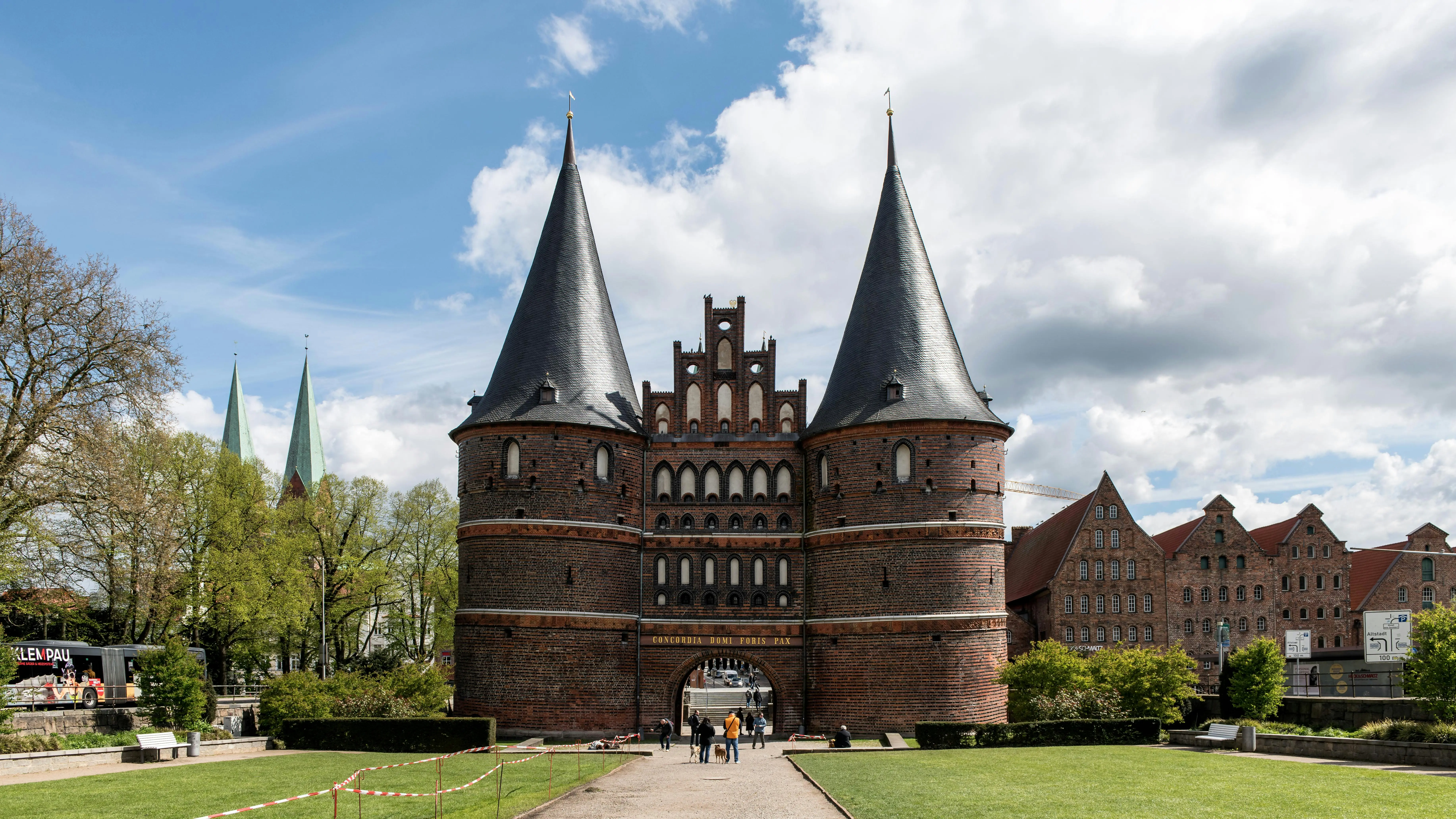
Museum Holstentor

Consigli e tour per esploratori e viaggiatori

Guida della città di Lübeck

Esplora il centro storico di Lubecca, tra gotico in mattoni rossi, banchine portuali e scorci marittimi, raccolto su un'isola fatta apposta per camminare.

Paese
Germania
Lingua
tedesco
Valuta
euro (EUR)
Presa
tipo F
Fuso orario
Europe/Berlin
Emergenze
112
Acqua del rubinetto
Generalmente potabile
Prefisso
+49

Le tappe

Cosa fare a Lübeck

Segui le chiese in mattoni del gotico baltico, i vicoli silenziosi e gli isolotti fluviali, poi salta su un autobus locale per raggiungere la stazione, Travemünde e le aree portuali più lontane.

Holstentor

<p>Welcome to Lübeck, a city steeped in history and brimming with stories waiting to be discovered. Your journey begins here, at the iconic Holstentor.</p> <img src="https://storage.googleapis.com/ciceru-assets-stg/eafcae58-0ee2-4e5f-9464-f3b13c38a32a/HQAmry4T-Nuremberg_chronicles_f_265-66_%28Lubeca%29.webp" alt="undefined" style="height: auto;width: 320px"/> <blockquote>Illustration of Lübeck in 1493 from the Nuremberg Chronicle - From Wikipedia</blockquote> <p>Picture yourself in the heart of medieval Lübeck. The air is filled with the chatter of merchants and the creak of wagon wheels on cobblestone streets. As you approach the city, the first thing you see is the Holstentor—two imposing towers of red brick rising boldly against the northern sky. Built in 1464, this gate wasn’t just a barrier; it was Lübeck’s way of announcing its power and prosperity to the world.</p> <img src="https://storage.googleapis.com/ciceru-assets-stg/eafcae58-0ee2-4e5f-9464-f3b13c38a32a/K8gHGxVu-fabian-kleiser-pSC9wUt29F0-unsplash.webp" alt="undefined" style="height: auto;width: 320px"/> <blockquote>The two imposing towers seen from the west</blockquote> <p>The Holstentor’s thick walls, nearly 3.5 meters deep, were designed to impress as much as to protect. The Gothic architecture, with its formidable towers and narrow slits for windows, spoke of strength and confidence. But if you look closely, you’ll notice something curious. The south tower leans, just slightly, like a northern cousin of the leaning tower of Pisa. This wasn’t a mistake by the builders—it was the inevitable result of constructing such a massive structure on the marshy ground near the river Trave. Even in the 15th century, they knew the earth would shift beneath them, but they pressed on, creating a landmark that would defy both nature and time.</p> <img src="https://storage.googleapis.com/ciceru-assets-stg/eafcae58-0ee2-4e5f-9464-f3b13c38a32a/dO3K8ZnL-wolfgang-weiser-VnojFnI_Cos-unsplash.webp" alt="undefined" style="height: auto;width: 320px"/> <blockquote>Holstentor seen from the east</blockquote> <p>Surprisingly, despite its formidable appearance, the Holstentor never faced a major siege. Its true challenges came from the steady march of time and the pressures of modernization. Yet, it stood firm, surviving to become the proud symbol of Lübeck’s enduring spirit—a gateway not just to a city, but to history itself, now honored as a UNESCO World Heritage Site.</p>
Salzspeicher

<p>From across the Trave River, your eyes are drawn to a striking row of six historic brick buildings—the Salzspeicher, or Salt Warehouses. These formidable structures, standing next to the Holstentor, are not just relics of the past; they are silent witnesses to Lübeck’s golden age. Built between the 16th and 18th centuries, these warehouses were once filled with one of the most valuable commodities of the time: salt.</p> <img src="https://storage.googleapis.com/ciceru-assets-stg/eafcae58-0ee2-4e5f-9464-f3b13c38a32a/mzQkdjp8-Salzspeicher_in_Lu%CC%88beck-msu-2021-39-8124.webp" alt="undefined" style="height: auto;width: 320px"/> <blockquote>Salzspeicher in Lübeck</blockquote> <p>The salt stored here was mined near Lüneburg and transported over the Stecknitz Canal, a remarkable feat of engineering for its time. From Lübeck, it was shipped to various ports across the Baltic region. As you gaze at the robust Gothic architecture and distinctive stepped gables from your vantage point across the river, you might wonder—how did something as simple as salt contribute to the rise of a powerful city like Lübeck?</p>

Rathaus

<p>Standing in Lübeck’s bustling market square, surrounded by the hum of daily life, your eyes are drawn to a structure that dominates the scene—the Lübeck Town Hall, or Rathaus. Built beginning in 1230, this isn’t just any administrative building; it’s a vivid tapestry of Lübeck’s history, woven into the very bricks and stones that form its walls.</p> <img src="https://storage.googleapis.com/ciceru-assets-stg/eafcae58-0ee2-4e5f-9464-f3b13c38a32a/yjWo27PB-Lu%CC%88beck_Lu%CC%88becker_Rathaus_%2850228526292%29.webp" alt="undefined" style="height: auto;width: 320px"/> <blockquote>Long House and New Chamber (right) from the market, coats of arms made of sheet metal cover Gothic originals made of oak - From Wikipedia</blockquote> <p>At first glance, the dark Gothic arcades draw you into Lübeck’s medieval past, where the city began its ascent as a major player in the Hanseatic League. The grand façade reflects the city's prominence, standing as a testament to centuries of governance and civic pride.</p> <img src="https://storage.googleapis.com/ciceru-assets-stg/eafcae58-0ee2-4e5f-9464-f3b13c38a32a/TY1uJxrd-HL_Damals_%E2%80%93_Senat.webp" alt="undefined" style="height: auto;width: 320px"/> <blockquote>Before the start of a senate meeting in Lübeck - From Wikipedia</blockquote> <p>Picture the square centuries ago: merchants unloading their wares, townsfolk gathering for proclamations, and city officials debating decisions that would ripple across Northern Europe. The Rathaus was more than just a seat of power—it was the heart of Lübeck’s civic life, pulsing with the energy of a city that shaped the course of history.</p>

Marienkirche

<p>Walking through Lübeck’s historic center, it’s impossible to miss the towering twin spires of St. Mary’s Church, or Marienkirche. These majestic brick Gothic structures rise confidently above the city skyline, standing as a symbol of Lübeck’s ambition and prosperity during the height of the Hanseatic League.</p> <img src="https://storage.googleapis.com/ciceru-assets-stg/eafcae58-0ee2-4e5f-9464-f3b13c38a32a/JxkoT0AP-Marienkirche-HL-Baugeschichte.webp" alt="undefined" style="height: auto;width: 320px"/> <blockquote>Building history of St. Mary's Church in Lübeck, permanent exhibition in the church - From Wikipedia</blockquote> <p>Construction of St. Mary’s began in 1250 and continued for nearly a century, reflecting the city’s immense wealth and dedication to architectural grandeur. The church’s soaring nave and intricate vaulted ceilings became a blueprint for many other brick Gothic churches in the Baltic region, influencing architectural trends far beyond Lübeck’s borders. As you stand near the southern wall, beneath the shadow of its towering façade, imagine the medieval merchants and townsfolk who once gathered here, their voices mingling with the solemn chants that echoed within these sacred walls.</p> <img src="https://storage.googleapis.com/ciceru-assets-stg/eafcae58-0ee2-4e5f-9464-f3b13c38a32a/PXNLxpGl-building-4038933_1280.webp" alt="undefined" style="height: auto;width: 320px"/> <blockquote>Marienkirche towers</blockquote> <p>But Marienkirche isn’t just a testament to medieval craftsmanship; it’s also a canvas marked by history’s trials. From grand celebrations to moments of devastation, the church has witnessed the full spectrum of Lübeck’s past.</p>

Casa Buddenbrook

<p>In the heart of Lübeck’s old town, amidst narrow cobblestone streets and the hum of daily life, stands a house that quietly tells the story of an entire era—the Buddenbrook House. Its unassuming white facade, crowned with a classic gabled roof, may seem modest at first glance. Yet, within these walls lies a cornerstone of German literary heritage, immortalized by Thomas Mann in his Nobel Prize-winning novel <em>Buddenbrooks: The Decline of a Family</em>.</p> <img src="https://storage.googleapis.com/ciceru-assets-stg/eafcae58-0ee2-4e5f-9464-f3b13c38a32a/tjUELCsw-Thomas_Mann_1900.webp" alt="undefined" style="height: auto;width: 320px"/> <blockquote>Thomas Mann in 1900 - From Wikipedia</blockquote> <p>Published in 1901, the novel paints a vivid, semi-autobiographical portrait of a wealthy merchant family’s rise and fall in Lübeck. The Mann family’s own story is intricately woven into this narrative, and standing before the house, you can almost feel the weight of the past pressing against the present. The 19th-century world of bustling trade, shifting societal expectations, and the quiet struggles between tradition and progress comes alive, echoing through the streets and into the soul of the city.</p> <img src="https://storage.googleapis.com/ciceru-assets-stg/eafcae58-0ee2-4e5f-9464-f3b13c38a32a/24GboBiN-1901_Thomas_Mann_Buddenbrooks.webp" alt="undefined" style="height: auto;width: 320px"/> <blockquote>The two-volume first edition in 1901 - From Wikipedia</blockquote> <img src="https://storage.googleapis.com/ciceru-assets-stg/eafcae58-0ee2-4e5f-9464-f3b13c38a32a/pZAeiyTv-Thomas_Mann_Buddenbrooks_1904.webp" alt="undefined" style="height: auto;width: 320px"/> <blockquote>Thomas Mann Buddenbrooks 1904 - From Wikipedia</blockquote>

Ospedale di Heiligen-Geist

<p>In the heart of Lübeck’s old town, nestled among winding medieval streets, stands the Hospital of the Holy Spirit, or Heiligen-Geist-Hospital. Founded in 1286 with the support of Lübeck’s prosperous merchants and city council, it is one of the oldest charitable institutions in Europe. For centuries, this hospital provided more than medical care—it was a sanctuary for the elderly, the sick, and the poor, offering shelter and dignity in a time when such support was rare.</p> <img src="https://storage.googleapis.com/ciceru-assets-stg/eafcae58-0ee2-4e5f-9464-f3b13c38a32a/gqGbMwei-2560px-Lu%CC%88beck_Heilig-Geist-Hospital_%2803%29.webp" alt="undefined" style="height: auto;width: 320px"/> <blockquote>Corridor in the hospital, small rooms on the left and right - From Wikipedia</blockquote> <p>The hospital’s establishment during Lübeck’s height as the "Queen of the Hanseatic League" reflects the city’s unique blend of economic power and civic responsibility. While the wealth of Lübeck’s merchants drove its commercial success, it also fueled initiatives like the Heiligen-Geist-Hospital, ensuring that the city’s prosperity extended to its most vulnerable citizens. This balance between commerce and care became a defining characteristic of Lübeck’s legacy.</p>

Burgtor

<p>As we reach the final stop of our journey through Lübeck’s old town, we stand before the "Burgtor"—the northern gateway that has watched over the city for centuries. Built in 1444, this late Gothic stronghold was not designed to impress, but to protect. Its solid brick walls and defensive towers once formed a critical part of Lübeck’s fortifications, controlling who could enter and leave this thriving Hanseatic city.</p> <img src="https://storage.googleapis.com/ciceru-assets-stg/eafcae58-0ee2-4e5f-9464-f3b13c38a32a/Vq5DALMG-Luebeck-Burgkloster-1-1.webp" alt="undefined" style="height: auto;width: 320px"/> <blockquote>Lübeck castle monastery - From placesofgermany</blockquote> <p>The gate takes its name from the "Burg", the old Lübeck castle that once overlooked the Trave River. After the Danish defeat at the Battle of Bornhöved in 1227, the fortress gradually lost its strategic importance and was later converted into a monastery. Yet, as Lübeck’s wealth and influence grew, so did its need for stronger defenses. By the 15th century, the city reinforced its northern perimeter, and the Burgtor became a vital checkpoint for trade and security.</p> <img src="https://storage.googleapis.com/ciceru-assets-stg/eafcae58-0ee2-4e5f-9464-f3b13c38a32a/5KaEeboT-Luebeck_Burgtor_1900.jpg" alt="undefined" style="height: auto;width: 320px"/> <blockquote>Burgtor between 1890 und 1905 - From Wikipedia</blockquote> <p>Through this very gate, merchants passed with goods from across the Baltic, messengers carried urgent news, and soldiers stood ready to defend Lübeck’s sovereignty. Over the centuries, it has seen both prosperity and war, standing as a silent witness to the city's changing fortunes.</p>

La tua guida privata, in tasca

Pronto a percorrerle a piedi?

  • Autoguidato, parti quando vuoi
  • Audio offline, 7 lingue
  • Soddisfatti o rimborsati
  • eSIM da 500 MB inclusa

da

7,00 €

1 tour autoguidato a Lübeck

Vedi i tour

Organizza i giorni

Quanti giorni a Lübeck? L'itinerario perfetto di 1 giorni

Giorno 1

Tra l'isola del centro storico e il porto di Lubecca

Attraversa i ponti di Lubecca per esplorare il centro storico, poi affidati al bus o al treno regionale quando il richiamo del fiume Trave e del Mar Baltico ti spinge più lontano.

7,00 €

Clima e affluenza

Quando visitare

Maggio, giugno e settembre sono i mesi ideali per passeggiare nel centro storico e lungo il porto. A luglio e agosto le giornate sono lunghissime, ma nei fine settimana la folla si fa sentire.

Consigliato

Inverno e primavera

gen–giu

0–21°C/ 32–70°F

Pochi visitatori
  • Vicoli in mattoni e musei

Estate e autunno

lug–dic

5–23°C/ 41–73°F

Pochi visitatori
  • Luce e passeggiate costiere

I tour

Lübeck, una storia alla volta

Gratta e vinci

Dai una grattata

Sotto potrebbe esserci qualcosa di bello. Se vinci, ti diciamo come usarlo.

Un premio per viaggiatore. Valido 2 anni.

Il passaparola

Cosa dicono i viaggiatori

Sicurezza

Lübeck è sicura?

Lubecca è una città tranquilla e sicura. Fai attenzione al pavé scivoloso quando piove, al traffico di bici e autobus, alle banchine del porto e ai borseggiatori tra la folla dei mercatini o nei weekend estivi. Chiama il 112 per emergenze mediche o vigili del fuoco e il 110 per la polizia.

Pavé bagnato

Rallenta il passo sui ponti e nei vicoli della città vecchia dopo la pioggia: con i bagagli al seguito, mattoni levigati e pietra diventano una pista di pattinaggio.

Banchine del porto

Non oltrepassare le barriere lungo il fiume Trave e ai terminal dei traghetti: vento, buio e superfici bagnate aumentano il rischio di scivolare in acqua.

Gite a Travemünde

Controlla l'orario dell'ultimo autobus o treno prima di rientrare dalla costa, soprattutto al di fuori dell'orario estivo.

Domande

FAQ su Lübeck

Il centro storico si gira magnificamente a piedi; prendi il bus per raggiungere la stazione, Travemünde e i quartieri fuori dall'isola.

Pronto a partire?

Tour audio autoguidati in tutta Lübeck.

Scopri i tour a Lübeck