Hauptmarkt Nürnberg

Consigli e tour per esploratori e viaggiatori

Guida della città di Nuremberg

Norimberga fonde le sue origini medievali del 1050 e i fasti dei primi pionieri della ferrovia con una Altstadt tutta da camminare, celebri bratwurst e panpepato tutelati dall'UE, e un comodo tragitto diretto di dodici minuti in U-Bahn fino alla stazione centrale.

Le tappe

Cosa fare a Nuremberg

Il modo migliore per scoprire Norimberga è a piedi, seguendo la dorsale pedonale che dalla Hauptbahnhof attraversa l'Altstadt, tra monumenti medievali, mercati locali e secoli di storia del commercio francone.

Handwerkerhof

<p>Wlcome to Nuremberg—a city of contrasts, where the grandeur of the Holy Roman Empire meets the sobering lessons of the 20th century.</p> <p>Let’s step through the gates of history to begin our journey at the Handwerkerhof, a living homage to Nuremberg’s craftsmanship. Created in 1971, this charming recreation of a medieval craftsman’s quarter is tucked within the city’s ancient walls, right by the Königstor, or King’s Gate. This space was designed not just as a nostalgic nod to the past but as a vibrant showcase for the traditional crafts that once made Nuremberg the pride of Europe.</p> <img src="https://storage.googleapis.com/ciceru-assets-stg/c41a7fde-337d-4db9-a1df-bd755d7ab549/izCUSWyN-810px-Nu%CC%88rnberg_Maxtormauer_Turm_schwarzes_H_2%20%281%29.jpg" alt="undefined" style="height: auto;width: 320px"/> <blockquote>Ancient city wall tower in Nuremberg. Photo by Andreas Praefcke.</blockquote> <p>In 1219, Emperor Frederick II—a ruler celebrated for his intellect and innovations—granted Nuremberg the "Großen Freiheitsbrief," a decree that secured the city’s independence. This freedom unleashed a wave of creativity among local artisans, leading to iconic creations like the famed Nuremberg eggs.</p> <img src="https://storage.googleapis.com/ciceru-assets-stg/c41a7fde-337d-4db9-a1df-bd755d7ab549/HUBh83fu-Frederick_II_and_eagle%20%281%29.jpg" alt="undefined" style="height: auto;width: 320px"/> <blockquote>Frederick II with his falcon, depicted in De arte venandi cum avibus (The Art of Hunting with Birds), late 13th century. Manuscript from Biblioteca Vaticana.</blockquote> <p>Today, as you wander through its cobblestone lanes and admire the timber-framed houses, you’ll see artisans practicing age-old trades. Glassblowers, metalworkers, and potters bring the medieval marketplace to life, connecting past and present in a way that feels almost magical.</p>
Lorenzkirche

<p>As we leave the bustling Handwerkerhof, the towering spires of St. Lorenz Church draw us into a realm where faith and artistry converge. Built in the 15th century, this Gothic masterpiece stands as a symbol of Nuremberg’s cultural and spiritual significance. Its construction spans centuries, with the nave completed around 1400 and the choir finished by 1477 in the ornate German Sondergotik style of Gothic architecture. The soaring west façade, dominated by two imposing towers and a sharp, intricate portal, features a 9-meter-wide rose window—a striking element that ties it to the city’s architectural lineage.</p> <img src="https://storage.googleapis.com/ciceru-assets-stg/c41a7fde-337d-4db9-a1df-bd755d7ab549/FPIzBGWL-Nu%CC%88rnberg_St._Lorenz_Tu%CC%88rme_Totale%20%281%29.jpg" alt="undefined" style="height: auto;width: 320px"/> <blockquote>West facade of the Lorenzkirche with its towering spires. Photo by Jailbird.</blockquote> <p>Inside, the treasures of St. Lorenz reveal themselves. The Angelic Salutation, a renowned carving by Veit Stoss—a master sculptor of the late Gothic period—hangs delicately in the choir, depicting the Annunciation with unmatched detail and emotion. Nearby stands the monumental tabernacle by Adam Kraft, an eminent late Gothic sculptor known for his intricate stonework. This tabernacle showcases the craftsmanship and devotion of its era.</p> <img src="https://storage.googleapis.com/ciceru-assets-stg/c41a7fde-337d-4db9-a1df-bd755d7ab549/KV1N6rGc-kraft-adam--11-_o%20%281%29.jpg" alt="undefined" style="height: auto;width: 320px"/> <blockquote>Tabernacle by Adam Kraft inside the Lorenzkirche, a stunning example of late Gothic craftsmanship.</blockquote> <p>Despite Nuremberg’s adoption of Lutheranism during the Reformation in 1525, the city’s affluent citizens preserved these treasures, honoring their ancestors’ artistic legacy. This decision reflects a deep respect for the artistic achievements that define the city’s identity.</p> <img src="https://storage.googleapis.com/ciceru-assets-stg/c41a7fde-337d-4db9-a1df-bd755d7ab549/LmEPvWA4-Matthias_Ank%20%281%29.jpg" alt="undefined" style="height: auto;width: 320px"/> <blockquote>Lorenzkantor (Choir Director of St. Lorenz) Matthias Ank, serving from 1996 to 2023. Photo by Tobias Bär.</blockquote> <p>The church’s musical heritage is equally profound. Housing three organs, each with its own storied past, St. Lorenz continues to resonate with its cultural significance. The main organ, originally built in 1937 by Steinmeyer and rebuilt in 2003 by Klais Orgelbau, boasts five manuals and stands as a marvel of engineering. The Stephans Organ, constructed by Steinmeyer in 1862 and restored in 2002, and the Laurentius Organ, built by Klais Orgelbau in 2005, complement this rich legacy. For over 500 years, the church has employed organists, including notable figures like Johann Gottlieb Frör and Carl Christian Mattäus, who left indelible marks on its musical tradition.</p>

Fleischbrücke

<p>Spanning the Pegnitz River with effortless grace, the Fleischbrücke, or Meat Bridge, is a masterpiece of late Renaissance engineering. Built between 1596 and 1598, it was designed to withstand the ravages of floods that had destroyed its wooden predecessors. At its core is an elegant single arch, with a span of 27 meters and a rise of just 4.2 meters, a flat and groundbreaking profile for its time. This design achieved an innovative span-to-rise ratio of 6.4 to 1, supported by over 2,000 wooden piles driven into the riverbed, with 400 angled to counter lateral thrusts. These techniques made the Fleischbrücke one of the most advanced structures of its era.</p> <img src="https://storage.googleapis.com/ciceru-assets-stg/c41a7fde-337d-4db9-a1df-bd755d7ab549/lGUJ0jmi-Nu%CC%88rnberg_-_Fleischbru%CC%88cke_2%20%281%29.jpg" alt="undefined" style="height: auto;width: 320px"/> <blockquote>Postcard of the Fleischbrücke, dated 1918.</blockquote> <p>Its name, "Meat Bridge," comes from its proximity to the Fleischhaus, or Meat House, which anchored the city’s thriving meat market. By connecting the districts of St. Sebald and St. Lorenz, it became a vital artery of commerce, ensuring the smooth flow of goods, livestock, and people.</p> <img src="https://storage.googleapis.com/ciceru-assets-stg/c41a7fde-337d-4db9-a1df-bd755d7ab549/tJYUZkCn-Nu%CC%88rnberg_-_Fleischbru%CC%88cke%20%281%29.jpg" alt="undefined" style="height: auto;width: 320px"/> <blockquote>Postcard of the Fleischbrücke, dated 1915.</blockquote> <p>Today, the Fleischbrücke stands as a symbol of Nuremberg’s ingenuity and resilience. Despite floods, wars, and the passage of time, it has retained much of its original structure, a testament to the skill of its creators and the foresight of its design. Its picturesque views of the Pegnitz River and the surrounding historic quarter continue to captivate visitors and photographers alike.</p>

Hauptmarkt

<p>The Hauptmarkt, Nuremberg’s historic and cultural hub, has been the city’s beating heart since the 14th century. Before its establishment, this area housed Nuremberg’s Jewish community, who were tragically displaced during the Black Death pogroms of 1349—a series of violent attacks fueled by fear and scapegoating during the spread of the plague.</p> <img src="https://storage.googleapis.com/ciceru-assets-stg/c41a7fde-337d-4db9-a1df-bd755d7ab549/bR4jk8lF-Screenshot%202025-01-23%20alle%2015.50.49.jpg" alt="undefined" style="height: auto;width: 320px"/> <blockquote>Jews being tortured and killed (woodcut, 1475), from The Medieval Holocaust: The Approach of the Plague and the Destruction of Jews in Germany, 1348-1349. Paper published by Winkler, A. in 2005.</blockquote> <p>Emperor Charles IV, a ruler known for his ambitious reforms and dedication to the Holy Roman Empire, envisioned the square as a focal point of the city’s life, both commercial and ceremonial. Dominating this vibrant space is the Frauenkirche, a Gothic masterpiece completed in 1368 under his orders. It was built as a site for imperial ceremonies, including the display of the Imperial Regalia and the baptism of his son, Wenceslas.</p> <img src="https://storage.googleapis.com/ciceru-assets-stg/c41a7fde-337d-4db9-a1df-bd755d7ab549/jsiy6JrK-818px-Nuernberg-Frauenkirche-gp%20%281%29.jpg" alt="undefined" style="height: auto;width: 320px"/> <blockquote>West facade of the Frauenkirche. Photo by Kolossos.</blockquote> <p>Architectural gems surround the Hauptmarkt. The Schöner Brunnen, or Beautiful Fountain, graces the northeastern corner with its intricate 14th-century carvings and the iconic golden ring that locals and visitors alike turn for luck. We’ll explore this magnificent fountain in the next chapter. The Frauenkirche itself stands as a Gothic marvel, overseeing the square with its elaborate west façade and rich history.</p> <img src="https://storage.googleapis.com/ciceru-assets-stg/c41a7fde-337d-4db9-a1df-bd755d7ab549/pqX9ou6D-Christkindlesmarkt_nuernberg%20%281%29.jpg" alt="undefined" style="height: auto;width: 320px"/> <blockquote>The Christkindlesmarkt in Nuremberg at the Hauptmarkt (2008). Photo by Roland Berger.</blockquote> <p>The Hauptmarkt also thrives as a living space. The Christkindlesmarkt, held during Advent, transforms the square into a festive wonderland. This centuries-old market is one of the most renowned Christmas markets in the world, featuring wooden stalls, traditional decorations, and the Nuremberg Christkind, who opens the event with a prologue from the church balcony. On weekdays, the square hosts bustling markets where vendors sell fresh produce, flowers, and local specialties, ensuring its continued role as a commercial hub.</p>

Schöner Brunnen

<p>Among the treasures of Nuremberg’s Hauptmarkt stands the Schöner Brunnen, or Beautiful Fountain, a masterpiece of medieval artistry crafted in the 14th century. Built between 1385 and 1396 by stonemason Heinrich Beheim, the fountain was initially designed to adorn the Frauenkirche (Church of Our Lady). However, it was deemed too magnificent for the church and found its rightful place in the market square, where it became a symbol of civic pride.</p> <img src="https://storage.googleapis.com/ciceru-assets-stg/c41a7fde-337d-4db9-a1df-bd755d7ab549/aPiK6ghs-kristijan-arsov-CEy_E8fIBDc-unsplash%20%281%29.jpg" alt="undefined" style="height: auto;width: 320px"/> <blockquote>Closer view of the Schöne Brunnen. Photo by Kristijan Arsov.</blockquote> <p>The fountain, standing approximately 19 meters tall, is designed as a Gothic spire with three tiers, each adorned with 40 intricately carved figures. These figures represent the worldview of the Holy Roman Empire, featuring philosophers, saints, and allegorical characters that embody harmony and unity.</p> <img src="https://storage.googleapis.com/ciceru-assets-stg/c41a7fde-337d-4db9-a1df-bd755d7ab549/V6anw1Uh-758px-Nuernberg_Schoener_Brunnen_005.jpg" alt="undefined" style="height: auto;width: 320px"/> <blockquote>Sculpture of Ptolemy as a symbol of astronomy, 2010. Photo by Janericloebe.</blockquote> <p>Encircling the fountain is an ornate iron fence and particular feature on it has drawn the curiosity of visitors for centuries.</p>

Kaiserburg

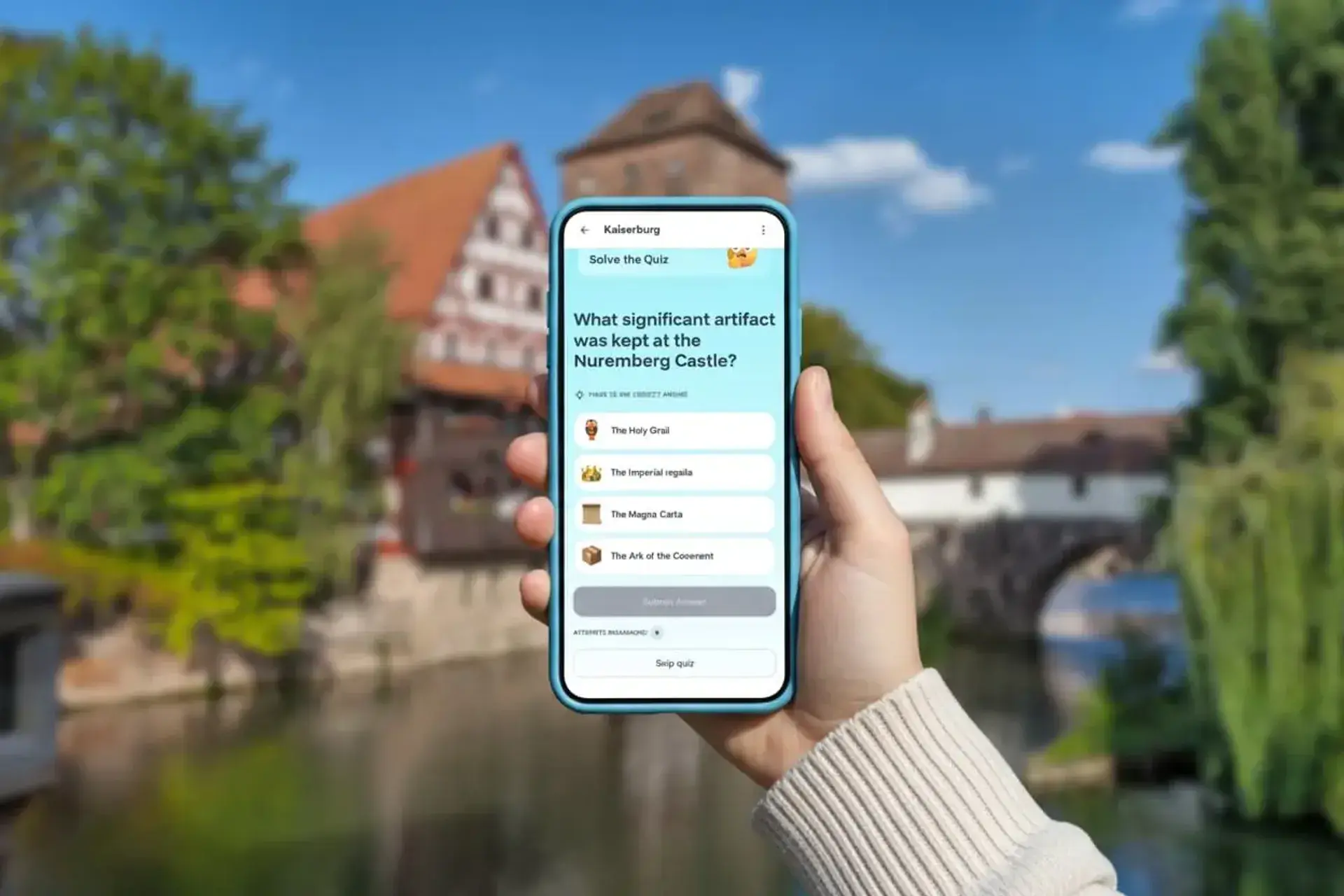
<p>Perched high above Nuremberg’s Old Town, the Kaiserburg—or Nuremberg Castle—has stood as a sentinel of power and prestige since its first documentation in 1050. This fortress was more than a military stronghold; it was a symbol of the Holy Roman Empire’s influence, serving as a residence for kings and emperors. Its strategic position overlooking trade routes and the city below underscored its importance within the empire.</p> <img src="https://storage.googleapis.com/ciceru-assets-stg/c41a7fde-337d-4db9-a1df-bd755d7ab549/LgkrEq7t-1920px-Nu%CC%88rnberg_Burg_ArM%20%281%29.jpg" alt="undefined" style="height: auto;width: 320px"/> <blockquote>Nuremberg Castle: Palas, Imperial Chapel, and Heathens' Tower on the right; Sinwell Tower in the middle left; Pentagonal Tower, Imperial Stables, and Luginsland Tower on the far right. Photo by ArtMechanic.</blockquote> <p>The castle played a pivotal role in 1356 when Emperor Charles IV issued the Golden Bull, declaring Nuremberg the site of the first Imperial Diet for newly elected kings. This decree solidified the city’s place in Imperial politics, and the castle became a repository for the Imperial regalia—crowns, swords, and orbs—from 1423 to 1796, further cementing its significance.</p> <img src="https://storage.googleapis.com/ciceru-assets-stg/c41a7fde-337d-4db9-a1df-bd755d7ab549/CAhE7fn4-Goldene_Bulle_Handschrift%20%281%29.jpg" alt="undefined" style="height: auto;width: 320px"/> <blockquote>Page from the Golden Bull manuscript of King Wenceslaus, circa 1400. Preserved in the Austrian National Library.</blockquote> <p>Inside, the Deep Well and the Sinwell Tower remain engineering marvels of their time, providing not just defense but also vital resources during sieges. The castle’s walls whisper stories of royal banquets, political negotiations, and the lives of those who called it home.</p>

Historischer Kunstbunker

<p>Beneath the streets of Nuremberg lies a hidden sanctuary—the Historischer Kunstbunker. Built during World War II, this underground bunker was designed to protect something priceless. Can you guess what it was?</p>

La casa di Albrecht Dürer

<p>This final stop on our tour brings us to the home of Albrecht Dürer, which we briefly encountered in the previous stop at the Historischer Kunstbunker, where some of his priceless works were safeguarded during World War II.</p> <img src="https://storage.googleapis.com/ciceru-assets-stg/c41a7fde-337d-4db9-a1df-bd755d7ab549/mUfYScqI-807px-Albrecht-self%20%281%29.jpg" alt="undefined" style="height: auto;width: 320px"/> <blockquote>Albrecht Dürer, Self-Portrait with Eryngium (1493). Preserved in the Louvre.</blockquote> <p>Nestled within Nuremberg’s historic Old Town, this meticulously preserved half-timbered house served as both his home and workshop.</p> <img src="https://storage.googleapis.com/ciceru-assets-stg/c41a7fde-337d-4db9-a1df-bd755d7ab549/LrUIlDYp-810px-Albrecht-Du%CC%88rer-Haus%2C_interno_07_cucina.jpg" alt="undefined" style="height: auto;width: 320px"/> <blockquote>Interior: Kitchen of the Albrecht Dürer House in Nuremberg.</blockquote> <p>Dürer lived here from 1509 until his death in 1528. The house itself is a masterpiece of 15th-century architecture, reflecting the wealth and status of its illustrious owner. The house also serves as a museum, offering a window into the life and legacy of an artist whose influence is still felt today.</p>

La tua guida privata, in tasca

Pronto a percorrerle a piedi?

  • Autoguidato, parti quando vuoi
  • Audio offline, 7 lingue
  • Soddisfatti o rimborsati
  • eSIM da 500 MB inclusa

da

7,00 €

1 tour autoguidato a Nuremberg

Vedi i tour

Organizza i giorni

Quanti giorni a Nuremberg? L'itinerario perfetto di 1 giorni

Giorno 1

A spasso nell'Altstadt di Norimberga dalla stazione centrale

Segui Königstraße dalla Nürnberg Hbf attraverso l'Altstadt pedonale, con i mezzi della Zona A a portata di mano per gli spostamenti più lunghi.

Clima e affluenza

Quando visitare

Per trovare l'equilibrio ideale tra bel tempo e poca folla, punta su maggio-giugno o settembre-ottobre: le massime oscillano tra 18,8-22,0 °C e 14,2-20,0 °C. Da luglio a dicembre 2025 si sono registrati record mensili di presenze, con dicembre a fare da pioniere superando per la prima volta i 400.000 pernottamenti.

Consigliato

Freddo e bassa affluenza

gen–feb

-4–4°C/ 25–40°F

Pochi visitatoriPiogge occasionali
  • I mesi più calmi in città
  • A gennaio le minime medie toccano i -4,0 °C.

Risveglio di primavera

mar–apr

-1–14°C/ 31–56°F

Si riempiePiogge occasionali
  • Fiera primaverile cittadina
  • Ad aprile le massime medie non superano i 13,6 °C.

Da non perdere

  • Nürnberger Volksfest, fiera di primavera

Mesi più caldi e piovosi

mag–giu

7–22°C/ 45–72°F

AffollatoPiovoso
  • I primi tepori a Norimberga
  • Giugno è di solito il più piovoso, con 75 mm di pioggia.

Alta stagione estiva

lug–ago

12–24°C/ 54–75°F

Alta stagionePiovoso
  • Massime estive a Norimberga
  • A luglio e agosto cadono in media 69 e 67 mm di pioggia.

Da non perdere

  • Nürnberger Volksfest, fiera d'autunno

Mesi miti e vivaci

set–nov

1–20°C/ 33–68°F

AffollatoPiogge occasionali
  • Nürnberger Herbstmarkt
  • A ottobre 2025 si sono registrati 354.916 pernottamenti.

Da non perdere

  • Nürnberger Herbstmarkt

  • Nürnberger Christkindlesmarkt

Il picco natalizio

dic

-2–3°C/ 28–38°F

Alta stagionePiogge occasionali
  • Il Christkindlesmarkt
  • A dicembre 2025 i pernottamenti hanno superato i 400.000.

Da non perdere

  • Nürnberger Christkindlesmarkt

Trasporti

Come arrivare e muoversi a Nuremberg

Nürnberg Flughafen

Come arrivare e muoversi a Nuremberg
U212 min3,90 €

Nürnberg Hbf

Come arrivare e muoversi a Nuremberg
A piedi per KönigstraßeCirca 5 min0,00 €

U-Bahn, tram e bus

Basta la Zona A

Biglietto singolo Zona A a 3,65 € online o 3,90 € cartaceo (90 min); carnet 4 corse a 14,60 € e giornaliero Solo a 10,60 €. A bordo dei bus VAG si paga solo con carta o app, senza contanti.

A piedi

Da Hbf: solo 5 min

Secondo la VAG, la Nürnberg Hbf dista circa cinque minuti dal centro; Königstraße ne rappresenta la dorsale pedonale. La rampa di Lorenzkirche su Königstraße è attualmente chiusa.

VAG_Rad

Brevi e low cost

Tariffa base: 0,10 € allo sblocco più 0,10 €/min, fino a 10 €/24h. Riconsegna una VAG_Rad standard in stazione o flexzone: lasciarla fuori da queste aree costa almeno 20 € extra.

Monopattini a noleggio

Attenti a dove sosti

Dentro il Bundesstraßenring di Norimberga chiudi la corsa solo negli stalli dedicati, altrimenti la tariffa continua a scorrere. Fuori dall'anello resta invece valido il free-floating.

Taxi

Tassametro e carte

La tariffa di Norimberga parte da 4,90 €; la tabella tariffaria preventiva indica 15,40 € per 3 km. Per regolamento, i taxi sono tenuti ad accettare le carte di pagamento su richiesta.

Meglio camminare e comprare biglietti Zona A. La NÜRNBERG CARD costa 38 € per 48h; due giornalieri Solo costano 21,20 €, quindi per soli spostamenti la card costa 16,80 € in più.

Budget

Quanto costa visitare Nuremberg?

I costi verificati sono di 1,90-2,10 € per una corsa breve, 3,65-3,90 € per un biglietto singolo in Zona A, 10,60 € per un giornaliero e 15,40-20,80 € per una tariffa preventiva in taxi tra i 3 e i 5 km. I prezzi per cibo e bevande risultano NON DISPONIBILI.

Quanto costa visitare Nuremberg?
Biglietto singolo Zona A, adulti3,65 €–3,90 €
Corsa breve singola1,90 €–2,10 €
Biglietto giornaliero Solo Zona A10,60 €
VAG_Rad, 10 minuti1,10 €
Tariffa taxi preventiva, 3-5 km15,40 €–20,80 €

Cash or card?

A bordo degli autobus VAG i biglietti si acquistano solo senza contanti dal 1° maggio 2026; il contante è ancora accettato alle emettitrici automatiche e nei punti vendita autorizzati. I taxi di Norimberga sono tenuti ad accettare le carte su richiesta.

Dove dormire

Dove dormire a Nuremberg

Altstadt St. Lorenz

Prima visita, vicino alla Hbf

Molte isole pedonali sono a St. Lorenz, con Königstraße verso la Hbf. I cantieri del Lorenzer Passage complicano l'accesso senza barriere architettoniche alla Lorenzkirche.

Gostenhof

Vivace, fuori dall'Altstadt

Gostenhof è descritto come vivace e fitto nei piani urbanistici, con offerta culturale e gastronomica che attira molti visitatori. L'alta densità urbana resta il rovescio della medaglia.

St. Johannis

Residenziale, vicino al centro

St. Johannis sorge a ovest della città vecchia e a nord del Pegnitz; i suoi densi caseggiati d'epoca richiedono una passeggiata in più o un breve tragitto con i mezzi rispetto a St. Lorenz.

I tour

Nuremberg, una storia alla volta

Gratta e vinci

Dai una grattata

Sotto potrebbe esserci qualcosa di bello. Se vinci, ti diciamo come usarlo.

Un premio per viaggiatore. Valido 2 anni.

Il passaparola

Cosa dicono i viaggiatori

Sicurezza

Nuremberg è sicura?

Norimberga è generalmente una città sicura: la polizia l'ha classificata come la quinta più sicura tra le città tedesche con oltre 200.000 abitanti nel 2025. I furti rappresentano la categoria di reato più comune con 13.573 casi; i borseggi sono scesi a 447 episodi.

Zona della Hauptbahnhof

Nel 2025 la polizia ha registrato 1.526 reati nei dintorni della Nürnberg Hbf, di cui 696 legati al controllo degli stupefacenti. L'uscita sud è diventata il nuovo punto critico, mentre il lato nord si è stabilizzato.

Folla natalizia

La polizia mette in guardia dai borseggiatori tra la folla fitta del Christkindlesmarkt: tieni contanti, carte e telefono in tasche interne separate e ben chiuse, e porta zaini e borse davanti a te.

Zone con divieto di alcolici

A Norimberga il divieto di consumo di alcolici è attivo 24 ore su 24 a Bahnhofsplatz/Königstorpassage e Aufseßplatz; bere o portare con sé alcolici pronti al consumo può costare fino a 1.000 € di multa.

Pedoni e monopattini elettrici

A sud di Königstraße le bici circolano sempre, a nord della Mauthalle vanno condotte a mano; monopattini vietati su marciapiedi e aree pedonali. Con tasso alcolemico da 0,5‰ in su, la multa sul monopattino può toccare i 500 €.

Assistenza medica

Per problemi di salute non gravi fuori dall'orario dei medici di base, Norimberga indica il 116117 e la clinica in Bahnhofstraße 11a; per le emergenze chiama il 112. La disponibilità garantita dell'inglese al 112 risulta NON VERIFICATA.

Da sapere

Da sapere

Niente contanti sui bus VAG

Dal 1° maggio 2026, a bordo dei bus VAG i biglietti si pagano esclusivamente senza contanti; il contante resta accettato alle emettitrici automatiche, nelle rivendite convenzionate e presso il centro clienti VAG.

Aree di riconsegna dei monopattini

All'interno del Bundesstraßenring di Norimberga, i monopattini elettrici a noleggio possono essere riconsegnati solo negli stalli contrassegnati; altrove la sessione non si chiude e la tariffa continua a salire.

Validità oraria della NÜRNBERG CARD

La NÜRNBERG CARD dura esattamente 48 ore dalla data e dall'ora selezionate; non esistono versioni da 24 o 72 ore e la validità non può essere modificata successivamente.

Alcolici per strada nella città vecchia

Al di fuori delle aree di Hbf e Aufseßplatz, bere alcolici per strada nell'Altstadt e nelle aree pedonali è consentito soltanto all'interno dei dehors autorizzati dei locali.

Domande

FAQ su Nuremberg

Esattamente 48 ore. Scegli data e ora di inizio al momento dell'acquisto; Norimberga non offre versioni da 24 o 72 ore.

Pronto a partire?

Tour audio autoguidati in tutta Nuremberg.

Scopri i tour a Nuremberg