Consigli e tour per esploratori e viaggiatori
Guida della città di Oxford
Passeggia tra i vicoli dei college di Oxford, i sentieri lungo il fiume e
- Paese
- Regno Unito
- Lingua
- inglese
- Valuta
- sterlina britannica (GBP)
- Presa
- tipo G
- Fuso orario
- Europe/London
- Emergenze
- 112
- Acqua del rubinetto
- Generalmente potabile
- Prefisso
- +44
Le tappe
Cosa fare a Oxford
Passeggia tra cortili storici alla scoperta di luoghi iconici come la Bodleian Library, l'inconfondibile Radcliffe Camera e la venerabile Turf Tavern.
Ponte dei Sospiri (Hertford Bridge)
<p>Built in 1914, the Bridge of Sighs is younger than your grandmother but wears Oxford's architectural gravitas like an heirloom brooch. Intended to unify Hertford College’s two buildings, it instead ended up unifying ‘Instagrammers’ and ‘wedding parties’ under a singular banner of ‘photo op.’</p> <p>It looks Venetian, and that’s the point—it’s a knockoff of Venice’s infamous Bridge of Sighs, where condemned prisoners sighed on their last stroll to sentencing. In Oxford’s less dramatic version, students cross it mostly to reach dinner or avoid an exam they’ve convinced themselves isn’t today. The name was never official, but the myth stuck harder than a Fresher to their highlighter tabs.</p> <img src="https://storage.googleapis.com/ciceru-assets-stg/ad62fd21-26a3-4801-9010-d113694a4179/p9lrU3wN-Bridge_of_Sighs_sea_facade_Venice.webp" alt="undefined" style="height: auto;width: 320px"/> <blockquote>Venice’s Bridge of Sighs - From Wikimedia Commons</blockquote> <p>Sir Thomas Graham Jackson, the architect, managed to make the bridge look both ancient and theatrical—all in service of connecting a single college. Such is Oxford’s policy on subtlety: there is none. And as myths go, students like to joke that sighs heard on the bridge are pre-lab anxiety manifesting in real time.</p> <img src="https://storage.googleapis.com/ciceru-assets-stg/ad62fd21-26a3-4801-9010-d113694a4179/NSoxJpIR-ThomasGrahamJackson.webp" alt="undefined" style="height: auto;width: 320px"/> <blockquote>1900 oil on canvas painting of Thomas Graham Jackson by Henri Rivière. Jackson is depicted with an architectural drawing. As of December 2023, this painting hangs in the hall of Wadham College, Oxford. - From Wikimedia Commons</blockquote> <p>It’s still used daily by Hertford’s students, who walk its short span carrying laptops and essays rather than existential despair. Outsiders stare up from New College Lane, angling for that perfect shot. The smooth stone glows gold in good light and glowers in bad moods.</p> <p>The bridge's structure is arched and enclosed, making it architecturally more twin to Venice’s Rialto than its sigh-happy sibling. But in Oxford, fact rarely stands in the way of a good poetic mislabeling. And honestly, it's hard to compete with the drama of a name that promises sighs, even if the only thing inside is a history student running late for their supervision.</p> <img src="https://storage.googleapis.com/ciceru-assets-stg/ad62fd21-26a3-4801-9010-d113694a4179/KmdpJERU-Rialto_2025_4.webp" alt="undefined" style="height: auto;width: 320px"/> <blockquote>Venice’s Rialto Bridge - From Wikimedia Commons</blockquote> <p>From this photogenic overpass, it’s a short stroll to a more literal performance space—where Oxford still flexes its architectural bravado under a painted ceiling.</p>
Teatro Sheldonian
<p>Before Sir Christopher Wren built St. Paul’s Cathedral, he warmed up with Oxford’s Sheldonian Theatre—a non-church building so grand it practically coughs hymns. Completed in 1668, it provided something the university desperately needed: a place to ceremoniously brag.</p> <img src="https://storage.googleapis.com/ciceru-assets-stg/ad62fd21-26a3-4801-9010-d113694a4179/doNvfKw9-Christopher_Wren_by_Godfrey_Kneller_1711.webp" alt="undefined" style="height: auto;width: 320px"/> <blockquote>Portrait of Sir Christopher Wren (1711), an English architect, astronomer, mathematician and physicist who is one of the most highly acclaimed architects in the history of England - From Wikimedia Commons</blockquote> <p>Prior to the Sheldonian, degree ceremonies were held at St Mary’s Church, where academic robes clashed with ecclesiastical ones and seating was less than judgment-proof. Archbishop Gilbert Sheldon bankrolled Wren’s audacious design, which included no supportive columns and a ceiling that seems held aloft by divine approval and physics homework.</p> <img src="https://storage.googleapis.com/ciceru-assets-stg/ad62fd21-26a3-4801-9010-d113694a4179/SUsRXroO-Oxford%2C_St_Mary%E2%80%99s_church_-_geograph.org.uk_-_5931576.webp" alt="undefined" style="height: auto;width: 320px"/> <blockquote>St Mary’s Church, Oxford - From Wikimedia Commons</blockquote> <p>Inside, the theater has hosted everything from honorary degree ceremonies to musical performances that may or may not have included reluctant undergraduates fulfilling some final credit. Wren also happened to be an astronomy professor at Oxford when he designed the Sheldonian—so naturally he shaped its roof like a D-shaped surveyor’s quadrant. A nerd’s flourish, if ever there was one.</p> <img src="https://storage.googleapis.com/ciceru-assets-stg/ad62fd21-26a3-4801-9010-d113694a4179/VeQAEhyb-Ptolemy_Astrology_1564.webp" alt="undefined" style="height: auto;width: 320px"/> <blockquote>Ptolemy using a quadrant - From Wikimedia Commons</blockquote> <p></p> <img src="https://storage.googleapis.com/ciceru-assets-stg/ad62fd21-26a3-4801-9010-d113694a4179/pMO5qZdx-Sheldonian_Theatre_Interior%2C_Oxford%2C_UK_-_Diliff.webp" alt="undefined" style="height: auto;width: 320px"/> <blockquote>Interior of the theatre - From Wikimedia Commons</blockquote> <p>The ceiling’s grand painting by Robert Streater stages a magnificent PR campaign for the liberal arts, with ‘Truth’ literally descending upon ‘Arts and Sciences.’ It’s both a sermon and a screensaver. From the upper cupola, the city sprawls below in all its gleaming, spired ambition.</p> <p>Local superstition once claimed walking clockwise around the Sheldonian before an exam was a bad omen. No word on what standing still does—other than make you a good target for pigeons. Today, tourists climb the cupola between concerts and ceremonies while students, possibly hungover, receive degrees beneath Streater’s painted gaze, enduring Oxford's idea of pomp: hours trapped in gowns while contemplating Truth, or at least post-ceremony snacks.</p> <p>Leaving the Sheldonian’s dignified ceremonies behind, we now cross into the shadow of conviction—etched in stone and memory at a nearby Gothic spire.</p>
Memoriale dei martiri
<p>Erected in 1843, the Martyrs’ Memorial looks like someone dropped an ornate cathedral tower onto a traffic island. Dedicated to three Protestant bishops—Thomas Cranmer, Hugh Latimer, and Nicholas Ridley—who were burned at the stake nearby in the 1550s, it commemorates one of the grimmest chapters in reformation history with all the architectural fuss Victorian gothic could muster.</p> <img src="https://storage.googleapis.com/ciceru-assets-stg/ad62fd21-26a3-4801-9010-d113694a4179/sxGOPXtC-martyrs.webp" alt="undefined" style="height: auto;width: 320px"/> <blockquote>This photograph of the Martyrs' Memorial was taken by William Henry Fox Talbot in 1844. - From oxfordhistory org</blockquote> <p>Queen Mary I’s attempt to restore Catholicism wasn’t known for subtlety; burning prominent churchmen was her version of a press release. The actual execution site sits a stone’s throw away on Broad Street, marked by a cross in the tarmac commuters skim over daily, oblivious to its ashy past.</p> <img src="https://storage.googleapis.com/ciceru-assets-stg/ad62fd21-26a3-4801-9010-d113694a4179/08salXwE-Anthonis_Mor_001.jpg.webp" alt="undefined" style="height: auto;width: 320px"/> <blockquote>Mary I of England in 1554 - From Wikimedia Commons</blockquote> <p>The 19th-century Oxford Movement, with its high-church leanings and taste for medieval grandeur, pushed for the memorial's construction to honor these theological heavyweights. The result looked oddly nostalgic for a moment best remembered as ‘trial by fire.’ Still, design by George Gilbert Scott ensured it had historical heft—whether that comforted anyone is another matter.</p> <img src="https://storage.googleapis.com/ciceru-assets-stg/ad62fd21-26a3-4801-9010-d113694a4179/j78UW9vr-George_Gilbert_Scott_full.webp" alt="undefined" style="height: auto;width: 320px"/> <blockquote>Sir George Gilbert Scott (13 July 1811 – 27 March 1878), a prolific English Gothic Revival architect - From Wikimedia Commons</blockquote> <p>Today, the spire looms above St Giles’, a solemn backdrop to food markets, buskers, and students shuffling off to tutorials. At certain angles, it feels like it’s glaring at Starbucks. Whispers supposedly heard near the site on windy nights are attributed to the ghostly final words of the martyrs—or, more plausibly, to overcaffeinated undergrads quoting Monty Python.</p> <img src="https://storage.googleapis.com/ciceru-assets-stg/ad62fd21-26a3-4801-9010-d113694a4179/4gOqABEe-The_Taylor_Institute_from_behind_the_Martyrs%27_Memorial%2C_in_Oxford%2C_England.webp" alt="undefined" style="height: auto;width: 320px"/> <blockquote>View of Martyrs' Memorial at the southern end of St Giles' with the Macdonald Randolph Hotel and Taylor Institution Library behind - From Wikimedia Commons</blockquote> <p>The monument’s resemblance to the medieval Eleanor Crosses was intentional: a neat way to wrap state violence in the ribbon of national memory. The spiritual cost was enormous, but the memorial? Impeccably symmetrical.</p> <img src="https://storage.googleapis.com/ciceru-assets-stg/ad62fd21-26a3-4801-9010-d113694a4179/leHXynNa-Geddington_Eleanor_cross.webp" alt="undefined" style="height: auto;width: 320px"/> <blockquote>The Eleanor crosses were a series of twelve tall and lavishly decorated stone monuments erected in a line down part of the east of England. King Edward I had them built between 1291 and about 1295 in memory of his wife Eleanor of Castile - From Wikimedia Commons</blockquote> <p>Just beyond that solemn pinnacle, an older structure marks the northern threshold of old Oxford—where faith once shared quarters with fortification.</p>
San Michele alla Porta Nord
<p>St Michael at the North Gate doesn’t just predate the Reformation. It predates the Normans. Built around 1000 AD, it was Oxford's northern guardian—a church and fortification in one, proving that spiritual salvation and city defense once shared a roof.</p> <img src="https://storage.googleapis.com/ciceru-assets-stg/ad62fd21-26a3-4801-9010-d113694a4179/HR460278-Bocardo_Prison%2C_Northgate%2C_Oxford.webp" alt="undefined" style="height: auto;width: 320px"/> <blockquote>The church and former North Gate in 1770 - From Wikimedia Commons</blockquote> <p>The tower is among the oldest buildings in Oxford, a stone veteran in a city of youthful neo-Gothics. Its rough masonry suggests urgent construction, perhaps by monks with a pressing sense of apocalypse. During the English Civil War, Royalist soldiers used its lofty vantage point to track enemy movements, proving even ecclesiastical spaces had military resumes.</p> <img src="https://storage.googleapis.com/ciceru-assets-stg/ad62fd21-26a3-4801-9010-d113694a4179/6jmMVanz-Battle_of_Naseby.jpg" alt="undefined" style="height: auto;width: 320px"/> <blockquote>The English Civil War or Great Rebellion was a series of civil wars and political machinations between Royalists and Parliamentarians in the Kingdom of England from 1642 to 1651 - From Wikimedia Commons</blockquote> <p>While much of the original church burned or was remodeled beyond recognition, the tower held firm. More grimly, this was also the first prison for the Oxford Martyrs—Latimer, Ridley, and Cranmer—before their fiery exits. It’s the kind of backstory that makes incense smell more like smoke damage.</p> <img src="https://storage.googleapis.com/ciceru-assets-stg/ad62fd21-26a3-4801-9010-d113694a4179/FvKsJTA3-St_Michael_at_the_North_Gate_cell_door.webp" alt="undefined" style="height: auto;width: 320px"/> <blockquote>The cell door from the Bocardo Prison, now preserved in the Saxon bell tower of St Michael's Church. - From Wikimedia Commons</blockquote> <p>Today, the church functions as both spiritual home and scenic escapism. Climb the tower’s tight corkscrew staircase and you'll understand medieval cardio. At the top: striking views and mild vertigo. Below, community concerts and open doors welcome anyone curious or lost.</p> <p>Local ghost stories circulate, as they must, though the only spirits likely to linger here are gusts funneled up from Cornmarket Street. Either way, the stone remains cool to the touch—like it hasn’t quite forgiven the last thousand years. The bells once rang for Queen Elizabeth I’s visit in 1592; now they mark time for a city trying, with some difficulty, to keep up.</p> <p>As we descend from the watchtower's past, the city's pulse leads us toward its traditional crossroads—part clocktower, part civic compass.</p>
Torre Carfax
Il mercato coperto
<p>In 1774, Oxford decided it had had enough of filthy street markets and built the Covered Market as a kind of tamed chaos. Under its tiled roof, cows were no longer butchered in broad daylight, and shoppers no longer stumbled into puddles of unspecific origin. It was a civic upgrade disguised as retail.</p> <p>John Gwynn designed this domestic colosseum for commerce. But where other monuments sport lions and saints, the Covered Market comes with butchers, florists, haberdashers, and an unrelenting smell of five competing cuisines.</p> <img src="https://storage.googleapis.com/ciceru-assets-stg/ad62fd21-26a3-4801-9010-d113694a4179/zrJVjxGv-John_Gwynn_from_NPG.webp" alt="undefined" style="height: auto;width: 320px"/> <blockquote>John Gwynn (1713 – 1786) was an English architect and civil engineer - From Wikipedia Commons</blockquote> <p>It survived two world wars and the slow apocalypse of mall culture. Today, it thrives on local allegiance and artisanal defiance. You’ll find everything from bespoke hats to vegan brownies, all within echoing distance of a Victorian meat hook. Some stalls have been operating for over a century, often still family-run, propping up the market’s stubborn continuity.</p> <img src="https://storage.googleapis.com/ciceru-assets-stg/ad62fd21-26a3-4801-9010-d113694a4179/1sHTcLYd-Image%205%20-%200Lindsey%20unit.webp" alt="undefined" style="height: auto;width: 320px"/> <blockquote>The Covered Market - From Oxfordpreservation org</blockquote> <p>A pervasive Oxford saying: “If you can't find it in the Covered Market, it doesn’t exist.” This is clearly false, but it speaks to the market’s reputation as a compact universe. Long before Amazon suggested what you might like, this is where Oxford browsed—with joy, suspicion, and the faint scent of cheddar.</p> <p>Look closely and you’ll glimpse original signage and tiny architectural details that whisper of 18th-century shopkeeping logistics. It may have been about hygiene at birth, but the result is a maze of nostalgia, resilience, and cakes the size of cathedral buttresses.</p> <p>Refueled and slightly dazed by Victorian signage, we return to matters of soul and scholarship at the university’s oldest spiritual anchor.</p>
Chiesa universitaria di Santa Maria Vergine
<p>If Oxford had a mother, it might be the University Church of St Mary the Virgin. Before gleaming lecture halls and baroque libraries, this was the university's HQ. In the 13th century, the church’s nave hosted lectures, degree ceremonies, and defences so fierce they probably needed divine arbitration.</p> <img src="https://storage.googleapis.com/ciceru-assets-stg/ad62fd21-26a3-4801-9010-d113694a4179/dQLOq0hD-St_Mary%27s_Church_Interior_1%2C_Radcliffe_Sq%2C_Oxford%2C_UK_-_Diliff.webp" alt="undefined" style="height: auto;width: 320px"/> <blockquote>The nave viewed in an easterly direction from the gallery - From Wikimedia Commons</blockquote> <p>The pulpit saw fire and brimstone, literally. Thomas Cranmer stood trial here in 1555, charged with heresy. Forced to recant under pressure, he later retracted his recantation and marched to a nearby stake. His ashes joined the older stones—Oxford’s version of performance feedback.</p> <img src="https://storage.googleapis.com/ciceru-assets-stg/ad62fd21-26a3-4801-9010-d113694a4179/yPWXmlGt-Thomas_Cranmer_by_Gerlach_Flicke.webp" alt="undefined" style="height: auto;width: 320px"/> <blockquote>Thomas Cranmer (2 July 1489 – 21 March 1556) was a theologian, leader of the English Reformation and Archbishop of Canterbury. He is honoured as a martyr in the Church of England. - From Wikipedia Commons</blockquote> <p>In the 19th century, John Henry Newman used the same pulpit to launch the Oxford Movement, which attempted—but failed—to make Anglicanism feel exotic. The church thus gathered scholarly repute and religious controversy like lint under a cassock.</p> <img src="https://storage.googleapis.com/ciceru-assets-stg/ad62fd21-26a3-4801-9010-d113694a4179/h9dVQJF2-John-Henry-Newman.webp" alt="undefined" style="height: auto;width: 320px"/> <blockquote>John Henry Newman in 1887 - From Wikimedia Commons</blockquote> <p>Today, visitors roam the church’s interior unaware that it once shaped English theology between sips of communion wine. The tower, accessible to those with strong calves and low claustrophobia thresholds, rewards with unbeatable views. Also, slight windburn.</p> <img src="https://storage.googleapis.com/ciceru-assets-stg/ad62fd21-26a3-4801-9010-d113694a4179/63l8vu4m-Oxford_Skyline_Panorama_from_St_Mary%27s_Church_-_Oct_2006.webp" alt="undefined" style="height: auto;width: 320px"/> <blockquote>View looking south from the church tower - From Wikimedia Commons</blockquote> <p>A twisted Baroque porch, added in 1637, caused spiritual tremors for appearing just Catholic enough to worry the Protestant faithful. Its very survival is a testament to poor taste surviving good intentions.</p> <img src="https://storage.googleapis.com/ciceru-assets-stg/ad62fd21-26a3-4801-9010-d113694a4179/DC0gKZ6L-1024px-SMV_Porch.webp" alt="undefined" style="height: auto;width: 320px"/> <blockquote>The south porch. Its style was too close to Roman baroque for the puritans. - From Wikimedia Commons</blockquote> <p>Some say if you stare too long at its facade, you might miss a lecture. Others say if you’re staring that long, you’ve already missed the point.</p> <p>Step into Radcliffe Square, where a domed marvel waits—a library disguised as a monument to symmetry.</p>
La Radcliffe Camera
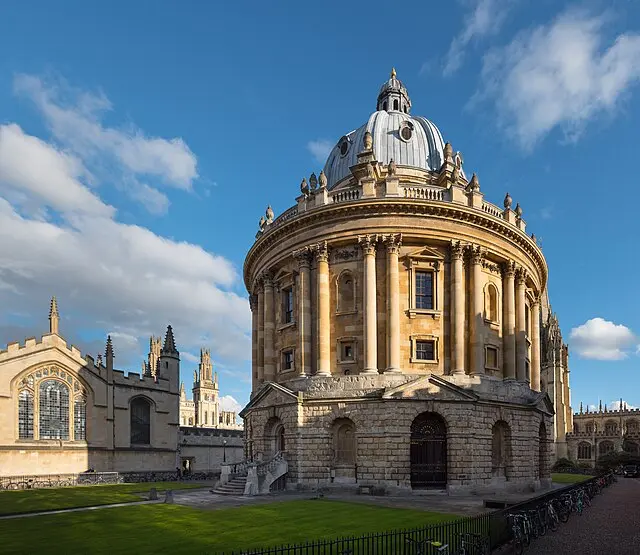
<p>The Radcliffe Camera is a monument so round and ornate, you'd swear it was designed by geometry enthusiasts with a flair for drama. Finished in 1749, it was Oxford’s first circular library and looks like it could roll elegantly down Broad Street if sufficiently nudged.</p> <img src="https://storage.googleapis.com/ciceru-assets-stg/ad62fd21-26a3-4801-9010-d113694a4179/alNvmAe2-Radcliffe_Camera%2C_Oxford%3B_panoramic_view_with_All_Soul%27s_Col_Wellcome_V0014214.webp" alt="undefined" style="height: auto;width: 320px"/> <blockquote>Radcliffe Camera, line engraving - From Wikimedia Commons</blockquote> <p>Funded by physician-turned-wealth-machine Dr. John Radcliffe, it was meant to house science texts, though you could argue its real purpose was to intimidate with grace. Architect James Gibbs opted for Palladianism at full throttle—classical proportions, domed roof, and enough columns to inspire scholarship or mild vertigo.</p> <img src="https://storage.googleapis.com/ciceru-assets-stg/ad62fd21-26a3-4801-9010-d113694a4179/ICEYdtiN-John_Radcliffe.webp" alt="undefined" style="height: auto;width: 320px"/> <blockquote>John Radcliffe (1650 – 1714) was an English physician, academic and politician. - From Wikimedia Commons</blockquote> <p>Though now part of the Bodleian Libraries complex, the Camera remains a restricted temple of study. Tourists stare enviously while students inside furiously annotate essays under whispers of intellectual pressure. It’s a vacuum-sealed room of academic energy you’ll never be allowed into.</p> <img src="https://storage.googleapis.com/ciceru-assets-stg/ad62fd21-26a3-4801-9010-d113694a4179/FEYMho3T-Radcliffe2ndlevel.webp" alt="undefined" style="height: auto;width: 320px"/> <blockquote>Inside Upper Camera - From Wikimedia Commons</blockquote> <p>The name “Camera” isn’t a photographic anachronism—it derives from the Latin for “room.” Though arguably, it feels more like a shrine. Myths abound: that the roof was built removable in case of fire, or that its perfect shape was meant to mirror the human brain. Rationally false, emotionally plausible.</p> <img src="https://storage.googleapis.com/ciceru-assets-stg/ad62fd21-26a3-4801-9010-d113694a4179/s0Mfwcpj-Radcliffe_Camera%2C_Oxford_-_Oct_2006.webp" alt="undefined" style="height: auto;width: 320px"/> <blockquote>Radcliffe Camera, viewed from the University Church - From Wikimedia Commons</blockquote> <p>Underground tunnels link the Camera to the rest of the Bodleian Library like a bookish version of the Batcave. Above ground, the structure lords over Radcliffe Square, mocked only occasionally by a pigeon.</p> <p>Before we end, follow the literary footpaths underground and above—into the ever-growing, ever-guarded heart of Oxford's intellect.</p>
La tua guida privata, in tasca
Pronto a percorrerle a piedi?
- Autoguidato, parti quando vuoiAutoguidato, parti subito o più avanti e fermati quando vuoi
- Audio offline, 7 lingueStorie audio offline in 7 lingue
- Soddisfatti o rimborsatiSoddisfatti o rimborsati entro 30 giorni
- eSIM da 500 MB inclusaeSIM globale da 500 MB inclusa
da
5,00 €
1 tour autoguidato a Oxford
Organizza i giorni
Quanti giorni a Oxford? L'itinerario perfetto di 1 giorni
Passeggia tra i college, i vicoli e i fiumi di Oxford
Parti dal quartiere dei college, attraversa il centro storico e concludi l'itinerario lungo il Tamigi o il Cherwell quando la luce si fa radente.
5,00 € →Clima e affluenza
Quando visitare
Maggio, l'inizio di giugno e settembre offrono il perfetto equilibrio tra clima mite per camminare e folla contenuta. Luglio e agosto regalano giornate lunghissime ma portano il picco dei turisti; da novembre a febbraio l'atmosfera è più tranquilla, ma decisamente più piovosa.
Inverno
gen–giu1–8°C/ 34–46°F
Pochi visitatori
- Brina sui vicoli dei college
Primavera ed estate
lug–dic10–23°C/ 50–73°F
Pochi visitatori
- Luce e passeggiate sul fiume
I tour
Oxford, una storia alla volta
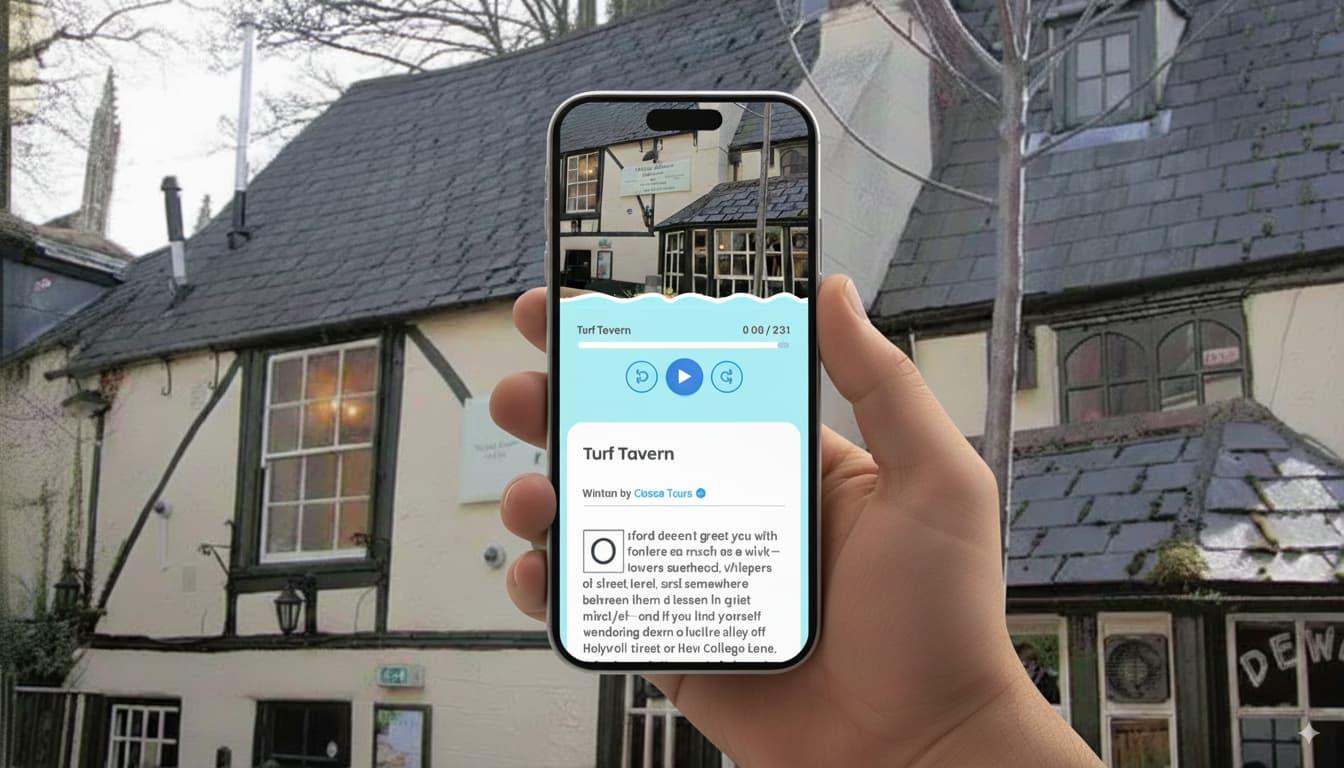
5 €1,5 ore
Tour a piedi autoguidato di Oxford con Ciceru
 Ciceru Originals
- Audio
- eSIM gratis
Gratta e vinci
Dai una grattata
Sotto potrebbe esserci qualcosa di bello. Se vinci, ti diciamo come usarlo.
Un premio per viaggiatore. Valido 2 anni.
Il passaparola
Cosa dicono i viaggiatori

Sicurezza
Oxford è sicura?
Oxford è generalmente una città sicura. Fai comunque attenzione al traffico ciclistico, ai ciottoli sconnessi, ai corsi d'acqua e ai borseggiatori nelle zone più frequentate e della vita notturna. In caso di emergenza, chiama il 999.
Traffico ciclistico
Guarda bene da entrambi i lati nei varchi per i bus e sulle piste ciclabili attorno a St Giles’, Broad Street e Queen Street: le biciclette possono avvicinarsi in silenzio.
Corsi d'acqua
Evita di tuffarti nel Tamigi o nel Cherwell dopo aver bevuto: tra l'acqua gelida e profonda e la poca luce, le rive possono diventare insidiose.
Trasporti notturni
Tieni d'occhio borsa e telefono attorno a Gloucester Green e sui bus notturni; a fine serata, scegli linee presidiate e taxi con regolare licenza.
Domande
FAQ su Oxford
Il pullman The Airline offre un collegamento diretto tra Heathrow e Oxford; consulta il sito della compagnia per tariffe e orari aggiornati.
Il centro storico è raccolto e perfetto da esplorare a piedi, ma vicoli stretti, pavimentazione sconnessa e il continuo viavai di biciclette richiedono un minimo di cautela.
Componi il 999 per polizia, ambulanza o vigili del fuoco; chiama l'NHS 111 per assistenza medica urgente non di emergenza.