Château Frontenac

为探索者和旅行者准备的贴士与路线

Québec City城市指南

魁北克市将依悬崖而建、由陡峭阶梯串联的历史上城与下城,与各具风情的街区生活、热闹非凡的文化节庆以及凌冽漫长的严冬巧妙融为一体。法语是这里的官方语言;游览这座城市,少不了在风景如画的步道漫行与搭乘当地RTC公交车之间灵活切换。

国家
加拿大
语言
法语
货币
加拿大元 (CAD)
插头
类型 A/B
时区
America/Toronto
紧急电话
911
自来水
可饮用
区号
+1

景点

Québec City必做之事

探索魁北克市,意味着要在上城与下城之间的垂直落差间穿行,在古老城墙与特色街区之间探寻,而连接这一切的,正是依山而建的公共阶梯与RTC公交网络。

漫步之前:魁北克市简介

<p>Before you set off, know this: Québec City isn’t a museum piece—it’s a negotiation between centuries. Perched on a cliff above the St. Lawrence River, it remains the only fortified city north of Mexico still intact, which tells you everything about its temperament. Stone walls, copper roofs, and French street names coexist with espresso machines and Wi-Fi, and somehow none of it feels forced. The city doesn’t perform history; it inhabits it.</p> <p>This tour follows that layered rhythm—from the modern heights of the <strong>Observatoire de la Capitale</strong> down to the waterfront markets of the <strong>Old Port</strong>. Along the way you’ll encounter fortresses that never fought, churches that refused to die, prisons turned libraries, and murals that turned history into architecture. Think of it less as sightseeing and more as time travel without the paradoxes.</p> <p><strong>Distance:</strong> about 4.5 kilometers (roughly 2 hours).<br><strong>Terrain:</strong> steep in places—Upper Town is confident in its elevation.<br><strong>Pace:</strong> unhurried. Every leg is under 10 minutes; linger freely.<br><strong>Essentials:</strong> good shoes, layered clothing, and curiosity. You won’t need to enter any buildings; every story can be read from the street.</p> <p>Québec’s weather changes its mind often—sun, mist, drizzle, sometimes all before lunch. Treat it as part of the narrative. The same sky that once watched over Champlain’s wooden settlement now shades buskers, bureaucrats, and the odd ghost tour.</p> <p>You’re about to walk through a city fluent in time, where survival doubles as an art form. Open the app near the <strong>Observatoire de la Capitale</strong>, take in the skyline, and let the city begin its argument with eternity.</p>
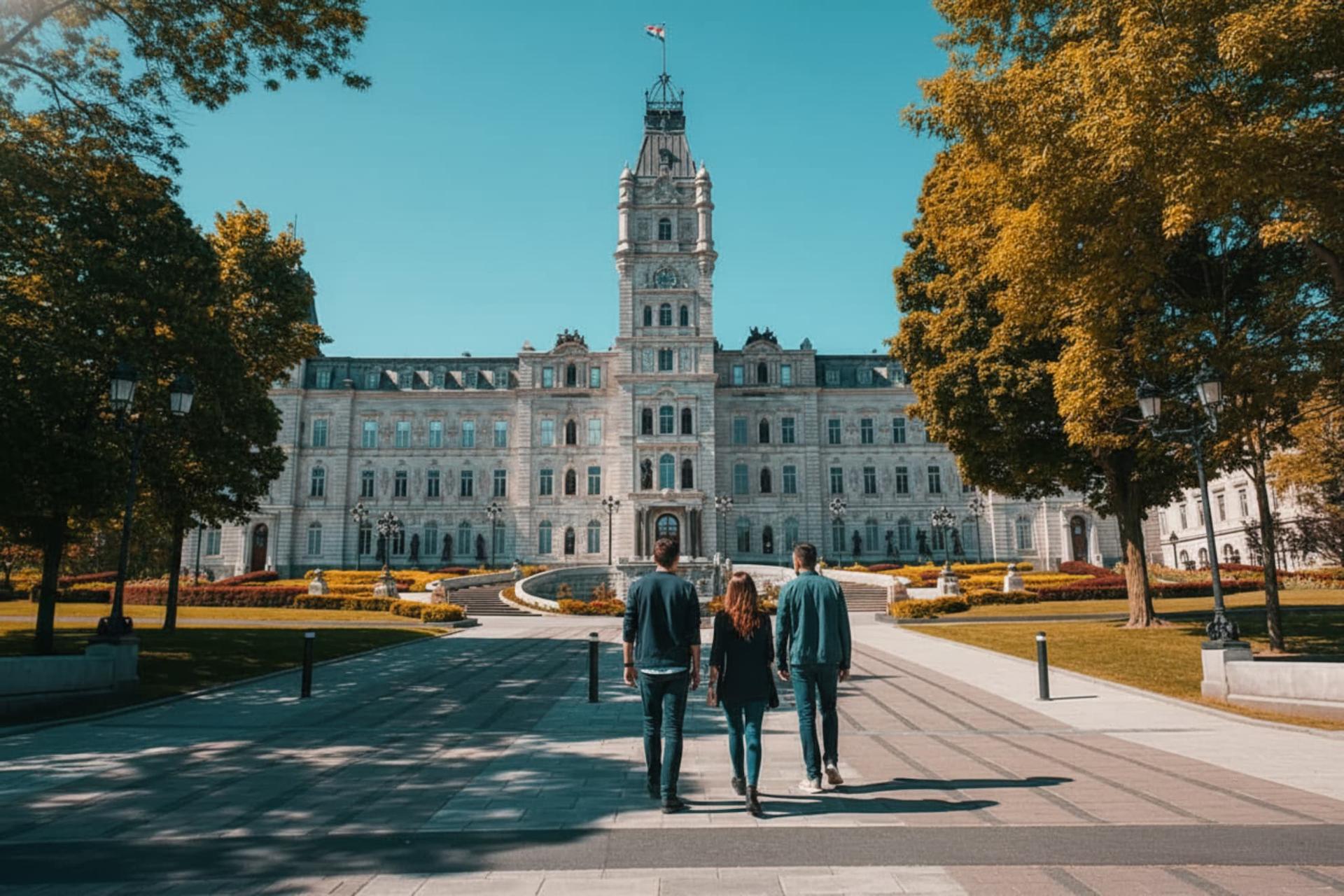
刻在石头上的政治

从未发生过战斗的堡垒

<p>Don’t be fooled by the quiet. The Citadelle was built for a war that refused to arrive. Between 1820 and 1850, British engineers carved this star-shaped fortress into Cap Diamant, a cliff so steep that Samuel de Champlain once mistook its glittering quartz for diamonds. When the stones proved worthless, the French coined a proverb: <em>“false as a Canadian diamond.”</em> The fortress inherited both the sparkle and the irony.</p> <p>After the War of 1812, Britain feared the Americans might try again, so the Duke of Wellington ordered a stronghold “to discourage ambition.” Lieutenant-Colonel Elias Walker Durnford obliged, hauling stone by barge and horse hoist up 360 feet of cliff to form what became North America’s largest British-built fortress. It was designed as a “last refuge” during siege or uprising—complete with rainwater reservoirs, barracks, and paranoia in five-point symmetry. The rebellion never came, but the bills did.</p> <p>History compensated with theatrics. In 1943 and 1944, Winston Churchill and Franklin D. Roosevelt met here to plan the Allied invasions of Europe and Asia. The D-Day calendar was finalized in rooms meant for musket drills. The same bastions that once braced for cannon fire now hosted secretaries, interpreters, and the faint smell of pipe tobacco. Not bad for a fort that never saw a battle.</p> <p>Today, the Citadelle serves three masters: Canada’s Governor General, the Royal 22e Régiment (the “Van Doos”), and two hundred thousand annual visitors. At 10 a.m. sharp in summer, the Changing of the Guard fills the parade ground with scarlet uniforms, bear-fur hats, and Batisse the goat—descendant of a Persian gift to Queen Victoria. When the noon gun fires, car alarms across town respond like an unplanned salute.</p> <p>At night, guides whisper of phantom footsteps on the ramparts—soldiers who died of duty or frost, or maybe just echoes of all that discipline. Either way, the ghosts are punctual; you could set your watch by them.</p> <p>Wind needles your skin along these granite walls, cold as empire. Look down at the river, glittering where Champlain’s “diamonds” once fooled a dreamer. For four centuries, Cap Diamant has defended many things—some real, some imagined. Mostly, it defends the idea that vigilance itself is a kind of heritage.</p> <p>Next stop: the Morrin Centre — where the fortress walls turn inward, and Québec trades gunpowder for grammar.</p>

墙壁改变主意的地方

<p>From the outside, the Morrin Centre looks polite—Victorian stone symmetry, wrought-iron balconies, and a library’s hush. You’d never guess it began as Québec’s most notorious jail. Architect François Baillairgé built it in 1812 on the new model of “moral reform”: thick limestone walls, solitary cells, and the belief that silence could civilize. The windows you see now once opened onto isolation. Between 1812 and 1867, thieves, rebels, and debtors were confined behind them; sixteen left by way of the gallows that once stood above the front door. In 1823, half the city crowded these streets to watch a public hanging—a civic ritual that passed for justice.</p> <p>When the last prisoners were transferred to a newer facility, the building reinvented itself as Morrin College. The new purpose came courtesy of Dr. Joseph Morrin, a Scottish-born physician and twice mayor who believed education could rescue what punishment couldn’t. The façade you’re facing hides an improbable metamorphosis: prison cells converted into lecture halls, and gallows replaced by Greek Revival trim. Behind those windows, Québec’s first English-language degrees were earned—including one by a woman in the 1880s, proof that the walls were learning too.</p> <p>Look closely and you’ll spot the contrast between the original stone blocks and later Victorian masonry—architectural layers of repentance. The balcony railings where guards once paced now frame the library windows of the Literary and Historical Society of Québec, the province’s oldest English cultural institution. Inside those shelves rest volumes older than the city itself, rescued from two fires and a century of bilingual politics.</p> <p>Locals still claim that on quiet evenings, the sound of footsteps drifts from the basement vents—a faint echo of chains or maybe applause from a poetry reading. From out here, it’s hard to tell which would be stranger.</p> <p>The building stands as proof that walls, like people, can outgrow their original sentence. A place once designed to suppress voices now preserves them in ink and memory.</p> <p>Next stop: Château Frontenac — where penitence gives way to opulence, and the ghosts finally get room service.</p>

一次又一次重建信仰

把加拿大卖给自己的酒店

<p>Stand here and look up: this isn’t just a hotel; it’s Canada’s most successful sales pitch in stone. The Château Frontenac was born in 1893 from the Canadian Pacific Railway’s belief that tourism could be industrialized. If Europe had castles, Canada would simply build better ones. Architect Bruce Price borrowed his blueprints from the Loire Valley, added turrets for theatrical effect, and let the whole structure loom over the St. Lawrence like a medieval fortress that accidentally joined a marketing campaign.</p> <p>The result was a fairytale built on capitalism. CPR president William Van Horne—who quipped, “If we can’t export the scenery, we’ll import the tourists”—named it after Louis de Buade, Comte de Frontenac, the 17th-century governor who once ruled New France and refused to surrender to the British. Fittingly, the hotel now rules every postcard rack in the country.</p> <p>The site beneath those copper roofs has hosted four centuries of authority. The Château Frontenac replaced a line of vanished powerhouses: the French Château Saint-Louis, the British Château Haldimand, then, finally, this baronial hybrid where empire met expense account. Each rebuild erased the previous occupant while pretending to preserve it—a tradition Québec has perfected.</p> <p>During the Second World War, the hotel briefly doubled as Allied headquarters. Inside, Churchill and Roosevelt drafted the plans for D-Day while Canada’s own Prime Minister Mackenzie King played the role of polite host, excluded from most conversations. Outside, locals simply noted that the lights stayed on past curfew.</p> <p>The copper roof above you—replaced entirely between 2011 and 2014—still wears its green patina like aged armor. In winter, the air carries a hint of metal and salt from the river; in summer, the turrets flare orange at sunset, as if the building remembers its 1926 fire. Rumor has it that Frontenac’s ghost still patrols his namesake tower, not out of torment but because he refuses to give up the view.</p> <p>The Château’s silhouette tells you everything about Québec’s self-esteem: half fortress, half fantasy, always photogenic. You don’t need to stay the night to feel its pull—the façade already performs hospitality on a civic scale.</p> <p>Next stop: Dufferin Terrace — the wooden promenade that turned defense into leisure and keeps the river company year-round.</p>

要塞变成木板路的地方

<p>If you ever needed proof that history can loosen its collar, this is it. Dufferin Terrace began as the governor’s private patio—an off-limits platform for lords to admire the river in solitude. Today, it’s 430 meters of democracy on timber, where anyone with shoes can walk the same edge once reserved for aristocracy.</p> <p>Look down through the glass skylights and you’ll see the bones of the old Château Saint-Louis, the 17th-century seat of New France. That château burned in 1834, leaving a literal power vacuum. Five years later, Lord Durham—British governor, reformist, and part-time controversy magnet—ordered the ruins turned into a public promenade. It was a radical idea: let commoners enjoy the governor’s view. The result was Durham Terrace, a short wooden platform with a railing and a message—“authority can afford transparency.”</p> <p>Four decades later, Lord Dufferin took the concept personally. In the 1870s he arrived in Québec, fell hopelessly in love with the city, and stopped municipal engineers from demolishing the fortifications. Instead, he doubled down on preservation and spectacle. Between 1878 and 1879, the terrace stretched to its current length, with six green-and-white gazebos named after the usual suspects—Frontenac, Victoria, Princess Louise, Dufferin himself. On June 28, 1879, Princess Louise cut the ribbon. The British Empire had just inaugurated Canada’s most photogenic boardwalk.</p> <p>Then came 1885, when 34 arc lamps flickered on along this very railing—electric light beamed 30 kilometers from Montmorency Falls. For one week, Dufferin Terrace was North America’s most modern boulevard, glowing over a 200-year-old cliff. Québec had officially entered the future without leaving its past.</p> <p>In winter, this place belongs to the toboggan slide, a 140-year-old wooden rocket run where riders hit 70 kilometers an hour screaming patriotic nonsense into the wind. In summer, street performers juggle and mimes mime while tourists photograph the Champlain monument—whose sculptor, Paul Chevré, later survived the Titanic. Québec never wastes a good plot twist.</p> <p>Listen for the whistle of river wind around Château Frontenac’s turrets, the wood creaking under millions of footsteps, the faint smell of cedar and brine. This boardwalk is more than a viewpoint; it’s a declaration that history doesn’t have to hide behind walls.</p> <p>Next stop: Rue du Petit-Champlain — where the view descends to street level, and commerce becomes the city’s native language again.</p>

拒绝衰老的最古老街道

记住一切的墙

你的私人导游,就在口袋里

这些地方,准备好去走一趟了吗?

  • 自助导览,现在出发或改天再走
  • 离线音频,7 种语言
  • 30 天内不满意可退款
  • 含 500MB 全球 eSIM 流量

€5.00

Québec City的 1 条自助导览

查看全部导览

规划行程

Québec City要待几天?1天完美行程

第1天

漫步魁北克市上城与下城

沿着陡峭小巷、标志性广场和公共阶梯串联起历史悠久的上城与下城,若要走得更远,搭乘RTC公交便能轻松搞定。

€5.00

天气与人流

最佳旅行时间

7月是魁北克市气候常态下最温暖的月份,均温约25.0°C,不过6月至10月也是降水最为频繁的时期。5月和9月是性价比极高的折中之选;1月至3月极度严寒,而夏季以及12月的节庆季则会迎来客流高峰。

推荐

隆冬深雪

1月–3月

-17–0°C/ 2–33°F

人多拥挤多雨
  • 魁北克冬季狂欢节
  • 1月常年平均最低温为-16.7°C。

不容错过

  • 魁北克冬季狂欢节

春融过渡季

4月–5月

-1–18°C/ 30–64°F

游客渐多多雨
  • 5月白天均温可达17.5°C
  • 4月常年降水量为94.4毫米。

暖夏节庆季

6月–9月

8–25°C/ 47–77°F

旅游旺季多雨
  • 魁北克夏季音乐节
  • 7月常年降水量为118.7毫米。

不容错过

  • 魁北克夏季音乐节

绚烂深秋

10月–12月

-11–11°C/ 11–52°F

人多拥挤多雨
  • 德国圣诞集市
  • 12月常年平均最高温为-3.3°C。

不容错过

  • 魁北克市德国圣诞集市

交通

Québec City到达与交通

魁北克让·勒萨热国际机场

Québec City到达与交通
前往市中心的RTC 80路公交未公布CA$3.85
前往圣富瓦的RTC 76路公交30分钟以内CA$3.85

RTC公交

首选出行方式

RTC 2026年普通票价为电子票3.85加元,现金4.00加元;一日通票为10.50加元,五日通票为34.75加元。800路和801路是班次极为密集的实用主干线路。

步行

游览市中心首选

步行是探索魁北克老城及周边核心街区的绝佳方式,但城内遍布公共阶梯与连接上下城的陡峭坡道,冬季脚下更是少不了积雪与薄冰。

自行车

仅限夏季

温暖月份沿着标示清晰的专用道骑行很惬意;但到了冬季,起伏的坡道、阶梯、积雪以及繁忙路口让骑行变得很不实际。官方渠道并未针对游客公布统一的自行车租借费率。

出租车或网约车

夜间或远距离出行

若在非高峰或深夜时段往返让·勒萨热机场(YQB),或前往外围街区,出租车与网约车更为合适。机场官网列出了出租车与网约车服务,但在公共交通页面并未公布针对游客的固定参考价。

魁北克老城与核心街区适合步行丈量,较长路程可搭乘RTC 800、801、76及80路。乘车超过三次购买一日票就已划算,若行程中预计乘车达到十次以上,五日通票则是更明智的选择。

预算

游览Québec City需要多少钱?

魁北克市官方公布的公共交通票价较为亲民:一日通票10.50加元,五日通票34.75加元。权威官方渠道并未提供咖啡、午餐、啤酒及出租车的代表性价格区间,因此请勿将此当作完整的餐饮预算参考。

游览Québec City需要多少钱?
RTC单程票(电子票或纸质票)CA$3.85
RTC车费(现金)CA$4.00
RTC一日通票CA$10.50
RTC五日通票CA$34.75
RTC周末无限次通票CA$19.00

Cash or card?

机场航站楼的RTC自动售票机支持主流银行卡及移动支付。市公交票价页面区分了购票与现金投币价格;若出行路线超出机场所支持的支付环境,建议随身备少许加元现金。

住宿

Québec City住宿区域

魁北克老城

初次到访

这个历史核心区是游览上下城陡峭阶梯和搭乘中心公交最紧凑便利的下榻点。不过做好心理准备,这里多台阶与鹅卵石路,逢节庆活动人流如织,市井的静谧感自然少了几分。

圣让巴蒂斯特

咖啡馆林立、夜生活便利

圣让巴蒂斯特区紧挨古城墙外,街巷交错、生机勃勃,步行即可轻松到达老城。但起伏的地势和阶梯在冬季依然是个不小的考验。

圣罗克

夜生活丰富、烟火气息浓郁

圣罗克位于下城,市政生活配套完善,公交四通八达。比起明信片般的老城,这里更多了几分多元混杂的真实市井气,这也正是长居短住的魅力所在。

蒙卡尔姆

清幽静谧、文化氛围

蒙卡尔姆是一处位于市中心的生活居住区,公园与咖啡馆遍布,街巷布局远比游客扎堆的核心区从容舒缓。返回老城时,需要预留更长的步行时间或坐一段上坡公交。

圣富瓦

临近机场、空间开阔、枢纽便利

圣富瓦是城西一处务实的落脚点,靠近机场并汇集了包括76路机场专线在内的多条公交干线。但若打算每晚都在老城流连,这里显然不是首选。

导览

一步一故事,探索Québec City

刮刮乐

来刮一刮

涂层下面也许藏着好东西。中奖的话,我们会告诉你怎么用。

每位旅行者限一份奖品,有效期 2 年。

口碑

旅行者评价

安全

Québec City安全吗?

魁北克市总体对旅行者十分友好。行前需要留意的主要隐患包括冬日的冰雪路面、上下城之间陡峭的阶梯、公交与机动车通行的十字路口,以及冬夏季重大节庆时拥挤的人潮。如需报警、火警或急救请拨打911;非紧急健康咨询可拨打魁北克官方健康热线811。

冬季阶梯与积冰

魁北克城内台阶众多,连接上下城的坡道在降雪或冻雨后极易打滑。行走时请握紧扶手,穿防滑鞋底的鞋子;若遇恶劣天气,不妨改乘公交,切勿硬闯阶梯。

节庆拥挤

魁北克市官方活动日程包括冬季狂欢节、魁北克夏季音乐节以及12月的德国圣诞集市。在拥挤的排队人群中以及活动场馆附近的公交车上,务必收妥贵重物品。

公交与过街安全

切勿低头看手机过马路,尤其是在连接老城与圣罗克、圣让巴蒂斯特的宽阔干道上。穿行前请务必确认是否有公交车及转弯车辆通过。

天气骤变

让·勒萨热机场气象站数据显示,7月均温达25.0°C,而1月日均最低温可跌至-16.7°C。若一日行程涵盖河滨、攀爬阶梯与开阔观景台,建议备好防风保暖衣物、饮用水以及防水防滑的鞋履。

紧急医疗求助

如遇紧急情况请拨打911。非紧急健康问题可拨打魁北克Info-Santé 811热线咨询护士;官方资料并未明确所有接线环节均能提供英语服务。

实用信息

实用提示

法语为通用语言

法语是魁北克唯一的官方语言兼社会通用语。尽管许多旅游从业人员能说英语,但一句简单的“bonjour”(你好)以及知晓法语地名,在日常交流、辨识路标和获取公共服务时依然大有裨益。

城市六大区

魁北克市下设六个行政区:Beauport、Charlesbourg、La Cité-Limoilou、La Haute-Saint-Charles、Les Rivières 和 Sainte-Foy–Sillery–Cap-Rouge。所以,哪怕地址上标着“魁北克市”,它离魁北克老城也可能还有好长一段距离。

阶梯之城

当地的官方文旅资料总爱提及这里数不清的公共阶梯。从上城走到下城,可不是平地漫步,而是一趟名副其实的垂直攀登;冬季在地图上选最短路线之前,务必先看看路面冰雪情况。

问题

Québec City常见问题

乘坐 RTC 80 路公交车经由 Les Saules 可从魁北克机场(YQB)直达市中心。乘坐 76 路公交车可在 30 分钟内抵达 Sainte-Foy,在那里换乘班次频繁的 800 路或 801 路即可继续前往市中心。

准备出发?

遍布Québec City的自助语音路线。

查看Québec City的路线