Altes Rathaus

Tipps und Touren für Entdecker und Reisende

City-Guide für Bamberg

Bamberg ist herrlich kompakt: Nach nur 15 Minuten Fußweg vom Bahnhof stehst du mitten in einer Altstadt voller Brücken, Kopfsteinpflaster und uriger Rauchbierbrauereien.

Land
Deutschland
Sprache
Deutsch
Währung
Euro (EUR)
Stecker
Typ C/F
Zeitzone
Europe/Berlin
Notruf
112 und 110
Leitungswasser
Trinkbar
Vorwahl
+49

Die Stopps

Sehenswürdigkeiten in Bamberg

Bambergs kompaktes historisches Zentrum erkundest du am besten zu Fuß. Kopfsteingassen und alte Brücken verbinden die Inselstadt mit dem Domberg und den traditionsreichen Brauereien.

Altes Rathaus

<p>Welcome to the Altes Rathaus, the jewel of Bamberg, and the perfect gateway to exploring this city of legends and history. As you stand before this breathtaking structure, you find yourself at the crossroads of past and present, where myth and reality dance together across the centuries. This isn’t just a building; it’s a story etched in stone and wood, dramatically poised in the middle of the Regnitz River. It bridges two worlds—both literally and symbolically—connecting the episcopal city on one bank with the bustling merchant’s quarter on the other. Its audacious location alone whispers tales of power, defiance, and an unyielding spirit of independence.</p> <img src="https://storage.googleapis.com/ciceru-assets-stg/5b3c3cd2-34de-4847-81cb-79c383ba6f65/S3cfzAvm-800px-Geyerswoerth_Altes_Rathaus_Bamberg.webp" alt="undefined" style="height: auto;width: 320px"/> <blockquote>Historical map of the German town of Bamberg by Georg Braun and Franz Hogenberg (between 1572 and 1618) - From Wikipedia</blockquote> <p>Legend has it that the Bishop of Bamberg denied the townspeople land to build their town hall. Refusing to be defeated, they chose to defy the bishop’s authority in the most creative way possible. They constructed the Altes Rathaus on an artificial island, driving wooden stakes into the riverbed to support their new seat of governance. It was more than an architectural feat; it was an act of rebellion, a bold statement of autonomy, and a declaration of independence. Whether or not this tale is historically accurate, its spirit is alive in the very walls of this remarkable building.</p> <p>The Altes Rathaus has stood here since the 14th century, witnessing the ebb and flow of Bamberg’s fortunes. In the 18th century, architect Johann Jakob Michael Küchel transformed it, blending Gothic foundations with Baroque and Rococo embellishments.</p>
Heilige Kunigunde

<p>The majestic statue of Saint Kunigunde stands gracefully on the Untere Brücke, overlooking the serene waters of the Regnitz River. Her presence is more than just a tribute; it is a reminder of a time of legends, faith, and leadership. Born around 980 AD, Kunigunde was a woman of remarkable influence and piety, remembered not only for her devotion but also for her role in shaping Bamberg’s spiritual and cultural legacy.</p> <p>Kunigunde was known for her deep faith and charity, dedicating her life to the church and the well-being of the people. Her commitment to spiritual values was unwavering, and she became an enduring symbol of virtue and compassion.</p> <img src="https://storage.googleapis.com/ciceru-assets-stg/5b3c3cd2-34de-4847-81cb-79c383ba6f65/l4jikM7K-800px-Corvey_Deckengemaelde.webp" alt="undefined" style="height: auto;width: 320px"/> <blockquote>Kunigunde's run over glowing coals, ceiling painting in the summer hall of Corvey Abbey - From Wikipedia</blockquote> <p>According to legend, Kunigunde once faced a severe accusation of infidelity that threatened her honor and faith. To prove her innocence, she agreed to undergo an ordeal by fire, walking over red-hot plough blades. Emerging without a single burn, this was seen as divine proof of her chastity and virtue, cementing her path to sainthood. This dramatic story reflects medieval beliefs in divine justice and the miraculous power of faith.</p>

Schlenkerla

<p>Schlenkerla is more than just a brewery, it’s a symbol of Bamberg’s rich brewing tradition. Located in the heart of Bamberg’s Old Town, Schlenkerla has been part of the city’s history since at least 1405, making it one of the oldest breweries in Bamberg. Since 1877, it has been owned by the Trum family, who have preserved the ancient craft of brewing Rauchbier—literally “smoke beer.” This beer is renowned for its bold, smoky flavor, crafted using age-old techniques that date back to the Middle Ages. Unlike modern brews, it carries a taste that transports you to medieval Bamberg.</p> <img src="https://storage.googleapis.com/ciceru-assets-stg/5b3c3cd2-34de-4847-81cb-79c383ba6f65/OrpfPa1h-800px-Schlenkerla_-_Nasenschild_in_Bamberg.webp" alt="undefined" style="height: auto;width: 320px"/> <blockquote>Schlenkerla (Brauerei Heller) - From Wikipedia</blockquote> <p>The name “Schlenkerla” has an interesting origin. It is linked to Andreas Graser, a former brewer known for his peculiar, lurching walk due to an injury. In the Franconian dialect, “schlenkern” means to sway or dangle, and locals humorously nicknamed him “Schlenkerla”—the “little dangler.” The nickname stuck and became the name of the brewery itself, adding to the folklore and charm that surrounds this historic tavern.</p> <img src="https://storage.googleapis.com/ciceru-assets-stg/5b3c3cd2-34de-4847-81cb-79c383ba6f65/SsyJTGeI-image-003.webp" alt="undefined" style="height: auto;width: 320px"/> <blockquote>Schlenkerla - inside - From schlenkerla-de</blockquote> <p>Inside, the atmosphere is unmistakably rustic. Low-hanging wooden beams, dim lighting, and long wooden benches create a cozy, traditional setting. The beer is poured directly from old oak barrels, preserving its rich flavor and distinctive smoky aroma. It’s easy to imagine how generations of locals and travelers have gathered here, savoring the unique taste of Rauchbier and soaking in the historic ambiance.</p> <img src="https://storage.googleapis.com/ciceru-assets-stg/5b3c3cd2-34de-4847-81cb-79c383ba6f65/0HFduTsc-image-004.webp" alt="undefined" style="height: auto;width: 320px"/> <blockquote>Schlenkerla - pouring beer - From schlenkerla-de</blockquote>

Dom St. Peter und St. Georg

<p>Bamberg Cathedral, or Dom St. Peter und St. Georg, stands majestically atop one of Bamberg’s seven hills, dominating the skyline with its four towering spires. It is not merely an architectural marvel but a testament to faith, power, and vision. Founded in 1002 by Emperor Henry II and his wife, Empress Kunigunde—the same figure you met earlier at the bridge—this cathedral was meant to be the heart of a spiritual empire. Together, they envisioned Bamberg as a center of religious influence, shaping its destiny for generations.</p> <img src="https://storage.googleapis.com/ciceru-assets-stg/5b3c3cd2-34de-4847-81cb-79c383ba6f65/kRqxOQgN-Bamberger_Dom_u_Alte_Hofhaltung_v_Friedrich_Karl_Rupprecht_1819.webp" alt="undefined" style="height: auto;width: 320px"/> <blockquote>Bamberg Cathedral in 1819 - From Wikipedia</blockquote> <p>Consecrated in 1012, the cathedral has witnessed the unfolding of a thousand years of history. It has survived fires, wars, and political upheavals, standing resilient through the ages. The structure you see today is a masterpiece of Romanesque and Gothic architecture. Its massive stone walls and rounded arches embody Romanesque strength, while its pointed arches and lofty spires reach towards the heavens in Gothic elegance.</p> <img src="https://storage.googleapis.com/ciceru-assets-stg/5b3c3cd2-34de-4847-81cb-79c383ba6f65/FuAPnNbU-Bamberg-Turm-EW.webp" alt="undefined" style="height: auto;width: 320px"/> <blockquote>Difference between Romanesque and Gothic towers - From Wikipedia</blockquote> <p>Inside, the cathedral envelops you in a sacred silence. Grand arches soar above, and the vaulted ceilings seem to lift the spirit. Among its treasures is the Bamberg Horseman, the first life-sized equestrian statue created in Europe since antiquity. Its identity remains a mystery, shrouded in legend and speculation. Some say it represents a king, others believe it’s a symbol of chivalry. Its lifelike grace and serene expression invite contemplation, adding an air of mystery to this ancient sanctuary.</p> <img src="https://storage.googleapis.com/ciceru-assets-stg/5b3c3cd2-34de-4847-81cb-79c383ba6f65/zZFBMC4k-Bamberger_Reiter_BW_2.webp" alt="undefined" style="height: auto;width: 320px"/> <blockquote>Der Bamberger Reiter - From Wikipedia</blockquote> <p>Outside, on the eastern side, you’ll find the Adamspforte (Adam's Portal), an entrance guarded by six statues. These figures are not merely decorative; they tell stories of faith, leadership, and humanity. As you approach, take a closer look and try to identify who they are. Their presence is a reminder that Bamberg Cathedral is a place where the divine and the human intersect, bridging the earthly with the eternal.</p>

Alte Hofhaltung

<p>Beside Bamberg Cathedral, the Alte Hofhaltung (Old Court) stands as a silent witness to the city’s medieval past. Its half-timbered facades, steep gabled roofs, and cobblestone courtyards preserve the atmosphere of an era when power and faith were deeply intertwined. Before grander palaces and ornate residences rose in later centuries, this complex was the epicenter of authority, intrigue, and spiritual leadership in Bamberg.</p> <img src="https://storage.googleapis.com/ciceru-assets-stg/5b3c3cd2-34de-4847-81cb-79c383ba6f65/N4Ytilkx-bam_hof-innenhof790.webp" alt="undefined" style="height: auto;width: 320px"/> <blockquote>The Old Court courtyards - From schloesser-bayern-de</blockquote> <p>The Old Court occupies the site of an imperial palace built by Emperor Henry II, founder of Bamberg Cathedral. It was here that Henry II established his rule in Franconia, using political alliances and religious influence to shape his realm. When Bamberg became a prince-bishopric in 1007, the Old Court evolved into the residence of the prince-bishops, blending secular power with ecclesiastical authority. In these chambers, spiritual decrees and political decisions were made, echoing through the centuries to shape Bamberg’s destiny.</p> <img src="https://storage.googleapis.com/ciceru-assets-stg/5b3c3cd2-34de-4847-81cb-79c383ba6f65/oR45DMiw-bam_hof-katharinenkapelle790.webp" alt="undefined" style="height: auto;width: 320px"/> <blockquote>Inside the Old Court - From schloesser-bayern-de</blockquote> <p>Walking around the Old Court, you can almost hear the whispers of history—courtly intrigues, royal audiences, and ceremonial gatherings. In the Great Hall (Festsaal), with its imposing timber beams and vaulted ceiling, imperial guests were entertained, and legislative assemblies were held. It was in this hall that the prince-bishops displayed their power, reinforcing Bamberg’s status as a center of influence within the Holy Roman Empire. Yet, as the centuries passed and architectural tastes evolved, the Old Court remained a reminder of a time when political and spiritual power were inseparable.</p> <img src="https://storage.googleapis.com/ciceru-assets-stg/5b3c3cd2-34de-4847-81cb-79c383ba6f65/bSIc9OUz-374px-Erinnerung_an_Bamberg_004_Die_Alte_Hofhaltung.webp" alt="undefined" style="height: auto;width: 320px"/> <blockquote>The Old Court around 1880 - From Wikipedia</blockquote>

Neue Residenz

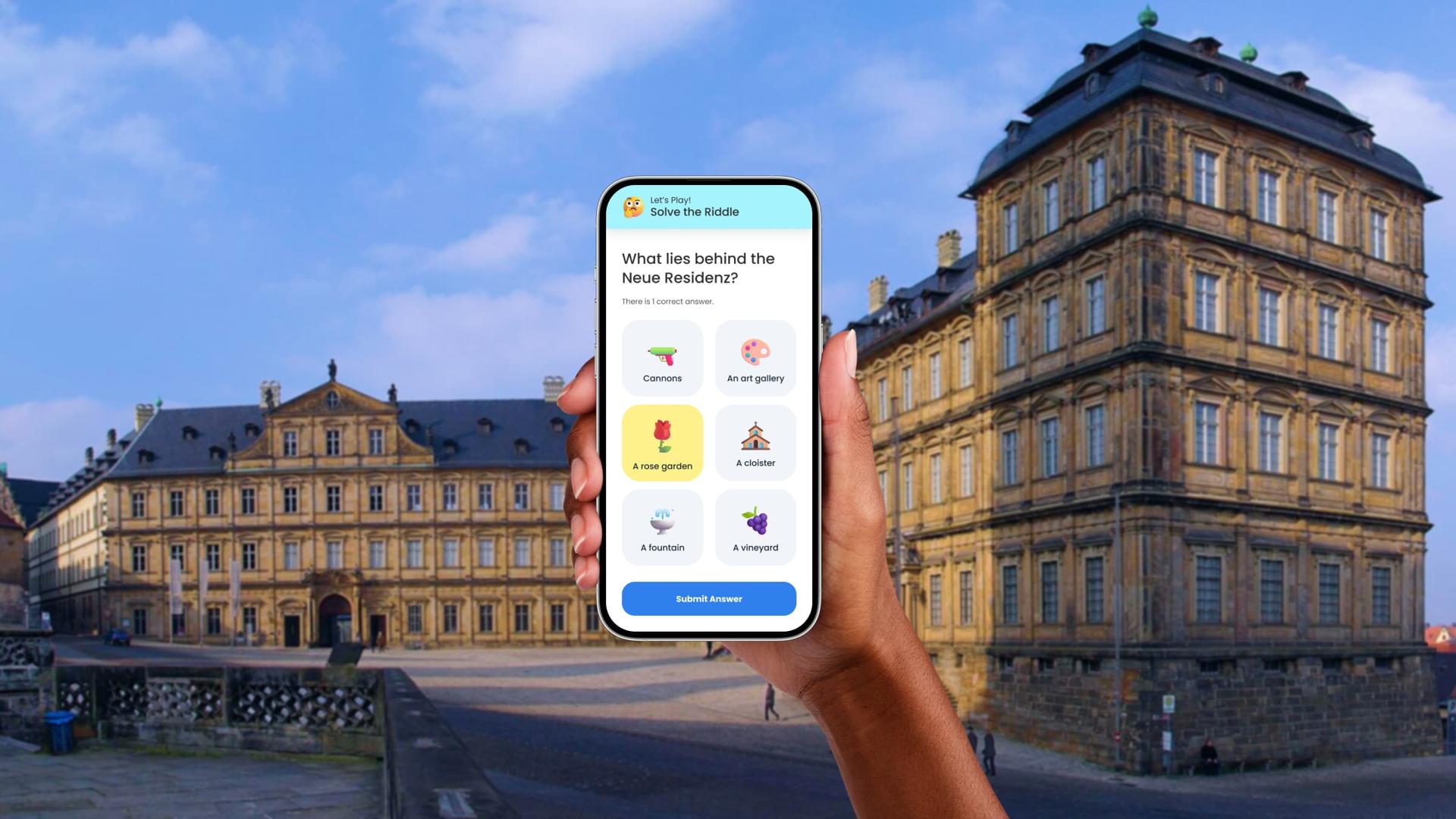
<p>Overlooking the Domplatz with regal splendor, the Neue Residenz stands as a testament to Bamberg’s golden age of power and prestige. Continuing from the Old Court, where power and faith once intertwined, the Neue Residenz represents a new era of authority and cultural ambition for Bamberg’s prince-bishops. this architectural masterpiece symbolizes a shift from medieval austerity to Baroque opulence. It is a palace that not only housed rulers but also proclaimed their authority and sophistication.</p> <img src="https://storage.googleapis.com/ciceru-assets-stg/5b3c3cd2-34de-4847-81cb-79c383ba6f65/SLZ0AQaO-bam_res-fuerstbisch-app-thronsaal790.webp" alt="undefined" style="height: auto;width: 320px"/> <blockquote>Inside the New Residence - From schloesser-bayern-de</blockquote> <p>Construction of the Neue Residenz began in 1604 under Prince-Bishop Johann Philipp von Gebsattel but reached its zenith under Prince-Bishop Lothar Franz von Schönborn between 1697 and 1703. Determined to rival the grand palaces of Vienna and Würzburg, Lothar Franz transformed the residence into a statement of power and cultural ambition. With its two majestic wings and four grand courtyards, the Neue Residenz is a harmonious blend of Renaissance symmetry and Baroque grandeur.</p> <img src="https://storage.googleapis.com/ciceru-assets-stg/5b3c3cd2-34de-4847-81cb-79c383ba6f65/dk2WJ0P9-bam_res-kaisersaal790.webp" alt="undefined" style="height: auto;width: 320px"/> <blockquote>The Imperial Hall - From schloesser-bayern-de</blockquote> <p>Inside, the Imperial Hall (Kaisersaal) steals the show. Its gilded stucco ceilings and monumental frescoes, painted by Melchior Steidl, narrate the life of Emperor Henry II, the founder of Bamberg Cathedral. These vibrant scenes glorify the divine right of the prince-bishops, linking their authority to the legacy of the Holy Roman Empire. Standing here, one feels the weight of history, surrounded by art that once proclaimed the absolute power of Bamberg’s rulers.</p> <img src="https://storage.googleapis.com/ciceru-assets-stg/5b3c3cd2-34de-4847-81cb-79c383ba6f65/hlNy0rfd-Residenz_Bamberg_Chinese_Kabinet_%282%29.webp" alt="undefined" style="height: auto;width: 320px"/> <blockquote>The Mirror Cabinet - From Wikipedia</blockquote> <p>The Mirror Cabinet, adorned with dazzling mirrors and intricate gold carvings, reflects a world of opulence. It was here that the prince-bishops held private meetings, weaving political strategies behind closed doors. The sheer extravagance of this room is a glimpse into the wealth and influence that Bamberg’s rulers once wielded.</p> <p>Yet, behind the stately walls of the Neue Residenz, there is a place that reveals the cultural sophistication of Bamberg’s rulers and offers a breathtaking view over Bamberg’s rooftops and the distant Michaelsberg Abbey.</p>

Bischof St. Otto

<p>In the heart of Bamberg, the Denkmal Bischof St. Otto honors Otto of Bamberg, a pivotal figure in the city’s history. Appointed Bishop of Bamberg in 1102, Otto was a statesman and diplomat who navigated political challenges with remarkable skill. He maintained stability in Bamberg during power struggles between the Holy Roman Empire and the Papacy, securing its prosperity.</p> <img src="https://storage.googleapis.com/ciceru-assets-stg/5b3c3cd2-34de-4847-81cb-79c383ba6f65/gVL98uzI-Otto_der_Heilige.webp" alt="undefined" style="height: auto;width: 320px"/> <blockquote>Statue of Otto of Bamberg, in Monastery of Saint Michael in Bamberg - From Wikipedia</blockquote> <p>Beyond politics, Otto was a visionary builder who expanded Bamberg Cathedral and founded monasteries, transforming the city into a cultural hub. His strategic investments in architecture and education helped shape Bamberg’s influence within the Holy Roman Empire.</p> <img src="https://storage.googleapis.com/ciceru-assets-stg/5b3c3cd2-34de-4847-81cb-79c383ba6f65/yzig0m7n-800px-Heilsbronn_Mu%CC%88nster_-_Stiftungsbild.webp" alt="undefined" style="height: auto;width: 320px"/> <blockquote>The 15th century Heilbronn monastery establishment - Bishop Otto von Bamberg carries a model of the cathedral with Count Rapoto von Abenberg - From Wikipedia</blockquote> <p>Sculpted with masterful detail, Saint Otto stands with a calm yet resolute expression, embodying his leadership and vision. His gaze is firm, reflecting his determination to guide his people through political turmoil and cultural transformation. The folds of his vestments seem to ripple with movement, lending a sense of life and purpose to the statue, as if he is ready to continue his journey.</p>

Schöner Blick

<p>High above Bamberg, the Schöner Blick offers sweeping views of the city’s hills, winding rivers, and the iconic red-tiled rooftops that weave together a picturesque tapestry. This viewpoint unveils Bamberg’s rich historical layers, showcasing the city’s evolution over time. From here, you can observe how the medieval core merges with Baroque elegance, a visual story of centuries of architectural evolution and cultural growth.</p> <img src="https://storage.googleapis.com/ciceru-assets-stg/5b3c3cd2-34de-4847-81cb-79c383ba6f65/FwYWT5Va-800px-Kloster_Michaelsberg_Parkseite.webp" alt="undefined" style="height: auto;width: 320px"/> <blockquote>The historic Monastery of St. Michael - From Wikipedia</blockquote> <p>The hill itself is crowned by the historic Monastery of St. Michael, founded in the 12th century. Once a vibrant center of faith and culture, the monastery reflects the influence of the Benedictine order on Bamberg’s religious and social fabric. Today, its majestic facade stands as a testament to a time when power and spirituality were closely linked, shaping the city’s identity.</p> <img src="https://storage.googleapis.com/ciceru-assets-stg/5b3c3cd2-34de-4847-81cb-79c383ba6f65/Oi4adj2S-367px-Bamberg_Sankt_Michael_BW_12.webp" alt="undefined" style="height: auto;width: 320px"/> <blockquote>The majestic facade of St. Michael - From Wikipedia</blockquote> <p>Schöner Blick is more than a scenic viewpoint, it is a journey through history. Each view reveals the intricate relationship between nature and architecture, reflecting the vision of those who shaped Bamberg’s identity. From emperors to citizens, their legacy is woven into the city’s fabric, connecting past achievements to present-day vibrancy.</p>

Dein persönlicher Guide, immer dabei

Lust, diese Orte zu Fuß zu entdecken?

  • Selbstgeführt, wann du willst
  • Offline-Audio, 7 Sprachen
  • 30 Tage Geld-zurück-Garantie
  • 500 MB eSIM inklusive

ab

7,00 €

1 selbstgeführte Tour in Bamberg

Touren ansehen

Tage planen

Wie viele Tage in Bamberg? Die perfekte 1-Tage-Route

Tag 1

Bambergs Altstadt zu Fuß

Folge dieser Route und verbinde Bambergs Altstadtbrücken, Flussinseln, den Domberg und die hiesige Rauchbiertradition an einem einzigen, kompakten Tag.

Wetter & Andrang

Beste Reisezeit

Von April bis September herrschen beste Bedingungen für lange Spaziergänge, auch wenn im Sommer Regen und Besucherandrang zunehmen können. Von Oktober bis März wird es ruhiger, aber auch kälter und die Tage sind kürzer. Genaue Wetterwerte und monatliche Besucherzahlen erfordern einen Blick in offizielle Statistiken oder den DWD.

Empfohlen

Spätfrühling bis Herbst

Apr–Sep

9–22°C/ 48–72°F

Viel losGelegentlicher Regen
  • Perfekt für Spaziergänge
  • Regentage und Hochbetrieb möglich

Spätherbst bis Frühling

Okt–Mär

0–7°C/ 32–45°F

Wenig losNass
  • Entspanntere Altstadtbesuche
  • Kürzere Tage und kälteres Wetter

Verkehr

Anreise & Verkehr in Bamberg

Zu Fuß

Top in der Altstadt

Bambergs historischer Kern ist überschaubar, und der Bahnhof liegt etwa 15 Gehminuten entfernt. Stell dich auf Kopfsteinpflaster, Brücken und ein paar Steigungen ein.

Busse der Stadtwerke

Praktisch außerhalb

Bamberg verfügt über rund 30 Stadtbuslinien. Die BAMBERGcard gilt drei Tage lang und beinhaltet Fahrten im öffentlichen Nahverkehr; die aktuellen Preise solltest du vorab prüfen.

Auto

Schwierig im Zentrum

Nutze lieber Park-and-Ride, statt mit dem Auto ins historische Zentrum zu fahren. Genaue Parkgebühren und Beschränkungen entnimmst du den offiziellen städtischen Seiten.

Erkunde das historische Zentrum zu Fuß. Nimm für entlegenere Viertel die Busse der Stadtwerke und prüfe vorab den Preis der BAMBERGcard im Vergleich zu Einzeltickets.

Übernachten

Übernachten in Bamberg

Altstadt

Für den ersten Besuch

Die beste Ausgangsbasis, um das historische Zentrum und alle Tour-Highlights zu Fuß zu entdecken. Rechne mit Kopfsteinpflaster, lebendigem Treiben und wenig Platz fürs Auto.

Inselstadt

Zentral und etwas ruhiger

Zentrale Insellage mit kurzen Wegen in die Altstadt. Über Brücken und Uferpfade wird Rollkoffer-Ziehen allerdings schnell zur Geduldsprobe.

Wunderburg

Authentisches Flair

Liegt südlich des Zentrums, wirkt wohnlicher und lässt sich zu Fuß mit der Altstadt verbinden. Lokale Nahverkehrsverbindungen vorab am besten kurz gegenprüfen.

Gaustadt

Für längere Aufenthalte

Ein etwas abgelegenerer Stadtteil für alle, die für eine ruhigere Umgebung gerne auf den Bus zurückgreifen.

Die Touren

Bamberg, Geschichte für Geschichte

Rubbeln und gewinnen

Rubbel los

Da unten könnte etwas Gutes warten. Wenn du gewinnst, zeigen wir dir, wie du es einlöst.

Ein Gewinn pro Reisenden. 2 Jahre gültig.

Weiterempfohlen

Was Reisende sagen

Sicherheit

Ist Bamberg sicher?

Bamberg gilt allgemein als sicheres Pflaster. Die größten Herausforderungen sind unebenes Kopfsteinpflaster, Radverkehr, Gedränge an engen Zugängen und mäßige Beleuchtung bei abendlichen Spaziergängen. Notrufnummern: 112 für Feuerwehr und Rettungsdienst, 110 für die Polizei.

Kopfsteinpflaster und Brücken

Trage Schuhe mit gutem Profil und nimm dein Gepäck auf unebenen Gassen und Brücken fest in die Hand, besonders bei Regen.

Abends in der Altstadt

Sei in ruhigen Gassen nach Kneipenschluss wie gewohnt aufmerksam. Nimm im Zweifel ein lizenziertes Taxi oder den Bus, wenn dir der nächtliche Fußweg ungemütlich ist.

Radverkehr

Schau an Radüberwegen und auf gemischten Wegen in beide Richtungen. Bleib nicht mitten in engen Gassen oder vor Brücken stehen.

Hilfe im Notfall

Wähle die 112 für Feuerwehr und Rettungsdienst, die 110 für die Polizei. Wenn du keinen Notfall hast, aber ärztliche Hilfe brauchst, helfen dir Tourist-Info oder dein Hotel weiter.

Gut zu wissen

Gut zu wissen

BAMBERGcard gilt drei Tage

Laut den offiziellen Angaben zu nachhaltiger Mobilität gilt die BAMBERGcard drei Tage lang und schließt alle Busse des Nahverkehrs ein. Prüfe vorher den aktuellen Preis, um zu sehen, ob sie sich gegenüber Einzelfahrkarten lohnt.

Rund 30 Buslinien

Laut Bamberg Tourismus umfasst das städtische Liniennetz rund 30 Busverbindungen, was praktisch ist, wenn deine Unterkunft außerhalb des historischen Kerns liegt.

Rauch im Biernamen

Rauchbier ist Bambergs urige Spezialität. Eine lokale Besonderheit, die du auf fast jeder Speisekarte findest, auch wenn hier natürlich längst nicht jedes Bier rauchig schmeckt.

Fragen

Bamberg FAQ

Ja. Laut Bamberg Tourismus liegt der Bahnhof nur rund 15 Gehminuten vom Zentrum entfernt. Wegen des Kopfsteinpflasters und der Brücken lohnen sich bequeme Schuhe.

Bereit?

Selbstgeführte Audiotouren in ganz Bamberg.

Touren in Bamberg ansehen