
Tipps und Touren für Entdecker und Reisende
City-Guide für Berlin
Berlin ist eine weitläufige Kiezmetropole: Für den Flughafen BER brauchst du Tarifzone C, und nach Einbruch der Dunkelheit hat jedes Viertel seinen ganz eigenen Takt.
- Land
- Deutschland
- Sprache
- Deutsch
- Währung
- Euro (EUR)
- Stecker
- Typ F
- Zeitzone
- Europe/Berlin
- Notruf
- 112
- Leitungswasser
- Im Allgemeinen trinkbar
- Vorwahl
- +49
Die Stopps
Sehenswürdigkeiten in Berlin
Tauche ein in Berlins bewegte Geschichte und entdecke Ikonen wie das Reichstagsgebäude, das Brandenburger Tor und das historische Nikolaiviertel.
Mittelalterliche Ursprünge
Die Hauptstadt von Preußen
Der Erste Weltkrieg
Nazi-Propaganda
Friedrich II.
Ein Tor des Triumphs
Take a look up at those twin stone towers and the five rings suspended between them. You are standing before the Olympiastadion, a structure that manages to be both magnificent and deeply unsettling at the same time. This is not just a sports venue. It is a massive, limestone-clad ghost story. Built for the 1936 Olympics under the orders of Adolf Hitler, it was designed as a neoclassical titan, drawing inspiration from both modernism and ancient Greek architecture. But notice how it doesn't tower over you like a typical stadium. To achieve that ancient, grounded feeling, the architects actually dug the field thirty-three feet into the earth. You are standing above a sunken bowl of history, designed to project a strength intended to last a thousand years. The man responsible for this austere look was Werner March, who chose the limestone casing you see to evoke a sense of permanence and the 'master race' narrative. Even the Marathon Gate on the western side was carefully placed to maintain a military-style sightline to the nearby Bell Tower. As you walk along the facade, feel the coldness of the architecture. It was built during a dark era when construction companies were forced to hire only 'Aryan' workers, explicitly excluding the Jewish community from the very soil you are standing on. It was a space designed to prove a point about racial superiority to the rest of the world. But the best part of the story is how that narrative backfired right here on these grounds. In 1936, a Black American athlete named Jesse Owens stepped into this arena and shredded the Nazi script. He didn't just win, he dominated, taking home four gold medals in front of a stunned Hitler. There is a persistent legend that Hitler refused to shake his hand out of spite. In reality, Hitler had been told to shake everyone's hand or no one's, and he conveniently chose 'none' after the first day. But the image of Owens standing on the podium, surrounded by Nazi iconography while the crowd roared for him, remains the ultimate middle finger to the regime that built this place. The locals were so fascinated by Owens that he became an overnight celebrity, captivating the German public despite the hateful ideology of the state. Since the war, Berlin has faced a difficult choice: keep it or tear it down. They chose 'vergangenheitsaufarbeitung,' which is a quintessentially German word for 'working through the past.' They de-Nazified the site by stripping the swastikas and lowering the height of the honorary stand where Hitler once sat. Since then, the stadium has been reclaimed. It has hosted the British military, the 2006 World Cup final, and Usain Bolt’s legendary world records. It is no longer a monument to a regime, but a place where the world actually comes together, regardless of what the original architects intended. Today, the Olympiastadion serves as a massive, functional reminder that you can build a monument to last a millennium, but you cannot control the spirit of the people who fill it. It is a place where the echoes of a dark past meet the cheers of a modern, diverse Europe. As you head off, take one last look at that limestone. It was meant to be a wall, but today, it is just a backdrop for the next chapter of Berlin’s story.
Die Nacht des zerbrochenen Glases
Die deutsche Wiedervereinigung
Dein persönlicher Guide, immer dabei
Lust, diese Orte zu Fuß zu entdecken?
- Selbstgeführt, wann du willstSelbstgeführt: Starte jetzt oder später und mach Pause, wann du willst
- Offline-Audio, 7 SprachenOffline-Audiogeschichten in 7 Sprachen
- 30 Tage Geld-zurück-Garantie30 Tage Geld-zurück-Garantie
- 500 MB eSIM inklusive500 MB weltweite eSIM inklusive
ab
7,00 €
1 selbstgeführte Tour in Berlin
Tage planen
Wie viele Tage in Berlin? Die perfekte 1-Tage-Route
Berlins Kieze per Bahn und zu Fuß entdecken
Verbinde Berlins Viertel bequem mit U- und S-Bahn und nimm dir dann Kiez für Kiez Zeit, während sich die Stadt in Parks, Kanälen und Nachtleben entfaltet.
7,00 € →Wetter & Andrang
Beste Reisezeit
Mai, Juni und September sind die besten Monate, um Berlin zu Fuß zu erkunden. Juli und August sind am wärmsten und vollsten, Januar und Februar am ruhigsten.
Winter und Frühling
Jan–Jun-2–24°C/ 28–75°F
Wenig los
- Museen und erste Parkbesuche
Sommer und Herbst
Jul–Dez5–25°C/ 41–77°F
Wenig los
- Open-Airs und lange Abende
Die Touren
Berlin, Geschichte für Geschichte
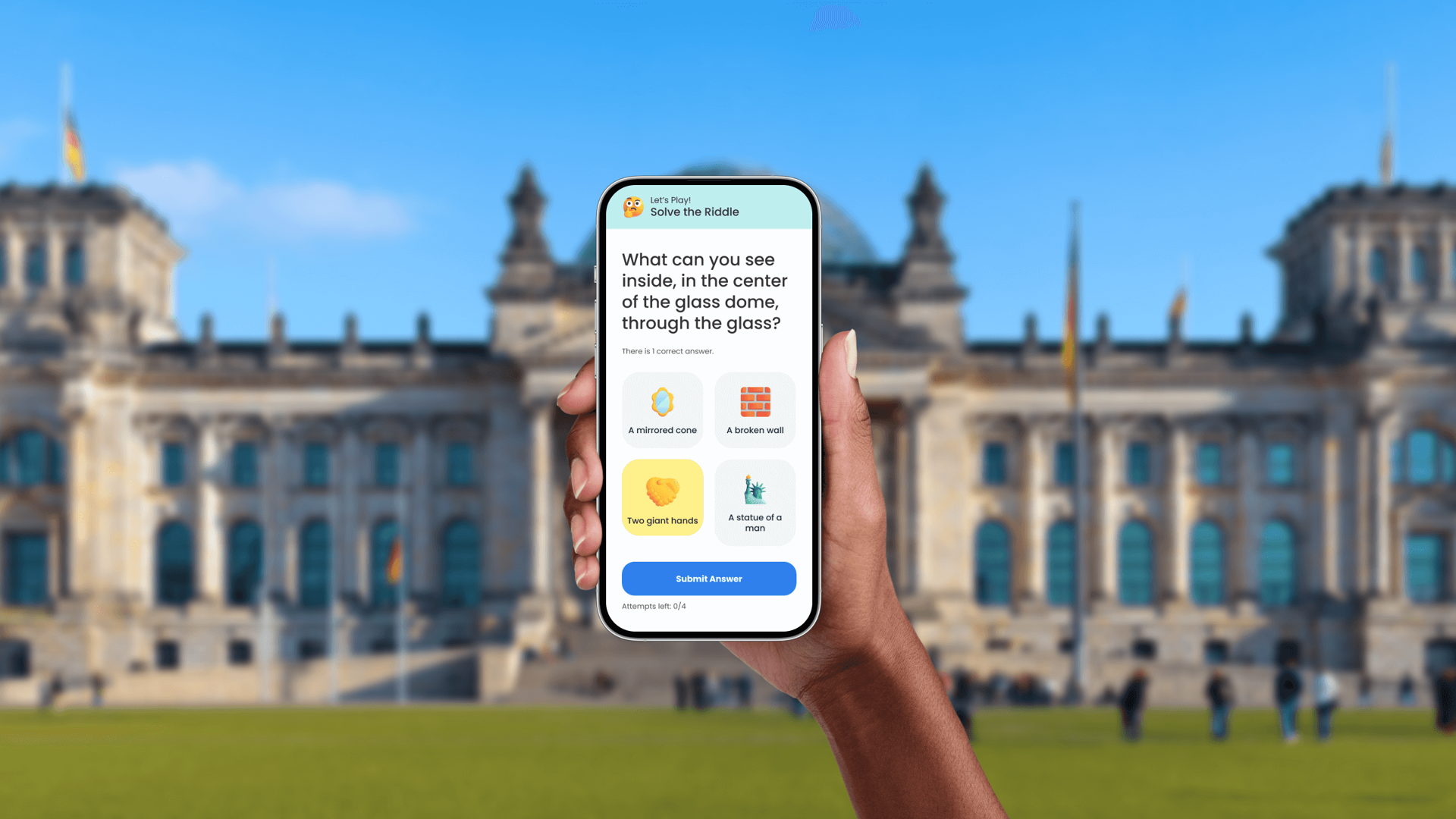
7 €2 Stunden
Berlin im Wandel der Zeit
 Andrea Rabinelli
- Audio
- Quizze
- Multiplayer
- Gratis-eSIM
Rubbeln und gewinnen
Rubbel los
Da unten könnte etwas Gutes warten. Wenn du gewinnst, zeigen wir dir, wie du es einlöst.
Ein Gewinn pro Reisenden. 2 Jahre gültig.
Weiterempfohlen
Was Reisende sagen

Sicherheit
Ist Berlin sicher?
Berlin ist für Reisende grundsätzlich sicher, aber als Metropole nicht frei von Taschendiebstahl, Nachtleben-Risiken und lebhaftem Verkehr. Pass an Bahnhöfen, Tramgleisen und auf dunklen Parkwegen gut auf. Notruf: 112 für Rettungsdienst und Feuerwehr, 110 für die Polizei.
Diebstahl an Bahnhöfen
Achte am Hauptbahnhof, Alexanderplatz, Zoologischen Garten und an vollen S-Bahnhöfen besonders gut auf Smartphone und Geldbeutel.
Nachtleben
Bleib rund um die Warschauer Straße und das Kottbusser Tor auf gut beleuchteten Wegen. Nimm keine offenen Getränke oder Mitfahrgelegenheiten von Fremden an.
Tram-Verkehr
Überquere Gleise nur an markierten Stellen und sei auf Wegen, die sich Fußgänger und Radfahrer teilen, besonders aufmerksam.
Lesenswert
Mehr über Berlin

Story9 Min. Lesezeit
Berlin kurz erklärt: Wofür die Stadt bekannt ist, beste Reisezeit und was man gesehen haben muss
Zuletzt aktualisiert: Oktober 2026
WeiterlesenStory8 Min. Lesezeit
Kostenlos in Berlin: Was 2026 noch umsonst ist
Zuletzt aktualisiert: Oktober 2026
WeiterlesenStory9 Min. Lesezeit
Essen in Berlin: Lokale Spezialitäten und wo du sie findest
Zuletzt aktualisiert: Oktober 2026
WeiterlesenStory6 Min. Lesezeit
Die günstigsten Coworking-Spaces in Berlin
Zuletzt aktualisiert: Oktober 2026
WeiterlesenStory9 Min. Lesezeit
Berlin mit kleinem Budget: Was drei Tage wirklich kosten
Zuletzt aktualisiert: Oktober 2026
WeiterlesenStory9 Min. Lesezeit
Unterwegs in Berlin: Nahverkehr, Flughafentransfer und Gepäckaufbewahrung
Zuletzt aktualisiert: Oktober 2026
WeiterlesenStory13 Min. Lesezeit
Audioguide-Stadtrundgänge in Deutschland: Wähle deine Route
Zuletzt aktualisiert: September 2026
WeiterlesenStory10 Min. Lesezeit
Was hat in Deutschland geschlossen? Regeln für Sonntage und 2027
Zuletzt aktualisiert: August 2026
WeiterlesenStory7 Min. Lesezeit
Grenzkontrollen innerhalb Europas: Was du dabeihaben solltest
Vorübergehende Kontrollen, Reisedokumente und EU-Einreisepflichten, Stand: 31. August 2026.
WeiterlesenStory4 Min. Lesezeit
Die Top 5 Berliner Techno-Clubs im Jahr 2025: Der Beat geht weiter
Auch im Jahr 2025 ist Berlin die Hauptstadt des Techno - und das trotz steigender Mieten, Clubschließungen und der allgegenwärtigen Spannung zwischen Gentrifizierung und…
WeiterlesenFragen
Berlin FAQ
Ja, der BER liegt in der Tarifzone C. Für die Fahrt vom Flughafen in die Berliner Innenstadt brauchst du ein ABC-Ticket.
Ja. Nutze die Bahn für lange Strecken quer durch die Stadt und entdecke die einzelnen Kieze zu Fuß. Achte vor dem Ticketkauf auf die passende Tarifzone.
Wähle die 112 für Feuerwehr und Rettungsdienst und die 110 für die Polizei.