St. Euphemia Church: Rovinj's Hilltop Landmark
Questo contenuto non è ancora disponibile in italiano. Mostriamo la versione in inglese.
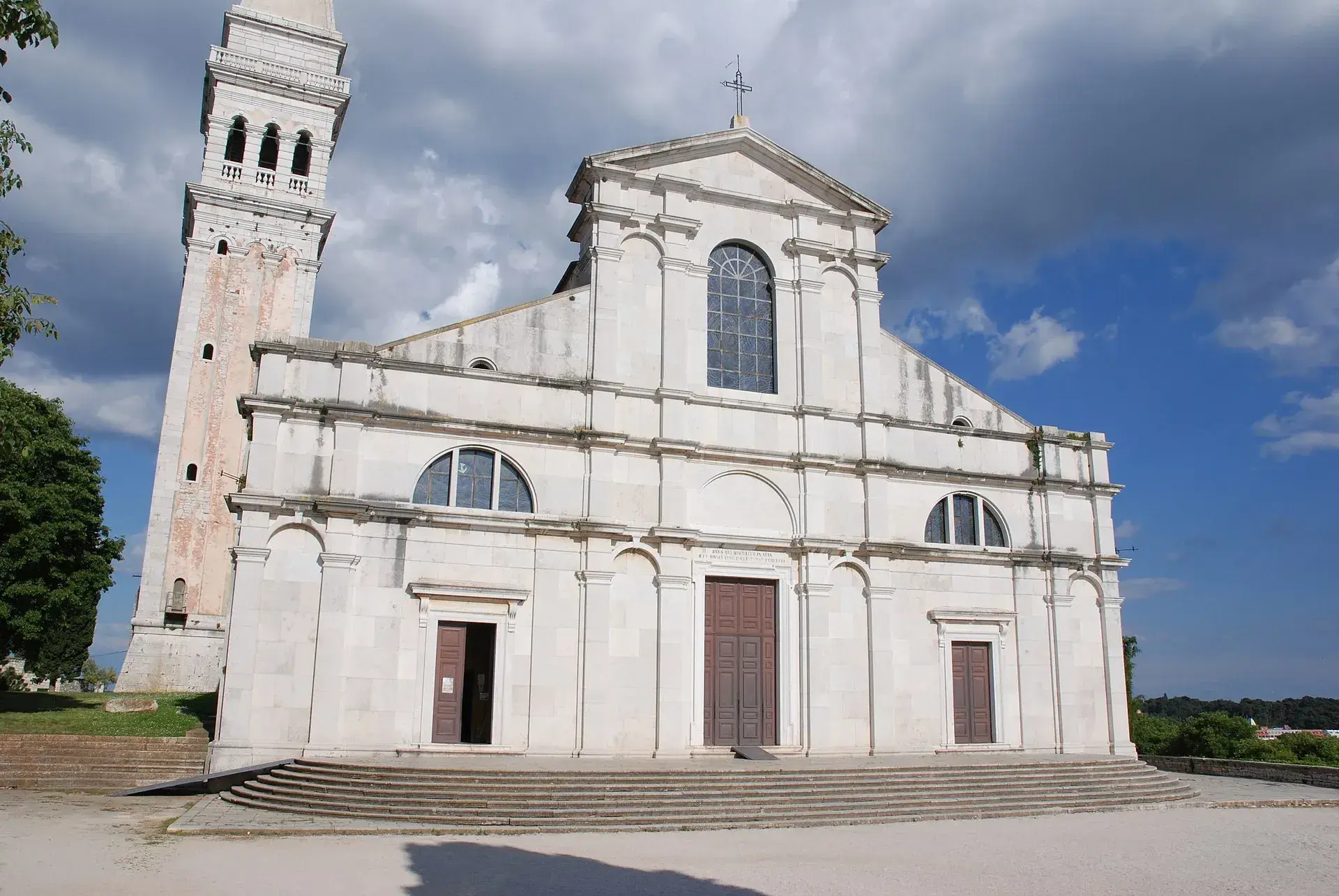
Perched on the highest point of Rovinj's historic peninsula, the Church of St. Euphemia serves as the crowning architectural landmark of the coastal town. The town's historical street layout, arranged on a Roman grid, features narrow cobbled alleys that slope upward toward the plateau where the church stands. Below the church grounds on the seaward side lie historic town walls with the Holy Cross gate, as well as the rocky swimming area known as Monte Beach or Spiaggia Balota.
Architecture and the Venetian Campanile
The present structure is a three-nave Baroque church built between 1725 and 1736 over the grounds of an early Christian site. The project was designed by Venetian architect Giovanni Scalfarotta and brought to completion by Giovanni Dozza. The church facade was later added between 1861 and 1883 by Giacomo Depozza. Prior to this construction, a medieval church dedicated to St. George occupied the location; St. George remains a co-patron of the parish today.
Adjoining the church is a 60-meter bell tower dating to the late 17th century, explicitly modeled after St. Mark's Campanile in Venice. The tower is capped by a 4.7-meter copper statue of St. Euphemia, forged in 1758 after a lightning strike destroyed an earlier wooden statue. Mounted on an axis, the statue functions as a practical weather vane. According to local lore, when the saint faces toward the Adriatic Sea, clear and sunny weather will follow, whereas facing inland toward the town indicates rain or clouds.
The Relics and Legends of St. Euphemia
St. Euphemia was a 15-year-old Christian martyr executed in 304 AD under Roman Emperor Diocletian. Her remains were initially moved to Constantinople before vanishing in the early 7th century following the destruction of her church by Persian forces. According to local tradition, her Roman marble sarcophagus—dating between the 3rd and 6th centuries—miraculously floated into Rovinj during a storm on July 13, 800 AD. Legend recounts that while the townspeople could not shift the heavy stone tomb, a young boy led by a dream hauled it up the hilltop using two small calves.
The relics faced further upheaval in 1379 during the Genoese-Venetian War, when Genoese forces looted the tomb. Venetian forces recovered and returned the relics in 1401, an event tradition commemorates with tales of a swimming flock of sheep greeting the returning vessel. Local accounts also suggest the Venetians kept the saint's left arm. Today, the sarcophagus rests behind the church altar, featuring a small viewing window that displays the saint's body, fitted with a wax facial mask created in 1953 by Hungarian artist Mila Vod.
Current Use and Visiting
St. Euphemia Church remains an active parish church and a major destination for visitors. While access to the church interior is free, visitors can pay a fee to climb the bell tower via more than 190 narrow, open-tread wooden steps to view panoramas of the Adriatic Sea and the Istrian mainland.
The church is the focal point of the town's most prominent annual event on September 16, the feast of St. Euphemia. The celebration includes a solemn mass, a morning relic procession, and town-wide festivities.
FAQ
Is there a fee to enter St. Euphemia Church?
Admission to the interior of the church is free, though a ticket fee is charged to climb the bell tower.
How does the statue atop the bell tower predict the weather?
The 4.7-meter copper statue rotates on an axis to serve as a weather vane. By local tradition, the weather is expected to be sunny when the statue turns toward the sea, and overcast or rainy when it faces inland.
What is inside the sarcophagus of St. Euphemia?
The marble sarcophagus contains the relics of the saint, which can be viewed through a small glass opening displaying a wax mask made in 1953 by Hungarian artist Mila Vod.
What is celebrated at the church on September 16?
September 16 marks the feast day of St. Euphemia, featuring Rovinj's largest annual festival, a relic procession, and a solemn church mass.