Bath Abbey

为探索者和旅行者准备的贴士与路线

Bath城市指南

巴斯是英国唯一整座城市被列入联合国教科文组织世界遗产名录的城市。皇家新月楼与圆形广场的蜜色巴斯石建筑,以及古罗马时代的天然温泉浴场,让这里闻名遐迩。

国家
英国
语言
英语
货币
英镑 (GBP)
插头
类型 G
时区
Europe/London
紧急电话
112、101和999
自来水
可饮用
区号
+44

景点

Bath必做之事

巴斯被列入世遗的核心城区将古罗马考古遗迹与乔治亚时代的城市规划融为一体,极为适宜漫步。从罗马浴场、巴斯修道院到线条优雅的皇家新月楼,城中最负盛名的地标仅凭双脚就能轻松走遍。

热水与上层社会

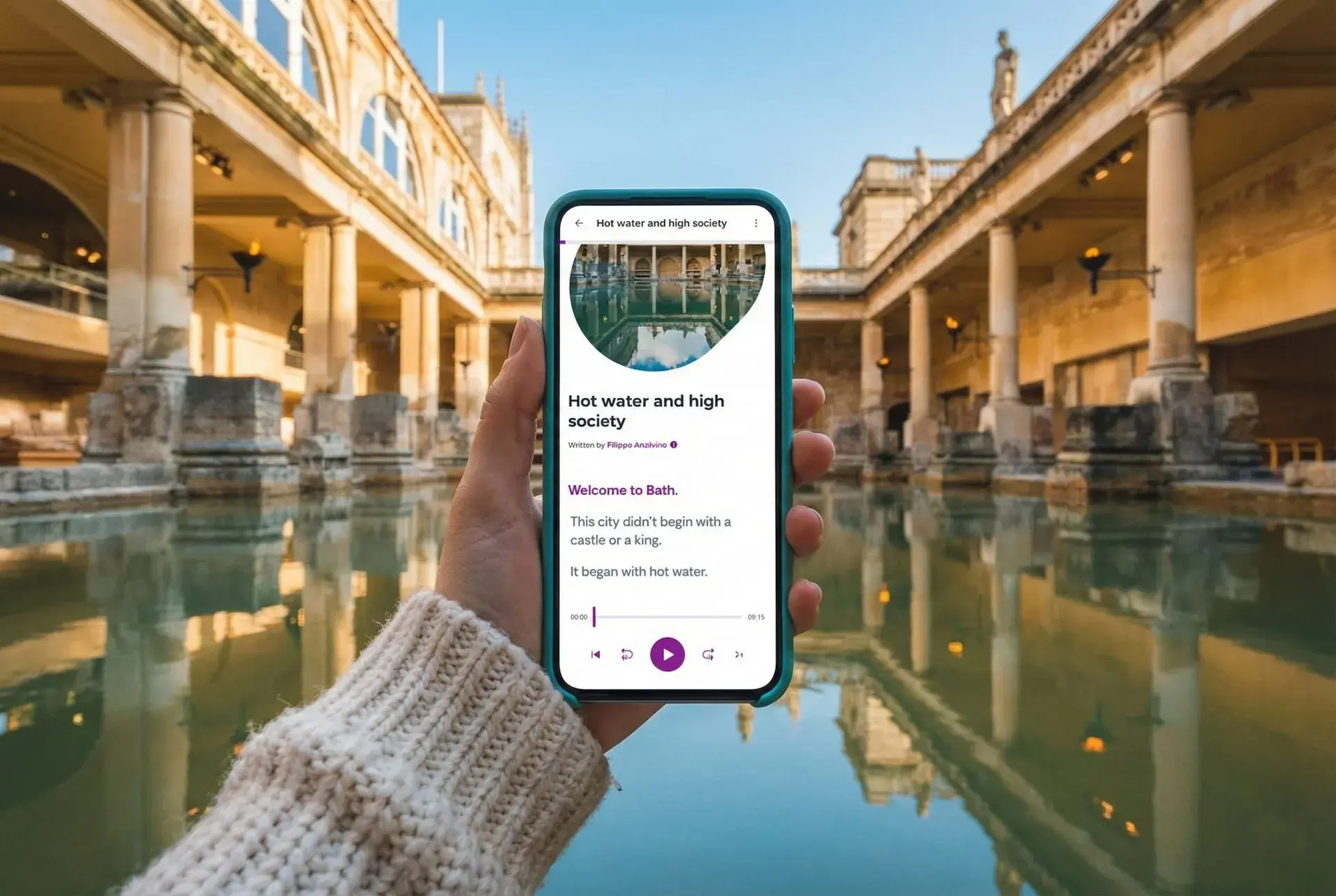
<p>Welcome to Bath.</p> <p>This city didn't begin with a castle or a king. It began with hot water.</p> <p>On this Ciceru tour, we are going to trace the city's rise, both literally and socially. We will walk from the ancient river level up to the exclusive heights of the Royal Crescent. It is a journey through Roman engineering, Medieval grit, and the golden architecture of the Georgian era.</p> <p>I’ll be your guide to the stories hidden in the limestone. We have a lot of ground to cover, so let’s get moving.</p> <p>We start our journey here in the Abbey Churchyard. While the queue next to you might be long, the history beneath your feet is even longer.</p> <p>You are currently standing on top of Aquae Sulis. This was the Roman name for the city, meaning "The Waters of Sulis." When Roman engineers arrived here around 70 AD, they found a hot, swampy spring revered by the locals. But the Romans didn't just conquer the site. They translated it.</p> <p>They took the local Celtic goddess, Sulis, and identified her with their own goddess, Minerva. This wasn't a crude mash-up of a nature spirit and a war deity. It was a sophisticated theological merger based on their shared power of healing and wisdom. The result was Sulis Minerva, a powerful figure who presided over a complex of pools that were as much a hospital as they were a place of worship.</p> <p>The building you see in front of you is the Grand Pump Room. It is much newer, built in the 1790s. This is where high-society Georgians would come to drink the water rather than swim in it. If you look at the Greek inscription above the columns, it reads Ariston Men Hydor, or "Water is Best."</p> <p>Although you are standing on the dry pavement of the 21st century, the ancient plumbing is still hard at work below you. The spring gushes over a million liters of water every day at a steaming 46°C.</p> <p>Beneath the museum floor, the original Roman drain still functions. It carries the waste water out to the river just as it did two thousand years ago. We call that heritage hydraulics.</p> <p>But it wasn't all wellness and relaxation down there. The Romans also used the sacred spring to air their grievances. Archaeologists have found lead "curse tablets" thrown into the water, inscribed with angry messages to the goddess. They usually asked for revenge against thieves or unfaithful lovers. It seems that even in the first century, people loved leaving a bad review.</p> <p>This spot is the thermal heart of the city. Everything we will see next, from the Abbey to the grand houses on the hill, only exists because the Romans decided to stop here for a soak.</p> <p>Now, turn your attention to the massive stone structure looming right next to the Baths. It is time to look at the Medieval layer of the city.</p>
天使的梯子

<p>At first glance, Bath Abbey looks like a Gothic cathedral that has learned to smile politely. Its lacy stone facade and sprawling windows catch the sunlight with improbable optimism. This is especially impressive for a building that has been sacked, neglected, and rebuilt more times than your average Tudor table.</p> <p>It began in the 7th century as a monastery, but the structure standing before you is a 15th-century reboot in the Perpendicular Gothic style. Note the high ceilings and the massive tall windows. The walls seem unsure whether they are structural or merely decorative frames for the glass.</p> <p>Now, let’s address a local myth. You will often hear that this site hosted the coronation of England’s "first" King, Edgar, in 973 AD. That is not entirely true.</p> <p>Athelstan, his uncle, was actually crowned King of the Anglo-Saxons nearly fifty years earlier in 925 AD. However, Bath still holds a vital place in royal history. Edgar’s ceremony here introduced a specific service and liturgy that created the template for every British coronation that followed. So while he wasn't the first, he set the style that Charles III used over a thousand years later.</p> <p>Turning your eyes to the stone facade itself, the West Front demands a pause. Look closely at the turrets flanking the main window. You will see angels climbing up and tumbling down stone ladders.</p> <p>This unique design was inspired by a dream allegedly sent to Bishop Oliver King in 1499. It was possibly a divine epiphany, or possibly the result of questionable wine. Regardless of the source, the imagery stuck. It makes for a compelling sermon carved directly into the limestone.</p> <p>Because we are staying outside, you can't smell the beeswax or hear the choir, but you can appreciate why this building is nicknamed the "Lantern of the West." The walls are more glass than stone. If you were to step inside, you would find yourself surrounded by over 1,000 memorial tablets on the walls. It serves as a densely annotated "Who's Who" of Georgian grief. It is part church and part vertical graveyard.</p> <p>It is easy to be distracted by the grandeur. Yet the Abbey’s most enduring trait is continuity. Despite regimes, reforms, and restorations, it persists in holy matrimony with its historic setting.</p> <p>Tucked around the corner, a humbler structure claims both culinary fame and medieval roots. Let’s go sample the famous Bath Bun at one of the city's oldest houses.</p>

一口1482

<p>Few buildings dare to boast both medieval architecture and a menu. Sally Lunn’s pulls it off.</p> <p>You are standing in front of one of the oldest houses in Bath. Dating back to 1482, this structure was already old before Henry VIII had his first heartbreak. If you look at the rough stone masonry and the way the house sits slightly lower than the modern street level, you can see how much the city has risen around it over the centuries.</p> <p>Now, let’s talk about the legend. You might hear a romantic story about a French Huguenot refugee named "Solange Luyon" who fled to Bath in 1680 to bake brioche.</p> <p>I hate to ruin a good story, but that is likely a fabrication. Historical records suggest the "Solange" character was invented in 1937 by the tea shop owner, Marie Byng-Johnson, to add a little French flair to her marketing. The real "Sally Lunn" was more likely a hawker selling buns in the streets of Bath in the late 1700s.</p> <p>But while the baker might be a myth, the bun is very real. It is a golden, airy carb-cloud that tourists queue for daily.</p> <p>There is another secret here that you cannot see from the alley. Beneath the floorboards of the dining room lies a Roman hypocaust system.</p> <p>This was the ancient version of central heating. Hot air from a furnace was circulated through empty spaces under the floor, keeping the Romans warm in the damp British winter. It is a literal "hot plate" of the Empire resting right beneath the modern bakehouse.</p> <p>Locals treat this place like a mildly eccentric aunt. It is loved, a bit theatrical, and possibly stretching the truth, but it is part of the family regardless. Because in Bath, even your bun tells a story.</p> <p>After a bite steeped in legend, let’s retreat to a quieter pleasure. We will head to the riverside gardens for a view of the famous weir.</p>

在监督下调情

<p>Look down over the stone balustrade into the manicured green space below. This is Parade Gardens.</p> <p>In the 18th century, this was the answer to a specific social problem. The city planners needed a place where the wealthy could flirt under supervision.</p> <p>Planted with both flowers and strict codes of Georgian decorum, it quickly became Bath’s open-air ballroom. It was a genteel promenade for spa-goers to dry off after their morning plunge.</p> <p>Today, the gardens feed packed lunches and selfie sticks rather than scandalous glances. But the fragrance of precisely arranged blooms still wafts up with practiced grace.</p> <p>They may look like just another park, but dig a little and you will find the past refusing to stay buried.</p> <p>In 1997, an archaeological excavation took place right beneath those neat flower beds. You might hear rumors that they discovered a lost Roman temple precinct here.</p> <p>That is a lovely thought, but it is untrue.</p> <p>What they actually found was the "Great Drain". This was the massive Roman culvert designed to carry waste and overflow away from the Baths and into the river.</p> <p>It seems we often go looking for sacred architecture and find plumbing instead. But in Bath, the plumbing is just as impressive as the temples.</p> <p>Back in the Georgian heyday, entry into these lawns required the right pedigree and a subscription fee. Today you still have to pay a small fee to enter, but the only pedigree required is a tolerance for goose prints.</p> <p>Nothing mythic springs from Parade Gardens today unless you count high-society gossip. But its role endures as a pause button in a city built for display.</p> <p>From this vantage point, turn your head to the left. You are perfectly positioned to see our next stop. It is one of only a few bridges worldwide with shops built into its structure.</p>

佛罗伦萨桥

<p>Pulteney Bridge might be the closest Bath gets to theatrical overkill. It is a graceful Georgian structure draped in boutiques and strewn across the Avon like a limestone doily.</p> <p>Built in 1774 by Robert Adam, it is often said that this bridge was built to rival the Ponte Vecchio in Florence. That is a nice story, but the truth is more local and mercenary.</p> <p>The bridge was actually a piece of aggressive real estate marketing. The landowner, William Pulteney, wanted to connect his estate in Bathwick to the city center. He wasn't trying to outshine Florence. He was trying to compete with the fashionable west side of Bath.</p> <p>Adam’s design is technically a copy of a copy. He based it on Andrea Palladio’s rejected design for the Rialto Bridge in Venice.</p> <p>You might hear a rumor that Adam originally wanted a massive central dome here but was rejected due to cost. That is a case of mistaken identity. Adam never planned a central dome. He designed a temple-like pediment for the center and placed small saucer domes on the pavilions at the far ends. Furthermore, his design wasn't rejected for being too expensive. In fact, his expensive plan was chosen over a cheaper rival.</p> <p>As you walk across, you will notice shops lining both sides. Unless you lean over the parapet to look at the roaring weir below, you might not notice you have crossed water at all. This was exactly the sort of sleight of hand Georgian planners delighted in.</p> <p>Legend also whispers of secret rooms and passageways hidden in the bridge's underbelly.</p> <p>In reality, these "secrets" are well-documented shop cellars and structural voids designed to handle floods. It turns out that in Bath, even the mysteries have practical explanations.</p> <p>Now, let's head uphill to where tailoring once met literary cameos. We are going to window shop along the street favored by Jane Austen's characters.</p>

时装秀

<p>Milsom Street has always known its angles.</p> <p>Laid out in the mid-18th century with a gentle curve and a hint of architectural swagger, it was Bath’s catwalk long before that meant flashing cameras. Here, wealth wasn’t hidden. It was tailored, perfumed, and on public display. Think Fitzwilliam Darcy with a pocket watch addiction.</p> <p>During the Georgian era, this was the epicenter of polite consumerism. It was packed with tailors, milliners, bookstores, and jewelers.</p> <p>Jane Austen, never one to miss a detail, made Milsom Street a recurring character in her novels. You might read in some guidebooks that she described this as Bath’s "principal street of entrance." That is actually a misquote. In Northanger Abbey, her characters usually stayed in Great Pulteney Street or the Paragon. However, Milsom Street was the undisputed social hub where they went to check the windows, track down fashionable hats, and accidentally-on-purpose run into eligible bachelors.</p> <p>Today, it remains a retail thoroughfare, albeit one dressed in Zara rather than muslin. The architecture is still the star. Look at the restrained facades in Bath stone. Notice the bow windows on the upper floors that seem to watch passersby like silent chaperones.</p> <p>Under the cobbles, rumor has it there are clandestine passageways. Locals might tell you these were Georgian shortcuts for illicit affairs. That is probably untrue. They were likely just service vaults for coal and deliveries. But the idea that fashion once required escape routes is, in itself, delightfully on-brand for Milsom Street.</p> <p>The rhythmic clack of shoes still echoes here. It confirms that style in Bath has never really gone out of fashion. It just updates seasonally.</p> <p>Just a few doors away awaits the city’s most famous reluctant resident. Let’s go see where the legend of Jane Austen meets the souvenir shop.</p>

不情愿的居民

<p>The Jane Austen Centre has a simple premise. What if we took a woman known for social satire and turned her into a waxwork?</p> <p>It is housed in this classic Georgian townhouse here on Gay Street. This is just a stone’s throw from where Austen actually lived. She resided higher up the hill at number 25 after her father died.</p> <p>If you are lucky, you will see a staff member in full Regency costume standing right here by the door. It is proof that top hats and petticoats never go out of fashion if you ignore the weather forecast.</p> <p>Austen lived in Bath from 1801 to 1806. She did not love it. In fact, she found it noisy, hot, and expensive. But she mined it for material. She used the streets you have just walked as the social petri dishes for her novels Northanger Abbey and Persuasion.</p> <p>There is no great myth here, unless you count the persistent rumor that Austen adored Bath. She didn't. But locals have embraced her anyway. They have effectively turned her mild disdain into excellent marketing.</p> <p>Even if you don't go inside, the building itself is a perfect example of the architecture she would have known. Gay Street acts as a connector. It links the commercial buzz of Milsom Street below to the exclusive residential heights above.</p> <p>Now, let's make that climb ourselves. Turn from fiction to geometry. We are going to marvel at a masterpiece of Georgian architecture comprised of three curved segments of townhouses.</p>

德鲁伊的斗兽场

<p>Designed by John Wood the Elder and finished by his son in 1768, the Circus is a platinum example of what happens when British eccentricity meets Roman obsession.</p> <p>From above, the layout looks like a key. Some say it is a Masonic symbol. Others say it represents the eye of a serpent.</p> <p>You will often hear guides claim that the diameter of this circle is the same as the Colosseum in Rome. That is a myth. The Colosseum is nearly double the size of this space.</p> <p>The diameter here is exactly 318 feet. That number was chosen deliberately to match the outer earth bank of Stonehenge. John Wood was obsessed with the Druids. He believed Bath was a lost British Troy.</p> <p>However, the design of the houses is definitely Roman. Wood modeled the facades on the Colosseum but turned inside out. He didn't do this because he loved Rome. He did it because he believed the Romans had plagiarized the style from the Jewish Temple of Solomon and the British Druids. He was trying to reclaim the architecture for its "original" owners.</p> <p>Look closely at the three tiers of columns.</p> <p>They progress in complexity as they go up. The bottom is plain Doric. The middle is scrolled Ionic. The top is flowery Corinthian. It represents the ascent of civilization.</p> <p>On the roofline, you will see stone acorns. This is another nod to the Druids who worshipped the oak tree.</p> <p>In the center of the grassy circle, you see massive London Plane trees. Locals might tell you these were planted to match the height of the buildings. That is also untrue.</p> <p>The original design had no trees at all. It was a paved open theatre. Today, these trees tower over the rooftops and completely dwarf the Georgian architecture. They are beautiful, but they are very much an accident of history rather than a piece of precision planning.</p> <p>Whether or not the Circus forms a geomantic key, it unlocks a curious truth. Bath’s past was never just about order. It was about spectacle, belief, and the audacity of geometry.</p> <p>Step just beyond the circus arc to behold the finale. We are heading to the iconic crescent of 30 Grade I listed terraced houses.</p>

建筑上的胜利

<p>We have arrived at our final stop. The Royal Crescent looks like it landed here during a particularly elegant apocalypse.</p> <p>Thirty townhouses in a perfect curl, designed by John Wood the Younger and built between 1767 and 1774, it was less "housing" and more of a real estate mic drop. Executed in the Palladian style with a dramatic sweep of Ionic columns, the Crescent was Bath’s answer to Versailles. It just came without the fountains and with more sheep.</p> <p>If you look at the lawn, you might notice a sunken fence line. This is called a "Ha-Ha." It was a clever landscape trick designed to keep the livestock out of the garden without interrupting the view from the drawing room windows.</p> <p>Behind the uniform front facade, however, lies chaos. Each owner finished their interior and rear as they pleased. If you were to see the back of the building, it looks like a row of rowdy cousins dressed for different occasions.</p> <p>Originally, this street was simply called "The Crescent." It did not gain the "Royal" prefix from Queen Charlotte, as rumors often claim. She visited later. The honorific was actually adopted around 1795 to celebrate a visit by Prince Frederick, the Duke of York.</p> <p>This is Bath at its most theatrical. It is a building that performs even when it is doing absolutely nothing.</p> <p>If you are not quite ready to end your exploration here, the city has a few more secrets tucked away. You might wander down Great Pulteney Street to find the Holburne Museum, which served as a grand estate in Bridgerton and houses a fantastic art collection. For a greener escape, the Skyline Walk offers panoramic views, or you can find the authentic Palladian Bridge in Prior Park Landscape Garden. And if all this history has made you hungry, you are in luck. You could return to the Pump Room for a traditional afternoon tea with a side of classical music, or for something less formal but equally legendary, seek out The Scallop Shell for what many claim is the best fish and chips in the country.</p> <p>From all of us at Ciceru, thank you for letting us share Bath’s social climb with you. We hope you enjoyed the Romans, the rumors, and the architecture. We cannot wait to walk with you again soon. Goodbye!</p>

你的私人导游,就在口袋里

这些地方,准备好去走一趟了吗?

  • 自助导览,现在出发或改天再走
  • 离线音频,7 种语言
  • 30 天内不满意可退款
  • 含 500MB 全球 eSIM 流量

€5.00

Bath的 1 条自助导览

查看全部导览

规划行程

Bath要待几天?1天完美行程

第1天

埃文河畔的罗马水疗之都

跟随导览路线漫步巴斯小巧精巧的历史中心,随后不妨留出时间沿河畔高处漫游,探访城中开阔的乔治亚式大道。

天气与人流

最佳旅行时间

夏季气候最为宜人,节庆活动纷呈,但游人也最为密集,物价随之上涨。4月至5月以及9月至10月属于平季,气候温和,游人相对较少。冬季虽然湿冷,却是游览成本最低、环境最清幽的时节,只有在圣诞集市期间才会短暂迎来客流高峰。

推荐

冬季

12月–2月

2–8°C/ 36–46°F

游客较少多雨
  • 凉季
  • 天气湿冷
  • 日照时间短

不容错过

  • 巴斯圣诞集市

春季

3月–5月

4–17°C/ 38–63°F

游客渐多偶有降雨
  • 暖季
  • 阵雨飘忽不定

不容错过

  • 巴斯文学节

夏季

6月–8月

11–22°C/ 51–71°F

旅游旺季偶有降雨
  • 气候最为温和
  • 夏季节庆季
  • 游人如织
  • 住宿价格偏高

不容错过

  • 巴斯骄傲节

秋季

9月–11月

5–19°C/ 41–66°F

人多拥挤多雨
  • 简·奥斯汀节
  • 降雨频繁
  • 天黑较早

不容错过

  • 简·奥斯汀节

交通

Bath到达与交通

布里斯托机场 (BRS)

Bath到达与交通
First Bus A4机场特快巴士约60分钟~£9.50

伦敦帕丁顿车站 (LON)

Bath到达与交通
大西部铁路列车至巴斯水疗站85分钟~£45.00

当地巴士

郊区与丘陵地带

First West of England运营覆盖巴斯全城及外围郊区的巴士线路,单程票价约2.60英镑。支持非接触式银行卡、手机应用或备齐零钱现金支付。请注意,伦敦蚝卡不可在此使用。

步行

最佳探索方式

巴斯格局紧凑,各大主要景点之间的距离都在一公里之内。市中心街道铺有历史悠久的鹅卵石,建议穿合脚耐磨的平底鞋,并在狭窄巷道中留意过往巴士。

出租车与网约车

深夜出行或赶时间

计程出租车与Uber起步价约为2英镑,之后每公里加收2至3英镑。深夜或携带沉重行李时乘坐十分方便,但花费远高于步行或搭乘巴士。

市内骑行

仅限居民租借方案

巴斯的短期自行车租借服务需要居民凭证,并不面向游客开放。加之城中专属骑行道稀少且坡道较陡,游客若想随意骑行会颇感吃力。

步行是探索巴斯紧凑城区的最佳方式,主要景点均在一公里范围之内。当地巴士可通往外围郊区,但在市中心几乎无需搭乘公共交通。

预算

游览Bath需要多少钱?

巴斯是英国物价偏高的城市之一,消费水平位列全英第四。餐饮与住宿占日常开销的大头,正餐和酒吧酒水价格均高于全国平均水平。餐厅通常会酌情加收10%至15%的服务费,游客每天的餐饮预算建议在20至40英镑左右。

游览Bath需要多少钱?
咖啡(卡布奇诺)£1.89–£4.75
三明治(超值套餐)£2.75–£4.25
啤酒(酒吧1品脱/约0.5升)£6.00
当地巴士单程票£2.60
瓶装水(0.5升)£0.22–£1.20

Cash or card?

巴斯几乎处处支持信用卡与借记卡,巴士、商店与餐厅广泛接受非接触式支付。市集小摊位除现金外大多也支持刷卡。市中心自动取款机随处可见,且不收取专门的城市附加手续费。

住宿

Bath住宿区域

巴斯市中心

初次到访者

紧邻罗马浴场、修道院与繁华商圈,是极为适宜步行的核心街区。各大景点举步即达,不过酒店价格全城最高,中心街巷也难免喧闹。

沃尔科特与绿色公园

文艺气息与咖啡馆

沃尔科特街汇聚了独立画廊、活力市集与风情小酒馆,距离市中心步行仅需十分钟。街巷稍显局促,路边停车位极为稀缺。

康姆唐恩

恬静村落氛围

宁静古朴的山顶村落,拥有街坊小店和适合家庭入住的处所。前往巴斯市中心后回程需要爬一段陡峭上坡路,或搭乘20至30分钟的巴士。

拉克霍尔

街坊酒吧与熟食小店

位于市中心南部,拥有繁华的本地商业街与价格亲民的家庭旅馆。这里稍稍超出了步行直达主要景点的范围,附近的绕城道路车流也可能略显吵闹。

导览

一步一故事,探索Bath

刮刮乐

来刮一刮

涂层下面也许藏着好东西。中奖的话,我们会告诉你怎么用。

每位旅行者限一份奖品,有效期 2 年。

口碑

旅行者评价

安全

Bath安全吗?

按照英国标准,巴斯整体治安良好,犯罪率偏低。多数违法案件为发生在拥挤旅游景点与交通枢纽的小偷小摸及商铺顺手牵羊。只要做好基本防范,在游客集中的老街上多留一份心,旅程便可高枕无忧。

扒窃与盗窃

小偷小摸与扒窃主要发生在人流密集的景点,如罗马浴场、巴斯圣诞集市,以及巴士站和火车站周边。身处人群时,请保管好贵重物品,并将随身背包拉好拉链。

狭窄巷道交通

老城区街巷狭窄,巴士、出租车与骑行者常常共道通行,极易出现拥堵。在米尔森街和维多利亚公园周边过街时,请务必走划线人行横道,留意来往车辆。

清洁空气区驾车规定

巴斯在市中心推行清洁空气区政策,对排放不达标的老旧商用车、出租车和厢式货车收取通行费。虽然本地居民私家车免受限制,但自驾游客在驶入前仍应核实车辆是否符合准入标准。

紧急求助电话

如遇报警、火警或急救等紧急状况,请拨打999或112。若有非紧急医疗需求,可拨打NHS 111。当地主要综合医疗机构为巴斯皇家联合医院 (RUH Bath)。

实用信息

实用提示

品尝传统巴斯小圆面包

诞生于18世纪的巴斯小圆面包是一种极具代表性的甜酵母面包,表面覆有压碎的粗糖粒。不妨在当地茶室或老字号莎莉伦茶屋点上一只温热的面包,配着晨茶细细品味。

周日营业时间缩短

巴斯的许多独立商铺与咖啡馆在周日会缩短营业时间,往往在下午5点前便早早关门。餐馆与酒吧会营业得晚一些,但若打算购物采买,建议尽早安排在周末前半段。

路面高低不平的历史石板

巴斯的乔治亚风格建筑与教堂内部常铺有磨损不平的老石板与石砖。在探索历史古迹或漫步鹅卵石街巷时,建议换上一双轻便好走的鞋子。

受保护的巴斯石

造就巴斯标志性建筑风貌的蜜色石灰岩受法律严加保护。当地法规对污损石材表面的行为处以重罚。在日出与日落时分,整座城市的建筑会泛起最温润柔和的光彩。

问题

Bath常见问题

搭乘 First Bus 运营的 A4 机场专线(A4 Airport Flyer),往返于布里斯托机场到达区与巴斯市中心之间,每小时一班,车程约 60 分钟。单程票价约 9.5 英镑,上车购票即可。

准备出发?

遍布Bath的自助语音路线。

查看Bath的路线