Albert Memorial Clock

为探索者和旅行者准备的贴士与路线

Belfast城市指南

维多利亚时代的工业底蕴与泰坦尼克号的造船传奇,在贝尔法斯特交融共生。整座市中心精巧适于步行,教堂区热闹的酒馆与深刻的政治壁画相隔不过数步之遥。

国家
英国
语言
英语和爱尔兰语
货币
英镑 (GBP)
插头
类型 G
时区
Europe/London
紧急电话
112和999
自来水
可饮用
区号
+44

景点

Belfast必做之事

迈步探索贝尔法斯特,将宏伟的爱德华时代建筑、厚重的海洋历史,与教堂区的鹅卵石巷弄、故事满满的维多利亚金酒酒馆及现代街头壁画串联一体。

歌剧的坚韧阶段

Welcome to Belfast, where theatre and thunder often compete for the same applause. This is a city that wears its scars and sequins without apology—a place as known for industrial grit as for fierce cultural defiance. From the calloused hands that built ships and spun linen, to the pens that scribbled revolutions in pubs, Belfast's story is one of resilience draped in creativity. As you walk its streets, you'll encounter buildings that argue with gravity, pubs that have survived more than their license renewals, and murals that refuse to be mere decoration. This tour offers a glance at the spaces where history performed its long, complicated rewrite—where art, politics, architecture, and local wit collide. We begin where the lights dim and the curtains rise: a grand old dame whose survival is as dramatic as any scene she's staged. The Grand Opera House has the confident swagger of a venue that knows it has hosted more drama in its walls than on its stage. Built in 1895 by the architectural showman Frank Matcham, this Victorian theatre stands like a diva frozen mid-curtain call. It is plush, flamboyant, and absolutely unapologetic. It has survived war, economic downturns, and local politics. It is less a building and more a resilient actor refusing to exit stage left. Blitzed in 1941 and rattled by bombs during the Troubles, the Grand never quite took a final bow, though it came dangerously close. By the 1970s, it was shuttered and nearly demolished to make way for office blocks, only to be saved at the eleventh hour. During the Second World War, it doubled as a morale machine. It staged pantomimes and repertory shows for a weary public and allied troops who badly needed a dance number or two. In a city full of literal walls, this one chose curtains. As you look at the facade, you will notice the distinct "Oriental" influence that Matcham loved. This exotic exterior of red brick and cast stone is merely the overture. If you could peek inside, you would see that the theme explodes into gilded plasterwork, including famous elephant heads that crown the private boxes. The theatre’s real legacy, however, is less visual than social. It served as a neutral bubble floating above the sectarian grid, where even the darkest days could not keep the footlights off for long. Today, it remains very much alive with velvet seats and murmuring crowds. Between operas, musicals, and local productions, it hosts an eclectic program that draws everyone from drama students to drama queens. Ghost stories abound here, largely featuring a disgruntled former actor-turned-phantom who is said to sabotage lighting cues when displeased. It is theatrical to the end. A quirky trivia morsel for you. When this venue opened in 1895, it was originally called the "Grand Opera House and Cirque" because the stage could be mechanically lowered to form a circus ring for horses and acrobats. It is proof that in Belfast, versatility is the key to survival. The Grand may have aged, but like all veterans of spectacle, it prefers being seen in soft lighting. For another taste of Victorian grandeur—with a twist of whiskey and a whisper of rebellion—head just around the corner to the Crown Liquor Saloon.
酒与玻璃的宫殿

If pubs were actors, the Crown Liquor Saloon would be the old ham who still insists on full costume just to open a door. Originally a humble taproom from the 1820s, it was spectacularly reimagined in 1885 by the Flanagan family. They hired Italian craftsmen who were in Ireland to build churches, which explains why the place looks less like a saloon and more like a baroque fever dream. Every surface, from the polychromatic tiles on the facade to the amber glass, seems to whisper "Drink here, but do try to respect the upholstery." The saloon once catered to railway passengers, dock workers, and the occasional smuggler pretending to be a dock worker. Owned today by the National Trust, it is probably the only boozer in the UK where conservationists outnumber rowdy lads. It was a bold purchase in 1978, making this the first pub ever acquired by the Trust to be preserved as a national monument. Back when religious tension divided neighborhoods, the Crown held court as one of the few truly mixed rooms in the city. It was a rare place where Protestants and Catholics could jointly ignore politics in favor of porter and bitter. That alone makes it more historically progressive than half of Westminster. From where you stand, take a close look at the exterior tile work. It is a riot of color and texture that creates a shield against the grey street. Behind those etched glass windows lie the famous "snugs" or private wooden booths. These were originally designed for Victorian prudery, allowing people to drink without being seen by the street, but they later became perfect for secret deals and quiet sedition. As for legends, there is a story about the restoration that needs correcting. While some claim the pub was dismantled brick-by-brick and rebuilt like a piece of furniture, the reality was a bit more grounded but equally heroic. When the National Trust took over, they did not take it apart. Instead, they spent years painstakingly scrubbing away a century of nicotine tar and coal smoke to reveal the original Italian craftsmanship underneath. The Crown is not just a watering hole. It is a tiled time capsule filled with polished brass, ghost stories, and the gentle clink of pints bridging old divides. Just beyond the polished brass and snugs lies our next stop—a structure that shouts civic pride from its copper dome: Belfast City Hall.

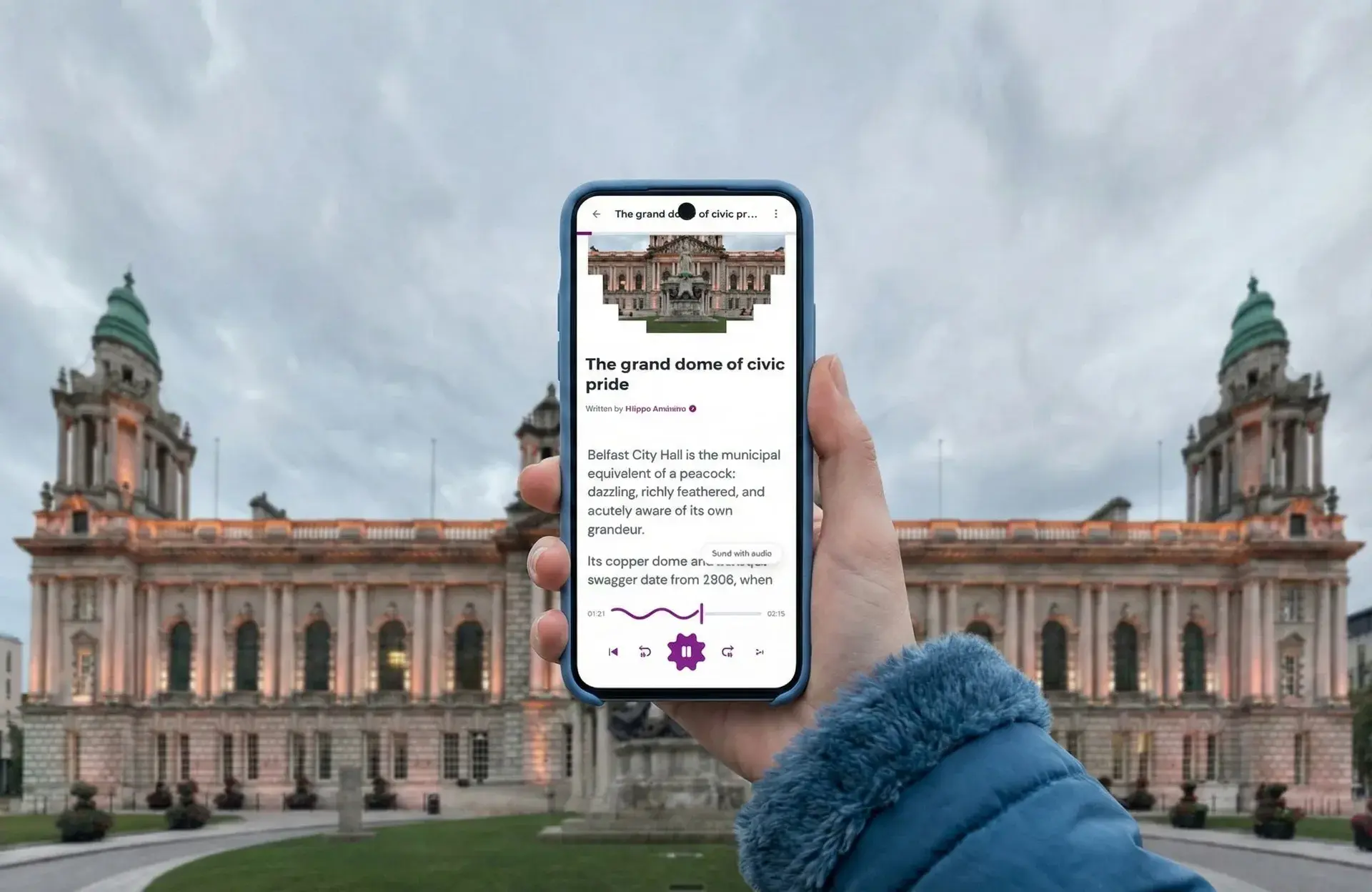
公民自豪感的宏伟穹顶

Belfast City Hall is the municipal equivalent of a peacock: dazzling, richly feathered, and acutely aware of its own grandeur. Its copper dome and baroque swagger date from 1906, when Belfast’s industrial ego finally matched its finances. The city had just been granted 'city' status by Queen Victoria in 1888; this was its architectural mic drop. Rising on the ashes (well, actual textiles) of the old White Linen Hall, City Hall was built by and for a city swollen with shipyards, linen looms, and Victorian ambition. The building itself is a masterpiece of white Portland stone, but if you look up, you will see the distinctive green copper of the dome rising 173 feet above the street. It has hosted as much political theatre as any proper stage. In 1912, Edward Carson stood on these very steps to sign the Ulster Covenant, swearing resistance to Irish Home Rule with a flourish that would shape the next century. In 2012, the building took center stage again as flag protests rang through its gates, showing that civic symbolism in Belfast remains anything but symbolic. Now, it doubles as a tourist magnet and a civic workspace. It is part museum, part parliament, with gilded murals battling photocopiers for aesthetic dominance. The grounds around you feature a well-manicured garden, statues galore, and, supposedly, a lunar-enhanced wish-granting ritual involving circumnavigation and mild public embarrassment. A hidden gem lies inside that green dome you are looking at: a whispering gallery. The acoustics are so precise that two people standing at opposite ends of the dome's interior can conspire, flirt, or criticize public art directly into each other's ears. It is efficient engineering for covert municipal plotting. Built to impress and occasionally to repress, City Hall remains Belfast’s glittering town crier, poised between grandeur and the grit that built it. From the formal corridors of power, we now duck into something older and far less official—Kelly’s Cellars awaits with low ceilings and high stories.

叛军的秘密地窖

Kelly’s Cellars looks like a pub that has been dodging modernity since it was old enough to drink. Established in 1720, it squats on Bank Street with the weary charm of a revolutionary in semi-retirement. It has a low profile, a long memory, and an endurance that puts the modern concrete around it to shame. Once the watering hole of the United Irishmen, this was where radical Presbyterians and restless Catholics whispered about overthrowing the British Crown over pints. Henry Joy McCracken, one of the leading voices of the 1798 Rebellion, allegedly laid low here after the uprising failed, though "laying low" in a public bar suggests either bravado or very good ales. Unlike the fancier establishments with chandeliers or soap, Kelly’s has stayed rooted in its stone-and-beam authenticity. There are no television screens here to distract from your political convictions. If you were to step inside, you would find low beams (mind your head), the smell of peat smoke, and the definite possibility of being seated beside a minor local folk legend. Today, it functions as both a pub and a relic. Locals drink beside stained history buffs, and tourists wonder if the beer is supposed to taste this real. It is also a music venue, offering the kind of traditional Irish sessions that might convince you McCracken walked in with a banjo. A ghost story clings to the place, suggesting McCracken returns for one last pint or to mutter unfinished manifestos into forgotten whiskey dregs. Or perhaps it is just draughty. A bonus curiosity regarding the architecture involves those famous low ceilings. Some romantics claim they were designed to encourage conspiracy whispering, but the reality is likely more practical. In the 1700s, keeping the heat in was far more important than headroom. Revolution may simmer, but heat rises. After that smoky pint of insurrection, step outside and follow the alley walls—some of Belfast's most vivid voices now paint rather than plot in the Cathedral Quarter.

这片区的彩绘墙壁

The Cathedral Quarter didn’t so much evolve as mutate. It is an area once filled with ink-stained printers and whiskey bonders that is now awash in aerosol commentary. These days, you are more likely to spot international street artists than bookbinders. The walls here never learned the phrase “keep it down.” This neighbourhood, anchored by the nearby St. Anne’s Cathedral, turned from post-industrial purgatory into Belfast’s creative cortex thanks to spray cans and stubborn optimism. Post-Troubles, it became a petri dish for a new kind of expression. Unlike the famous "Peace Walls" elsewhere in the city, the street art here is not about sectarian territory or political dogmas. Instead, it is a full-blown soliloquy in pigment that refuses to pick a side. As you walk these streets, you will notice the themes are refreshingly surreal. Instead of paramilitaries or politicians, you are greeted by hyper-realistic portraits, psychedelic animals, and abstract splashes of colour. It is what some call a "third culture," a visual language that transcends the old binary of Green versus Orange. The art shifts regularly, like Belfast’s version of seasonal foliage, with walls painted, overpainted, and repainted as if the entire district is constantly reinventing itself. Local business owners often sponsor the work, making it a rare example of commerce and counter-culture sharing a brick. While some critics argue this gentrification softens the city's edge, historian Feargal Cochrane has noted that this area functions as a "neutral spectacle." It is a space where people of any background can gather without the baggage of history staring down from the gable walls. Still, if you pause, you might just hear the walls whisper back. They speak not of the past, but of a vibrant, slightly chaotic future. One curiosity to note is that many of these striking murals are not permanent. They come, go, and vanish like conversations in the rain. Art here is less object, more moment. So take a good look. Blink and you might miss the masterpiece before it is painted over next week. A few paces onward and upward, the spiritual geometry of Belfast Cathedral brings a shift in both tempo and tone.

希望与石头的尖塔

Belfast Cathedral, or St. Anne’s to its Anglican friends, is the city’s most devout overachiever. Started in 1899 and finally opened in 1904, it is still taking architectural additions like it is on a celestial installment plan. The style is Neo-Romanesque. It is tall, stony, and more serious than a Presbyterian tax audit. Built to replace an older parish church, the cathedral has always held an ambition slightly holier than the local weather. For decades, the nave remained unfinished, which was a kind of holy shrug towards funding issues and political distraction. That changed in 2007 with the arrival of the “Spire of Hope,” a stainless-steel needle puncturing the nave roof and aiming for divine signal reception. During the Troubles, the building hosted memorial services and fragile symbols of civic unity. Neither purely sacred nor purely ceremonial, it has acted as Belfast’s emotional cloister. It absorbs grief, celebration, and periodic architectural envy from less-pointy churches. If you were to step inside, you would find a space that is cool and resonant, with the faint scent of stone and incense hanging in the air like a quiet sermon. Behind those walls, stained-glass windows battle with LED lighting and Gothic arches compete with Instagram filters. There is serious stonework there, but also quiet intimacy. It is a space that might forgive you for your sins if you just quietly sit down. Local legend insists that buried within the foundation is a time capsule from the original builders containing messages, prayers, or perhaps just a note marked "good luck." The Spire itself is 80 meters tall and glows at night like a stainless-steel exclamation mark. Is it unsubtle? Sure. But then, subtlety was never a core tenet of Victorian ecclesiastical architecture. To continue our vertical theme—this time with a pronounced tilt—we make our way to the Albert Memorial Clock.

王子的倾斜塔

The Albert Memorial Clock is Belfast’s most respectable structural flaw. Built in 1869 to honor Queen Victoria’s husband, the tower quickly gained fame as the city’s most literal lean toward royalty. Thanks to soggy wooden foundations, it lists noticeably to one side like a tipsy gentleman leaving the pub he has just passed twelve times a day for a century. Designed in flamboyant French Gothic style by W. J. Barre (because what is a memorial without gargoyles?), the clock was erected near the docks, which were then the city’s bustling financial lung. Sailors met here, traders timed their deals, and presumably street urchins played period-appropriate games involving cholera and hoop sticks. At 34 meters tall, or about 113 feet, the clocktower leans a solid 1.25 meters off-center. That is not quite Pisa, but it is certainly not plumb. Locals have long defended it as having “character,” which is Belfast code for 'it stayed up, didn’t it?' Today, the clock stands largely decorative but remains a handy rendezvous spot. Its recent cleaning efforts scrubbed away decades of soot, possibly to remind people that Prince Albert’s cheeks are, in fact, sculpted and not made of moss. A myth clings to the tower that a wronged fairy cursed it, forcing it to bow eternally in apology. It is a convenient bit of folklore, though perhaps it is just a distraction from the more mundane villainy of swampy soil. The statue of Albert faces the docks as if forever watching ships leave without him. For a man who inspired 19th-century mourning fashion, this leaning Victorian sentinel remains remarkably buoyant. From Victorian leanings to ceramic symbolism, our final stop glistens beside the river—the Big Fish is waiting.

知识的鲑鱼

The Big Fish, officially titled ‘The Salmon of Knowledge,’ is Belfast’s largest ceramic animal and quite possibly its most brilliant multitasker. It is part public art, part time capsule, and part aquatic oracle. Installed in 1999, the ten-meter beast stares blankly at the River Lagan as if waiting for something better to swim by. Created by artist John Kindness (his real name, improbably), each of the salmon’s shiny blue-and-white scales tells a slice of Belfast’s history. You will find images ranging from shipbuilding to sectarian struggle to sugar processing, because even dystopia needs dessert. Portraits, clippings, and nuggets of trivia are plastered across its glazed skin. It provides a tactile Wikipedia for cold hands and curious minds. Commissioned as part of the Laganside redevelopment, the Fish arrived right as Belfast was rebranding itself. It marked the shift from a barricaded no-go zone to a cheerful waterfront destination. Strategically placed near the river, which was itself a former industrial artery, it became a symbol of civic optimism with scales. Local lore insists that kissing the Big Fish imparts wisdom, preferably from the correct ceramic tile. This is risky in flu season but appealing to those who think urban planning could use a sprinkle of Celtic legend. Tiled, massive, and cooler than a bronze statue of a long-dead official, the Big Fish swiftly became Belfast’s second-favorite selfie partner, though City Hall likely holds the crown. It is also popular with children who climb it illicitly and adults who pretend not to encourage them. Forget statues of generals. Belfast gave its post-conflict hope a fish. Which is, quite frankly, both absurd and rather perfect. Each city has its own way of telling a story. Belfast tells its tale in sandstone and soot, in chorused whispers over drinks, in extravagant domes and leaning towers, in spray paint and ceramic scales. As we end this journey beside the River Lagan, where a surreal fish guards both memory and myth, it’s clear that this city prefers its symbolism a touch slippery. What emerges from these stops is not just a set of buildings or anecdotes, but a portrait—part stubborn, part soaring, entirely Belfast. Here is a city that doesn't hide its complexities, but lets them molt into murals and monuments, pubs and pews. Thank you for walking through its contradictions with us. May your next visit be equally curious, and may the fish—if you were bold enough to kiss it—have shared a story or two in return.

你的私人导游,就在口袋里

这些地方,准备好去走一趟了吗?

  • 自助导览,现在出发或改天再走
  • 离线音频,7 种语言
  • 30 天内不满意可退款
  • 含 500MB 全球 eSIM 流量

€5.00

Belfast的 1 条自助导览

查看全部导览

规划行程

Belfast要待几天?1天完美行程

第1天

船厂与音乐交织的海港之城

借助贝尔法斯特的导览路线,将精巧的市中心与海港区串联起来,沿途不妨留出些时间应对起伏的地形、多变的天气,或是随性拐进街巷来场小探险。

天气与人流

最佳旅行时间

春夏两季(4月至8月)气候温和,还会迎来贝尔法斯特多元文化节等盛事,不过此时游人最多、房价也水涨船高。秋季天高气爽、游人较少;冬季虽阴冷潮湿,市政厅前的欧式圣诞集市却别有温暖滋味。

推荐

春季

3月–5月

3–16°C/ 37–61°F

游客渐多偶有降雨
  • 凉爽时节
  • 阵雨难测

不容错过

  • 圣帕特里克节游行

夏季

6月–8月

10–20°C/ 50–68°F

旅游旺季偶有降雨
  • 温暖时节
  • 游人如织
  • 住宿价格上涨

不容错过

  • 贝尔法斯特多元文化节

秋季

9月–10月

6–18°C/ 43–64°F

人多拥挤多雨
  • 贝尔法斯特半程马拉松
  • 白昼渐短
  • 暮色早临

不容错过

  • 贝尔法斯特城市半程马拉松

冬季

11月–2月

2–11°C/ 36–52°F

游客较少多雨
  • 圣诞集市
  • 气温寒冷
  • 细雨连绵

不容错过

  • 贝尔法斯特欧式圣诞集市

交通

Belfast到达与交通

贝尔法斯特城市机场

Belfast到达与交通
Translink Metro 600路公交10分钟£2.30

贝尔法斯特国际机场

Belfast到达与交通
Translink 300路公交40分钟£9.00

斯特纳客轮码头

Belfast到达与交通
Translink 96路公交15分钟£2.40

步行

地势平坦且小巧

贝尔法斯特市中心地势平坦且格局紧凑,市政厅和教堂区等核心景点相距均在1公里以内。在较窄的人行道上步行时,请留意身旁的骑行者和公交专用道。

Translink Metro与Glider快线

线路覆盖广泛

班次频繁的Metro公交与Glider快速公交贯通全城。使用无接触支付单程票价为2.30英镑。售价7英镑的一日游客通票唯有在单日乘车超过3次时才算划算。

Translink北爱尔兰铁路

市区铁路线路有限

该铁路线呈东西走向,连接兰扬广场与沿海小镇、都柏林,以及通往城市机场的西德纳姆站。对于市中心观光而言,其覆盖范围相对有限。

出租车与网约车

夜间出行便利

计价黑出租车与Uber在贝尔法斯特随处可见。深夜跨城出行尤为方便,市中心内的短途车费通常在3至5英镑之间。

紧凑的市中心完全可以靠双脚丈量,前往远一点的景点则可搭乘Translink Metro或Glider公交。使用无接触支付每日车费设有约4英镑的封顶上限,深夜出行则有出租车补位。

预算

游览Belfast需要多少钱?

贝尔法斯特的物价与英国整体平均水平持平。超市生活必需品和平价咖啡馆小点的消费相当亲民,旅行预算的大头主要花在住宿、正餐餐厅以及收费景点上。

游览Belfast需要多少钱?
咖啡£4.00–£4.50
烘焙点心£3.90–£4.95
牛奶(1升)£0.80
面包(800克一条)£1.75
瓶装水(500毫升)£0.50–£1.00

Cash or card?

带有无接触感应或芯片密码的信用卡和借记卡在这里几乎处处通行。日常极少需要英镑现金,不过备上几枚硬币或零钱纸币,用来付小费或在独立小摊消费会更加从容。

住宿

Belfast住宿区域

市中心

初访首选

以多尼戈尔广场为核心,博物馆、商铺和交通枢纽齐聚于此。出行极其便利,不过盛夏时节游人如潮,房价达至顶峰,周末夜晚也难免有些嘈杂喧嚣。

教堂区

夜生活与美食

铺满历史感鹅卵石的街区,老牌酒馆、现场音乐圣地和画廊密布。沉浸体验文化与饕餮的不二之选,但周末夜晚街头的欢腾声往往会持续到深夜。

女王区

高性价比住宿与咖啡馆

位于贝尔法斯特南部,环抱贝尔法斯特女王大学与植物园。绿树成荫,悠闲自在,消费更加亲民,不过周末大学生聚会社交时气氛会格外热烈。

泰坦尼克区

现代滨水住宿

经过重新开发的船坞区,坐落着泰坦尼克贝尔法斯特博物馆与SSE巨蛋体育馆。环境安宁,交通便利,十分适合家庭出游,不过餐饮选择较少,离老城区的那些风味酒馆也有一段距离。

导览

一步一故事,探索Belfast

刮刮乐

来刮一刮

涂层下面也许藏着好东西。中奖的话,我们会告诉你怎么用。

每位旅行者限一份奖品,有效期 2 年。

口碑

旅行者评价

安全

Belfast安全吗?

贝尔法斯特对游客而言总体非常安全,市中心的犯罪率甚至低于英国全国平均水平。多尼戈尔坊和维多利亚广场等核心区域照明充足且巡逻频繁,不过夜间出行依然建议保持常规的城市安全防范意识。

市中心核心区域

多尼戈尔坊、维多利亚广场及周边街巷人流熙攘且巡警密集。在夜生活喧嚣拥挤的场所,保持基本的防范即可。

香基尔路与福尔斯路

白天前往这些街区参观和平墙与历史壁画十分安全,但鉴于残留的历史紧张情绪,入夜后请避免在此随意游荡。

球衣与阵营色彩

在公共混合区域,尤其是本地比赛日期间,切忌穿着带有敌对色彩的球队球衣(例如流浪者队或凯尔特人队)或具有宗派暗示的特定颜色服饰。

教堂区人流

周五和周六深夜,人头攒动的酒馆街区偶有小偷趁乱下手。贵重物品请贴身放于前兜,深夜返程建议搭乘正规执照出租车。

实用信息

实用提示

酒馆营业时间

传统酒馆通常在晚间11点打烊,但北爱尔兰的牌照法规允许店家在每年最多104个指定夜晚营业至凌晨2点,节庆期间尤为常见。

本地纸币

北爱尔兰通用英镑,但有四家本地银行获准发行自己的钞票。这些纸币在北爱尔兰全境均为法定货币,但在大不列颠岛(英格兰、苏格兰及威尔士)的商户中可能会被拒收。

与爱尔兰共和国边境

穿越南爱尔兰(爱尔兰共和国)与北爱尔兰的陆路边境时没有例行的护照检查,但非英国或非爱尔兰籍游客仍必须持有有效的英国旅行许可。

问题

Belfast常见问题

不征收。北爱尔兰不收取任何城市税或游客住宿税,因此住宿费用中不含额外的本地旅游附加费。

准备出发?

遍布Belfast的自助语音路线。

查看Belfast的路线