Sinagoga di Pitigliano: Little Jerusalem in Tuff
Dieser Inhalt ist noch nicht auf Deutsch verfügbar. Wir zeigen die englische Version.
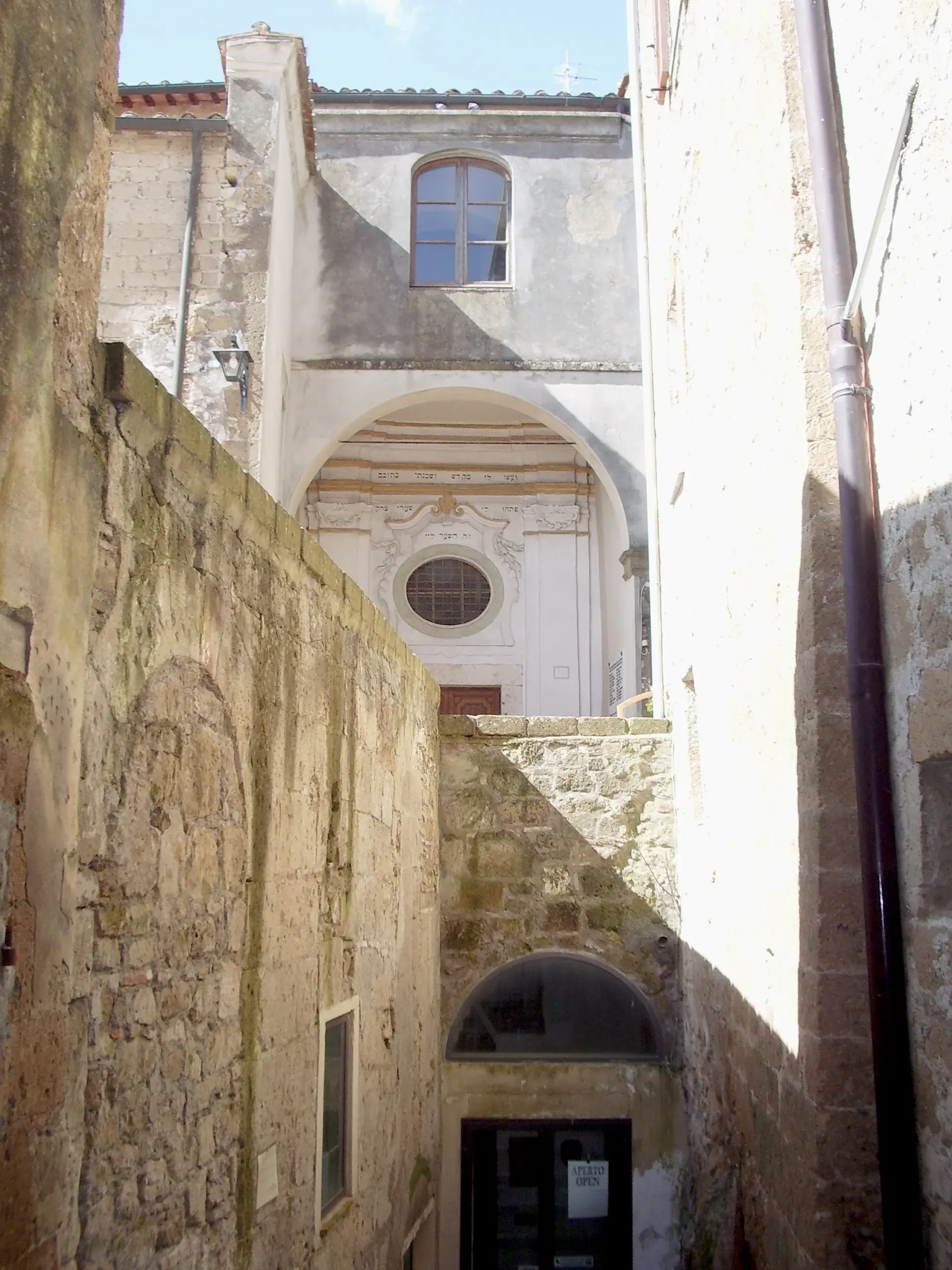
Perched on the edge of a volcanic tuff promontory in southern Tuscany, the Sinagoga di Pitigliano stands as the historic centerpiece of the town's former Jewish quarter. Located along Via Zuccarelli and Vicolo Marghera, the synagogue and its associated buildings represent centuries of Jewish settlement, an enduring legacy that earned Pitigliano its historic nickname, La Piccola Gerusalemme ("Little Jerusalem").
Refuge and the Establishment of the Ghetto
During the mid-to-late 16th century, Jewish families fled the Papal States following restrictive counter-reformation decrees, including Pope Paul IV's 1555 bull Cum nimis absurdum. The independent Counts of Orsini offered refuge in Pitigliano to stimulate the local economy. The Orsini granted land for a Jewish cemetery in 1556 and authorized the construction of a synagogue, which was completed in 1598 with funding from community members such as Leone di Sabato.
In 1608, the Grand Duchy of Tuscany annexed the territory under the Medici family. By October 1622, the Medici administration established a walled ghetto around Via Zuccarelli, enforcing curfews and identification badges. This transition gave rise to a local culinary emblem: lo sfratto ("the eviction"). Jewish bakers created this honey-and-walnut pastry in the shape of a baton to mimic the wooden rods used by grand ducal bailiffs to rap on doors when delivering eviction notices for the ghetto.
The Subterranean Tuff Network
Beneath the prayer hall and surrounding street lies a communal infrastructure carved directly into the soft volcanic tuff rock, repurposing ancient Etruscan-era excavated caves. These cool, subterranean chambers feature rough, pick-marked stone walls that contrast sharply with the airy, white-plastered prayer room above.
This underground network allowed the community to observe religious laws and maintain daily traditions within a confined space. The excavated complex preserves a mikveh (ritual bath), a forno delle azzime (an oven dedicated to baking unleavened Passover bread), a kosher butchery, a kosher wine cellar, and a textile dye workshop.
Flourishing, Decline, and Reconstruction
Restrictions eased significantly in the 18th and 19th centuries under the House of Habsburg-Lorraine. The Jewish community integrated into local civic life, growing to represent between 12 and 20 percent of Pitigliano's population. Inscriptions preserved on the synagogue's interior walls document official visits by Grand Duke Ferdinand III in 1823 and Grand Duke Leopold II in 1829.
Emigration toward larger industrial centers reduced the congregation in the late 19th and early 20th centuries. During World War II, local Catholic neighbors shielded Jewish residents by hiding them in the surrounding countryside and caves. After the war, only a few individuals returned, and regular religious services ceased around 1960. The historic 18th-century gilded wooden Holy Ark (Aron ha-Kodesh) was eventually relocated to a synagogue in Carmiel, Israel.
Following a landslide-induced collapse in the 1960s, the municipal government undertook a full restoration with the support of the European Union. The reconstructed synagogue, featuring a reproduction of the original Ark, was rededicated in 1995.
Modern Museum and Cultural Life
Today, the site operates as the Museo Ebraico - La Piccola Gerusalemme, managed by the local Associazione La Piccola Gerusalemme. The museum is open daily to the public, with closures on Saturdays and Jewish religious holidays. Male visitors are provided a kippah to wear upon entry.
Although Pitigliano no longer retains a permanent minyan, the synagogue remains a consecrated house of worship. It continues to host holiday services, destination weddings, and Bar Mitzvahs for visiting Jewish communities from Italy and abroad.
FAQ
Why is Pitigliano known as Little Jerusalem?
Pitigliano earned the moniker 'La Piccola Gerusalemme' because of the size, civic integration, and cultural vitality of its Jewish community, which flourished from the 16th to the 19th centuries and comprised up to 20 percent of the town's population.
What is located beneath the Sinagoga di Pitigliano?
Beneath the synagogue is an underground complex carved directly into volcanic tuff rock. It contains historical communal facilities including a mikveh (ritual bath), a Passover matzah oven, a kosher butchery, a kosher wine cellar, and a dye workshop.
What is the historical origin of the local sweet 'lo sfratto'?
Lo sfratto ('the eviction') is a traditional pastry created by Jewish bakers in 1622. Shaped like a cylinder, it mimics the wooden batons used by Medici bailiffs to knock on doors when serving eviction notices for the newly established ghetto.
Can the public visit the synagogue today?
Yes. The complex functions as the Jewish Museum of Pitigliano and offers visits to the prayer hall and excavated underground rooms daily, except on Saturdays and Jewish holidays.