Montréal

Tipps und Touren für Entdecker und Reisende

City-Guide für Montréal

Montreal verbindet nordamerikanische Energie mit französischer Sprache und europäischem Flair. Das Zentrum ist durch ein 33 km langes unterirdisches Wegenetz und eine schnelle U-Bahn mit 68 Stationen nahtlos verbunden, sodass du die Stadt zu jeder Jahreszeit bequem erkunden kannst.

Land
Kanada
Sprache
Französisch und Englisch
Währung
Kanadischer Dollar (CAD)
Stecker
Typ A/B
Zeitzone
America/Toronto
Notruf
911
Leitungswasser
Trinkbar
Vorwahl
+1

Die Stopps

Sehenswürdigkeiten in Montréal

Schlendere durch das Kopfsteinpflaster von Vieux-Montréal, wo jahrhundertealte Architektur auf moderne Boutiquen trifft. Spaziere am malerischen Alten Hafen entlang, tauche im Pointe-à-Callière in die nordamerikanische Geschichte ein und bestaune das beeindruckende Innere der Basilika Notre-Dame.

Geschichte unter Glas (und einer Berliner Mauer)

Montréal is less a city and more a palimpsest—layers upon layers of ambition, reinvention, and dual nostalgia. Its streets don’t just connect addresses; they braid time periods, hold dialects in transit, and carry the subtle scent of espresso or ice melt, depending on the season. This is a city that built itself on the fur trade and now trades in data, ideas, and a distinct sense of style. Somewhere between the cobblestones of Old Montréal and the sleek glass of the downtown core lies a key to understanding its rhythms: it rarely replaces the past—it absorbs it. Our starting point embraces that ethos in architectural form. The World Trade Centre Montreal isn’t merely a building; it’s a curated collision of centuries, mid-stride. Imagine commerce with a conscience, or at least a decent memory. As you prepare to wander through the arteries of this metropolis—part museum, part market, part stage—keep an eye on the seams. Montréal doesn’t hide its past. It frames it, under glass, ideally with a coffee bar nearby. Beneath its polished glass canopy and politely echoing atrium, the World Trade Centre Montreal does something few commercial buildings dare: it shows its seams. Rather than erase its 19th-century bones, this 1992 project stitched several heritage buildings together, like a Franken-palazzo with a corporate mission statement. The result: a suave hybrid of sandstone facades and Italianate arches, all under one smugly symmetrical roof. Credit for this architectural resurrection goes to Faucher Aubertin Brodeur Gauthier, who treated history not like wallpaper to be stripped, but bricks to be reanimated. Today, white-collar denizens briskly pace through boutiques and cafés en route from Place Victoria to Old Montréal, oblivious to the fact that they’re crossing through time zones as much as city blocks. A historical curiosity lingers in the foundations—literally: a chunk of Montréal’s original city wall is encased in glass, as if the building swallowed one of its ancestors and politely left a window. Even more out of left field is the Berlin Wall segment sitting rather idly in the atrium. Former Cold War barrier, now flanked by Sephora and espresso. The locals call this place a magical shortcut—legend has it you can cross half the neighborhood without weather or traffic ever laying a finger on you. That’s only a slight exaggeration. You can’t, unfortunately, dodge awkward corporate mixers. The most distinct sensory note? The clack of shoes on polished stone reverberating under a glass ceiling, periodically interrupted by the hiss of a latte machine. In essence, the World Trade Centre Montreal is historical cosplay done with restraint. It’s not pretending to be old—it just refuses to forget it ever was. From here, wander toward Rue Saint-Paul, where the city trades its glass ceiling for something distinctly older—and just as performative.
Der Laufsteg von 1672

Rue Saint-Paul is the sort of street that looks like it was designed for Instagram centuries before the app existed. Laid out in 1672, it was Montréal’s main commercial artery back when goods were moved by ox and ambition. Once home to fur traders, blacksmiths, and the odd priest with a bad temper, the street has slipped into something a little more linen-blend: galleries, wine bars, and souvenir shops catering to tourists seeking authenticity with air conditioning. Underneath the cobblestones—uneven enough to sprain your ankle and your sense of direction—lies the hard-packed residue of a city forever rebuilding itself. Fires repeatedly razed the wooden originals, persuading owners to opt for stone, which held up better against both flames and merchants with inflated invoices. By the time it was commercially humming in the 18th century, nearly every important boot heel had crossed it—from Charles Le Moyne to Marguerite Bourgeoys. Current myth suggests that at least one ghostly shopkeeper still haunts this historic promenade, endlessly pacing in search of a lost ledger—or perhaps just trying to remember if his eggs were organic. One odd fact: it was originally named Rue Notre-Dame, until 1801, when it switched to honor Paul de Chomedey de Maisonneuve. Like many renamings, it likely caused more confusion than joy. Today, it’s a beautiful cliché: couples stroll hand in hand, painters sip espresso while pretending to think, and school groups eagerly learn that people used to live without Wi-Fi. Locals generally avoid it unless bribed with good duck confit. Rue Saint-Paul doesn’t whisper the past—it hands you a business card in calligraphy and invites you to dinner. Next, descend even deeper into the city’s origin story at Pointe-à-Callière, where history refuses to stay buried.

Der Geburtsort auf dem Rasen

<p>To walk to Pointe-à-Callière is to stand, literally, on Montréal’s buried beginnings. Perched where two rivers once met like gossiping neighbors, this site marks the city’s 1642 birth, chosen by Paul de Chomedey de Maisonneuve and Jeanne Mance for their little missionary adventure-turned-metropolis.</p> <p>Today, the museum looms confidently above ground, all modern angles and cultural swagger, standing guard over the city's most important patch of grass. You don't need a ticket to be on holy ground; you're already standing on it. The building's architecture is a bold statement: it refuses to let you forget what's underneath.</p> <p>This was also the symbolic site of the 1701 Great Peace of Montreal, a diplomatic triumph involving the French and dozens of Indigenous nations. Imagine the logistics, right here: a peace treaty with subtitles in Mohawk, Ojibwe, and French. Add to that a persistent local tale: on summer days, heat ripples are said to reveal the spirits of settlers and Indigenous leaders still convening at the point. Sounds improbable. But then again, never underestimate Montréal’s flair for the dramatic.</p> <p>Pointe-à-Callière doesn’t just show you history; it makes you stand on its lawn. It’s the literal foundation of the city, hiding in plain sight. Having stood on Montréal’s beginnings, it’s time to look up, to one of its grandest gestures skyward at the Notre-Dame Basilica.</p>

Die verführerische Fassade

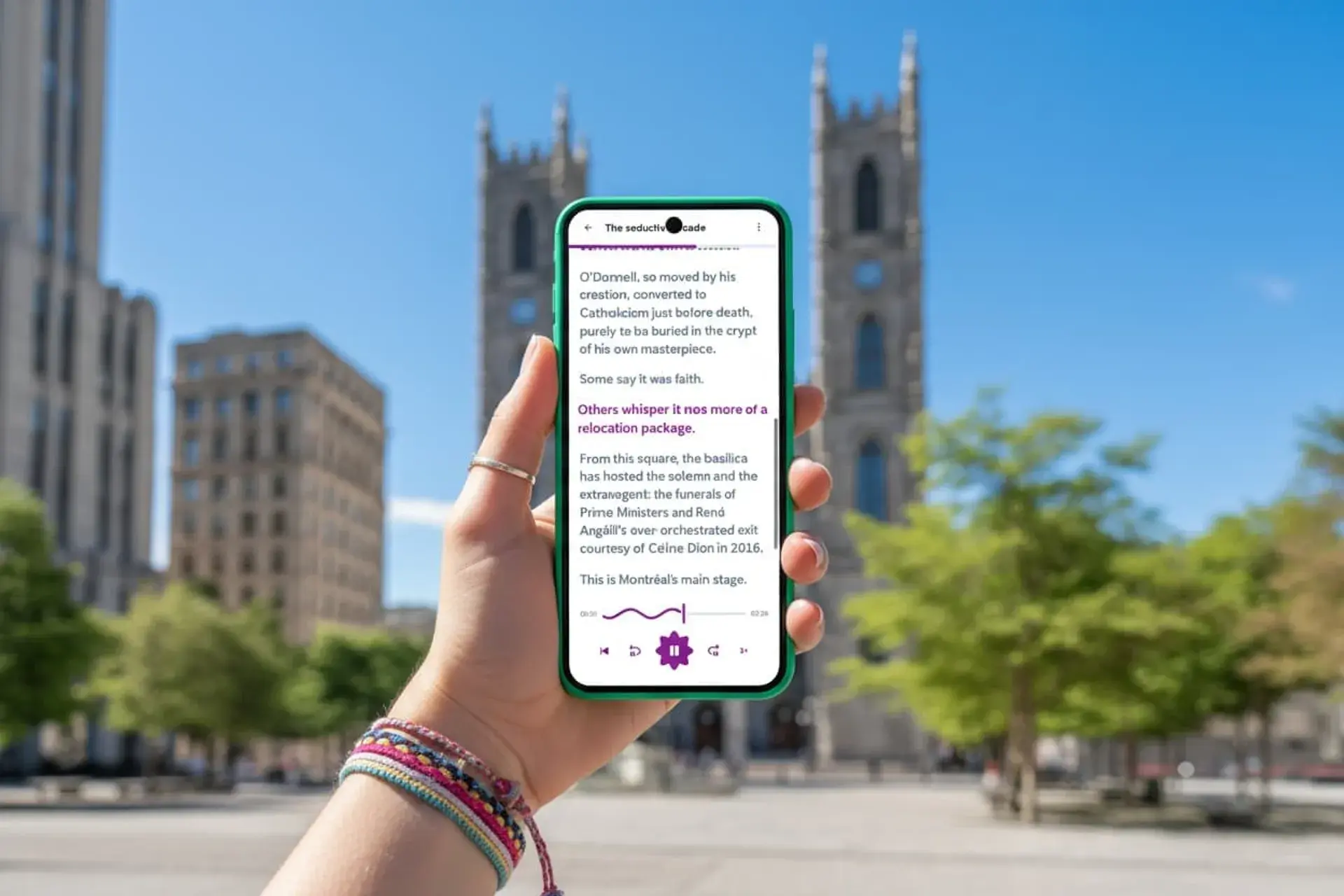
<p>Notre-Dame Basilica has never been accused of subtlety. Forget austere pews: this 1829 Neo-Gothic colossus went full theatrical before you even step inside. This is a church that demands you stare. Montréal, suddenly rich and ambitious, decided its main church should look like it could moonlight as the Vatican’s flashy cousin, and it built this monument on the Place d'Armes to prove it.</p> <p>Built over the ruins of a humbler 17th-century church, the current structure was conceived by an Irish-American Protestant, James O'Donnell. The facade you're looking at is apparently so persuasive that it converted its own architect. O'Donnell, so moved by his creation, converted to Catholicism just before death, purely to be buried in the crypt of his own masterpiece. Some say it was faith. Others whisper it was more of a relocation package.</p> <p>From this square, the basilica has hosted the solemn and the extravagant: the funerals of Prime Ministers and René Angélil’s over-orchestrated exit courtesy of Céline Dion in 2016. This is Montréal's main stage.</p> <p>Grand, glorious, and mildly self-important, you don't need to see the famous blue ceiling to get the point. Notre-Dame is where Montréal's spiritual history embraced spectacle. It never looked back. After all that grandeur, let’s change pace with a meal where the past lingers in both the recipes and the rafters. L'Auberge Saint-Gabriel awaits.</p>

Abendessen mit Geistern (und Foie Gras)

L’Auberge Saint-Gabriel wears its age like a badge and a tailored waistcoat. Founded in 1688 by Étienne Truteau (yes, from a lineage destined for front pages), it claims to be the oldest inn in North America. Whether or not that’s technically true, it has certainly outlived enough empires, governments, and fashion cycles to scare away complaint. Initially a boisterous public house catering to soldiers, fur traders, and other wandering archetypes, it eventually witnessed the polite chaos of the British takeover. One imagines ale-fueled negotiations punctuated by bad accents and worse intentions. Today, the walls—an uneven patchwork of stone and time—hold court over an upscale restaurant. Diners enjoy foie gras where muddy voyageurs once threw up in corners. Each room has a vibe: rustic chic with a whiff of ghost story. Speaking of which, legend says a mischievous young girl who perished in a fire haunts the place. She apparently whispers in shadowy corners and occasionally moves furniture. None of this appears on Yelp. The aroma is layered: wood smoke, candle wax, and sauces too complex to describe without a culinary degree. If ghosts exist, they’re probably jealous of the charcuterie. Down in the cellar, 17th-century stonework peeks through, like history sticking out its elbow in case you forgot it was here first. L’Auberge doesn’t just serve meals—it marinates them in centuries. It eats irony for breakfast and probably serves it with truffle oil. With appetites sated and ancestry respected, the path opens into Place Jacques-Cartier—a plaza built for performative charm and civic chaos.

Die Bühnendekoration und der britische Admiral

Place Jacques-Cartier is Montréal’s version of town square meets stage set. Born in 1804 from the ashes of Château de Vaudreuil’s garden, it quickly became the city’s social megaphone. Here, butcher met banker, soldiers clashed horns with poets, and the smell of bread often battled horse droppings for atmospheric dominance. Today the square teems with selfie sticks, saxophonists on summer sabbatical, and artists hawking watercolors of a city glittering in theoretical sunlight. Café terraces edge the plaza like spectators at a civic parade that never ends. Its centerpiece is the painfully British Admiral Nelson, stern atop Canada’s oldest public column (1809). It rises out of a French-speaking metropolis like a Union Jack at a Quebec sovereignty rally. Locals tolerate its presence with the same fond indifference reserved for stubborn relatives. A misty legend claims that during early morning fog, you can hear the clatter of carts and chatter of merchants from centuries past. More likely, it’s delayed audio from a street performer warming up. A fountain embedded beneath Nelson once quenched the thirst of 19th-century marketgoers—and apparently still works, if you know which bureaucrat to bribe. Place Jacques-Cartier isn’t subtle. It wants to be seen, sketched, performed in front of. And it doesn’t mind wearing its contradictions on its cobblestones. A few cobbles away stands Château Ramezay, where diplomacy once flirted with rebellion over creaky floorboards.

Das Haus, das Ben Franklin ablehnte

<p>Château Ramezay introduces itself like an elderly aristocrat: impeccably dressed, faintly aloof, but full of dramatic stories if you're polite enough to ask. Built in 1705 by Claude de Ramezay (governor and host), it was a showpiece of colonial opulence from the moment the last stone was set. This was the governor's mansion, at least until the British decided they'd like it better under new management.</p> <p>But its real "secret" story? This building was briefly commandeered by the Americans during the Revolution in 1775. Yes, that Benjamin Franklin. He camped out right here, probably staring at these same walls, trying to charm Canadiens into secession. It didn’t work. The locals, it seems, were more interested in not freezing.</p> <p>There’s also a rumor that the Ramezay family buried treasure on-site to keep it out of British hands. It’s never been found. This means it either doesn’t exist or was especially well hidden, perhaps in that prim, geometric garden right next to us.</p> <p>Today, the building is a time capsule museum, but the best stories are right here on the sidewalk. This isn’t just Montréal’s flashiest old house; it’s the house that taught the city how to posture, and to politely show a revolutionary the door. Crossing over to Marché Bonsecours, you’ll find the echoes of commerce amplified beneath an ambitious dome.</p>

Die silberne Kuppel-Flex

Marché Bonsecours doesn’t suffer from modesty. When it opened in 1847, it was meant to be the city’s grandeur incarnate—a neoclassical flex so expensive it nearly bankrupted the city. Think 300,000 pounds of civic pride stacked into a silver-domed shopping hall. It doubled as Parliament between 1849–1852, hosted grand balls, and housed enough vendors to feed a city and fuel several political uprisings. Basically, if something major happened in 19th-century Montréal, odds are it passed through here, probably late and over budget. Its architects, William Footner and George Browne, gave it enough frosting to impress Europe's elite. The dome, visible from nearly any angle in Old Montréal, was supposed to have a more elaborate cupola—plans that were quietly abandoned when the bills arrived. Today, it sells artisanal maple syrup in sleek tins, high-end Québec design, and the idea of history as tasteful commerce. But don’t be fooled—the bones underneath those boutiques once echoed with fishmongers, gossip, and cold political ambition. Locals joke about the ghost of a disgruntled fish vendor who grumbles in French when the gift-shop prices get out of hand. He may have a point. Bonsecours is where legislative dreams and market haggling once rubbed elbows. Now, it just asks you to admire the dome—and maybe buy a scented candle while you're at it. From neoclassical flair to nautical precision, let’s make our way toward the river’s edge and the ever-punctual Clock Tower Pier.

Big Bens Art-Déco-Cousin

The Clock Tower Pier is Montréal’s modest attempt at nautical timekeeping grandeur. Built between 1919–1922 to honor sailors lost in WWI, it sneaks its memorial function into a whitewashed Art Deco exclamation point. It also doubles as one heck of a lookout. Back in its working port days, this pier throbbed with cargo, semaphore, and the non-stop cursing of dockworkers. It welcomed ocean-going ships straight from Europe, thanks to the accommodating ego of the St. Lawrence River. Today, the pier is more beach towel than bulkhead. Locals stretch out on imported sand, climb the Clock Tower’s 192 steps for Instagram karma, or flirt under its shadow. The clock mechanism was engineered by the same minds that gave Big Ben its timeliness—though here, the vibe is more flirtatious ferry ride than empire. Some say that when the fog creeps in just right, you can hear ghost ships ring their bells—that or someone’s Bluetooth speaker buffering. What most visitors miss: this dock once hosted a full-fledged rail line, seamlessly sucking freight from ship to train. Today, it hosts food trucks and weekend joggers. Montréal recycled its industrial muscles into a maritime playground. The Clock Tower stands like a veteran who swapped the uniform for linen pants—and kept the perfectly punctual watch. Round off your waterside journey at the Vieux-Port de Montréal, where cargo once ruled and leisure now lounges.

Dein persönlicher Guide, immer dabei

Lust, diese Orte zu Fuß zu entdecken?

  • Selbstgeführt, wann du willst
  • Offline-Audio, 7 Sprachen
  • 30 Tage Geld-zurück-Garantie
  • 500 MB eSIM inklusive

ab

5,00 €

1 selbstgeführte Tour in Montréal

Touren ansehen

Wetter & Andrang

Beste Reisezeit

Juni bis August locken mit pulsierendem Straßenleben und Festivals, aber teuren Hotels. September und Oktober bieten klare Luft, bunte Herbstwälder und perfektes Spazierwetter. Von Dezember bis März herrscht klirrender Frost – ideal für Igloofest und Wintersport, doch echte Arktisausrüstung ist Pflicht.

Empfohlen

Tiefster Winter

Dez–Mär

-13–2°C/ 8–36°F

Wenig losNass
  • Igloofest-Schneerave
  • Zuflucht Untergrundstadt
  • Klirrender Frost
  • Kurze Tageslichtphasen

Nicht verpassen

  • Igloofest

  • Montréal en Lumière

Frühlingserwachen

Apr–Mai

1–19°C/ 34–67°F

Wird vollerNass
  • Straßencafés öffnen
  • Ahornsirup-Saison
  • Schneematsch auf den Wegen
  • Unberechenbarer Frühlingsregen

Nicht verpassen

  • Festival TransAmériques

Festival-Hochsommer

Jun–Aug

14–27°C/ 57–80°F

HauptsaisonNass
  • Fußgängerzonen
  • Weltklasse-Festivals
  • Hohe Luftfeuchtigkeit
  • Hotelpreise auf Höchststand

Nicht verpassen

  • Festival Int. de Jazz

  • Juste pour rire

Herbstlaub

Sep–Nov

-2–21°C/ 29–70°F

Wird vollerNass
  • Herbstfärbung in Stadtparks
  • Frisches Spazierwetter
  • Frischer Spätherbstwind
  • Rasch schwindendes Tageslicht

Nicht verpassen

  • POP Montréal

  • Montréal Bach Festival

Verkehr

Anreise & Verkehr in Montréal

Flughafen YUL

Anreise & Verkehr in Montréal
Expressbus Linie 747 (STM)45–70 Min.11,25 CA$
Offizieller Taxistand20–35 Min.49,45 CA$
Fahrdienst-App25–40 Min.~35,00 CA$

Métro und STM-Bus

Schnelle U-Bahn

Vier gummibereifte Linien bedienen 68 Stationen. Einzelfahrten kosten 3,75 CAD, der 3-Tages-Pass für Zone A 21,75 CAD. Kontaktlos am Drehkreuz einchecken. Umstiege zwischen Bus und Métro inklusive.

BIXI-Fahrradverleih

Leihrad im Sommer

Aktiv von April bis November. Eine Einzelfahrt kostet 1,60 CAD Freischaltgebühr plus 0,21 CAD pro Minute. Pro Rad wird eine Kreditkartenkaution von 100 CAD fällig.

Zu Fuß und RÉSO-Netzwerk

Stadtzentrum zu Fuß

Die Zentren sind kompakt und fußgängerfreundlich. Im Winter weichst du auf das 33 km lange unterirdische Wegenetz RÉSO aus, das Métro-Stationen, Bürotürme und Einkaufszentren nahtlos verbindet.

Mietwagen

Auto lieber meiden

Dichter Verkehr, teure Parkplätze, striktes Rechtsabbiegeverbot bei Rot auf der Montreal-Insel und winterliche Parkverbote zur Schneeräumung machen Autofahren für Besucher unattraktiv.

Öffentliche Verkehrsmittel (STM), Fußwege und BIXI-Leihräder sind ideal. Meide das Auto im Zentrum wegen Staus, teurer Parkplätze und strenger Insel-Verkehrsregeln.

Budget

Was kostet eine Reise nach Montréal?

Montreal bietet im Vergleich zu anderen nordamerikanischen Metropolen ein exzellentes Preis-Leistungs-Verhältnis bei Kultur und Kulinarik. Das meiste Geld fließt in Essen und Unterkunft, wobei übliche 15 bis 20 % Trinkgeld und kombinierte 14,975 % Steuern die Endabrechnung im Restaurant spürbar nach oben treiben.

Was kostet eine Reise nach Montréal?
Espresso / Kaffeespezialität~3,50 CA$–~5,50 CA$
Poutine (Klassiker)~9,50 CA$–~16,00 CA$
Pint lokales Craft-Bier (ca. 0,6 l)~7,50 CA$–~11,50 CA$
Einzelfahrt Nahverkehr (Zone A)3,75 CA$
Taxi-Grundgebühr4,10 CA$–4,70 CA$
Günstiges Mittagsmenü~15,00 CA$–~25,00 CA$
Sandwich aus dem Supermarkt~6,50 CA$–~11,00 CA$

Cash or card?

Kartenzahlung geht kontaktlos fast überall, nur Chinatown nutzt teils noch Bargeld. Geldautomaten kosten 3–6 CAD Gebühr. Terminals berechnen Trinkgeld standardmäßig auf den Betrag inklusive Steuern; tippe es lieber manuell auf den Nettobetrag ein, um nicht draufzuzahlen.

Übernachten

Übernachten in Montréal

Vieux-Montréal

Erstbesuch, Historie, Charme

Kopfsteinpflastergassen und historische Architektur nahe dem Alten Hafen. Hohe Hotelpreise und touristische Lokale; spätabends deutlich ruhiger als die Ausgehviertel.

Le Plateau-Mont-Royal

Flair, Gastronomie, Boutiquen

Wendeltreppen, grüne Straßen, lebhafte BYOB-Lokale und charmante Gästehäuser. Exzellente Busanbindung; kaum große Hotelketten.

Centre-Ville

Knotenpunkt, Luxus, Shopping

Wolkenkratzerviertel mit großen Hotelketten, direktem Zugang zur Untergrundstadt RÉSO und Shopping auf der Rue Sainte-Catherine. Äußerst praktisch, aber ohne historischen Wohnviertel-Charme.

Mile End

Indie-Szene, Kunst, Foodies

Trendviertel, bekannt für rund um die Uhr geöffnete Bagel-Bäckereien, Cafés und unabhängige Boutiquen. Perfekt zu Fuß erkundbar, zur Métro-Hauptlinie braucht man allerdings eine kurze Busfahrt.

Griffintown und Sud-Ouest

Chic & Spaziergänge am Kanal

Neu belebtes Industrieareal am Lachine-Kanal mit modernen Apartmenthotels und gehobener Gastronomie entlang der Rue Notre-Dame. Etwas weiterer Fußweg zu den Métro-Stationen.

Die Touren

Montréal, Geschichte für Geschichte

Rubbeln und gewinnen

Rubbel los

Da unten könnte etwas Gutes warten. Wenn du gewinnst, zeigen wir dir, wie du es einlöst.

Ein Gewinn pro Reisenden. 2 Jahre gültig.

Weiterempfohlen

Was Reisende sagen

Sicherheit

Ist Montréal sicher?

Montreal zählt zu den sichersten Metropolen Nordamerikas, Gewaltkriminalität gegen Reisende ist extrem selten. Achten solltest du vor allem auf typische Eigentumsdelikte wie Taschendiebstahl im Nahverkehr, Fahrraddiebstahl oder Gelegenheitsdiebstähle aus Autos.

Taschendiebstahl im Nahverkehr

Taschendiebe nutzen das Gedränge an Zugtüren und Rolltreppen in belebten Umsteigestationen wie Berri-UQAM und McGill gezielt aus, um offene Taschen und lose Wertsachen abzugreifen.

Fahrraddiebstahl

Auf der Straße abgestellte Räder werden nachts häufig geknackt. Nutze immer massive Bügelschlösser für Rahmen und Laufräder oder greife gleich auf das BIXI-Leihrad zurück.

Schlepper am Flughafen

Ignoriere Personen, die dir im Ankunftsbereich von YUL unaufgefordert Fahrten anbieten. Gehe direkt zum offiziellen Taxistand vor dem Terminal, wo verbindliche Festpreise gelten.

Autoaufbrüche

Lass niemals Gepäck, Taschen oder sichtbare elektronische Geräte im Auto liegen, besonders nicht auf offenen Parkplätzen am Alten Hafen oder am Parc du Mont-Royal.

Gut zu wissen

Gut zu wissen

BYOB-Restaurantkultur

Viele beliebte Lokale im Plateau und Mile End tragen das Schild 'Apportez votre vin/bière'. Du kaufst deinen Wein oder dein Bier einfach selbst im SAQ-Laden oder Dépanneur und trinkst ihn ohne Korkgeld zum Essen.

Sprachknigge

Französisch ist Québecs Amtssprache. Begrüßt wird oft mit „Bonjour-Hi“. Mit einem freundlichen „Bonjour“ sammelst du Sympathiepunkte, bevor du auf Englisch wechselst, das im Tourismus ohnehin jeder beherrscht.

Sommerliche Fußgängerzonen

Von Juni bis September werden große Einkaufsstraßen wie die Rue Mont-Royal und die Rue Wellington komplett für Autos gesperrt. Sie verwandeln sich dann in lebendige Fußgängerzonen voller Straßencafés, Terrassen und Märkte.

Orientierung in der Untergrundstadt

Das 33 km lange RÉSO-Netz verbindet Innenstadtgebäude unter der Erde. Folge den blauen Decken-Schildern mit dem „RÉSO“-Symbol. Zur Orientierung dienen dabei eher Gebäudenamen und Métro-Stationen als Straßennamen.

Fragen

Montréal FAQ

Nein. Französisch ist zwar die offizielle Amtssprache in Québec, doch in Montréals Hotels, Restaurants, Geschäften und Sehenswürdigkeiten spricht man fließend Englisch. Ein paar einfache Grußformeln wie „Bonjour“ (Guten Tag) und „Merci“ (Danke) kommen bei den Einheimischen trotzdem immer gut an.

Bereit?

Selbstgeführte Audiotouren in ganz Montréal.

Touren in Montréal ansehen