Hauptmarkt Nürnberg

Tipps und Touren für Entdecker und Reisende

City-Guide für Nuremberg

Nürnberg verbindet seine mittelalterliche Gründung im Jahr 1050 und seine stolze Eisenbahngeschichte mit einer wunderbar kompakten Altstadt, weltberühmten EU-geschützten Rostbratwürsten und Lebkuchen sowie einer direkten U-Bahn-Fahrt von nur zwölf Minuten zum Hauptbahnhof.

Die Stopps

Sehenswürdigkeiten in Nuremberg

Nürnberg lässt sich am besten zu Fuß entdecken, entlang der Flaniermeile vom Hauptbahnhof quer durch die Altstadt, vorbei an mittelalterlichen Ikonen, quirligen Märkten und Jahrhunderten fränkischer Handelsgeschichte.

Handwerkerhof

<p>Wlcome to Nuremberg—a city of contrasts, where the grandeur of the Holy Roman Empire meets the sobering lessons of the 20th century.</p> <p>Let’s step through the gates of history to begin our journey at the Handwerkerhof, a living homage to Nuremberg’s craftsmanship. Created in 1971, this charming recreation of a medieval craftsman’s quarter is tucked within the city’s ancient walls, right by the Königstor, or King’s Gate. This space was designed not just as a nostalgic nod to the past but as a vibrant showcase for the traditional crafts that once made Nuremberg the pride of Europe.</p> <img src="https://storage.googleapis.com/ciceru-assets-stg/c41a7fde-337d-4db9-a1df-bd755d7ab549/izCUSWyN-810px-Nu%CC%88rnberg_Maxtormauer_Turm_schwarzes_H_2%20%281%29.jpg" alt="undefined" style="height: auto;width: 320px"/> <blockquote>Ancient city wall tower in Nuremberg. Photo by Andreas Praefcke.</blockquote> <p>In 1219, Emperor Frederick II—a ruler celebrated for his intellect and innovations—granted Nuremberg the "Großen Freiheitsbrief," a decree that secured the city’s independence. This freedom unleashed a wave of creativity among local artisans, leading to iconic creations like the famed Nuremberg eggs.</p> <img src="https://storage.googleapis.com/ciceru-assets-stg/c41a7fde-337d-4db9-a1df-bd755d7ab549/HUBh83fu-Frederick_II_and_eagle%20%281%29.jpg" alt="undefined" style="height: auto;width: 320px"/> <blockquote>Frederick II with his falcon, depicted in De arte venandi cum avibus (The Art of Hunting with Birds), late 13th century. Manuscript from Biblioteca Vaticana.</blockquote> <p>Today, as you wander through its cobblestone lanes and admire the timber-framed houses, you’ll see artisans practicing age-old trades. Glassblowers, metalworkers, and potters bring the medieval marketplace to life, connecting past and present in a way that feels almost magical.</p>
Lorenzkirche

<p>As we leave the bustling Handwerkerhof, the towering spires of St. Lorenz Church draw us into a realm where faith and artistry converge. Built in the 15th century, this Gothic masterpiece stands as a symbol of Nuremberg’s cultural and spiritual significance. Its construction spans centuries, with the nave completed around 1400 and the choir finished by 1477 in the ornate German Sondergotik style of Gothic architecture. The soaring west façade, dominated by two imposing towers and a sharp, intricate portal, features a 9-meter-wide rose window—a striking element that ties it to the city’s architectural lineage.</p> <img src="https://storage.googleapis.com/ciceru-assets-stg/c41a7fde-337d-4db9-a1df-bd755d7ab549/FPIzBGWL-Nu%CC%88rnberg_St._Lorenz_Tu%CC%88rme_Totale%20%281%29.jpg" alt="undefined" style="height: auto;width: 320px"/> <blockquote>West facade of the Lorenzkirche with its towering spires. Photo by Jailbird.</blockquote> <p>Inside, the treasures of St. Lorenz reveal themselves. The Angelic Salutation, a renowned carving by Veit Stoss—a master sculptor of the late Gothic period—hangs delicately in the choir, depicting the Annunciation with unmatched detail and emotion. Nearby stands the monumental tabernacle by Adam Kraft, an eminent late Gothic sculptor known for his intricate stonework. This tabernacle showcases the craftsmanship and devotion of its era.</p> <img src="https://storage.googleapis.com/ciceru-assets-stg/c41a7fde-337d-4db9-a1df-bd755d7ab549/KV1N6rGc-kraft-adam--11-_o%20%281%29.jpg" alt="undefined" style="height: auto;width: 320px"/> <blockquote>Tabernacle by Adam Kraft inside the Lorenzkirche, a stunning example of late Gothic craftsmanship.</blockquote> <p>Despite Nuremberg’s adoption of Lutheranism during the Reformation in 1525, the city’s affluent citizens preserved these treasures, honoring their ancestors’ artistic legacy. This decision reflects a deep respect for the artistic achievements that define the city’s identity.</p> <img src="https://storage.googleapis.com/ciceru-assets-stg/c41a7fde-337d-4db9-a1df-bd755d7ab549/LmEPvWA4-Matthias_Ank%20%281%29.jpg" alt="undefined" style="height: auto;width: 320px"/> <blockquote>Lorenzkantor (Choir Director of St. Lorenz) Matthias Ank, serving from 1996 to 2023. Photo by Tobias Bär.</blockquote> <p>The church’s musical heritage is equally profound. Housing three organs, each with its own storied past, St. Lorenz continues to resonate with its cultural significance. The main organ, originally built in 1937 by Steinmeyer and rebuilt in 2003 by Klais Orgelbau, boasts five manuals and stands as a marvel of engineering. The Stephans Organ, constructed by Steinmeyer in 1862 and restored in 2002, and the Laurentius Organ, built by Klais Orgelbau in 2005, complement this rich legacy. For over 500 years, the church has employed organists, including notable figures like Johann Gottlieb Frör and Carl Christian Mattäus, who left indelible marks on its musical tradition.</p>

Fleischbrücke

<p>Spanning the Pegnitz River with effortless grace, the Fleischbrücke, or Meat Bridge, is a masterpiece of late Renaissance engineering. Built between 1596 and 1598, it was designed to withstand the ravages of floods that had destroyed its wooden predecessors. At its core is an elegant single arch, with a span of 27 meters and a rise of just 4.2 meters, a flat and groundbreaking profile for its time. This design achieved an innovative span-to-rise ratio of 6.4 to 1, supported by over 2,000 wooden piles driven into the riverbed, with 400 angled to counter lateral thrusts. These techniques made the Fleischbrücke one of the most advanced structures of its era.</p> <img src="https://storage.googleapis.com/ciceru-assets-stg/c41a7fde-337d-4db9-a1df-bd755d7ab549/lGUJ0jmi-Nu%CC%88rnberg_-_Fleischbru%CC%88cke_2%20%281%29.jpg" alt="undefined" style="height: auto;width: 320px"/> <blockquote>Postcard of the Fleischbrücke, dated 1918.</blockquote> <p>Its name, "Meat Bridge," comes from its proximity to the Fleischhaus, or Meat House, which anchored the city’s thriving meat market. By connecting the districts of St. Sebald and St. Lorenz, it became a vital artery of commerce, ensuring the smooth flow of goods, livestock, and people.</p> <img src="https://storage.googleapis.com/ciceru-assets-stg/c41a7fde-337d-4db9-a1df-bd755d7ab549/tJYUZkCn-Nu%CC%88rnberg_-_Fleischbru%CC%88cke%20%281%29.jpg" alt="undefined" style="height: auto;width: 320px"/> <blockquote>Postcard of the Fleischbrücke, dated 1915.</blockquote> <p>Today, the Fleischbrücke stands as a symbol of Nuremberg’s ingenuity and resilience. Despite floods, wars, and the passage of time, it has retained much of its original structure, a testament to the skill of its creators and the foresight of its design. Its picturesque views of the Pegnitz River and the surrounding historic quarter continue to captivate visitors and photographers alike.</p>

Hauptmarkt

<p>The Hauptmarkt, Nuremberg’s historic and cultural hub, has been the city’s beating heart since the 14th century. Before its establishment, this area housed Nuremberg’s Jewish community, who were tragically displaced during the Black Death pogroms of 1349—a series of violent attacks fueled by fear and scapegoating during the spread of the plague.</p> <img src="https://storage.googleapis.com/ciceru-assets-stg/c41a7fde-337d-4db9-a1df-bd755d7ab549/bR4jk8lF-Screenshot%202025-01-23%20alle%2015.50.49.jpg" alt="undefined" style="height: auto;width: 320px"/> <blockquote>Jews being tortured and killed (woodcut, 1475), from The Medieval Holocaust: The Approach of the Plague and the Destruction of Jews in Germany, 1348-1349. Paper published by Winkler, A. in 2005.</blockquote> <p>Emperor Charles IV, a ruler known for his ambitious reforms and dedication to the Holy Roman Empire, envisioned the square as a focal point of the city’s life, both commercial and ceremonial. Dominating this vibrant space is the Frauenkirche, a Gothic masterpiece completed in 1368 under his orders. It was built as a site for imperial ceremonies, including the display of the Imperial Regalia and the baptism of his son, Wenceslas.</p> <img src="https://storage.googleapis.com/ciceru-assets-stg/c41a7fde-337d-4db9-a1df-bd755d7ab549/jsiy6JrK-818px-Nuernberg-Frauenkirche-gp%20%281%29.jpg" alt="undefined" style="height: auto;width: 320px"/> <blockquote>West facade of the Frauenkirche. Photo by Kolossos.</blockquote> <p>Architectural gems surround the Hauptmarkt. The Schöner Brunnen, or Beautiful Fountain, graces the northeastern corner with its intricate 14th-century carvings and the iconic golden ring that locals and visitors alike turn for luck. We’ll explore this magnificent fountain in the next chapter. The Frauenkirche itself stands as a Gothic marvel, overseeing the square with its elaborate west façade and rich history.</p> <img src="https://storage.googleapis.com/ciceru-assets-stg/c41a7fde-337d-4db9-a1df-bd755d7ab549/pqX9ou6D-Christkindlesmarkt_nuernberg%20%281%29.jpg" alt="undefined" style="height: auto;width: 320px"/> <blockquote>The Christkindlesmarkt in Nuremberg at the Hauptmarkt (2008). Photo by Roland Berger.</blockquote> <p>The Hauptmarkt also thrives as a living space. The Christkindlesmarkt, held during Advent, transforms the square into a festive wonderland. This centuries-old market is one of the most renowned Christmas markets in the world, featuring wooden stalls, traditional decorations, and the Nuremberg Christkind, who opens the event with a prologue from the church balcony. On weekdays, the square hosts bustling markets where vendors sell fresh produce, flowers, and local specialties, ensuring its continued role as a commercial hub.</p>

Schöner Brunnen

<p>Among the treasures of Nuremberg’s Hauptmarkt stands the Schöner Brunnen, or Beautiful Fountain, a masterpiece of medieval artistry crafted in the 14th century. Built between 1385 and 1396 by stonemason Heinrich Beheim, the fountain was initially designed to adorn the Frauenkirche (Church of Our Lady). However, it was deemed too magnificent for the church and found its rightful place in the market square, where it became a symbol of civic pride.</p> <img src="https://storage.googleapis.com/ciceru-assets-stg/c41a7fde-337d-4db9-a1df-bd755d7ab549/aPiK6ghs-kristijan-arsov-CEy_E8fIBDc-unsplash%20%281%29.jpg" alt="undefined" style="height: auto;width: 320px"/> <blockquote>Closer view of the Schöne Brunnen. Photo by Kristijan Arsov.</blockquote> <p>The fountain, standing approximately 19 meters tall, is designed as a Gothic spire with three tiers, each adorned with 40 intricately carved figures. These figures represent the worldview of the Holy Roman Empire, featuring philosophers, saints, and allegorical characters that embody harmony and unity.</p> <img src="https://storage.googleapis.com/ciceru-assets-stg/c41a7fde-337d-4db9-a1df-bd755d7ab549/V6anw1Uh-758px-Nuernberg_Schoener_Brunnen_005.jpg" alt="undefined" style="height: auto;width: 320px"/> <blockquote>Sculpture of Ptolemy as a symbol of astronomy, 2010. Photo by Janericloebe.</blockquote> <p>Encircling the fountain is an ornate iron fence and particular feature on it has drawn the curiosity of visitors for centuries.</p>

Kaiserburg

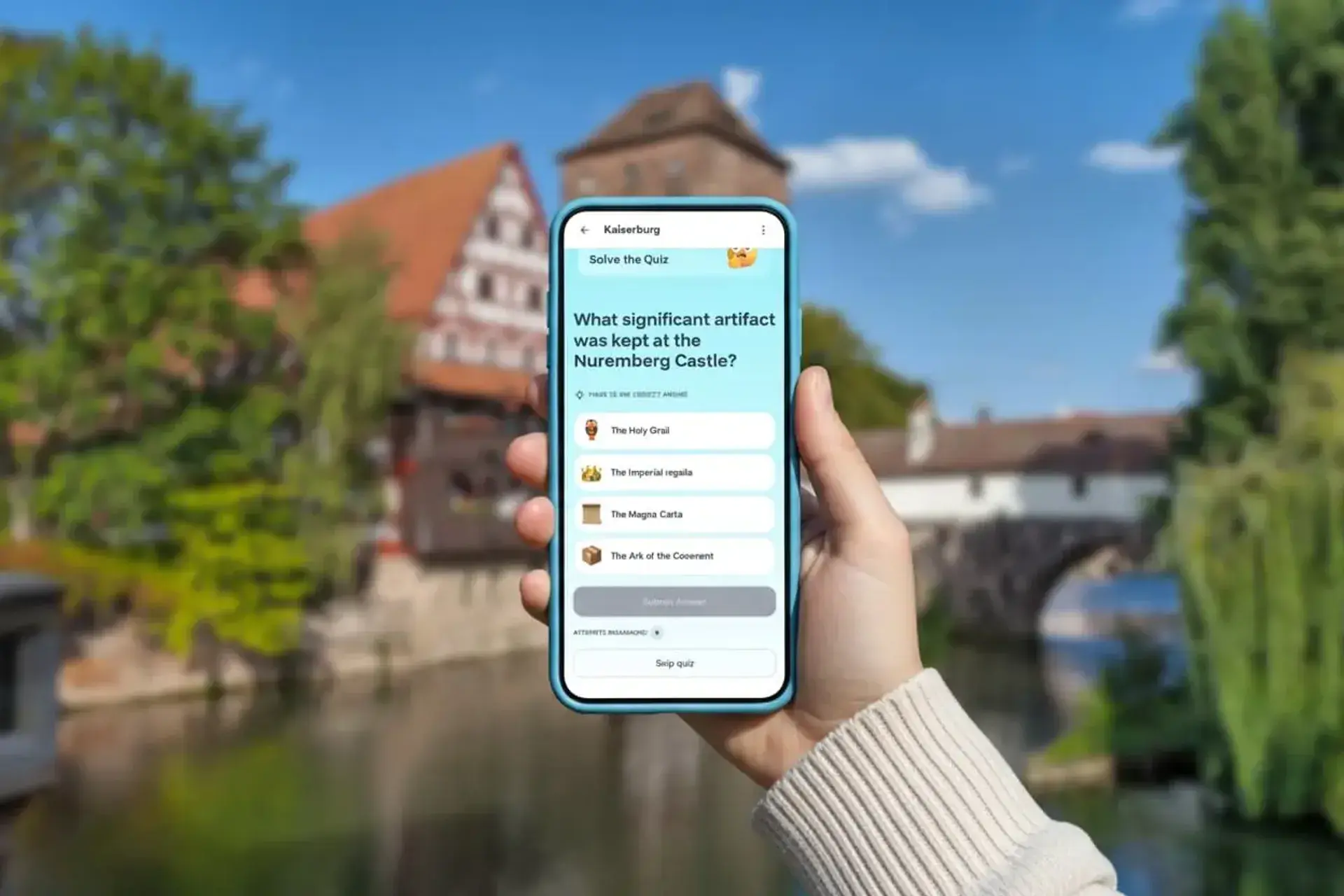
<p>Perched high above Nuremberg’s Old Town, the Kaiserburg—or Nuremberg Castle—has stood as a sentinel of power and prestige since its first documentation in 1050. This fortress was more than a military stronghold; it was a symbol of the Holy Roman Empire’s influence, serving as a residence for kings and emperors. Its strategic position overlooking trade routes and the city below underscored its importance within the empire.</p> <img src="https://storage.googleapis.com/ciceru-assets-stg/c41a7fde-337d-4db9-a1df-bd755d7ab549/LgkrEq7t-1920px-Nu%CC%88rnberg_Burg_ArM%20%281%29.jpg" alt="undefined" style="height: auto;width: 320px"/> <blockquote>Nuremberg Castle: Palas, Imperial Chapel, and Heathens' Tower on the right; Sinwell Tower in the middle left; Pentagonal Tower, Imperial Stables, and Luginsland Tower on the far right. Photo by ArtMechanic.</blockquote> <p>The castle played a pivotal role in 1356 when Emperor Charles IV issued the Golden Bull, declaring Nuremberg the site of the first Imperial Diet for newly elected kings. This decree solidified the city’s place in Imperial politics, and the castle became a repository for the Imperial regalia—crowns, swords, and orbs—from 1423 to 1796, further cementing its significance.</p> <img src="https://storage.googleapis.com/ciceru-assets-stg/c41a7fde-337d-4db9-a1df-bd755d7ab549/CAhE7fn4-Goldene_Bulle_Handschrift%20%281%29.jpg" alt="undefined" style="height: auto;width: 320px"/> <blockquote>Page from the Golden Bull manuscript of King Wenceslaus, circa 1400. Preserved in the Austrian National Library.</blockquote> <p>Inside, the Deep Well and the Sinwell Tower remain engineering marvels of their time, providing not just defense but also vital resources during sieges. The castle’s walls whisper stories of royal banquets, political negotiations, and the lives of those who called it home.</p>

Historischer Kunstbunker

<p>Beneath the streets of Nuremberg lies a hidden sanctuary—the Historischer Kunstbunker. Built during World War II, this underground bunker was designed to protect something priceless. Can you guess what it was?</p>

Albrecht Dürer's Haus

<p>This final stop on our tour brings us to the home of Albrecht Dürer, which we briefly encountered in the previous stop at the Historischer Kunstbunker, where some of his priceless works were safeguarded during World War II.</p> <img src="https://storage.googleapis.com/ciceru-assets-stg/c41a7fde-337d-4db9-a1df-bd755d7ab549/mUfYScqI-807px-Albrecht-self%20%281%29.jpg" alt="undefined" style="height: auto;width: 320px"/> <blockquote>Albrecht Dürer, Self-Portrait with Eryngium (1493). Preserved in the Louvre.</blockquote> <p>Nestled within Nuremberg’s historic Old Town, this meticulously preserved half-timbered house served as both his home and workshop.</p> <img src="https://storage.googleapis.com/ciceru-assets-stg/c41a7fde-337d-4db9-a1df-bd755d7ab549/LrUIlDYp-810px-Albrecht-Du%CC%88rer-Haus%2C_interno_07_cucina.jpg" alt="undefined" style="height: auto;width: 320px"/> <blockquote>Interior: Kitchen of the Albrecht Dürer House in Nuremberg.</blockquote> <p>Dürer lived here from 1509 until his death in 1528. The house itself is a masterpiece of 15th-century architecture, reflecting the wealth and status of its illustrious owner. The house also serves as a museum, offering a window into the life and legacy of an artist whose influence is still felt today.</p>

Dein persönlicher Guide, immer dabei

Lust, diese Orte zu Fuß zu entdecken?

  • Selbstgeführt, wann du willst
  • Offline-Audio, 7 Sprachen
  • 30 Tage Geld-zurück-Garantie
  • 500 MB eSIM inklusive

ab

7,00 €

1 selbstgeführte Tour in Nuremberg

Touren ansehen

Tage planen

Wie viele Tage in Nuremberg? Die perfekte 1-Tage-Route

Tag 1

Nürnbergs Altstadt zu Fuß ab Hauptbahnhof

Folge der Königstraße vom Nürnberger Hauptbahnhof durch die Fußgängerzone der Altstadt, für weitere Wege steht die Tarifzone A bereit.

Wetter & Andrang

Beste Reisezeit

Die perfekte Balance aus gutem Wetter und entspannten Gassen bieten Mai bis Juni oder September bis Oktober bei Höchstwerten von 18,8 bis 22,0 °C und 14,2 bis 20,0 °C. Von Juli bis Dezember 2025 brach jeder Monat den Übernachtungsrekord, wobei der Dezember erstmals die Marke von 400.000 Übernachtungen knackte.

Empfohlen

Kalt, wenig Andrang

Jan–Feb

-4–4°C/ 25–40°F

Wenig losGelegentlicher Regen
  • Nürnbergs ruhigste Zeit
  • Im Januar sinken Tiefstwerte im Schnitt auf -4,0 °C.

Frühlingserwachen

Mär–Apr

-1–14°C/ 31–56°F

Wird vollerGelegentlicher Regen
  • Nürnberger Frühlingsfest
  • Der April klettert im Schnitt auf gerade einmal 13,6 °C.

Nicht verpassen

  • Nürnberger Volksfest, Frühlingsausgabe

Warm, teils regnerisch

Mai–Jun

7–22°C/ 45–72°F

Viel losNass
  • Frühlingswärme in Nürnberg
  • Der Juni ist mit durchschnittlich 75 mm der nasseste Monat.

Sommerhochbetrieb

Jul–Aug

12–24°C/ 54–75°F

HauptsaisonNass
  • Nürnberger Sommerwärme
  • Im Juli und August fallen im Schnitt 69 und 67 mm Regen.

Nicht verpassen

  • Nürnberger Volksfest, Herbstausgabe

Mild und gut besucht

Sep–Nov

1–20°C/ 33–68°F

Viel losGelegentlicher Regen
  • Nürnberger Herbstmarkt
  • Im Oktober 2025 wurden 354.916 Übernachtungen gezählt.

Nicht verpassen

  • Nürnberger Herbstmarkt

  • Nürnberger Christkindlesmarkt

Weihnachtshochbetrieb

Dez

-2–3°C/ 28–38°F

HauptsaisonGelegentlicher Regen
  • Christkindlesmarkt-Saison
  • Im Dezember 2025 gab es über 400.000 Übernachtungen.

Nicht verpassen

  • Nürnberger Christkindlesmarkt

Verkehr

Anreise & Verkehr in Nuremberg

Flughafen Nürnberg

Anreise & Verkehr in Nuremberg
U212 Min.3,90 €

Nürnberg Hbf

Anreise & Verkehr in Nuremberg
Zu Fuß über die Königstraßeca. 5 Min.0,00 €

U-Bahn, Tram und Bus

Preisstufe A genügt

Ein Einzelticket Preisstufe A kostet online 3,65 €, auf Papier 3,90 € (gilt 90 Min.); die 4er-Streifenkarte 14,60 €, Tagesticket Solo 10,60 €. Im VAG-Bus zahlst du nur bargeldlos.

Zu Fuß unterwegs

Hbf ins Herz: 5 Min.

Vom Hauptbahnhof erreichst du das Zentrum in gut fünf Minuten zu Fuß, die Königstraße bildet dabei die zentrale Fußgängerachse. Die Rampe an der Lorenzkirche zur Königstraße ist derzeit gesperrt.

VAG_Rad

Günstige Kurzstrecke

Der Basistarif beträgt 0,10 € Startgebühr plus 0,10 € pro Minute, gedeckelt auf 10 € pro 24 Stunden. Gib das Rad an einer Station oder in der Flexzone zurück, sonst werden mindestens 20 € fällig.

E-Scooter im Verleih

Achtung in Parkzonen

Innerhalb des Nürnberger Bundesstraßenrings dürfen Fahrten nur in markierten Parkzonen beendet werden, andernfalls läuft die Miete einfach weiter. Außerhalb des Rings gilt weiterhin Free-Floating.

Taxi

Taxameter und Karte

Der Nürnberger Grundpreis liegt bei 4,90 €, der Festpreis für 3 km bei 15,40 €. Taxis sind laut Tarifordnung verpflichtet, auf Wunsch Kartenzahlung zu akzeptieren.

Erkunde die Stadt zu Fuß, ergänzt um Tickets der Preisstufe A. Die NÜRNBERG CARD kostet 38 € für 48 Stunden. Da zwei Tagestickets Solo 21,20 € kosten, zahlst du für reinen Nahverkehr 16,80 € drauf.

Budget

Was kostet eine Reise nach Nuremberg?

Bestätigte Tarife liegen bei 1,90 bis 2,10 € für die Kurzstrecke, 3,65 bis 3,90 € für die Einzelfahrt Preisstufe A, 10,60 € für das Tagesticket und 15,40 bis 20,80 € für vorbestellte Taxifahrten von 3 bis 5 km. Preisspannen für Gastronomie liegen aktuell nicht vor.

Was kostet eine Reise nach Nuremberg?
Einzelfahrt Erwachsene, Preisstufe A3,65 €–3,90 €
Kurzstrecke Einzelkarte1,90 €–2,10 €
Tagesticket Solo, Preisstufe A10,60 €
VAG_Rad, 10 Minuten1,10 €
Taxi-Festpreis, 3 bis 5 km15,40 €–20,80 €

Cash or card?

In VAG-Bussen gilt seit dem 1. Mai 2026 ausschließlich bargeldlose Zahlung; an Automaten und Vorverkaufsstellen kannst du weiterhin bar zahlen. Nürnberger Taxis müssen Kartenzahlung auf Wunsch annehmen.

Übernachten

Übernachten in Nuremberg

Altstadt St. Lorenz

Für Erstbesucher, nah am Hbf

Die meisten Fußgängerzonen liegen in St. Lorenz, die Königstraße führt direkt zum Hbf. Bauarbeiten an der Lorenzer Passage schränken den barrierefreien Zugang an der Lorenzkirche derzeit ein.

Gostenhof

Lebendig abseits der Altstadt

Die Stadt preist Gostenhof als quirliges Szeneviertel, geprägt von dichter Bebauung, bunter Kulturszene und Gastronomie. Es geht hier urbaner und trubeliger zu als im historischen Zentrum.

St. Johannis

Wohnlich, nah am Kern

St. Johannis liegt westlich der Altstadt und nördlich der Pegnitz. Die schönen Altbauten bedeuten im Vergleich zu St. Lorenz einen etwas längeren Fußweg oder eine kurze Fahrt mit der Bahn.

Die Touren

Nuremberg, Geschichte für Geschichte

Rubbeln und gewinnen

Rubbel los

Da unten könnte etwas Gutes warten. Wenn du gewinnst, zeigen wir dir, wie du es einlöst.

Ein Gewinn pro Reisenden. 2 Jahre gültig.

Weiterempfohlen

Was Reisende sagen

Sicherheit

Ist Nuremberg sicher?

Nürnberg gilt als sicher: Laut Polizeistatistik für 2025 belegte die Stadt den fünften Platz unter den sichersten deutschen Großstädten über 200.000 Einwohnern. Diebstahl war mit 13.573 Fällen das häufigste Delikt, Taschendiebstähle gingen auf 447 Fälle zurück.

Bahnhofsviertel

Rund um den Nürnberger Hauptbahnhof erfasste die Polizei 2025 insgesamt 1.526 Straftaten, darunter 696 Drogendelikte. Nachdem sich die Nordseite beruhigt hat, steht nun eher der Südausgang im Fokus.

Weihnachtsgedränge

Die Polizei warnt vor Taschendieben im dichten Gedränge des Christkindlesmarkts: Trage Geld, Karten und Smartphone getrennt in verschlossenen Innentaschen und nimm Taschen stets nach vorn.

Alkoholverbotszonen

Am Bahnhofsplatz, in der Königstorpassage und am Aufseßplatz gilt ein striktes Alkoholverbot rund um die Uhr. Wer dort Alkohol trinkt oder offen mitführt, riskiert bis zu 1.000 € Bußgeld.

Fußgänger und E-Scooter

In der südlichen Königstraße darfst du ganztägig radeln, nördlich der Mauthalle musst du absteigen. E-Scooter sind auf Gehwegen und in Fußgängerzonen tabu; ab 0,5 Promille drohen 500 € Bußgeld.

Medizinische Hilfe

Bei nicht lebensbedrohlichen Beschwerden außerhalb der Praxiszeiten hilft der ärztliche Bereitschaftsdienst unter 116117 oder in der Bahnhofstraße 11a; bei Notfällen gilt die 112. Englischsprachige Hilfe unter 112 ist nicht garantiert.

Gut zu wissen

Gut zu wissen

Bargeldlos in VAG-Bussen

Seit dem 1. Mai 2026 werden Fahrscheine in VAG-Bussen nur noch bargeldlos verkauft; an Automaten, privaten Verkaufsstellen und im VAG-Kundencenter kannst du weiterhin bar zahlen.

Rückgabezonen für E-Scooter

Innerhalb des Bundesstraßenrings können Leih-E-Scooter nur auf gekennzeichneten Abstellflächen abgegeben werden. Andernfalls lässt sich die Miete nicht beenden und die Kosten laufen weiter.

Gültigkeitsdauer der NÜRNBERG CARD

Die NÜRNBERG CARD gilt ab dem gewählten Startzeitpunkt für exakt 48 Stunden. Es gibt keine Variante für 24 oder 72 Stunden, und der Zeitraum lässt sich nachträglich nicht mehr ändern.

Alkoholkonsum auf Straßen der Altstadt

Abseits von Hauptbahnhof und Aufseßplatz ist der Konsum von Alkohol auf öffentlichen Straßen in der Altstadt und in Fußgängerzonen nur in genehmigten Außengastronomiebereichen gestattet.

Fragen

Nuremberg FAQ

Exakt 48 Stunden. Datum und Uhrzeit des Starts legst du beim Kauf fest; es gibt keine Variante für 24 oder 72 Stunden.

Bereit?

Selbstgeführte Audiotouren in ganz Nuremberg.

Touren in Nuremberg ansehen