
Tipps und Touren für Entdecker und Reisende
City-Guide für Trier
Erkunde Triers römische Tore, Moselufer und Altstadtgassen von einem kompakten Zentrum aus, mit Bussen direkt in die Weinberge.
- Land
- Deutschland
- Sprache
- Deutsch
- Währung
- Euro (EUR)
- Stecker
- Typ F
- Zeitzone
- Europe/Berlin
- Notruf
- 112
- Leitungswasser
- Im Allgemeinen trinkbar
- Vorwahl
- +49
Die Stopps
Sehenswürdigkeiten in Trier
Folge römischen Monumenten, Domplätzen und Moselpanoramen durch Deutschlands älteste Stadt, mit Weinbergen und Museen gleich hinter dem Zentrum.
Kaisertherme
Barbarathermen
Römerbrücke
<p>Let's continue along the Südallee towards the Römerbrücke, our next stop and another UNESCO World Heritage Site of Trier. This vault bridge made of stone has a length of 198 metres and is 13 metres wide, but these are not even the most impressive metrics; at the graceful age of about 1877 years (built between 142 and 150 AD), this Roman keepsake has unwaveringly stood the test of time. Today cars and pedestrians can still cross from one side of the Mosel to the other.</p> <img src="https://storage.googleapis.com/ciceru-assets-stg/7098d3b9-8ce3-47d6-9b65-8631dd1c0c0e/2rpsUxWV-IMG_7717.jpg" alt="undefined" style="height: auto;width: 320px"/> <blockquote>The Römerbrücke (view from the left side)</blockquote> <p>The origins of the bridge date back to the first century BC (before Christ), where a wooden construction was first erected. Between 1190 and 1490, in the Middle Ages, the bridge underwent substantial changes, including the addition of the stone arches. The construction was led by the electoral prince Balduin, whose reign spanned the epoch between 1307 and 1354. Astonishingly, all nine of the original pillars have been preserved, which is a strong testament to the robustness of the design and its ingenious Roman engineers.</p> <p>If only the bridge could speak of the historical events it has witnessed, what incredible insights we would have today. However, we can safely rely on the expertise of multiple historians, who have deduced that the Romerbrücke was destroyed by French troops in 1689.</p>
Karl-Marx-Haus
<p>On the 5th of May 1818, Karl Marx was born in this lovely three-story house situated on the Brückenstrasse (Bridge street). He was the third son of the lawyer Heinrich Marx and his wife Henrietta, who were both Jewish from traditional rabbinical families. For a number of economic, political and social reasons, they made the decision to convert to Protestantism. Following this religious conversion, Heinrich Marx received permission to take up work as a lawyer at a Prussian court.</p> <p>Karl also somewhat benefitted from his parents' social standing and made his historical mark as a philosopher, journalist, economist and writer of the "Capital", which is an expression of criticism of the capitalist society of the 19th century. Few philosophers have reached Marx's worldwide fame, revery and yet controversy.</p> <img src="https://storage.googleapis.com/ciceru-assets-stg/7098d3b9-8ce3-47d6-9b65-8631dd1c0c0e/ayqTXDFE-IMG_7726_1.jpg" alt="undefined" style="height: auto;width: 320px"/> <blockquote>Plaque with the face of Karl Marx on the Karl-Marx-Haus</blockquote> <p>His publications and theories have permanently affected the history of the 19th and 20th century. Germany's development of its social democracy, the European labour movement and the communist ideologies would have remained inexplicable without the deep exploration into the mind(set) of Karl Marx.</p> <p>He had a colourful past that started in Trier, where he spent the first 17 years of his life, later moving to Bonn, Berlin, Paris, Brussels, Cologne and lastly London.</p>
Konstantin-Basilika
<p>It is 310 AD and the Konstantin-Basilika serves as the throne room and the seat of the government of Emperor Constantine the Great. Known as a schemer, he is not known to ever lose a battle - and he does not hesitate to assert his authority by making decisions about the life of his subjects.</p> <p>The walls of the basilica are decorated with mosaics and the floor is made of black and white marble. Whereby, whether the floor is made of marble or not, bears less significance to petitioners who have to take the 75-metre-walk from the entrance towards the imperial throne to make their request and both the path to and the queue, must seem endless.</p> <img src="https://storage.googleapis.com/ciceru-assets-stg/7098d3b9-8ce3-47d6-9b65-8631dd1c0c0e/KIx5ZNEc-IMG_7738_1.jpg" alt="undefined" style="height: auto;width: 320px"/> <blockquote>Image of the side of the basilica where the imperial throne stood</blockquote> <p>Each petitioner is accompanied by a guarantor, in case the petitioner tries to assassinate the emperor, the guarantor is arrested and punished; pure Roman logic. Emperor Constantine the Great conducts the audiences behind a sailcloth, whose shadow is addressed by the requestor. It is important to note that nobody can turn their back to the emperor, meaning that each petitioner and his/her guarantor must make their way the entire length of the Konstantin-Basilika facing the imperial throne, backwards, until they hit the entrance.</p> <p>The main auditorium (Aula Palatina) is 27 metres in width, 33 metres in height and 67 metres in length. Its walls are 2.7 metres thick, which has resulted in its longevity; impressively, over 1715 years later, it remains at 90% of its original state.</p>
Kurfürstlicher Palast (Palais)
<p>By now we have gotten to know Emperor Constantine the Great to be a relentless ruler, who impacted substantial change during the time of the Roman Empire. Amongst his many memorable doings, he was responsible for the establishment of an elegant city palace in 306 AD.</p> <img src="https://storage.googleapis.com/ciceru-assets-stg/7098d3b9-8ce3-47d6-9b65-8631dd1c0c0e/zyM3Gj2F-IMG_7731.jpg" alt="undefined" style="height: auto;width: 320px"/> <blockquote>Main entrance of the royal palace (Kurfürstliches Palais)</blockquote> <p>Electoral princes and archbishops took up residence in the majestic halls of the royal palace until 1794. The electoral prince Lothar von Metternich initiated the remodelling of the palace to a Renaissance castle in the 16th century, to which Philipp von Walderdorff added a Rococo wing in the 18th century.</p> <p>In 1803 Napoleon's troops invaded Trier and expropriated electoral princes, leading to the palace expropriation. It then became a military hospital with a casern, while the royal palace garden turned into a place of public gathering.</p> <p>Since the Congress of Vienna in 1815 Trier belonged to Prussia, resulting in its military usage lasting until the end of WWI (World War I), with ownership changing hands from time to time. Shortly after WWI it was in the hands of the US army, to then be taken over by the French army between 1919 until 1930, as the "Quartier de la Marne" barracks.</p>
Liebfrauenkirche
<p>We find ourselves transported back to the year 326 AD, the twentieth anniversary of Emperor Constantine the Great's reign. This occasion marked significant donations and the construction of churches in places that bear special significance to Christianity. Starting with the Church of the Nativity in Bethlehem, the Church of the Resurrection in Jerusalem, the first St. Sophia Church in Constantinople (now Istanbul), St. Peter's Church in Rome and the double church site in Trier, consisting of the Liebfrauenkirche and the Dom.</p> <img src="https://storage.googleapis.com/ciceru-assets-stg/7098d3b9-8ce3-47d6-9b65-8631dd1c0c0e/jIEhKC5S-IMG_7748.jpg" alt="undefined" style="height: auto;width: 320px"/> <blockquote>Front image of the Liebfrauenkirche (right) and Dom (left)</blockquote> <p>The Liebfrauenkirche contains the words "liebe Frau", meaning "lovely lady" and "Kirche" stands for "church". With such a melodious name that refers to Mary as the lovely lady, the unknown French architects' intentions were to create an architectural declaration of love to Mary (Virgin Mother) between 1225/1230 and 1260.</p> <p>Let us now step into the mystic world of the church where the layout of the church depicts a twelve-petalled rose (Rosa Mystica), twelve supporting columns that represent the apostles, eight chapels and the chalices of lilies that signify the maidenhood and purity of Mary. The idea behind this spiritual domain was to create nothing short of paradise on earth and allow its visitors to escape daily life and become part of a world filled with light, harmony and perfection.</p>
Dom
<p>Trier was the first city with the seat of a bishop on German soil and has retained the status of a cathedral without interruption for over 1700 years. From its centre, the seeds of Christianity were dispersed across Germany from the fourth century onwards. This was the time of the establishment of a monumental church complex; the largest of its kind.</p> <img src="https://storage.googleapis.com/ciceru-assets-stg/7098d3b9-8ce3-47d6-9b65-8631dd1c0c0e/LCoE1DU3-IMG_7752.jpg" alt="undefined" style="height: auto;width: 320px"/> <blockquote>Front face of the Dom</blockquote> <p>The cathedral's charm attracts about one million visitors annually. Over 100 bishops, countless believers, tradespeople and architects have come and gone, each leaving their special imprint and contributing to the mix of architectural styles of St. Peter's cathedral (Dom).</p> <p>Legend of the "Domstein" (cathedral rock) states that during the development of the house of worship, four heavy granite columns had to be obtained. When the devil came by, the architect thought of a ploy. He mentioned that he intends to build the largest tavern (public house) in the world and asked for the devil's help. Inquiring whether the devil could carry four pillars from the 350-river-kilometres' distant Odenwälder Felsenmeer back to Trier, the demon agreed. True to the devil's word, he carried the slabs of granite and as he was dropping off the final slab, he recognised the building as a church. Infuriated by this realisation, he tossed the pillar in the direction of the cathedral. Thankfully, it missed its aim and shattered into pieces.</p> <p>In truth, the Domstein was discovered under the floor of the cathedral during construction works in 1614 and later placed in front of its entrance. The two fragments were once part of one of the four granite pillars that supported the roof of the antique cathedral. Today, it is a token of good luck to slide down the rock.</p>
Dein persönlicher Guide, immer dabei
Lust, diese Orte zu Fuß zu entdecken?
- Selbstgeführt, wann du willstSelbstgeführt: Starte jetzt oder später und mach Pause, wann du willst
- Offline-Audio, 7 SprachenOffline-Audiogeschichten in 7 Sprachen
- 30 Tage Geld-zurück-Garantie30 Tage Geld-zurück-Garantie
- 500 MB eSIM inklusive500 MB weltweite eSIM inklusive
ab
7,00 €
1 selbstgeführte Tour in Trier
Tage planen
Wie viele Tage in Trier? Die perfekte 1-Tage-Route
Triers römischer Kern und das Moselufer zu Fuß
Starte an den römischen Stadttoren und im Domviertel, folge dann dem Fluss und beende die Tour in den Gassen am Fuß der Weinberge.
7,00 € →Wetter & Andrang
Beste Reisezeit
Mai, Juni und September sind die besten Monate für Erkundungen zu Fuß, mit warmen Tagen ohne die Hitze von Juli und August. Von November bis Februar ist es ruhig, feucht und kalt.
Winter und Frühling
Jan–Jun0–20°C/ 32–68°F
Wenig los
- Römererbe in ruhigen Gassen
Sommer und Herbst
Jul–Dez8–25°C/ 46–77°F
Wenig los
- Moselrunde mit Weinbergblick
Die Touren
Trier, Geschichte für Geschichte
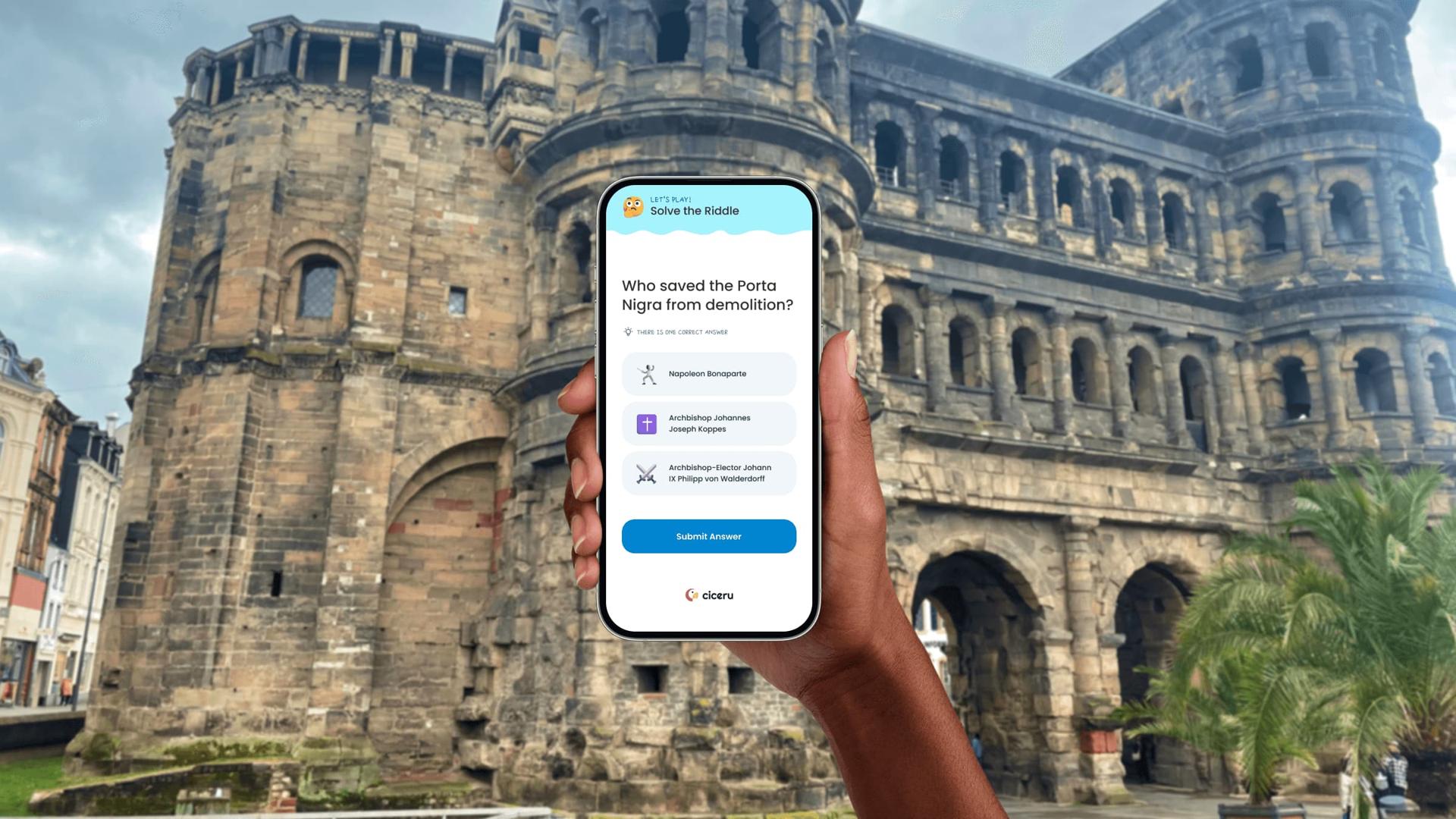
7 €2 Stunden
Bummel durch Deutschlands älteste Stadt Trier
 Michaela Scheiner
- Audio
- Quizze
- Multiplayer
- Gratis-eSIM
Rubbeln und gewinnen
Rubbel los
Da unten könnte etwas Gutes warten. Wenn du gewinnst, zeigen wir dir, wie du es einlöst.
Ein Gewinn pro Reisenden. 2 Jahre gültig.
Weiterempfohlen
Was Reisende sagen

Sicherheit
Ist Trier sicher?
Trier ist generell sicher. Achte auf unebenes historisches Kopfsteinpflaster, Rad- und Busverkehr, volle Feststraßen und Wege an Fluss oder Weinbergen nach Einbruch der Dunkelheit. Bei medizinischen Notfällen und Feuer wähle die 112, für die Polizei die 110.
Historisches Pflaster
Schalte rund um Porta Nigra, Simeonstiftplatz und Dom einen Gang runter; nasser Stein und belebte Kreuzungen werden schnell unterschätzt.
Moselufer
Halte dich nach ein paar Drinks vom Fluss fern; Dunkelheit, nasse Wege und wechselnde Pegelstände machen das Ufer tückisch.
Spätbusse
Prüfe die letzte SWT- oder VRT-Verbindung, bevor du die Innenstadt in Richtung Weinberge oder Bahnhof verlässt.

Fragen
Trier FAQ
Erkunde das historische Zentrum zu Fuß und nimm für Bahnhof, Randbezirke und Uferviertel die Busse von SWT oder VRT.
Mai, Juni und September bieten angenehmes Wetter für Erkundungstouren ohne die drückende Hitze des Hochsommers.
Wähle die 112 bei medizinischen Notfällen oder Feuer und die 110 für die Polizei.