Grossmünster

Tipps und Touren für Entdecker und Reisende

City-Guide für Zürich

Zürich ist eine deutschsprachige Stadt mit 12 Kreisen, in der aus 1.282 Brunnen Trinkwasser fließt, Züge vom Flughafen das Zentrum in 15 Minuten erreichen und Fußgängerzonen beide Limmatufer säumen.

Land
Schweiz
Sprache
Deutsch
Währung
Schweizer Franken (CHF)
Stecker
Typ C/J
Zeitzone
Europe/Zurich
Notruf
112, 117, 144 und 118
Leitungswasser
Trinkbar
Vorwahl
+41

Die Stopps

Sehenswürdigkeiten in Zürich

Fußgängerzonen zu beiden Seiten der Limmat machen die zentrale Altstadt ideal für Erkundungen zu Fuß, auch wenn du bei herannahenden Trams auf den Plätzen gut aufpassen solltest.

Hauptbahnhof - Der Gebäck-Express

<p>Welcome to Zurich. I’m Filippo, your guide for the next hour and a half. We’ll walk through Roman ruins, medieval power plays, and a few surprises that Zurich prefers not to advertise. The city may seem orderly, but its past is anything but. Let’s begin at Zürich Hauptbahnhof, where movement has always been part of the story.</p> <p>Zurich’s Central Station might not scream "romantic getaway" at first glance. It’s loud, massive, and swarming with rolling suitcases. But make no mistake: this is where the city’s story hits the tracks running.</p> <img src="https://storage.googleapis.com/ciceru-assets-stg/719d4130-a85c-475d-aecc-79477f066dc6/F0l6kHwS-Mainstation-Zuerich.jpg" alt="undefined" style="height: auto;width: 320px"/> <blockquote>Construction site of Zürich Main Station, 1867. Photo from the Baugeschichtliches Archiv. Public domain.</blockquote> <p>Opened in 1871, the Hauptbahnhof is more than just a transit hub. It’s a 19th-century temple to Swiss efficiency and ambition. The architect, Jakob Friedrich Wanner, designed it to feel imperial — a palace where trains, not emperors, reign. And let’s be honest, in Switzerland, trains might actually have more power. As you look up at the ornate stonework, spot the bronze figure of Alfred Escher: Zurich’s railroad messiah. Banker, politician, tycoon. The kind of man who, when he had a craving for a pastry, helped build a railway.</p> <p>Yes, really. The very first train line in Switzerland, launched in 1847, was nicknamed the <em>Spanisch-Brötli-Bahn</em>. It got its name from the flaky almond pastries the elite of Zurich had delivered fresh from Baden each morning. The pastries were so irresistible they justified inventing public transport. Uber Eats could never.</p> <img src="https://storage.googleapis.com/ciceru-assets-stg/719d4130-a85c-475d-aecc-79477f066dc6/PZGMU39S-Isenring_Bahnhof_Zu%CC%88rich_1847.jpg" alt="undefined" style="height: auto;width: 320px"/> <blockquote>Zürich station in 1847, viewed from the Limmat. Painting by Johann Baptist Isenring.</blockquote> <p>Today, Zürich HB is a 21-platform behemoth serving over 3,000 trains a day. It’s the living engine room of the country. Inside, the soaring concourse blends iron-and-glass grandeur with blinking timetables and the occasional piano that dares you to play a sonata while waiting for your ride. Look for the Art Nouveau tiles in the side passages — quiet leftovers from a time when even train stations had delusions of nobility.</p> <img src="https://storage.googleapis.com/ciceru-assets-stg/719d4130-a85c-475d-aecc-79477f066dc6/mBTC6Mgt-Bahnhofplatz_-_Hauptbahnhof_-_Bahnhofstrasse_Zu%CC%88rich_2010-09-21_14-34-44_ShiftN.jpg" alt="undefined" style="height: auto;width: 320px"/> <blockquote>Alfred Escher fountain by Richard Kissling on Bahnhofplatz, in front of Zürich Hauptbahnhof. Photo by Roland zh, 21 September 2010.</blockquote> <p>Step outside and you’ll find yourself in Bahnhofplatz, once a medieval moat, now a tram-crossed plaza guarded by Escher’s gaze. From here begins Bahnhofstrasse: Zurich’s famed shopping avenue, once a muddy ditch, now paved with gold. Or at least with boutiques that sell it.</p> <p>But don’t linger too long among the window displays. You’re about to leave the precision of the station behind and head into something older, quieter, and more poetic. Make your way uphill — next stop: Lindenhof. A hilltop of lime trees, chess tables, and Roman whispers.</p>
Lindenhof - Die große Klippe

<p>Welcome to Lindenhof. A quiet hilltop square with a few benches, some elderly men playing chess, and a postcard view of the city. But don’t be fooled. This unassuming plateau has been Zurich’s power center for over two millennia. Empires, tax collectors, and warrior women have all left a footprint here — sometimes literally carved into the stone.</p> <img src="https://storage.googleapis.com/ciceru-assets-stg/719d4130-a85c-475d-aecc-79477f066dc6/OUBFmkN9-Zurych_Turicum.jpg" alt="undefined" style="height: auto;width: 320px"/> <blockquote>Bird's-eye view of Zurich, 1581 etching by Georg Braun and Frans Hogenberg</blockquote> <p>Back in the Iron Age, this was a Celtic hillfort. Then came the Romans, who turned it into <em>Turicum</em>, a customs post where they could politely charge you for the privilege of crossing the Alps. Think of it as ancient Zurich’s first toll booth. In 1747, workers here dug up a Roman tombstone dedicated to a child named Lucius Aelius Urbicus. Just three years old, and already immortalized in Latin. His tomb was the first official mention of “Turicum” — Zurich’s earliest name. Grim, maybe, but also kind of poetic. The Romans came to tax, and they stayed to bury their children.</p> <img src="https://storage.googleapis.com/ciceru-assets-stg/719d4130-a85c-475d-aecc-79477f066dc6/GksgMYwb-Zu%CC%88rich_-_Lindenhof_-_Grabstein_Lucius_Aelius_Urbicus_IMG_1808.JPG" alt="undefined" style="height: auto;width: 320px"/> <blockquote>Replica of a Roman gravestone on Lindenhof hill in Zurich, commemorating Lucius Aelius Urbicus. Photo by Roland zh, 1 August 2011.</blockquote> <p>Fast forward to the Middle Ages, and Lindenhof shows its dramatic side. According to legend, in 1292 the Habsburg army was approaching Zurich, and the city’s men were away. So the women — mothers, daughters, and grandmothers — threw on armor, grabbed spears, and took to the ramparts. From a distance, it looked like the city was fully defended. The invading army hesitated, then backed off. Zurich was saved by a theatrical performance and a few brave bluffers. Somewhere between a military maneuver and a costume party, but it worked.</p> <img src="https://storage.googleapis.com/ciceru-assets-stg/719d4130-a85c-475d-aecc-79477f066dc6/GWJLeCum-Hedwig_ab_Burghalden_Fresko.jpg" alt="undefined" style="height: auto;width: 320px"/> <blockquote>Fresco by Wilhelm Hartung showing armed Zurich women on the Lindenhof, 1292. Photo by Jeannette Röthlisberger.</blockquote> <p>Today, Lindenhof is a peaceful spot suspended above the city’s noise. Lime trees rustle in the breeze, and old men still gather to play giant chess on the stone boards. The Hedwig Fountain stands at the center, commemorating those legendary women in arms. Touch the stone walls around the perimeter — you might be brushing up against reused Roman blocks, casually holding up modern benches like it’s no big deal.</p> <img src="https://storage.googleapis.com/ciceru-assets-stg/719d4130-a85c-475d-aecc-79477f066dc6/3BwJt1i0-Lindenhof_2012-09-27_23-09-08.jpg" alt="undefined" style="height: auto;width: 320px"/> <blockquote>Lindenhof hill in Zurich, photographed during Wiki Loves Monuments 2012 by Roland Fischer.</blockquote> <p>But Lindenhof isn’t just old, it’s layered. Beneath the grass and gravel are foundations of Roman watchtowers, a Carolingian palace, and perhaps a hundred love confessions carved into bark or whispered on benches. It’s the kind of place where Zurich breathes in through the nose. Quiet, steady, ancient.</p> <p>When you're ready to descend, look east. You’ll spot narrow, colorful facades climbing the hill like a stack of old storybooks. That’s Augustinergasse — a medieval street full of trade, chocolate, and carved wooden animals. Time to leave the ghosts of Celtic warriors and Roman customs agents behind. We’re heading into guild territory.</p>

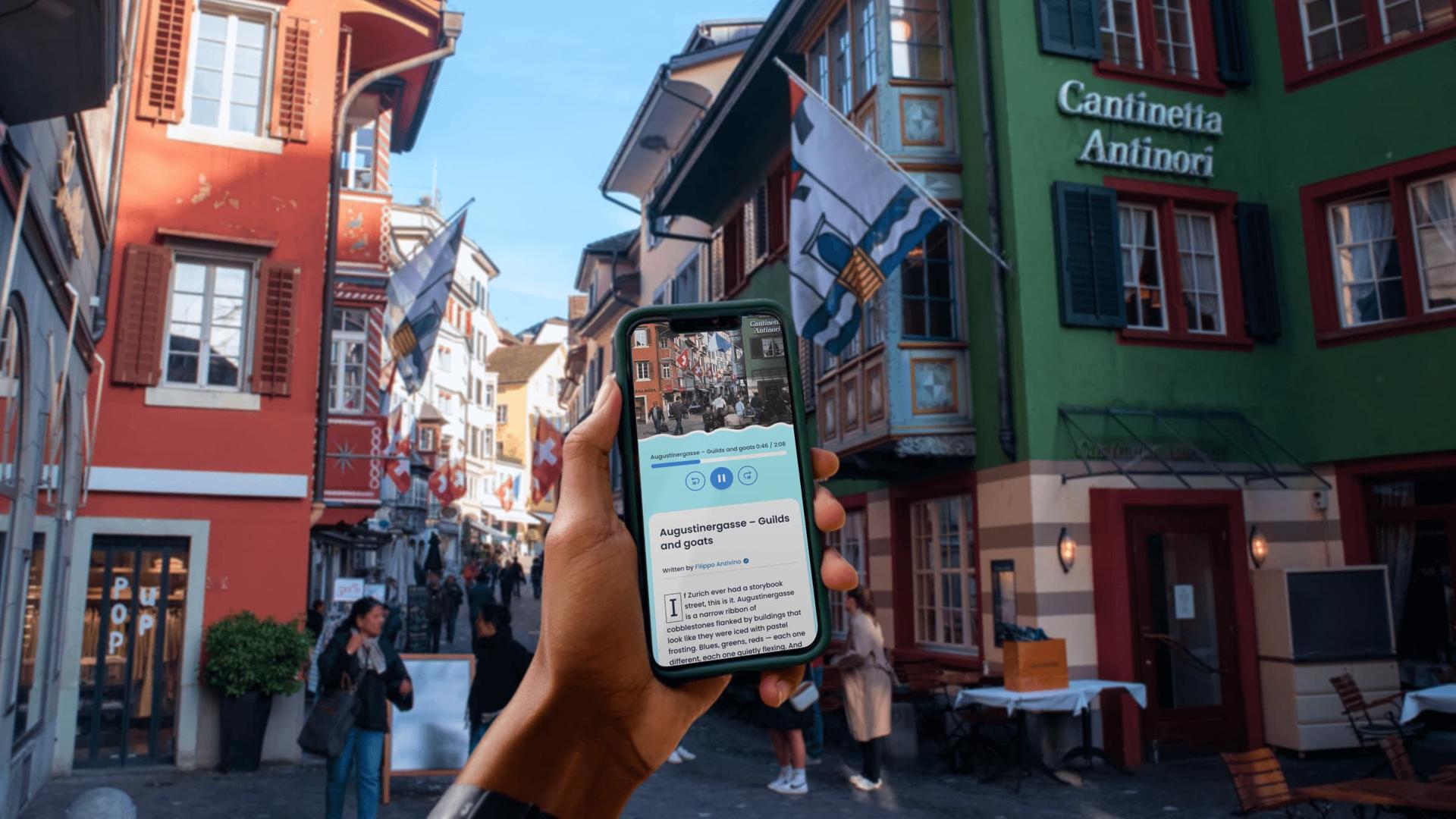
Augustinergasse - Zünfte und Ziegen

<p>If Zurich ever had a storybook street, this is it. Augustinergasse is a narrow ribbon of cobblestones flanked by buildings that look like they were iced with pastel frosting. Blues, greens, reds — each one different, each one quietly flexing. And there’s a reason for that. In medieval Zurich, this wasn’t just a street. It was a catwalk for the guilds.</p> <img src="https://storage.googleapis.com/ciceru-assets-stg/719d4130-a85c-475d-aecc-79477f066dc6/UHQAhiDu-20240411-TUR-Zuerich-Zuenfte-Header%20%281%29.jpg" alt="undefined" style="height: auto;width: 320px"/> <blockquote>Zentralbibliothek Zürich – The guilds of Zurich: centuries-old institutions that still shape the city’s culture, cuisine, and spring festivals like Sechseläuten.</blockquote> <p>Back in the 14th century, guilds ruled the city. They weren’t just trade associations — they were the city council, the military, the tax office, and the event planners all rolled into one. Here, in Augustinergasse, the textile merchants and dyers set up shop. One guild in particular, the Kämbel guild, became famous for its... camel. Yes, camel. Which is odd, because they mostly dealt in woven goat hair. The "camel" came from a misread house sign featuring an Angora goat. But the branding stuck. Medieval Zurich was quirky like that.</p> <img src="https://storage.googleapis.com/ciceru-assets-stg/719d4130-a85c-475d-aecc-79477f066dc6/0g2JPw9C-2013_Sechsela%CC%88uten_-_Saffran_-_Haue_%26_Ka%CC%88mbel_-_Limmatquai_2013-04-15_13-38-37%20%281%29.jpg" alt="undefined" style="height: auto;width: 320px"/> <blockquote>Sechseläuten 2013: The parade wagon of the Zunft zum Kämbel — also known as the Camel Guild — passes in front of the Haus zur Haue on Limmatquai, with the Saffran guild house in the background.</blockquote> <p>The guild members competed not just in business, but in architecture. The flashier your oriel window, the more respected you were. So they added those wooden bay windows jutting out over the street, carving little animals into the beams and painting every façade with as much flair as Zurich would allow. Walk slowly, and you might spot tiny carved mice near the window ledges — some say it’s a nod to pest control contracts, others think it's just guild humor. Either way, this street is full of visual Easter eggs.</p> <img src="https://storage.googleapis.com/ciceru-assets-stg/719d4130-a85c-475d-aecc-79477f066dc6/16GBM8rg-Zu%CC%88rich_-_Augustinergasse_IMG_5467_ShiftN%20%281%29.jpg" alt="undefined" style="height: auto;width: 320px"/> <blockquote>Augustinergasse in Zurich’s Lindenhof district, photographed in April 2010. One of the typical bay windows stands out along this colorful medieval street. Photo: Roland zh</blockquote> <p>Today, the guildhalls are gone, but the vibe remains. The bay windows are still here, like tiny time capsules. Some have stained glass, others house dusty dolls, antique globes, or nothing at all — just a view of the tourists below. Many of these buildings are still privately owned apartments, meaning you’re strolling under someone’s kitchen window from the 1600s.</p> <p>At the end of Augustinergasse, things open up into a square — and the spire of St. Peter’s Church begins to peek out. You’re about to go from guild pride to Protestant precision. Ahead lies Zurich’s oldest parish, and the biggest church clock face in Europe. Time, quite literally, is watching you.</p>

St. Peterskirche - Zeit an der Wand

<p>Turn the corner and you’ll see it. That tower with the enormous clock face staring back at you like a judgmental parent. Welcome to St. Peter’s Church — Zurich’s oldest parish and, for centuries, the city’s official timekeeper. If you’re ever late in Zurich, this place is partially to blame.</p> <p>The first version of the church was built here in the 8th or 9th century, but what you see now is a Baroque rebuild from the early 1700s, layered on top of medieval and Romanesque bones. One wall still contains a repurposed Roman block, casually placed like leftover IKEA stonework. Zurich doesn’t always flaunt its antiquity. Sometimes it just builds over it and moves on.</p> <img src="https://storage.googleapis.com/ciceru-assets-stg/719d4130-a85c-475d-aecc-79477f066dc6/GKRMpTaV-St_Peter_Escher%20%281%29.jpg" alt="undefined" style="height: auto;width: 320px"/> <blockquote>St. Peter’s Church in Zurich, around 1700. Drawing by Gerold Escher (1665–1738), from the <em>Regimentsbuch</em>, published in <em>Bilder aus dem alten Zürich</em> (Hans Rohr Verlag, 1954). Public domain.</blockquote> <p>But back to the clock. Added in 1538, its face is 8.7 meters wide — the largest on any church in Europe. For hundreds of years, it was Zurich’s official city clock. Every other clock in town had to match it. Which means this tower wasn’t just sacred, it was municipal. A divine-meets-civic kind of setup, very Zurich.</p> <img src="https://storage.googleapis.com/ciceru-assets-stg/719d4130-a85c-475d-aecc-79477f066dc6/3ykxTaYL-960px-Ansicht_vom_Lindenhof_auf_das_Ziffernblatt_der_Kirche_St._Peter_in_Zu%CC%88rich_2011-08-01.jpg" alt="undefined" style="height: auto;width: 320px"/> <blockquote>View of the St. Peter Church clock face from Lindenhof hill, Zurich. Roland zh – Own work (2011), CC BY-SA 3.0.</blockquote> <p>But things weren’t always so serene. In the early 1500s, this church became one of the main stages of the Protestant Reformation. Pastor Leo Jud, a prominent reformer and close friend of Huldrych Zwingli, preached here. Zwingli, the leading figure of the Swiss Reformation, and Jud together pushed Zurich into radical change: Latin masses were dropped, religious images removed, organs silenced. All that gold, incense, and choral music? Gone. The new motto was simplicity, scripture, and sermons in the local language. The inside of the church was stripped down to its bare essentials — white walls, no icons, no distractions. It still looks that way today.</p> <img src="https://storage.googleapis.com/ciceru-assets-stg/719d4130-a85c-475d-aecc-79477f066dc6/tvfs3WR9-Zwingli_Hans_Asper.jpg" alt="undefined" style="height: auto;width: 320px"/> <blockquote>Portrait of Ulrich Zwingli, the Zurich reformer, painted by Hans Asper in 1549. Public domain.</blockquote> <p>Step inside and you’ll notice something striking: silence. No visual overload, no theatrical stained glass. Just a baptismal font with a coiled dragon from 1598, symbol of vanquished evil. A subtle nod to the old medieval flair, hiding in plain sight.</p> <img src="https://storage.googleapis.com/ciceru-assets-stg/719d4130-a85c-475d-aecc-79477f066dc6/whnCsMNz-Zu%CC%88rich_Switzerland-St-Peter-02%20%281%29.jpg" alt="undefined" style="height: auto;width: 320px"/> <blockquote>Interior of St. Peter Church in Zurich, known for having Europe’s largest church clock face. Photo by CEphoto, Uwe Aranas.</blockquote> <p>Outside, the square around the church used to be a cemetery. And the church tower itself once doubled as a fire watchtower. If the city started to burn, it was this bell that rang out the alarm. Zurich, always practical — even its churches multitasked.</p> <p>St. Peter’s isn’t flashy, but it’s honest. It doesn’t seduce you with gold or drama. It reminds you that power, even sacred power, can be quiet, structured, and punctual. And if that’s not a Swiss theological lesson, what is?</p> <p>When you're ready, follow the curve of the street and head into Niederdorf. The rules loosen there. You'll go from civic order to bohemian chaos, from Reformation to revolution. And probably from churches to sausages. Let’s go.</p>

Hirschenplatz - Rebellen und Bratwurst

<p>If Zurich’s left bank is all clean lines, Protestant order, and clock towers, the right bank — Niederdorf — is where things start to unravel. In a good way. This is the Old Town’s liveliest tangle of medieval lanes, quirky shop signs, anarchist ghosts, and late-night accordion music. Here, Zurich lets its shirt collar breathe a little.</p> <p>Niederdorf means “Lower Village,” and it used to be exactly that — the working-class quarter. In the Middle Ages, this was home to butchers, tanners, coopers, and other professions that required water, knives, and a certain tolerance for smells. Even the street names tell on themselves: Rindermarkt? Literally “beef market.” Honest branding, no frills.</p> <p>But Niederdorf didn’t just trade in leather and meat. In the 20th century, it became a magnet for revolutionaries and misfits. Lenin himself lived at number 14 Spiegelgasse in 1917, where he wrote and plotted and probably drank more tea than anyone likes to imagine.</p> <img src="https://storage.googleapis.com/ciceru-assets-stg/719d4130-a85c-475d-aecc-79477f066dc6/xamGJk7B-zimmer-lenin-zuerich.jpg" alt="undefined" style="height: auto;width: 320px"/> <blockquote>The modest room on Spiegelgasse where Lenin and his wife lived in exile in 1916, before the Russian Revolution. By Anton Krenn / Swiss Foundation for Photography.</blockquote> <p>Just steps away, at number 1, the Cabaret Voltaire exploded onto the scene in 1916 — birthplace of the Dada movement, that absurdist rebellion against logic, war, and basically everything.</p> <img src="https://storage.googleapis.com/ciceru-assets-stg/719d4130-a85c-475d-aecc-79477f066dc6/9uEmK5fJ-1024px-Cabaretvoltaire%20%281%29.jpg" alt="undefined" style="height: auto;width: 320px"/> <blockquote>Cabaret Voltaire in Zurich, where the Dada movement was born in 1916. Photo by Absinthe, public domain via Wikimedia Commons.</blockquote> <p>So yes: while Lenin was upstairs writing Marxist manifestos, downstairs Hugo Ball and Emmy Hennings were wearing cardboard hats and shouting nonsense poetry. Zurich doesn’t do extremes. It just puts them in adjacent buildings and lets them coexist.</p> <img src="https://storage.googleapis.com/ciceru-assets-stg/719d4130-a85c-475d-aecc-79477f066dc6/1wAyhtbo-Hugo_Ball_Cabaret_Voltaire%20%281%29.jpg" alt="undefined" style="height: auto;width: 320px"/> <blockquote>Hugo Ball in his iconic costume at Cabaret Voltaire, Zurich, 1916 — a founding moment of the Dada movement. Public domain via Wikimedia Commons.</blockquote> <p>And then there’s James Joyce. He lived around the corner, hung out at Café Odeon with other exiles, and once tried to explain <em>Ulysses</em> to someone here. That someone probably nodded and ordered another espresso.</p> <p>But this quarter isn’t just for the dead intellectuals. It’s still alive and kicking — literally, if you walk through here on a Friday night. The bars fill up, music spills into the alleys, and the old façades glow under warm lanterns. At the heart of it all is Hirschenplatz, “Stag Square,” named after an old inn that no longer exists but left behind a bronze fountain statue. It’s a calm little square with a long memory.</p> <p>Just a few steps away, hidden on Rindermarkt, is Oepfelchammer — Zurich’s oldest wine tavern, open since 1801. Wood-paneled walls, carved initials, and a legendary challenge: if you can climb onto the ceiling beams and drink a glass of wine upside down, you get to carve your name into the rafters. No one knows exactly how this tradition started, but then again, no one who’s attempted it seems to remember either.</p> <img src="https://storage.googleapis.com/ciceru-assets-stg/719d4130-a85c-475d-aecc-79477f066dc6/OHeV7myK-picture-2600.jpg" alt="undefined" style="height: auto;width: 320px"/> <blockquote>Inside Zurich’s Oepfelchammer — carved walls, green stove, and centuries of tavern tradition. From the official website.</blockquote> <p>Niederdorf doesn’t present its history with plaques or podiums. It lets it sneak up on you between bratwurst stands and basement jazz bars. Here, Zurich shrugs off its seriousness and gives you a wink.</p> <p>When you're ready to trade chaos for contemplation again, head north through the alleyways. The Gothic spire rising ahead belongs to Predigerkirche, Zurich’s tall, strange, and unexpectedly mystical former monastery. Time to go from sausage and satire back to sandstone and sermons.</p>

Predigerkirche - Gott und Korn

<p>You’ve wandered through revolutionary whispers and medieval meat markets, and now, rising above the tiled rooftops like a gothic exclamation mark, stands Predigerkirche. It’s tall, austere, and slightly unexpected — like a monk in a nightclub. Welcome to Zurich’s tallest church tower, and one of its strangest transformations.</p> <p>The story begins in 1231, when Dominican friars arrived to preach, teach, and generally keep spiritual order. They weren’t subtle. Within a few decades, they tore down their humble Romanesque church and replaced it with a soaring Gothic nave, its ceiling nearly 22 meters high. Not because they needed the space, but because they had a rival: the canons of the Grossmünster across the river. Zurich’s skyline, it turns out, is built on passive-aggressive competition.</p> <img src="https://storage.googleapis.com/ciceru-assets-stg/719d4130-a85c-475d-aecc-79477f066dc6/NVzJ5Ei8-Predigerkloster_Murerplan%20%281%29.jpg" alt="undefined" style="height: auto;width: 320px"/> <blockquote>The Predigerkloster and hospital in Zurich, depicted on the 1576 Murerplan by Jos Murer. Public domain via Wikimedia Commons.</blockquote> <p>Then came the Reformation, and with it, a spiritual earthquake. In 1524, the Dominicans were out. Their sermons silenced, their monastery dissolved, their books burned. And what became of their glorious choir? A grain warehouse. For over two centuries, sacks of barley and wheat replaced Bibles and incense. It was Zurich’s very literal way of saying: we have no time for old ideas, but we’ll take the square footage.</p> <p>By 1607, part of the church reopened for Protestant worship. The rest sat empty or filled with hay — a strange coexistence of sermon and storage. The Gothic spire you see today came much later, added in the 1890s by architect Gustav Gull. Critics at the time called it “Gothic kitsch.” Zurich, in classic fashion, shrugged and kept it anyway.</p> <img src="https://storage.googleapis.com/ciceru-assets-stg/719d4130-a85c-475d-aecc-79477f066dc6/A0VsD5Pt-960px-Predigerkirche_-_Ku%CC%88nstlergasse_2011-08-10_09-48-22%20%281%29.jpg" alt="undefined" style="height: auto;width: 320px"/> <blockquote>Predigerkirche seen from Künstlergasse, Zurich, 2011. Photo by Roland zh, via Wikimedia Commons.</blockquote> <p>Inside, it’s quiet. Not touristy quiet — cathedral quiet. If you visit during Advent, you might see a glowing labyrinth of candles mapped across the floor, a modern meditation layered over medieval stone. This church now hosts interfaith services, Buddhist sessions, and Friday prayers for Muslims. Not bad for a place once built to combat heresy.</p> <img src="https://storage.googleapis.com/ciceru-assets-stg/719d4130-a85c-475d-aecc-79477f066dc6/mZThSlqP-1620px-Predigerkirche_-_Innenansicht_2012-09-27_15-06-57%20%281%29.jpg" alt="undefined" style="height: auto;width: 320px"/> <blockquote>Interior of Predigerkirche, Zurich, 2012. Photo by Roland zh, via Wikimedia Commons.</blockquote> <p>Step outside and look up at the southern wall. You’ll see a sundial with a Latin phrase that hits a little harder than your average horoscope: <em>Vulnerant omnes, ultima necat</em>. “All hours wound, the last one kills.” Not exactly a motivational quote, but effective. The Dominicans wanted you to feel the passage of time — and maybe hurry up with your repentance.</p> <p>Next door, the former cloister now houses Zurich’s Zentralbibliothek, the city’s main library. In its cool vaulted halls, you can browse manuscripts that once would’ve gotten you excommunicated. A fun irony: the Dominicans who once policed dangerous ideas are now buried beneath the world’s largest collection of works by Erasmus, the very man they tried to censor.</p> <img src="https://storage.googleapis.com/ciceru-assets-stg/719d4130-a85c-475d-aecc-79477f066dc6/vxdRpT4P-Screenshot%202025-07-07%20at%2016.53.49.jpg" alt="undefined" style="height: auto;width: 320px"/> <blockquote>Zurich’s Zentralbibliothek.</blockquote> <p>From here, the spires of Grossmünster call you further along this side of the river. You’ve seen where the Dominicans fell. Now let’s visit where Zwingli rose. Next stop: Zurich’s Reformation powerhouse, and the tomb of a king who never wore his crown.</p>

Grossmünster - Köpfe und Ketzer

<p>You’re now standing before the most famous silhouette in Zurich: the twin towers of the Grossmünster. Stoic. Symmetrical. A little too serious, maybe — but that's part of the charm. This isn’t just a church. It’s a monument to stubborn ideas, legendary martyrs, and a Reformation that flipped the city upside down and shook out all its gold leaf.</p> <img src="https://storage.googleapis.com/ciceru-assets-stg/719d4130-a85c-475d-aecc-79477f066dc6/sZXYPhqG-960px-Zu%CC%88rich_-_Grossmu%CC%88nster_Karl_der_Grosse_IMG_0236%20%281%29.jpg" alt="undefined" style="height: auto;width: 320px"/> <blockquote>Charlemagne seated on the south tower of the Grossmünster, known as the Karlsturm — viewed from the Wasserkirche. Photo by Roland zh / Wikimedia Commons</blockquote> <p>According to legend, Charlemagne himself founded the Grossmünster in the 8th century. The story goes that his horse stopped here and knelt, revealing the hidden graves of Zurich’s patron saints, Felix and Regula. These two were Roman converts who, after being decapitated, allegedly picked up their own heads and walked uphill before collapsing. Zurich doesn’t do miracles halfway.</p> <img src="https://storage.googleapis.com/ciceru-assets-stg/719d4130-a85c-475d-aecc-79477f066dc6/AnPetEIr-Felix_und_Regula.jpg" alt="undefined" style="height: auto;width: 320px"/> <blockquote>Martyrdom of Zurich’s patron saints Felix and Regula with their servant Exuperantius, painted by Hans Leu the Elder. The scene shows medieval Zurich with the Lindenhof and Uetliberg in the background. Late 15th century (ca. 1490s). Public domain, via Wikimedia Commons.</blockquote> <p>The actual church was begun in the early 1100s and finished around 1220. It’s Romanesque through and through: thick walls, rounded arches, a fortress in stone. The twin towers came later, in the late 15th century — and their original pointed spires were lost to a lightning strike in 1763. What you see now are their 18th-century neo-Gothic hats, added during the Enlightenment, because Zurich figured: why not mix medieval theology with a little architectural cosplay?</p> <img src="https://storage.googleapis.com/ciceru-assets-stg/719d4130-a85c-475d-aecc-79477f066dc6/2XM9UFrp-Altartafeln_von_Hans_Leu_d.A%CC%88._%28Haus_zum_Rech%29_-_rechtes_Limmatufer_-_Grossmu%CC%88nster_2013-04-08_15-04-58%20%281%29.jpg" alt="undefined" style="height: auto;width: 320px"/> <blockquote>Altarpanels by Hans Leu the Elder (c. 1490), showing Zurich's oldest cityscape Photo by Roland Fischer, 2013. via Wikimedia Commons.</blockquote> <p>But Grossmünster’s true fame comes from what happened inside. In 1519, a preacher named Huldrych Zwingli climbed into the pulpit and didn’t hold back. He launched Zurich into the Protestant Reformation with a series of sermons that attacked indulgences, relics, Latin masses — basically, everything ornate and Catholic. Within five years, the statues were gone. The frescoes whitewashed. The organ silenced. Even the altar was dismantled. What remained was raw stone, plain benches, and a very Swiss sense of theological minimalism.</p> <img src="https://storage.googleapis.com/ciceru-assets-stg/719d4130-a85c-475d-aecc-79477f066dc6/0LNajt3n-Ulrich-Zwingli-1%20%281%29.jpg" alt="undefined" style="height: auto;width: 320px"/> <blockquote>Portrait of reformer Ulrich Zwingli, painted by Hans Asper around 1531. Photo by Winterthur Kunstmuseum via Wikimedia Commons.</blockquote> <p>That stripped-down look is still here. Step inside and you’ll see a church that feels more like a manifesto. But it’s not without beauty. Look up, and you’ll spot stained glass windows by Augusto Giacometti from the 1930s — vibrant, fiery, unapologetically modern. Then, at the nave, a newer surprise: the agate windows of Sigmar Polke, installed in 2009. These thin slices of stone glow in soft bands of color, like frozen sunsets filtered through geology. Even Zwingli might have approved — no saints, just minerals.</p> <img src="https://storage.googleapis.com/ciceru-assets-stg/719d4130-a85c-475d-aecc-79477f066dc6/lIDC5OzB-960px-Grossmu%CC%88nster_-_Innenansicht_IMG_6430_ShiftN%20%281%29.jpg" alt="undefined" style="height: auto;width: 320px"/> <blockquote>Interior of the Grossmünster church in Zurich. Photo by Roland zh, 2010 via Wikimedia Commons.</blockquote> <p>Outside, don’t miss the bronze doors sculpted by Otto Münch in the 1930s. They show moments from Zurich’s spiritual history, including Felix and Regula carrying their heads like they forgot their umbrellas.</p> <p>And if you have the energy, climb the Karlsturm — 187 narrow, spiraling steps. From the top, Zurich opens up like a storybook: lake, hills, spires, trams, clouds. It’s the view Zwingli never had, but probably wouldn’t have minded. Not bad for a church that once tried to erase all distractions.</p> <p>Once you've caught your breath, cross Münsterbrücke back to the left bank. You’re heading to the Fraumünster — spiritual rival, artistic haven, and one of the only places in Zurich once ruled entirely by women. And yes, Marc Chagall’s waiting for you. In color.</p>

Fraumünster - Hirsche und Glasmalerei

<p>Cross the bridge, and the mood shifts. From the hard edges of Reformation at Grossmünster, you arrive at Fraumünster — softer, stranger, and full of stories that sound more like fairy tales than church history. But don’t let the pastel tower fool you. This place once ruled Zurich with an iron veil.</p> <p>Founded in 853 by Louis the German for his daughter Hildegard, Fraumünster wasn’t just a convent. It was a political machine. For centuries, Zurich’s abbess was the most powerful figure in town — minting coins, levying taxes, even appointing the mayor. And if that feels like a historical fluke, think again: the abbess answered only to the Holy Roman Emperor. Which made her something like a medieval CEO with divine backing.</p> <img src="https://storage.googleapis.com/ciceru-assets-stg/719d4130-a85c-475d-aecc-79477f066dc6/tUxQ6c9X-960px-Fraumu%CC%88nster_-_Bodmer-Frescos_-_Kreuzgang_2012-09-17_17-14-37_%28P7000%29.jpg" alt="undefined" style="height: auto;width: 320px"/> <blockquote>Paul Bodmer’s fresco of Hildegard and Bertha at Fraumünster, photo by Roland zh via Wikimedia Commons.</blockquote> <p>There’s even a founding legend. Hildegard and her sister were guided to this spot by a white stag with glowing antlers. When they arrived at the riverbank, a rope supposedly dropped from the sky to mark where to build. Zurich’s origin stories don’t mess around.</p> <p>But power, even in a nun’s habit, doesn’t last forever. By the 1300s, the guilds were gaining influence. And in 1524, during the Reformation, Fraumünster’s last abbess — Katharina von Zimmern — did something remarkable. She saw the writing on the cloister wall and peacefully handed over control of the abbey to the city council. No riots, no torches. Just a set of keys, a handshake, and 671 years of female rule… quietly over.</p> <img src="https://storage.googleapis.com/ciceru-assets-stg/719d4130-a85c-475d-aecc-79477f066dc6/0tAZ1w89-1080px-Fraumu%CC%88nster_-_Kreuzgang_-_Katharina_von_Zimmern_2010-08-28_19-10-06_ShiftN%20%281%29.jpg" alt="undefined" style="height: auto;width: 320px"/> <blockquote>Katharina von Zimmern memorial in Fraumünster’s cloister, photo by Roland zh via Wikimedia Commons.</blockquote> <p>Today, the convent buildings are long gone, but the church remains. And if you step inside, the past comes flooding back — in stained glass. In 1970, Marc Chagall, at 83 years old, designed five monumental windows for the choir. Cobalt blues, blood reds, glowing greens. Biblical stories told not through narrative, but through dream logic and emotion. A crucifixion melts into a field of fire. Jacob’s ladder climbs into lavender clouds. The windows don’t just tell stories — they hum.</p> <p>And then there’s the 1945 Giacometti window in the transept: a burst of sunlit orange called <em>Heavenly Paradise</em>. Chagall placed his prophet Elijah in the adjacent window, ascending toward it. Whether they meant to collaborate or just harmonize across decades, the result is sublime.</p> <img src="https://storage.googleapis.com/ciceru-assets-stg/719d4130-a85c-475d-aecc-79477f066dc6/tb4w2Gsq-960px-Fraumu%CC%88nster_-_Innenansicht_-_Giacometti-Fenster_2010-08-27_17-02-52_ShiftN%20%281%29.jpg" alt="undefined" style="height: auto;width: 320px"/> <blockquote>Giacometti stained-glass window inside Fraumünster, photo by Roland zh via Wikimedia Commons.</blockquote> <p>Don’t skip the crypt below. Reopened as a museum in 2016, it reveals the 9th-century foundations of the original church, plus scattered frescoes and a beheaded Virgin Mary statue — one of the few casualties of Zurich’s iconoclasm. And outside, tucked behind the cloister, Paul Bodmer’s murals quietly reenact the white stag legend, as if the walls themselves are remembering.</p> <p>Fraumünster is a place of contradictions. A church built for women, taken over by men. A monument to silence, now glowing with color. A seat of medieval power, now a sanctuary of light and glass. Zurich doesn’t forget. It just rewrites.</p> <p>And speaking of rewrites — you've earned a different kind of ending. It's time to leave the saints and martyrs behind and follow the tram tracks down to Paradeplatz. Just around the corner awaits your final destination: sausages, beer, and a former weapons depot turned Swiss food temple.</p> <p>Next stop: Zeughauskeller. No relics, just rösti. Let’s go eat.</p>

Zeughauskeller - Essen wie ein Soldat

<p>After eight stops of saints, soldiers, reformers, and Roman ghosts, you’ve arrived at the most sacred destination of all: the dinner table. Or in this case, a 15th-century weapons depot now dedicated to sausages, schnitzel, and Zurich’s deepest culinary traditions. Welcome to Zeughauskeller — where history is served with mustard and a side of beer foam.</p> <p>The building itself dates back to 1487. It was once a city arsenal, a place where weapons were stored, inspected, and distributed in times of war. You can still see traces of its martial past: wooden beams like ship hulls, thick stone walls, and a few actual cannons that now point peacefully at the salad bar. Somewhere between the sword and the sausage, Zurich decided this place was better suited for feeding stomachs than fueling battles. Good call.</p> <img src="https://storage.googleapis.com/ciceru-assets-stg/719d4130-a85c-475d-aecc-79477f066dc6/tZibj3RV-Screenshot%202025-07-07%20at%2017.27.47%20%281%29.jpg" alt="undefined" style="height: auto;width: 320px"/> <blockquote>Zeughauskeller as it appeared in 1487, photo by zeughauskeller.ch</blockquote> <p>Since 1926, Zeughauskeller has been one of the city’s most beloved restaurants — a kind of Swiss Hogwarts for meat lovers. Long wooden tables. Clattering plates. Tourists and locals elbow to elbow under crossed halberds. This is where bankers, backpackers, and bus drivers all come for the same thing: a perfectly browned <em>Bratwurst</em>, a steaming <em>Rösti</em>, or the city’s signature dish, <em>Zürcher Geschnetzeltes</em>. That’s veal in a creamy white wine and mushroom sauce, often served with crispy potatoes and the gentle promise of a food coma.</p> <img src="https://storage.googleapis.com/ciceru-assets-stg/719d4130-a85c-475d-aecc-79477f066dc6/WrithYzm-Geschnetzelte_Kalbsleber_Zeughauskeller_Zu%CC%88rich%20%281%29.jpg" alt="undefined" style="height: auto;width: 320px"/> <blockquote>Rösti, a traditional Swiss dish of grated and fried potatoes.</blockquote> <p>Look around and you’ll see relics tucked between the tables. Historical rifles, sabers, flags — the kind of décor that would feel absurd in a chain restaurant but somehow works here. It’s part beer hall, part museum, part time machine. And somehow, it’s never gimmicky. Maybe because it doesn’t try too hard. Like Zurich itself, it knows exactly what it is.</p> <p>If you’re thirsty, try the local brews or order the house beer by the liter — no judgment. The menu is a celebration of all things hearty, nostalgic, and defiantly untrendy. Vegetarian options exist, but let’s be honest: they know why you came.</p> <p>And while you’re waiting for your meal, take a moment. Think back to where this tour began: under the stone arches of the Hauptbahnhof, through Roman ruins, medieval guilds, revolutionary cafés, Gothic towers, and stained glass dreams. Zurich isn’t loud about its history. It doesn’t shout. It simmers. And if you listen closely, even in a place like this, between a pork knuckle and a pot of mustard, you can still hear it.</p> <p>So raise your glass — to abbesses, to reformers, to headless saints and pastry trains. But mostly, to you. You’ve just walked through two thousand years of Zurich in a single afternoon. And you’ve earned every bite.</p> <p>Cheers. Or as the locals say: <em>Zum Wohl</em>.</p>

Dein persönlicher Guide, immer dabei

Lust, diese Orte zu Fuß zu entdecken?

  • Selbstgeführt, wann du willst
  • Offline-Audio, 7 Sprachen
  • 30 Tage Geld-zurück-Garantie
  • 500 MB eSIM inklusive

ab

5,00 €

1 selbstgeführte Tour in Zürich

Touren ansehen

Tage planen

Wie viele Tage in Zürich? Die perfekte 1-Tage-Route

Tag 1

Zürichs Altstadt und die Limmat zu Fuß entdecken

Folge der Limmat durch die Zürcher Fußgänger-Altstadt und nutze anschließend das Tramnetz für eine größere Runde durch die Stadt.

Wetter & Andrang

Beste Reisezeit

Mit durchschnittlich 24,3 °C ist der Juli der wärmste Monat in Zürich, doch von Juni bis August regnet es auch reichlich. Der April ist mit 14,8 °C und 80,4 mm Niederschlag kühler, während der September mit 19,1 °C mild bleibt. Im Januar und Februar ist die Nachfrage nach Hotels am geringsten.

Empfohlen

Ruhiger Winter

Dez–Feb

-1–5°C/ 29–41°F

Wenig losGelegentlicher Regen
  • Geringe Hotelnachfrage
  • Höchstwerte bei 3,5–5,2 °C

Frühlingsauftakt

Mär–Mai

2–19°C/ 35–66°F

Wird vollerNass
  • Sechseläuten im April
  • Mai-Niederschlag erreicht 128 mm

Nicht verpassen

  • Sechseläuten

Warme, nasse Hochsaison

Jun–Aug

13–24°C/ 55–76°F

HauptsaisonNass
  • Street Parade im August
  • Bis zu 127,6 mm Regen im Monat

Nicht verpassen

  • Street Parade

Kühle Nebensaison

Sep–Nov

3–19°C/ 37–66°F

Viel losGelegentlicher Regen
  • Knabenschiessen im September
  • November-Höchstwerte bei nur 7,6 °C

Nicht verpassen

  • Knabenschiessen

Verkehr

Anreise & Verkehr in Zürich

Flughafen Zürich

Anreise & Verkehr in Zürich
SBB-Zug zum Zürich HB15 Min.7,20 CHF
Tram 10 zum HauptbahnhofUnveröffentlicht7,20 CHF

Tram und Bus

Beste Standardoption

Zone 110 (Stadtzentrum) zählt tariflich als zwei Zonen: 4,70 CHF für eine Stunde. Kurzstrecken bis 30 Minuten kosten 2,80 CHF. Ticket vor dem Einsteigen per ZVV-App oder am Automaten kaufen.

S-Bahn

Schnell durch Zürich

ZVV-Zonentickets gelten innerhalb der gelösten Zonen für alle Verkehrsmittel, Züge eingeschlossen. Eine 24-Stunden-Karte für den Flughafen plus die Stadtzone 110 kostet 14,40 CHF.

Zu Fuß

Perfekt in Kreis 1

Fußgängerzonen erstrecken sich über beide Limmatufer der Altstadt. Fußgänger haben hier Vorrang, außer dort, wo Tramgleise die Gehwege kreuzen.

Zürich Card

Mehr als Nahverkehr

Kostet 29 CHF für 24 Stunden und ist damit deutlich teurer als reguläre ZVV-Fahrkarten, es sei denn, du nutzt die enthaltenen Museumsrabatte und Vergünstigungen intensiv aus.

Erkunde Kreis 1 zu Fuß, für längere Strecken das ZVV-Netz. Das Check-in-Ticket (Zone 110) deckelt Fahrten je Kalendertag bis 05:00 Uhr bei 8,50 CHF; die reguläre 24-Stunden-Karte kostet 9,40 CHF.

Budget

Was kostet eine Reise nach Zürich?

Tickets für den Nahverkehr beginnen bei 2,80 CHF für Kurzstrecken und 4,70 CHF in der zentralen Zone 110; eine 24-Stunden-Karte ist bei 9,40 CHF gedeckelt. Supermarkt-Basics wie Brot kosten bis zu 4,60 CHF, Milch unter 2 CHF. Bedienung und Trinkgeld sind im Schweizer Gastgewerbe seit 1974 inbegriffen, ein Obolus ist völlig freiwillig.

Was kostet eine Reise nach Zürich?
ZVV-Kurzstrecke (30 Min.)2,80 CHF
ZVV-Einzelfahrt Zone 110 (1 Stunde)4,70 CHF
ZVV-Tageskarte Stadt Zürich (24 Stunden)8,50 CHF–9,40 CHF
ZVV-6-Fahrten-Karte (1–2 Zonen)26,80 CHF
Coop Vollmilch (1 l)1,35 CHF–1,80 CHF
Coop Brot (500 g)1,00 CHF–4,60 CHF
Coop Lagerbier (50 cl)0,60 CHF

Cash or card?

ZVV-Automaten akzeptieren kontaktlose Karten, und die App unterstützt gängige Kreditkarten sowie Mobile Wallets. Die Polizei meldete 2025 über ein Dutzend manipulierter Geldautomaten. Prüfe Automaten beim Bargeldabheben also genau.

Übernachten

Übernachten in Zürich

Altstadt / Kreis 1

Für den ersten Besuch

Fußgängerzonen erstrecken sich über beide Limmatufer und machen das Zentrum ideal zum Spazieren, doch Trams haben auf den Gehwegen stets Vorrang.

Langstrasse / Kreis 4

Nachtleben

Eine berühmt-berüchtigte Ausgehmeile. Wer Ruhe sucht, ist hier falsch, und die Polizei warnt abends vor einem erhöhten Risiko für Ablenkungsdiebstähle.

Oerlikon / Kreis 11

Flughafen- und Bahnanbindung

Durch die Tram 10 direkt mit dem Flughafen und dem Hauptbahnhof verbunden. Tauscht Altstadt-Charme und Flaniermeilen gegen erstklassige Verkehrsanbindungen.

Die Touren

Zürich, Geschichte für Geschichte

Rubbeln und gewinnen

Rubbel los

Da unten könnte etwas Gutes warten. Wenn du gewinnst, zeigen wir dir, wie du es einlöst.

Ein Gewinn pro Reisenden. 2 Jahre gültig.

Weiterempfohlen

Was Reisende sagen

Sicherheit

Ist Zürich sicher?

Zürich gilt generell als sicher; 2025 verzeichnete die Stadtpolizei 44.434 Delikte nach dem Strafgesetzbuch. Zu den Risiken für Besucher zählen Ablenkungsdiebstähle rund um die Langstrasse, Skimming an Geldautomaten, der strikte Vorrang von Trams und das Badeverbot in der zentralen Limmat.

Diebstahl an der Langstrasse

Diebe nutzen gerne Ablenkungsmanöver wie Antanzen, um Schmuck zu stehlen. Gehe ungebetenem Körperkontakt im Kreis 4 daher sofort konsequent aus dem Weg.

Skimming an Geldautomaten

Die Zürcher Polizei fasste 2025 Tatverdächtige, die über ein Dutzend Geldautomaten manipuliert hatten. Achte beim Abheben immer auf verdächtige Vorrichtungen und decke deine PIN ab.

Trams haben Vorrang

Trams haben ausnahmslos Vorrang, können nicht ausweichen und besitzen lange Bremswege. Warte an jeder Kreuzung, selbst mitten in den Fußgängerzonen der Stadt.

Limmat-Regeln

Zwischen Quaibrücke und Lettenkanal ist Schwimmen streng verboten. Die Nachtruhe gilt von 22:00 bis 07:00 Uhr und verschiebt sich an Sommerwochenenden auf 23:00 Uhr.

Medizinische Notfälle

Wähle bei medizinischen Notfällen die 144. Für dringende, nicht lebensbedrohliche Hilfe von Ärzten, Zahnärzten oder Notapotheken verweisen die Zürcher Rettungsdienste auf das Ärztefon unter 0800 33 66 55.

Gut zu wissen

Gut zu wissen

1.282 Trinkwasserbrunnen

Rund 70 % des Zürcher Leitungswassers stammen aus aufbereitetem Seewasser. Der Rest ist Grund- und Quellwasser, das durch über tausend öffentliche Brunnen fließt.

Schließung am Knabenschiessen

Die meisten Dienststellen der Stadtverwaltung und städtischen Betriebe bleiben am Feiertag zum Knabenschiessen geschlossen, der auf Montag, den 14. September 2026 fällt.

Nachtruhe in Zürich

Normalerweise beginnt die Nachtruhe um 22:00 Uhr, an Freitagen und Samstagen während der gesetzlichen Sommerzeit verschiebt sie sich jedoch auf 23:00 Uhr.

Fragen

Zürich FAQ

Nein. Im ZVV-Netz zählt die Stadtzone 110 als zwei Zonen, und der Flughafen liegt außerhalb. Für eine Fahrt vom Flughafen in die Stadt (2. Klasse, Erwachsene) brauchst du ein 3-Zonen-Ticket, das derzeit 7,20 CHF kostet.

Bereit?

Selbstgeführte Audiotouren in ganz Zürich.

Touren in Zürich ansehen