Altes Rathaus

Consejos y tours para exploradores y viajeros

Guía de la ciudad de Bamberg

Bamberg es una ciudad alemana tan compacta que basta un paseo de 15 minutos desde la estación para plantarte en un casco antiguo repleto de puentes, adoquines y tradicionales cervecerías de Rauchbier.

País
Alemania
Idioma
alemán
Moneda
euro (EUR)
Enchufe
tipo C/F
Zona horaria
Europe/Berlin
Emergencias
112 y 110
Agua del grifo
Potable
Prefijo
+49

Las paradas

Qué hacer en Bamberg

El compacto centro histórico de Bamberg se descubre mejor a pie, con callejuelas adoquinadas y puentes que conectan la ciudad insular con la colina de la catedral y las cervecerías históricas.

Antigua Alcaldía

<p>Welcome to the Altes Rathaus, the jewel of Bamberg, and the perfect gateway to exploring this city of legends and history. As you stand before this breathtaking structure, you find yourself at the crossroads of past and present, where myth and reality dance together across the centuries. This isn’t just a building; it’s a story etched in stone and wood, dramatically poised in the middle of the Regnitz River. It bridges two worlds—both literally and symbolically—connecting the episcopal city on one bank with the bustling merchant’s quarter on the other. Its audacious location alone whispers tales of power, defiance, and an unyielding spirit of independence.</p> <img src="https://storage.googleapis.com/ciceru-assets-stg/5b3c3cd2-34de-4847-81cb-79c383ba6f65/S3cfzAvm-800px-Geyerswoerth_Altes_Rathaus_Bamberg.webp" alt="undefined" style="height: auto;width: 320px"/> <blockquote>Historical map of the German town of Bamberg by Georg Braun and Franz Hogenberg (between 1572 and 1618) - From Wikipedia</blockquote> <p>Legend has it that the Bishop of Bamberg denied the townspeople land to build their town hall. Refusing to be defeated, they chose to defy the bishop’s authority in the most creative way possible. They constructed the Altes Rathaus on an artificial island, driving wooden stakes into the riverbed to support their new seat of governance. It was more than an architectural feat; it was an act of rebellion, a bold statement of autonomy, and a declaration of independence. Whether or not this tale is historically accurate, its spirit is alive in the very walls of this remarkable building.</p> <p>The Altes Rathaus has stood here since the 14th century, witnessing the ebb and flow of Bamberg’s fortunes. In the 18th century, architect Johann Jakob Michael Küchel transformed it, blending Gothic foundations with Baroque and Rococo embellishments.</p>
Santa Kunigunde

<p>The majestic statue of Saint Kunigunde stands gracefully on the Untere Brücke, overlooking the serene waters of the Regnitz River. Her presence is more than just a tribute; it is a reminder of a time of legends, faith, and leadership. Born around 980 AD, Kunigunde was a woman of remarkable influence and piety, remembered not only for her devotion but also for her role in shaping Bamberg’s spiritual and cultural legacy.</p> <p>Kunigunde was known for her deep faith and charity, dedicating her life to the church and the well-being of the people. Her commitment to spiritual values was unwavering, and she became an enduring symbol of virtue and compassion.</p> <img src="https://storage.googleapis.com/ciceru-assets-stg/5b3c3cd2-34de-4847-81cb-79c383ba6f65/l4jikM7K-800px-Corvey_Deckengemaelde.webp" alt="undefined" style="height: auto;width: 320px"/> <blockquote>Kunigunde's run over glowing coals, ceiling painting in the summer hall of Corvey Abbey - From Wikipedia</blockquote> <p>According to legend, Kunigunde once faced a severe accusation of infidelity that threatened her honor and faith. To prove her innocence, she agreed to undergo an ordeal by fire, walking over red-hot plough blades. Emerging without a single burn, this was seen as divine proof of her chastity and virtue, cementing her path to sainthood. This dramatic story reflects medieval beliefs in divine justice and the miraculous power of faith.</p>

Schlenkerla

<p>Schlenkerla is more than just a brewery, it’s a symbol of Bamberg’s rich brewing tradition. Located in the heart of Bamberg’s Old Town, Schlenkerla has been part of the city’s history since at least 1405, making it one of the oldest breweries in Bamberg. Since 1877, it has been owned by the Trum family, who have preserved the ancient craft of brewing Rauchbier—literally “smoke beer.” This beer is renowned for its bold, smoky flavor, crafted using age-old techniques that date back to the Middle Ages. Unlike modern brews, it carries a taste that transports you to medieval Bamberg.</p> <img src="https://storage.googleapis.com/ciceru-assets-stg/5b3c3cd2-34de-4847-81cb-79c383ba6f65/OrpfPa1h-800px-Schlenkerla_-_Nasenschild_in_Bamberg.webp" alt="undefined" style="height: auto;width: 320px"/> <blockquote>Schlenkerla (Brauerei Heller) - From Wikipedia</blockquote> <p>The name “Schlenkerla” has an interesting origin. It is linked to Andreas Graser, a former brewer known for his peculiar, lurching walk due to an injury. In the Franconian dialect, “schlenkern” means to sway or dangle, and locals humorously nicknamed him “Schlenkerla”—the “little dangler.” The nickname stuck and became the name of the brewery itself, adding to the folklore and charm that surrounds this historic tavern.</p> <img src="https://storage.googleapis.com/ciceru-assets-stg/5b3c3cd2-34de-4847-81cb-79c383ba6f65/SsyJTGeI-image-003.webp" alt="undefined" style="height: auto;width: 320px"/> <blockquote>Schlenkerla - inside - From schlenkerla-de</blockquote> <p>Inside, the atmosphere is unmistakably rustic. Low-hanging wooden beams, dim lighting, and long wooden benches create a cozy, traditional setting. The beer is poured directly from old oak barrels, preserving its rich flavor and distinctive smoky aroma. It’s easy to imagine how generations of locals and travelers have gathered here, savoring the unique taste of Rauchbier and soaking in the historic ambiance.</p> <img src="https://storage.googleapis.com/ciceru-assets-stg/5b3c3cd2-34de-4847-81cb-79c383ba6f65/0HFduTsc-image-004.webp" alt="undefined" style="height: auto;width: 320px"/> <blockquote>Schlenkerla - pouring beer - From schlenkerla-de</blockquote>

Dom de San Pedro y San Jorge

<p>Bamberg Cathedral, or Dom St. Peter und St. Georg, stands majestically atop one of Bamberg’s seven hills, dominating the skyline with its four towering spires. It is not merely an architectural marvel but a testament to faith, power, and vision. Founded in 1002 by Emperor Henry II and his wife, Empress Kunigunde—the same figure you met earlier at the bridge—this cathedral was meant to be the heart of a spiritual empire. Together, they envisioned Bamberg as a center of religious influence, shaping its destiny for generations.</p> <img src="https://storage.googleapis.com/ciceru-assets-stg/5b3c3cd2-34de-4847-81cb-79c383ba6f65/kRqxOQgN-Bamberger_Dom_u_Alte_Hofhaltung_v_Friedrich_Karl_Rupprecht_1819.webp" alt="undefined" style="height: auto;width: 320px"/> <blockquote>Bamberg Cathedral in 1819 - From Wikipedia</blockquote> <p>Consecrated in 1012, the cathedral has witnessed the unfolding of a thousand years of history. It has survived fires, wars, and political upheavals, standing resilient through the ages. The structure you see today is a masterpiece of Romanesque and Gothic architecture. Its massive stone walls and rounded arches embody Romanesque strength, while its pointed arches and lofty spires reach towards the heavens in Gothic elegance.</p> <img src="https://storage.googleapis.com/ciceru-assets-stg/5b3c3cd2-34de-4847-81cb-79c383ba6f65/FuAPnNbU-Bamberg-Turm-EW.webp" alt="undefined" style="height: auto;width: 320px"/> <blockquote>Difference between Romanesque and Gothic towers - From Wikipedia</blockquote> <p>Inside, the cathedral envelops you in a sacred silence. Grand arches soar above, and the vaulted ceilings seem to lift the spirit. Among its treasures is the Bamberg Horseman, the first life-sized equestrian statue created in Europe since antiquity. Its identity remains a mystery, shrouded in legend and speculation. Some say it represents a king, others believe it’s a symbol of chivalry. Its lifelike grace and serene expression invite contemplation, adding an air of mystery to this ancient sanctuary.</p> <img src="https://storage.googleapis.com/ciceru-assets-stg/5b3c3cd2-34de-4847-81cb-79c383ba6f65/zZFBMC4k-Bamberger_Reiter_BW_2.webp" alt="undefined" style="height: auto;width: 320px"/> <blockquote>Der Bamberger Reiter - From Wikipedia</blockquote> <p>Outside, on the eastern side, you’ll find the Adamspforte (Adam's Portal), an entrance guarded by six statues. These figures are not merely decorative; they tell stories of faith, leadership, and humanity. As you approach, take a closer look and try to identify who they are. Their presence is a reminder that Bamberg Cathedral is a place where the divine and the human intersect, bridging the earthly with the eternal.</p>

Antiguo Hofhaltung

<p>Beside Bamberg Cathedral, the Alte Hofhaltung (Old Court) stands as a silent witness to the city’s medieval past. Its half-timbered facades, steep gabled roofs, and cobblestone courtyards preserve the atmosphere of an era when power and faith were deeply intertwined. Before grander palaces and ornate residences rose in later centuries, this complex was the epicenter of authority, intrigue, and spiritual leadership in Bamberg.</p> <img src="https://storage.googleapis.com/ciceru-assets-stg/5b3c3cd2-34de-4847-81cb-79c383ba6f65/N4Ytilkx-bam_hof-innenhof790.webp" alt="undefined" style="height: auto;width: 320px"/> <blockquote>The Old Court courtyards - From schloesser-bayern-de</blockquote> <p>The Old Court occupies the site of an imperial palace built by Emperor Henry II, founder of Bamberg Cathedral. It was here that Henry II established his rule in Franconia, using political alliances and religious influence to shape his realm. When Bamberg became a prince-bishopric in 1007, the Old Court evolved into the residence of the prince-bishops, blending secular power with ecclesiastical authority. In these chambers, spiritual decrees and political decisions were made, echoing through the centuries to shape Bamberg’s destiny.</p> <img src="https://storage.googleapis.com/ciceru-assets-stg/5b3c3cd2-34de-4847-81cb-79c383ba6f65/oR45DMiw-bam_hof-katharinenkapelle790.webp" alt="undefined" style="height: auto;width: 320px"/> <blockquote>Inside the Old Court - From schloesser-bayern-de</blockquote> <p>Walking around the Old Court, you can almost hear the whispers of history—courtly intrigues, royal audiences, and ceremonial gatherings. In the Great Hall (Festsaal), with its imposing timber beams and vaulted ceiling, imperial guests were entertained, and legislative assemblies were held. It was in this hall that the prince-bishops displayed their power, reinforcing Bamberg’s status as a center of influence within the Holy Roman Empire. Yet, as the centuries passed and architectural tastes evolved, the Old Court remained a reminder of a time when political and spiritual power were inseparable.</p> <img src="https://storage.googleapis.com/ciceru-assets-stg/5b3c3cd2-34de-4847-81cb-79c383ba6f65/bSIc9OUz-374px-Erinnerung_an_Bamberg_004_Die_Alte_Hofhaltung.webp" alt="undefined" style="height: auto;width: 320px"/> <blockquote>The Old Court around 1880 - From Wikipedia</blockquote>

Nueva Residencia

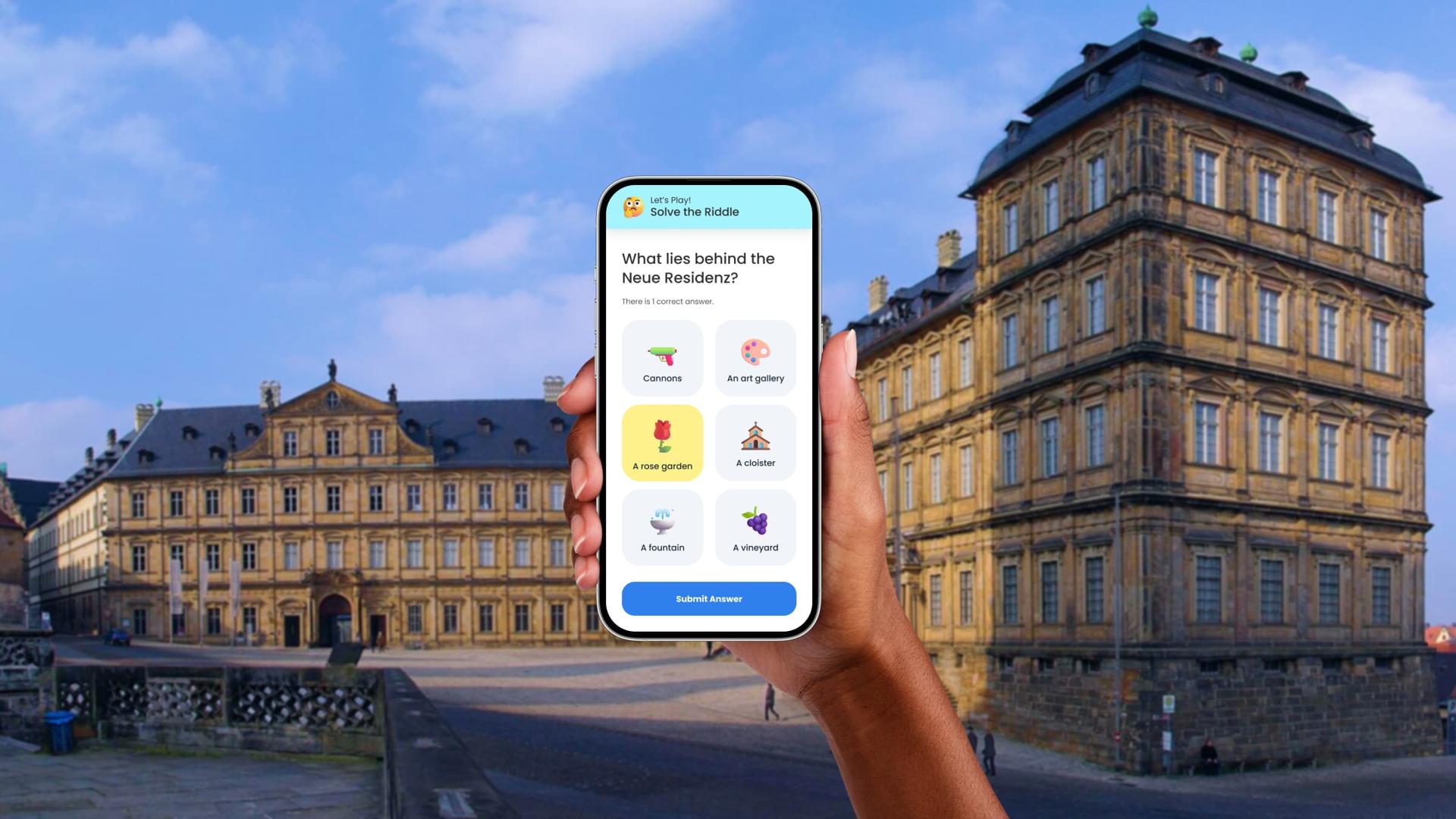
<p>Overlooking the Domplatz with regal splendor, the Neue Residenz stands as a testament to Bamberg’s golden age of power and prestige. Continuing from the Old Court, where power and faith once intertwined, the Neue Residenz represents a new era of authority and cultural ambition for Bamberg’s prince-bishops. this architectural masterpiece symbolizes a shift from medieval austerity to Baroque opulence. It is a palace that not only housed rulers but also proclaimed their authority and sophistication.</p> <img src="https://storage.googleapis.com/ciceru-assets-stg/5b3c3cd2-34de-4847-81cb-79c383ba6f65/SLZ0AQaO-bam_res-fuerstbisch-app-thronsaal790.webp" alt="undefined" style="height: auto;width: 320px"/> <blockquote>Inside the New Residence - From schloesser-bayern-de</blockquote> <p>Construction of the Neue Residenz began in 1604 under Prince-Bishop Johann Philipp von Gebsattel but reached its zenith under Prince-Bishop Lothar Franz von Schönborn between 1697 and 1703. Determined to rival the grand palaces of Vienna and Würzburg, Lothar Franz transformed the residence into a statement of power and cultural ambition. With its two majestic wings and four grand courtyards, the Neue Residenz is a harmonious blend of Renaissance symmetry and Baroque grandeur.</p> <img src="https://storage.googleapis.com/ciceru-assets-stg/5b3c3cd2-34de-4847-81cb-79c383ba6f65/dk2WJ0P9-bam_res-kaisersaal790.webp" alt="undefined" style="height: auto;width: 320px"/> <blockquote>The Imperial Hall - From schloesser-bayern-de</blockquote> <p>Inside, the Imperial Hall (Kaisersaal) steals the show. Its gilded stucco ceilings and monumental frescoes, painted by Melchior Steidl, narrate the life of Emperor Henry II, the founder of Bamberg Cathedral. These vibrant scenes glorify the divine right of the prince-bishops, linking their authority to the legacy of the Holy Roman Empire. Standing here, one feels the weight of history, surrounded by art that once proclaimed the absolute power of Bamberg’s rulers.</p> <img src="https://storage.googleapis.com/ciceru-assets-stg/5b3c3cd2-34de-4847-81cb-79c383ba6f65/hlNy0rfd-Residenz_Bamberg_Chinese_Kabinet_%282%29.webp" alt="undefined" style="height: auto;width: 320px"/> <blockquote>The Mirror Cabinet - From Wikipedia</blockquote> <p>The Mirror Cabinet, adorned with dazzling mirrors and intricate gold carvings, reflects a world of opulence. It was here that the prince-bishops held private meetings, weaving political strategies behind closed doors. The sheer extravagance of this room is a glimpse into the wealth and influence that Bamberg’s rulers once wielded.</p> <p>Yet, behind the stately walls of the Neue Residenz, there is a place that reveals the cultural sophistication of Bamberg’s rulers and offers a breathtaking view over Bamberg’s rooftops and the distant Michaelsberg Abbey.</p>

Obispo San Otto

<p>In the heart of Bamberg, the Denkmal Bischof St. Otto honors Otto of Bamberg, a pivotal figure in the city’s history. Appointed Bishop of Bamberg in 1102, Otto was a statesman and diplomat who navigated political challenges with remarkable skill. He maintained stability in Bamberg during power struggles between the Holy Roman Empire and the Papacy, securing its prosperity.</p> <img src="https://storage.googleapis.com/ciceru-assets-stg/5b3c3cd2-34de-4847-81cb-79c383ba6f65/gVL98uzI-Otto_der_Heilige.webp" alt="undefined" style="height: auto;width: 320px"/> <blockquote>Statue of Otto of Bamberg, in Monastery of Saint Michael in Bamberg - From Wikipedia</blockquote> <p>Beyond politics, Otto was a visionary builder who expanded Bamberg Cathedral and founded monasteries, transforming the city into a cultural hub. His strategic investments in architecture and education helped shape Bamberg’s influence within the Holy Roman Empire.</p> <img src="https://storage.googleapis.com/ciceru-assets-stg/5b3c3cd2-34de-4847-81cb-79c383ba6f65/yzig0m7n-800px-Heilsbronn_Mu%CC%88nster_-_Stiftungsbild.webp" alt="undefined" style="height: auto;width: 320px"/> <blockquote>The 15th century Heilbronn monastery establishment - Bishop Otto von Bamberg carries a model of the cathedral with Count Rapoto von Abenberg - From Wikipedia</blockquote> <p>Sculpted with masterful detail, Saint Otto stands with a calm yet resolute expression, embodying his leadership and vision. His gaze is firm, reflecting his determination to guide his people through political turmoil and cultural transformation. The folds of his vestments seem to ripple with movement, lending a sense of life and purpose to the statue, as if he is ready to continue his journey.</p>

Hermosa vista

<p>High above Bamberg, the Schöner Blick offers sweeping views of the city’s hills, winding rivers, and the iconic red-tiled rooftops that weave together a picturesque tapestry. This viewpoint unveils Bamberg’s rich historical layers, showcasing the city’s evolution over time. From here, you can observe how the medieval core merges with Baroque elegance, a visual story of centuries of architectural evolution and cultural growth.</p> <img src="https://storage.googleapis.com/ciceru-assets-stg/5b3c3cd2-34de-4847-81cb-79c383ba6f65/FwYWT5Va-800px-Kloster_Michaelsberg_Parkseite.webp" alt="undefined" style="height: auto;width: 320px"/> <blockquote>The historic Monastery of St. Michael - From Wikipedia</blockquote> <p>The hill itself is crowned by the historic Monastery of St. Michael, founded in the 12th century. Once a vibrant center of faith and culture, the monastery reflects the influence of the Benedictine order on Bamberg’s religious and social fabric. Today, its majestic facade stands as a testament to a time when power and spirituality were closely linked, shaping the city’s identity.</p> <img src="https://storage.googleapis.com/ciceru-assets-stg/5b3c3cd2-34de-4847-81cb-79c383ba6f65/Oi4adj2S-367px-Bamberg_Sankt_Michael_BW_12.webp" alt="undefined" style="height: auto;width: 320px"/> <blockquote>The majestic facade of St. Michael - From Wikipedia</blockquote> <p>Schöner Blick is more than a scenic viewpoint, it is a journey through history. Each view reveals the intricate relationship between nature and architecture, reflecting the vision of those who shaped Bamberg’s identity. From emperors to citizens, their legacy is woven into the city’s fabric, connecting past achievements to present-day vibrancy.</p>

Tu guía privado, en el bolsillo

¿Listo para recorrerlo todo a pie?

  • Autoguiado, cuando tú quieras
  • Audio sin conexión, 7 idiomas
  • Garantía de devolución
  • eSIM de 500 MB incluida

desde

7,00 €

1 tour autoguiado en Bamberg

Ver los tours

Planifica los días

¿Cuántos días en Bamberg? El itinerario perfecto de 1 días

Día 1

El casco antiguo de Bamberg a pie

Sigue la ruta a pie para enlazar en un solo día los puentes del casco antiguo de Bamberg, los islotes fluviales, la colina de la catedral y la arraigada tradición local de la Rauchbier.

Clima y afluencia

Mejor época para visitar

De abril a septiembre es la época ideal para largas caminatas, aunque en verano aumentan las lluvias y el turismo. De octubre a marzo el ambiente es más tranquilo, con días más fríos y cortos. Para consultar las medias climáticas exactas y las cifras de visitantes, conviene revisar los datos del DWD y los registros oficiales.

Recomendado

Fin de primavera a otoño

abr–sept

9–22°C/ 48–72°F

Mucha genteLluvia ocasional
  • Tiempo ideal para pasear
  • Posibilidad de días más lluviosos y picos de turistas

Fin de otoño a primavera

oct–mar

0–7°C/ 32–45°F

Pocos visitantesLluvioso
  • Casco antiguo más tranquilo
  • Días más cortos y temperaturas más frías

Transporte

Cómo llegar y moverse por Bamberg

A pie

Lo mejor en el casco

El centro histórico de Bamberg es muy recogido y la estación queda a unos 15 minutos a pie. Prepárate para encontrar adoquines, puentes y alguna que otra cuesta.

Autobuses de Stadtwerke

Útil en las afueras

Bamberg cuenta con unas 30 líneas de autobús urbano. La BAMBERGcard incluye el uso del autobús durante sus tres días de validez; consulta su precio actual antes de viajar.

En coche

Difícil en el centro

Conviene usar los aparcamientos disuasorios antes que meter el coche en el casco histórico. Consulta las tarifas y restricciones vigentes de estacionamiento en las páginas oficiales.

Muévete a pie por el casco histórico. Usa los autobuses de Stadtwerke para la periferia y valora la BAMBERGcard solo si compensa según los trayectos que tengas previstos.

Dónde alojarse

Dónde alojarse en Bamberg

Altstadt

Para una primera visita

La base más práctica para recorrer a pie el centro histórico y seguir la ruta propuesta. Cuenta con calles adoquinadas, ambiente animado y nula comodidad si te desplazas en coche.

Inselstadt

Paseos céntricos y tranquilos

Un enclave isleño muy céntrico con fácil acceso al casco antiguo, aunque los puentes y senderos junto al río pueden complicar el arrastre de maletas.

Wunderburg

Ambiente local

Al sur del centro, con un aire más residencial y la ventaja de poder llegar caminando al núcleo histórico. Los detalles exactos del transporte local deben verificarse.

Gaustadt

Para estancias más largas

Un barrio más apartado, ideal para quienes no tengan inconveniente en depender del autobús a cambio de un alojamiento tranquilo.

Los tours

Bamberg, historia a historia

Rasca y gana

Rasca a ver

Debajo podría haber algo bueno. Si ganas, te decimos cómo usarlo.

Un premio por viajero. Válido 2 años.

El boca a boca

Lo que dicen los viajeros

Seguridad

¿Es seguro Bamberg?

Por lo general, Bamberg es una ciudad muy segura para los viajeros. Las principales cuestiones prácticas son los adoquines, el tráfico ciclista, los accesos concurridos al casco histórico y la menor visibilidad al pasear de noche. Los números de emergencia son el 112 para bomberos y ambulancias, y el 110 para la policía.

Adoquines y puentes

Lleva calzado con buena suela y ten especial cuidado con el equipaje sobre el pavimento irregular y los puentes del casco antiguo, sobre todo si ha llovido.

El casco antiguo de noche

Mantén las precauciones habituales por las callejuelas más solitarias una vez cierran los locales; pide un taxi oficial o recurre al transporte público si no te apetece regresar a pie.

Tráfico ciclista

Mira bien a ambos lados en los pasos ciclistas y sendas compartidas; evita detenerte en mitad de callejones estrechos o en los accesos a los puentes.

Asistencia de emergencia

Llama al 112 para bomberos o ambulancias y al 110 para la policía. Si precisas atención médica no urgente, pide en la oficina de turismo o en tu hotel que te indiquen un médico.

Información útil

Conviene saber

La BAMBERGcard dura tres días

La información oficial de movilidad sostenible indica que la BAMBERGcard tiene una validez de tres días e incluye todos los autobuses de la red urbana. Revisa el precio vigente para ver si te compensa frente a los billetes sencillos.

Una treintena de líneas de autobús

Los datos oficiales de turismo cifran la red urbana de Bamberg en unas 30 líneas de autobús, una opción muy práctica si te alojas fuera del núcleo histórico peatonal.

Humo en el nombre de la cerveza

La Rauchbier es la emblemática cerveza ahumada propia de Bamberg; toda una seña de identidad que verás en las cartas locales, aunque eso no significa que aquí todas las cervezas se elaboren así.

Preguntas

Preguntas sobre Bamberg

Sí. La información turística de Bamberg sitúa la estación a unos 15 minutos a pie del centro. Con tanto adoquín y puente, agradecerás llevar buen calzado.

¿Listo para salir?

Tours de audio autoguiados por toda Bamberg.

Ver los tours en Bamberg