
Consejos y tours para exploradores y viajeros
Guía de la ciudad de Berlin
Berlín es una capital extensa y vertebrada por barrios, donde la zona C es clave para el aeropuerto BER y cada vecindario impone su propio ritmo al caer la noche.
- País
- Alemania
- Idioma
- alemán
- Moneda
- euro (EUR)
- Enchufe
- tipo F
- Zona horaria
- Europe/Berlin
- Emergencias
- 112
- Agua del grifo
- Generalmente potable
- Prefijo
- +49
Las paradas
Qué hacer en Berlin
Sumérgete en la densa historia de Berlín visitando iconos como el edificio del Reichstag, la Puerta de Brandeburgo y el histórico barrio de Nikolaiviertel.
Orígenes medievales
La capital de Prusia
Primera Guerra Mundial
Propaganda nazi
Federico II
Una puerta de triunfo
Take a look up at those twin stone towers and the five rings suspended between them. You are standing before the Olympiastadion, a structure that manages to be both magnificent and deeply unsettling at the same time. This is not just a sports venue. It is a massive, limestone-clad ghost story. Built for the 1936 Olympics under the orders of Adolf Hitler, it was designed as a neoclassical titan, drawing inspiration from both modernism and ancient Greek architecture. But notice how it doesn't tower over you like a typical stadium. To achieve that ancient, grounded feeling, the architects actually dug the field thirty-three feet into the earth. You are standing above a sunken bowl of history, designed to project a strength intended to last a thousand years. The man responsible for this austere look was Werner March, who chose the limestone casing you see to evoke a sense of permanence and the 'master race' narrative. Even the Marathon Gate on the western side was carefully placed to maintain a military-style sightline to the nearby Bell Tower. As you walk along the facade, feel the coldness of the architecture. It was built during a dark era when construction companies were forced to hire only 'Aryan' workers, explicitly excluding the Jewish community from the very soil you are standing on. It was a space designed to prove a point about racial superiority to the rest of the world. But the best part of the story is how that narrative backfired right here on these grounds. In 1936, a Black American athlete named Jesse Owens stepped into this arena and shredded the Nazi script. He didn't just win, he dominated, taking home four gold medals in front of a stunned Hitler. There is a persistent legend that Hitler refused to shake his hand out of spite. In reality, Hitler had been told to shake everyone's hand or no one's, and he conveniently chose 'none' after the first day. But the image of Owens standing on the podium, surrounded by Nazi iconography while the crowd roared for him, remains the ultimate middle finger to the regime that built this place. The locals were so fascinated by Owens that he became an overnight celebrity, captivating the German public despite the hateful ideology of the state. Since the war, Berlin has faced a difficult choice: keep it or tear it down. They chose 'vergangenheitsaufarbeitung,' which is a quintessentially German word for 'working through the past.' They de-Nazified the site by stripping the swastikas and lowering the height of the honorary stand where Hitler once sat. Since then, the stadium has been reclaimed. It has hosted the British military, the 2006 World Cup final, and Usain Bolt’s legendary world records. It is no longer a monument to a regime, but a place where the world actually comes together, regardless of what the original architects intended. Today, the Olympiastadion serves as a massive, functional reminder that you can build a monument to last a millennium, but you cannot control the spirit of the people who fill it. It is a place where the echoes of a dark past meet the cheers of a modern, diverse Europe. As you head off, take one last look at that limestone. It was meant to be a wall, but today, it is just a backdrop for the next chapter of Berlin’s story.
La noche de los cristales rotos
La reunificación alemana
Tu guía privado, en el bolsillo
¿Listo para recorrerlo todo a pie?
- Autoguiado, cuando tú quierasAutoguiado, empieza ahora o más adelante y haz una pausa cuando quieras
- Audio sin conexión, 7 idiomasHistorias en audio sin conexión, en 7 idiomas
- Garantía de devoluciónGarantía de devolución de 30 días
- eSIM de 500 MB incluidaeSIM global de 500 MB incluida
desde
7,00 €
1 tour autoguiado en Berlin
Planifica los días
¿Cuántos días en Berlin? El itinerario perfecto de 1 días
Recorre los barrios de Berlín en tren y a pie
Conecta los barrios de Berlín en U-Bahn y S-Bahn, y luego baja el ritmo para saborear cada distrito paso a paso, mientras la ciudad se va abriendo entre parques, canales y vida nocturna.
7,00 € →Clima y afluencia
Mejor época para visitar
Mayo, junio y septiembre son los meses más equilibrados para recorrer Berlín a pie. Julio y agosto traen el calor y las mayores aglomeraciones; enero y febrero son los más tranquilos.
Invierno y primavera
ene–jun-2–24°C/ 28–75°F
Pocos visitantes
- Museos y paseos en el parque
Verano y otoño
jul–dic5–25°C/ 41–77°F
Pocos visitantes
- Cultura y tardes al fresco
Los tours
Berlin, historia a historia
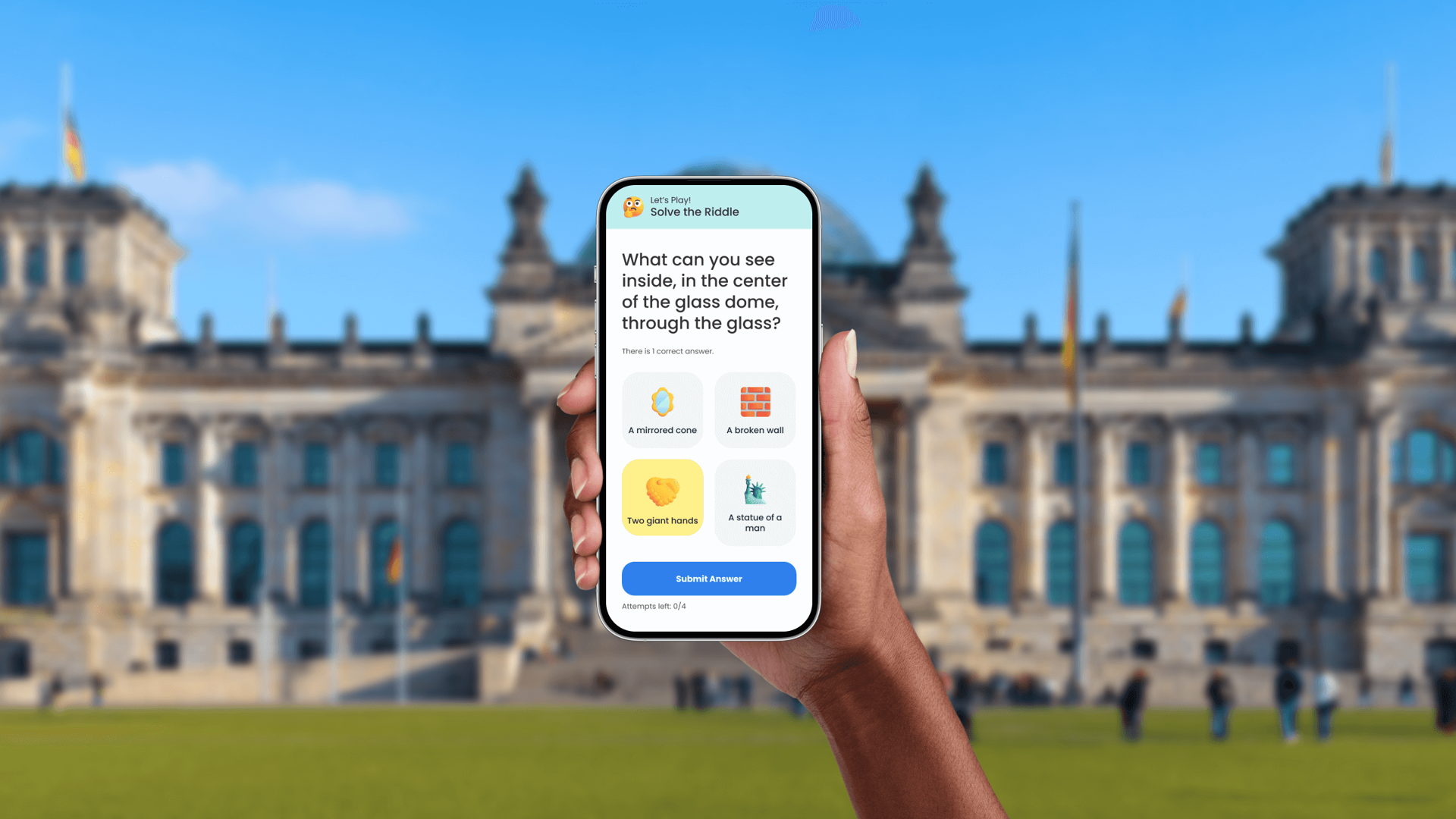
7 €2 horas
Berlín a través de los tiempos
 Andrea Rabinelli
- Audio
- Quizzes
- Multijugador
- eSIM gratis
Rasca y gana
Rasca a ver
Debajo podría haber algo bueno. Si ganas, te decimos cómo usarlo.
Un premio por viajero. Válido 2 años.
El boca a boca
Lo que dicen los viajeros

Seguridad
¿Es seguro Berlin?
Berlín suele ser una ciudad segura para el visitante, pero no deja de ser una gran capital con focos de carteristas, ciertos riesgos nocturnos y un tráfico denso. Anda con ojo en las estaciones, junto a las vías del tranvía y por los senderos de los parques al anochecer. Llama al 112 para ambulancias o bomberos, y al 110 para la policía.
Hurtos en estaciones
Vigila el móvil y la cartera en Hauptbahnhof, Alexanderplatz, Zoologischer Garten y en los intercambiadores de S-Bahn más concurridos.
Vida nocturna
Muévete por calles bien iluminadas en torno a Warschauer Straße y Kottbusser Tor, y no aceptes bebidas ni traslados de desconocidos.
Tráfico de tranvías
Cruza las vías únicamente por los puntos señalizados y no te descuides en las zonas compartidas entre peatones y bicis.
Para leer
Lee más sobre Berlin

Historia16 min de lectura
Rutas a pie autoguiadas por Alemania: elige tu recorrido
Última actualización: septiembre de 2026
Leer másHistoria13 min de lectura
¿Qué cierra en Alemania? Domingos y normativa para 2027
Última actualización: agosto de 2026
Leer másHistoria8 min de lectura
Controles fronterizos dentro de Europa: qué llevar
Controles temporales, documentos de viaje y sistemas de entrada de la UE, verificado el 31 de agosto de 2026.
Leer másHistoria4 min de lectura
Los 5 mejores clubes techno de Berlín en 2025: el ritmo continúa
En 2025, Berlín sigue reinando como capital del techno, incluso cuando la ciudad se enfrenta al aumento de los alquileres, al cierre de clubes y a la siempre presente tensión…
Leer másPreguntas
Preguntas sobre Berlin
Sí, el aeropuerto BER está en la zona tarifaria C, por lo que cualquier trayecto entre el aeropuerto y el centro de Berlín requiere un billete ABC.
Sí, lo mejor es coger el tren para los trayectos largos y explorar cada barrio a pie. Comprueba siempre la zona antes de comprar el billete.
Llama al 112 si necesitas una ambulancia o a los bomberos, y al 110 para la policía.