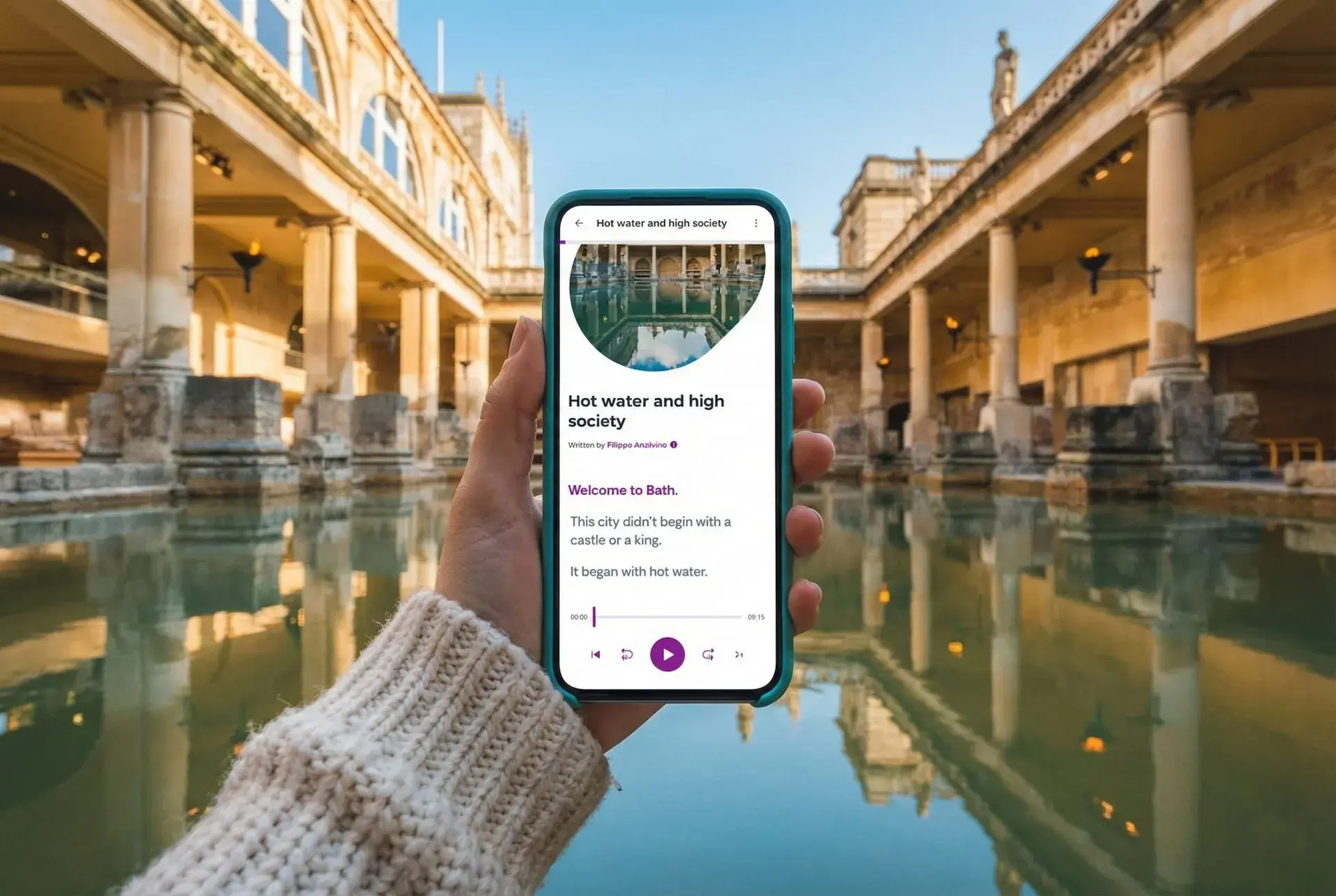
Agua caliente y alta sociedad
<p>Welcome to Bath.</p> <p>This city didn't begin with a castle or a king. It began with hot water.</p> <p>On this Ciceru tour, we are going to trace the city's rise, both literally and socially. We will walk from the ancient river level up to the exclusive heights of the Royal Crescent. It is a journey through Roman engineering, Medieval grit, and the golden architecture of the Georgian era.</p> <p>I’ll be your guide to the stories hidden in the limestone. We have a lot of ground to cover, so let’s get moving.</p> <p>We start our journey here in the Abbey Churchyard. While the queue next to you might be long, the history beneath your feet is even longer.</p> <p>You are currently standing on top of Aquae Sulis. This was the Roman name for the city, meaning "The Waters of Sulis." When Roman engineers arrived here around 70 AD, they found a hot, swampy spring revered by the locals. But the Romans didn't just conquer the site. They translated it.</p> <p>They took the local Celtic goddess, Sulis, and identified her with their own goddess, Minerva. This wasn't a crude mash-up of a nature spirit and a war deity. It was a sophisticated theological merger based on their shared power of healing and wisdom. The result was Sulis Minerva, a powerful figure who presided over a complex of pools that were as much a hospital as they were a place of worship.</p> <p>The building you see in front of you is the Grand Pump Room. It is much newer, built in the 1790s. This is where high-society Georgians would come to drink the water rather than swim in it. If you look at the Greek inscription above the columns, it reads Ariston Men Hydor, or "Water is Best."</p> <p>Although you are standing on the dry pavement of the 21st century, the ancient plumbing is still hard at work below you. The spring gushes over a million liters of water every day at a steaming 46°C.</p> <p>Beneath the museum floor, the original Roman drain still functions. It carries the waste water out to the river just as it did two thousand years ago. We call that heritage hydraulics.</p> <p>But it wasn't all wellness and relaxation down there. The Romans also used the sacred spring to air their grievances. Archaeologists have found lead "curse tablets" thrown into the water, inscribed with angry messages to the goddess. They usually asked for revenge against thieves or unfaithful lovers. It seems that even in the first century, people loved leaving a bad review.</p> <p>This spot is the thermal heart of the city. Everything we will see next, from the Abbey to the grand houses on the hill, only exists because the Romans decided to stop here for a soak.</p> <p>Now, turn your attention to the massive stone structure looming right next to the Baths. It is time to look at the Medieval layer of the city.</p>