Bath Abbey

Conseils et visites pour explorateurs et voyageurs

Guide de la ville de Bath

Bath est la seule ville du Royaume-Uni entièrement classée au patrimoine mondial de l'UNESCO, célèbre pour la pierre dorée de Bath qui habille le Royal Crescent et The Circus, sans oublier ses antiques thermes romains.

Pays
Royaume-Uni
Langue
anglais
Devise
livre sterling (GBP)
Prise
type G
Fuseau horaire
Europe/London
Urgences
112, 101 et 999
Eau du robinet
Potable
Indicatif
+44

Les étapes

Que faire à Bath

Le cœur de Bath, classé à l'UNESCO, fait dialoguer archéologie romaine et urbanisme géorgien dans une ville taillée pour la marche. Des thermes romains à l'abbaye de Bath, jusqu'aux courbes spectaculaires du Royal Crescent, ses monuments les plus emblématiques se découvrent facilement à pied.

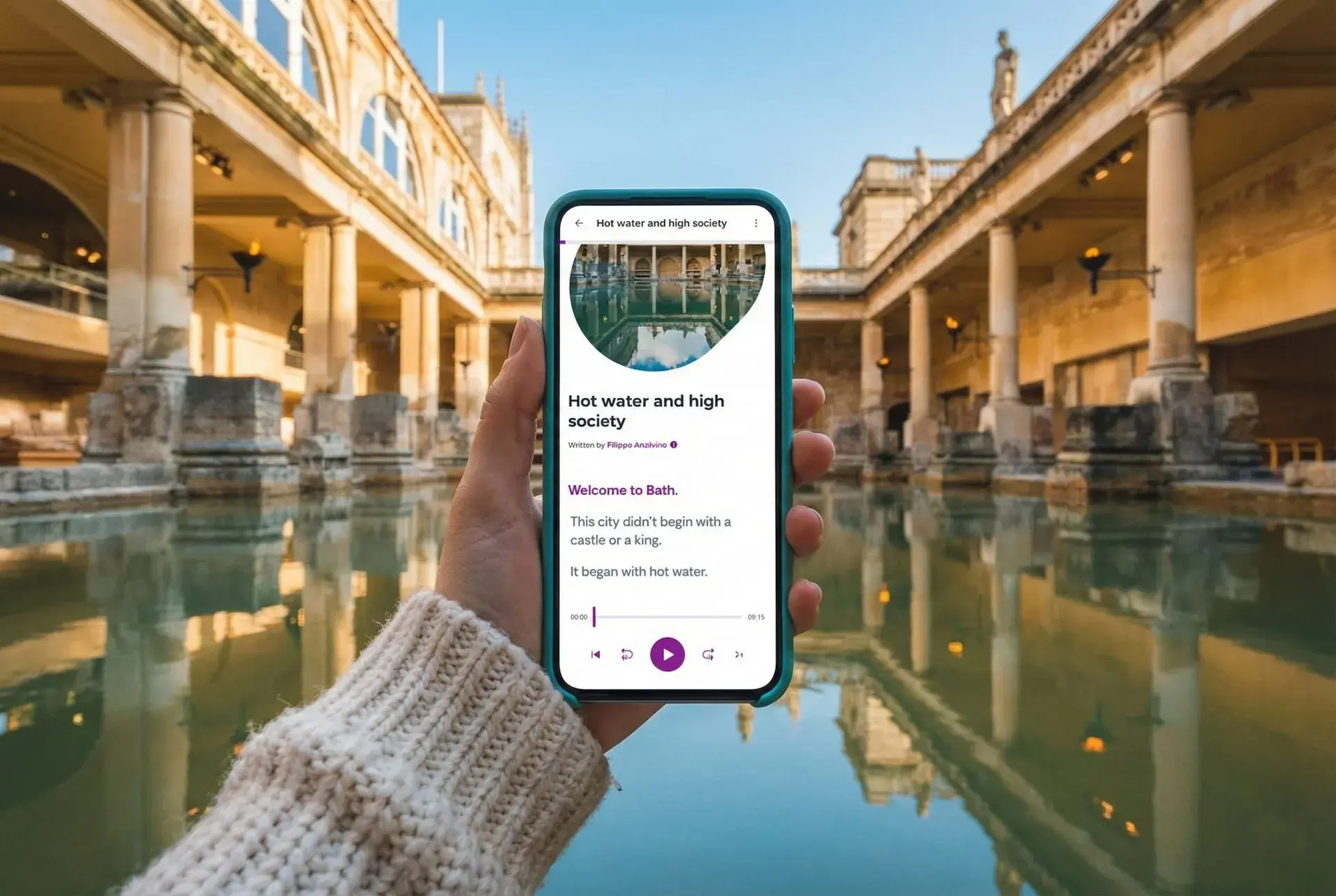
Eau chaude et haute société

<p>Welcome to Bath.</p> <p>This city didn't begin with a castle or a king. It began with hot water.</p> <p>On this Ciceru tour, we are going to trace the city's rise, both literally and socially. We will walk from the ancient river level up to the exclusive heights of the Royal Crescent. It is a journey through Roman engineering, Medieval grit, and the golden architecture of the Georgian era.</p> <p>I’ll be your guide to the stories hidden in the limestone. We have a lot of ground to cover, so let’s get moving.</p> <p>We start our journey here in the Abbey Churchyard. While the queue next to you might be long, the history beneath your feet is even longer.</p> <p>You are currently standing on top of Aquae Sulis. This was the Roman name for the city, meaning "The Waters of Sulis." When Roman engineers arrived here around 70 AD, they found a hot, swampy spring revered by the locals. But the Romans didn't just conquer the site. They translated it.</p> <p>They took the local Celtic goddess, Sulis, and identified her with their own goddess, Minerva. This wasn't a crude mash-up of a nature spirit and a war deity. It was a sophisticated theological merger based on their shared power of healing and wisdom. The result was Sulis Minerva, a powerful figure who presided over a complex of pools that were as much a hospital as they were a place of worship.</p> <p>The building you see in front of you is the Grand Pump Room. It is much newer, built in the 1790s. This is where high-society Georgians would come to drink the water rather than swim in it. If you look at the Greek inscription above the columns, it reads Ariston Men Hydor, or "Water is Best."</p> <p>Although you are standing on the dry pavement of the 21st century, the ancient plumbing is still hard at work below you. The spring gushes over a million liters of water every day at a steaming 46°C.</p> <p>Beneath the museum floor, the original Roman drain still functions. It carries the waste water out to the river just as it did two thousand years ago. We call that heritage hydraulics.</p> <p>But it wasn't all wellness and relaxation down there. The Romans also used the sacred spring to air their grievances. Archaeologists have found lead "curse tablets" thrown into the water, inscribed with angry messages to the goddess. They usually asked for revenge against thieves or unfaithful lovers. It seems that even in the first century, people loved leaving a bad review.</p> <p>This spot is the thermal heart of the city. Everything we will see next, from the Abbey to the grand houses on the hill, only exists because the Romans decided to stop here for a soak.</p> <p>Now, turn your attention to the massive stone structure looming right next to the Baths. It is time to look at the Medieval layer of the city.</p>
L'échelle des anges

<p>At first glance, Bath Abbey looks like a Gothic cathedral that has learned to smile politely. Its lacy stone facade and sprawling windows catch the sunlight with improbable optimism. This is especially impressive for a building that has been sacked, neglected, and rebuilt more times than your average Tudor table.</p> <p>It began in the 7th century as a monastery, but the structure standing before you is a 15th-century reboot in the Perpendicular Gothic style. Note the high ceilings and the massive tall windows. The walls seem unsure whether they are structural or merely decorative frames for the glass.</p> <p>Now, let’s address a local myth. You will often hear that this site hosted the coronation of England’s "first" King, Edgar, in 973 AD. That is not entirely true.</p> <p>Athelstan, his uncle, was actually crowned King of the Anglo-Saxons nearly fifty years earlier in 925 AD. However, Bath still holds a vital place in royal history. Edgar’s ceremony here introduced a specific service and liturgy that created the template for every British coronation that followed. So while he wasn't the first, he set the style that Charles III used over a thousand years later.</p> <p>Turning your eyes to the stone facade itself, the West Front demands a pause. Look closely at the turrets flanking the main window. You will see angels climbing up and tumbling down stone ladders.</p> <p>This unique design was inspired by a dream allegedly sent to Bishop Oliver King in 1499. It was possibly a divine epiphany, or possibly the result of questionable wine. Regardless of the source, the imagery stuck. It makes for a compelling sermon carved directly into the limestone.</p> <p>Because we are staying outside, you can't smell the beeswax or hear the choir, but you can appreciate why this building is nicknamed the "Lantern of the West." The walls are more glass than stone. If you were to step inside, you would find yourself surrounded by over 1,000 memorial tablets on the walls. It serves as a densely annotated "Who's Who" of Georgian grief. It is part church and part vertical graveyard.</p> <p>It is easy to be distracted by the grandeur. Yet the Abbey’s most enduring trait is continuity. Despite regimes, reforms, and restorations, it persists in holy matrimony with its historic setting.</p> <p>Tucked around the corner, a humbler structure claims both culinary fame and medieval roots. Let’s go sample the famous Bath Bun at one of the city's oldest houses.</p>

Une bouchée de 1482

<p>Few buildings dare to boast both medieval architecture and a menu. Sally Lunn’s pulls it off.</p> <p>You are standing in front of one of the oldest houses in Bath. Dating back to 1482, this structure was already old before Henry VIII had his first heartbreak. If you look at the rough stone masonry and the way the house sits slightly lower than the modern street level, you can see how much the city has risen around it over the centuries.</p> <p>Now, let’s talk about the legend. You might hear a romantic story about a French Huguenot refugee named "Solange Luyon" who fled to Bath in 1680 to bake brioche.</p> <p>I hate to ruin a good story, but that is likely a fabrication. Historical records suggest the "Solange" character was invented in 1937 by the tea shop owner, Marie Byng-Johnson, to add a little French flair to her marketing. The real "Sally Lunn" was more likely a hawker selling buns in the streets of Bath in the late 1700s.</p> <p>But while the baker might be a myth, the bun is very real. It is a golden, airy carb-cloud that tourists queue for daily.</p> <p>There is another secret here that you cannot see from the alley. Beneath the floorboards of the dining room lies a Roman hypocaust system.</p> <p>This was the ancient version of central heating. Hot air from a furnace was circulated through empty spaces under the floor, keeping the Romans warm in the damp British winter. It is a literal "hot plate" of the Empire resting right beneath the modern bakehouse.</p> <p>Locals treat this place like a mildly eccentric aunt. It is loved, a bit theatrical, and possibly stretching the truth, but it is part of the family regardless. Because in Bath, even your bun tells a story.</p> <p>After a bite steeped in legend, let’s retreat to a quieter pleasure. We will head to the riverside gardens for a view of the famous weir.</p>

Flirter sous surveillance

<p>Look down over the stone balustrade into the manicured green space below. This is Parade Gardens.</p> <p>In the 18th century, this was the answer to a specific social problem. The city planners needed a place where the wealthy could flirt under supervision.</p> <p>Planted with both flowers and strict codes of Georgian decorum, it quickly became Bath’s open-air ballroom. It was a genteel promenade for spa-goers to dry off after their morning plunge.</p> <p>Today, the gardens feed packed lunches and selfie sticks rather than scandalous glances. But the fragrance of precisely arranged blooms still wafts up with practiced grace.</p> <p>They may look like just another park, but dig a little and you will find the past refusing to stay buried.</p> <p>In 1997, an archaeological excavation took place right beneath those neat flower beds. You might hear rumors that they discovered a lost Roman temple precinct here.</p> <p>That is a lovely thought, but it is untrue.</p> <p>What they actually found was the "Great Drain". This was the massive Roman culvert designed to carry waste and overflow away from the Baths and into the river.</p> <p>It seems we often go looking for sacred architecture and find plumbing instead. But in Bath, the plumbing is just as impressive as the temples.</p> <p>Back in the Georgian heyday, entry into these lawns required the right pedigree and a subscription fee. Today you still have to pay a small fee to enter, but the only pedigree required is a tolerance for goose prints.</p> <p>Nothing mythic springs from Parade Gardens today unless you count high-society gossip. But its role endures as a pause button in a city built for display.</p> <p>From this vantage point, turn your head to the left. You are perfectly positioned to see our next stop. It is one of only a few bridges worldwide with shops built into its structure.</p>

Le pont florentin

<p>Pulteney Bridge might be the closest Bath gets to theatrical overkill. It is a graceful Georgian structure draped in boutiques and strewn across the Avon like a limestone doily.</p> <p>Built in 1774 by Robert Adam, it is often said that this bridge was built to rival the Ponte Vecchio in Florence. That is a nice story, but the truth is more local and mercenary.</p> <p>The bridge was actually a piece of aggressive real estate marketing. The landowner, William Pulteney, wanted to connect his estate in Bathwick to the city center. He wasn't trying to outshine Florence. He was trying to compete with the fashionable west side of Bath.</p> <p>Adam’s design is technically a copy of a copy. He based it on Andrea Palladio’s rejected design for the Rialto Bridge in Venice.</p> <p>You might hear a rumor that Adam originally wanted a massive central dome here but was rejected due to cost. That is a case of mistaken identity. Adam never planned a central dome. He designed a temple-like pediment for the center and placed small saucer domes on the pavilions at the far ends. Furthermore, his design wasn't rejected for being too expensive. In fact, his expensive plan was chosen over a cheaper rival.</p> <p>As you walk across, you will notice shops lining both sides. Unless you lean over the parapet to look at the roaring weir below, you might not notice you have crossed water at all. This was exactly the sort of sleight of hand Georgian planners delighted in.</p> <p>Legend also whispers of secret rooms and passageways hidden in the bridge's underbelly.</p> <p>In reality, these "secrets" are well-documented shop cellars and structural voids designed to handle floods. It turns out that in Bath, even the mysteries have practical explanations.</p> <p>Now, let's head uphill to where tailoring once met literary cameos. We are going to window shop along the street favored by Jane Austen's characters.</p>

Le défilé de mode

<p>Milsom Street has always known its angles.</p> <p>Laid out in the mid-18th century with a gentle curve and a hint of architectural swagger, it was Bath’s catwalk long before that meant flashing cameras. Here, wealth wasn’t hidden. It was tailored, perfumed, and on public display. Think Fitzwilliam Darcy with a pocket watch addiction.</p> <p>During the Georgian era, this was the epicenter of polite consumerism. It was packed with tailors, milliners, bookstores, and jewelers.</p> <p>Jane Austen, never one to miss a detail, made Milsom Street a recurring character in her novels. You might read in some guidebooks that she described this as Bath’s "principal street of entrance." That is actually a misquote. In Northanger Abbey, her characters usually stayed in Great Pulteney Street or the Paragon. However, Milsom Street was the undisputed social hub where they went to check the windows, track down fashionable hats, and accidentally-on-purpose run into eligible bachelors.</p> <p>Today, it remains a retail thoroughfare, albeit one dressed in Zara rather than muslin. The architecture is still the star. Look at the restrained facades in Bath stone. Notice the bow windows on the upper floors that seem to watch passersby like silent chaperones.</p> <p>Under the cobbles, rumor has it there are clandestine passageways. Locals might tell you these were Georgian shortcuts for illicit affairs. That is probably untrue. They were likely just service vaults for coal and deliveries. But the idea that fashion once required escape routes is, in itself, delightfully on-brand for Milsom Street.</p> <p>The rhythmic clack of shoes still echoes here. It confirms that style in Bath has never really gone out of fashion. It just updates seasonally.</p> <p>Just a few doors away awaits the city’s most famous reluctant resident. Let’s go see where the legend of Jane Austen meets the souvenir shop.</p>

Le résident réticent

<p>The Jane Austen Centre has a simple premise. What if we took a woman known for social satire and turned her into a waxwork?</p> <p>It is housed in this classic Georgian townhouse here on Gay Street. This is just a stone’s throw from where Austen actually lived. She resided higher up the hill at number 25 after her father died.</p> <p>If you are lucky, you will see a staff member in full Regency costume standing right here by the door. It is proof that top hats and petticoats never go out of fashion if you ignore the weather forecast.</p> <p>Austen lived in Bath from 1801 to 1806. She did not love it. In fact, she found it noisy, hot, and expensive. But she mined it for material. She used the streets you have just walked as the social petri dishes for her novels Northanger Abbey and Persuasion.</p> <p>There is no great myth here, unless you count the persistent rumor that Austen adored Bath. She didn't. But locals have embraced her anyway. They have effectively turned her mild disdain into excellent marketing.</p> <p>Even if you don't go inside, the building itself is a perfect example of the architecture she would have known. Gay Street acts as a connector. It links the commercial buzz of Milsom Street below to the exclusive residential heights above.</p> <p>Now, let's make that climb ourselves. Turn from fiction to geometry. We are going to marvel at a masterpiece of Georgian architecture comprised of three curved segments of townhouses.</p>

Le Colisée du Druide

<p>Designed by John Wood the Elder and finished by his son in 1768, the Circus is a platinum example of what happens when British eccentricity meets Roman obsession.</p> <p>From above, the layout looks like a key. Some say it is a Masonic symbol. Others say it represents the eye of a serpent.</p> <p>You will often hear guides claim that the diameter of this circle is the same as the Colosseum in Rome. That is a myth. The Colosseum is nearly double the size of this space.</p> <p>The diameter here is exactly 318 feet. That number was chosen deliberately to match the outer earth bank of Stonehenge. John Wood was obsessed with the Druids. He believed Bath was a lost British Troy.</p> <p>However, the design of the houses is definitely Roman. Wood modeled the facades on the Colosseum but turned inside out. He didn't do this because he loved Rome. He did it because he believed the Romans had plagiarized the style from the Jewish Temple of Solomon and the British Druids. He was trying to reclaim the architecture for its "original" owners.</p> <p>Look closely at the three tiers of columns.</p> <p>They progress in complexity as they go up. The bottom is plain Doric. The middle is scrolled Ionic. The top is flowery Corinthian. It represents the ascent of civilization.</p> <p>On the roofline, you will see stone acorns. This is another nod to the Druids who worshipped the oak tree.</p> <p>In the center of the grassy circle, you see massive London Plane trees. Locals might tell you these were planted to match the height of the buildings. That is also untrue.</p> <p>The original design had no trees at all. It was a paved open theatre. Today, these trees tower over the rooftops and completely dwarf the Georgian architecture. They are beautiful, but they are very much an accident of history rather than a piece of precision planning.</p> <p>Whether or not the Circus forms a geomantic key, it unlocks a curious truth. Bath’s past was never just about order. It was about spectacle, belief, and the audacity of geometry.</p> <p>Step just beyond the circus arc to behold the finale. We are heading to the iconic crescent of 30 Grade I listed terraced houses.</p>

Le triomphe architectural

<p>We have arrived at our final stop. The Royal Crescent looks like it landed here during a particularly elegant apocalypse.</p> <p>Thirty townhouses in a perfect curl, designed by John Wood the Younger and built between 1767 and 1774, it was less "housing" and more of a real estate mic drop. Executed in the Palladian style with a dramatic sweep of Ionic columns, the Crescent was Bath’s answer to Versailles. It just came without the fountains and with more sheep.</p> <p>If you look at the lawn, you might notice a sunken fence line. This is called a "Ha-Ha." It was a clever landscape trick designed to keep the livestock out of the garden without interrupting the view from the drawing room windows.</p> <p>Behind the uniform front facade, however, lies chaos. Each owner finished their interior and rear as they pleased. If you were to see the back of the building, it looks like a row of rowdy cousins dressed for different occasions.</p> <p>Originally, this street was simply called "The Crescent." It did not gain the "Royal" prefix from Queen Charlotte, as rumors often claim. She visited later. The honorific was actually adopted around 1795 to celebrate a visit by Prince Frederick, the Duke of York.</p> <p>This is Bath at its most theatrical. It is a building that performs even when it is doing absolutely nothing.</p> <p>If you are not quite ready to end your exploration here, the city has a few more secrets tucked away. You might wander down Great Pulteney Street to find the Holburne Museum, which served as a grand estate in Bridgerton and houses a fantastic art collection. For a greener escape, the Skyline Walk offers panoramic views, or you can find the authentic Palladian Bridge in Prior Park Landscape Garden. And if all this history has made you hungry, you are in luck. You could return to the Pump Room for a traditional afternoon tea with a side of classical music, or for something less formal but equally legendary, seek out The Scallop Shell for what many claim is the best fish and chips in the country.</p> <p>From all of us at Ciceru, thank you for letting us share Bath’s social climb with you. We hope you enjoyed the Romans, the rumors, and the architecture. We cannot wait to walk with you again soon. Goodbye!</p>

Votre guide privé, dans la poche

Prêt à aller les voir à pied ?

  • En autonomie, quand vous voulez
  • Audio hors ligne, 7 langues
  • Satisfait ou remboursé 30 jours
  • eSIM mondiale 500 Mo incluse

à partir de

5,00 €

1 visite autonome à Bath

Voir les visites

Planifier les jours

Combien de jours à Bath ? L'itinéraire parfait en 1 jours

Jour 1

Cité thermale romaine sur l'Avon

Parcourez le centre historique et compact de Bath avec notre catalogue de visites, puis prenez le temps de longer la rivière et d'arpenter les larges avenues géorgiennes.

Météo et affluence

Meilleure période pour partir

L'été offre le meilleur climat et des festivals animés, mais apporte foule et tarifs au plus haut. D'avril à mai et de septembre à octobre, l'arrière-saison promet plus de douceur et moins de monde. L'hiver est la période la plus calme et abordable, bien que froide et humide, avec un pic d'affluence pour le marché de Noël.

Recommandé

Hiver

déc.–févr.

2–8°C/ 36–46°F

Peu de visiteursHumide
  • Saison fraîche
  • Temps froid et pluvieux
  • Journées courtes

À ne pas manquer

  • Marché de Noël de Bath

Printemps

mars–mai

4–17°C/ 38–63°F

Ça se remplitPluies occasionnelles
  • Retour des beaux jours
  • Averses imprévisibles

À ne pas manquer

  • Festival de littérature de Bath

Été

juin–août

11–22°C/ 51–71°F

Haute saisonPluies occasionnelles
  • Période la plus chaude
  • Saison des festivals d'été
  • Forte affluence
  • Prix des hébergements en hausse

À ne pas manquer

  • Bath Pride

Automne

sept.–nov.

5–19°C/ 41–66°F

Beaucoup de mondeHumide
  • Festival Jane Austen
  • Pluies fréquentes
  • Tombée de la nuit précoce

À ne pas manquer

  • Festival Jane Austen

Transports

Aller à Bath et s’y déplacer

Aéroport de Bristol (BRS)

Aller à Bath et s’y déplacer
First Bus A4 Airport Flyer~60 min~9,50 £GB

Londres Paddington (LON)

Aller à Bath et s’y déplacer
Train GWR vers Bath Spa85 min~45,00 £GB

Bus local

Périphérie, collines

First West of England dessert Bath et sa périphérie pour environ 2,60 £ le trajet. Paiement sans contact, via appli ou appoint en espèces. La carte Oyster londonienne n'est pas acceptée.

À pied

Idéal pour explorer

Compacte, Bath réunit ses sites phares à moins d'un kilomètre. Le centre étant pavé, prévoyez de bonnes chaussures et prenez garde aux bus dans les ruelles étroites.

Taxis et VTC

En soirée ou urgence

Taxis au compteur et Uber démarrent vers 2 £, plus 2 à 3 £ le km. Pratiques la nuit ou chargés de bagages, ils restent bien plus onéreux que la marche ou le bus.

Vélo en ville

Pour les résidents

Les vélos en libre-service de Bath exigent des coupons réservés aux résidents. Entre pistes cyclables rares et collines abruptes, le vélo reste peu adapté aux visiteurs.

La marche reste idéale pour explorer le centre de Bath, ses sites majeurs tenant dans un rayon d'un kilomètre. Les bus locaux relient la périphérie, mais sont superflus au centre.

Budget

Quel budget pour visiter Bath ?

Quatrième ville la plus chère du Royaume-Uni, Bath pèse lourd sur l'hébergement et la restauration, où repas et verres au pub dépassent la moyenne nationale. Les restaurants ajoutent souvent un service facultatif de 10 à 15 % ; comptez environ 20 à 40 £ par jour pour vos repas.

Quel budget pour visiter Bath ?
Café (cappuccino)1,89 £GB–4,75 £GB
Sandwich (formule déjeuner)2,75 £GB–4,25 £GB
Bière (pinte de pub, 0,5 l)6,00 £GB
Billet de bus local aller simple2,60 £GB
Bouteille d'eau (0,5 l)0,22 £GB–1,20 £GB

Cash or card?

Les cartes bancaires sont acceptées partout ou presque à Bath : le sans-contact domine dans les bus, boutiques et restaurants. Même les stands de marché prennent la carte et le liquide. Les distributeurs, nombreux au centre, n'appliquent pas de frais propres à la ville.

Où dormir

Où dormir à Bath

Centre de Bath

Idéal pour un premier séjour

Aux portes des thermes romains, de l'abbaye et des boutiques, ce cœur piéton met tout à deux pas. En contrepartie, les hôtels y sont très chers et les rues centrales parfois animées.

Walcot et Green Park

Artisanat et cafés branchés

À dix minutes à pied du centre, Walcot Street compte galeries indépendantes, marchés vivants et pubs de caractère. Ses rues sont étroites et le stationnement très rare.

Combe Down

Atmosphère de village

Perché et paisible, ce village historique convient aux familles avec ses commerces. Rejoindre le centre de Bath exige toutefois une bonne montée au retour ou 20 à 30 minutes de bus.

Larkhall

Pubs locaux et épiceries fines

Au sud du centre, ce quartier offre rue commerçante et maisons d'hôtes abordables. Un peu loin pour rallier les sites à pied, il subit aussi le bruit de la rocade voisine.

Les visites

Bath, une histoire à la fois

Gratte et gagne

Vas-y, gratte

Il y a peut-être quelque chose de bien là-dessous. Si tu gagnes, on te montre comment l'utiliser.

Un lot par voyageur. Valable 2 ans.

Le bouche-à-oreille

L’avis des voyageurs

Sécurité

Bath est-elle sûre ?

Bath est une ville sûre selon les normes britanniques, avec une criminalité globalement faible. Les délits les plus courants sont de petits vols et du vol à l'étalage dans les lieux très fréquentés et près des gares. En prenant quelques précautions d'usage et en restant vigilant dans les rues bondées, votre séjour se passera sans le moindre accroc.

Vols à la tire et larcins

Des vols à la tire visent les lieux très fréquentés : thermes romains, marché de Noël ou abords des gares ferroviaire et routière. Gardez vos objets de valeur en lieu sûr et fermez bien vos sacs dans la foule.

Trafic en ruelles étroites

Les rues historiques peuvent être encombrées de bus, de taxis et de cyclistes se partageant des voies étroites. Empruntez les passages piétons balisés sur des axes comme Milsom Street et près de Victoria Park, et surveillez la circulation.

Zone à faibles émissions

Bath applique une zone à faibles émissions au centre-ville, taxant utilitaires, taxis et camionnettes les plus anciens. Si les voitures des résidents sont exemptées, vérifiez la conformité de votre véhicule avant d'entrer.

Services d'urgence

Composez le 999 ou le 112 pour la police, les pompiers ou le Samu, et le 111 (NHS) pour un souci non urgent. En cas de besoin, le Royal United Hospital (RUH Bath) dispose de services médicaux complets.

Bon à savoir

Bon à savoir

Goûter un Bath bun traditionnel

Inventé au XVIIIe siècle, le Bath bun est une brioche emblématique parsemée de sucre perlé. Dégustez-la encore tiède avec un thé du matin dans un salon de thé local ou chez Sally Lunn's Historic Eating House.

Commerces : horaires dominicaux réduits

Beaucoup de boutiques indépendantes et de cafés de Bath ferment plus tôt le dimanche, souvent dès 17 h. Si les restaurants et les pubs restent ouverts plus tard, anticipez vos achats et emplettes plus tôt dans le week-end.

Pavage historique irrégulier

Églises et édifices géorgiens de Bath présentent souvent des dallages en pierre usés et irréguliers. De bonnes chaussures de marche sont vivement conseillées pour arpenter ces demeures historiques et les rues pavées.

Pierre de Bath protégée

Le calcaire couleur miel de Bath est protégé par la loi, avec de lourdes amendes en cas de dégradation. Ces façades révèlent leurs reflets les plus chaleureux au lever comme au coucher du soleil.

Questions

FAQ sur Bath

La navette A4 Airport Flyer de First Bus relie le terminal des arrivées de l'aéroport de Bristol au centre-ville de Bath toutes les heures, pour un trajet d'environ 60 minutes. Le billet simple coûte environ 9,50 £ et s'achète directement à bord.

Prêt à partir ?

Visites audio en autonomie dans tout Bath.

Voir les visites à Bath