Albert Memorial Clock

Conseils et visites pour explorateurs et voyageurs

Guide de la ville de Belfast

Belfast conjugue son passé industriel victorien et l'héritage naval du Titanic avec un centre compact et facile à explorer à pied, où les pubs animés du Cathedral Quarter et les fresques politiques ne sont qu'à quelques minutes les uns des autres.

Pays
Royaume-Uni
Langue
anglais et irlandais
Devise
livre sterling (GBP)
Prise
type G
Fuseau horaire
Europe/London
Urgences
112 et 999
Eau du robinet
Potable
Indicatif
+44

Les étapes

Que faire à Belfast

Explorez Belfast à pied pour relier son imposante architecture édouardienne et son histoire maritime aux ruelles pavées, aux palais du gin d'époque victorienne et aux fresques modernes du Cathedral Quarter.

La scène résiliente de l'opéra

Welcome to Belfast, where theatre and thunder often compete for the same applause. This is a city that wears its scars and sequins without apology—a place as known for industrial grit as for fierce cultural defiance. From the calloused hands that built ships and spun linen, to the pens that scribbled revolutions in pubs, Belfast's story is one of resilience draped in creativity. As you walk its streets, you'll encounter buildings that argue with gravity, pubs that have survived more than their license renewals, and murals that refuse to be mere decoration. This tour offers a glance at the spaces where history performed its long, complicated rewrite—where art, politics, architecture, and local wit collide. We begin where the lights dim and the curtains rise: a grand old dame whose survival is as dramatic as any scene she's staged. The Grand Opera House has the confident swagger of a venue that knows it has hosted more drama in its walls than on its stage. Built in 1895 by the architectural showman Frank Matcham, this Victorian theatre stands like a diva frozen mid-curtain call. It is plush, flamboyant, and absolutely unapologetic. It has survived war, economic downturns, and local politics. It is less a building and more a resilient actor refusing to exit stage left. Blitzed in 1941 and rattled by bombs during the Troubles, the Grand never quite took a final bow, though it came dangerously close. By the 1970s, it was shuttered and nearly demolished to make way for office blocks, only to be saved at the eleventh hour. During the Second World War, it doubled as a morale machine. It staged pantomimes and repertory shows for a weary public and allied troops who badly needed a dance number or two. In a city full of literal walls, this one chose curtains. As you look at the facade, you will notice the distinct "Oriental" influence that Matcham loved. This exotic exterior of red brick and cast stone is merely the overture. If you could peek inside, you would see that the theme explodes into gilded plasterwork, including famous elephant heads that crown the private boxes. The theatre’s real legacy, however, is less visual than social. It served as a neutral bubble floating above the sectarian grid, where even the darkest days could not keep the footlights off for long. Today, it remains very much alive with velvet seats and murmuring crowds. Between operas, musicals, and local productions, it hosts an eclectic program that draws everyone from drama students to drama queens. Ghost stories abound here, largely featuring a disgruntled former actor-turned-phantom who is said to sabotage lighting cues when displeased. It is theatrical to the end. A quirky trivia morsel for you. When this venue opened in 1895, it was originally called the "Grand Opera House and Cirque" because the stage could be mechanically lowered to form a circus ring for horses and acrobats. It is proof that in Belfast, versatility is the key to survival. The Grand may have aged, but like all veterans of spectacle, it prefers being seen in soft lighting. For another taste of Victorian grandeur—with a twist of whiskey and a whisper of rebellion—head just around the corner to the Crown Liquor Saloon.
Le palais du gin et du verre

If pubs were actors, the Crown Liquor Saloon would be the old ham who still insists on full costume just to open a door. Originally a humble taproom from the 1820s, it was spectacularly reimagined in 1885 by the Flanagan family. They hired Italian craftsmen who were in Ireland to build churches, which explains why the place looks less like a saloon and more like a baroque fever dream. Every surface, from the polychromatic tiles on the facade to the amber glass, seems to whisper "Drink here, but do try to respect the upholstery." The saloon once catered to railway passengers, dock workers, and the occasional smuggler pretending to be a dock worker. Owned today by the National Trust, it is probably the only boozer in the UK where conservationists outnumber rowdy lads. It was a bold purchase in 1978, making this the first pub ever acquired by the Trust to be preserved as a national monument. Back when religious tension divided neighborhoods, the Crown held court as one of the few truly mixed rooms in the city. It was a rare place where Protestants and Catholics could jointly ignore politics in favor of porter and bitter. That alone makes it more historically progressive than half of Westminster. From where you stand, take a close look at the exterior tile work. It is a riot of color and texture that creates a shield against the grey street. Behind those etched glass windows lie the famous "snugs" or private wooden booths. These were originally designed for Victorian prudery, allowing people to drink without being seen by the street, but they later became perfect for secret deals and quiet sedition. As for legends, there is a story about the restoration that needs correcting. While some claim the pub was dismantled brick-by-brick and rebuilt like a piece of furniture, the reality was a bit more grounded but equally heroic. When the National Trust took over, they did not take it apart. Instead, they spent years painstakingly scrubbing away a century of nicotine tar and coal smoke to reveal the original Italian craftsmanship underneath. The Crown is not just a watering hole. It is a tiled time capsule filled with polished brass, ghost stories, and the gentle clink of pints bridging old divides. Just beyond the polished brass and snugs lies our next stop—a structure that shouts civic pride from its copper dome: Belfast City Hall.

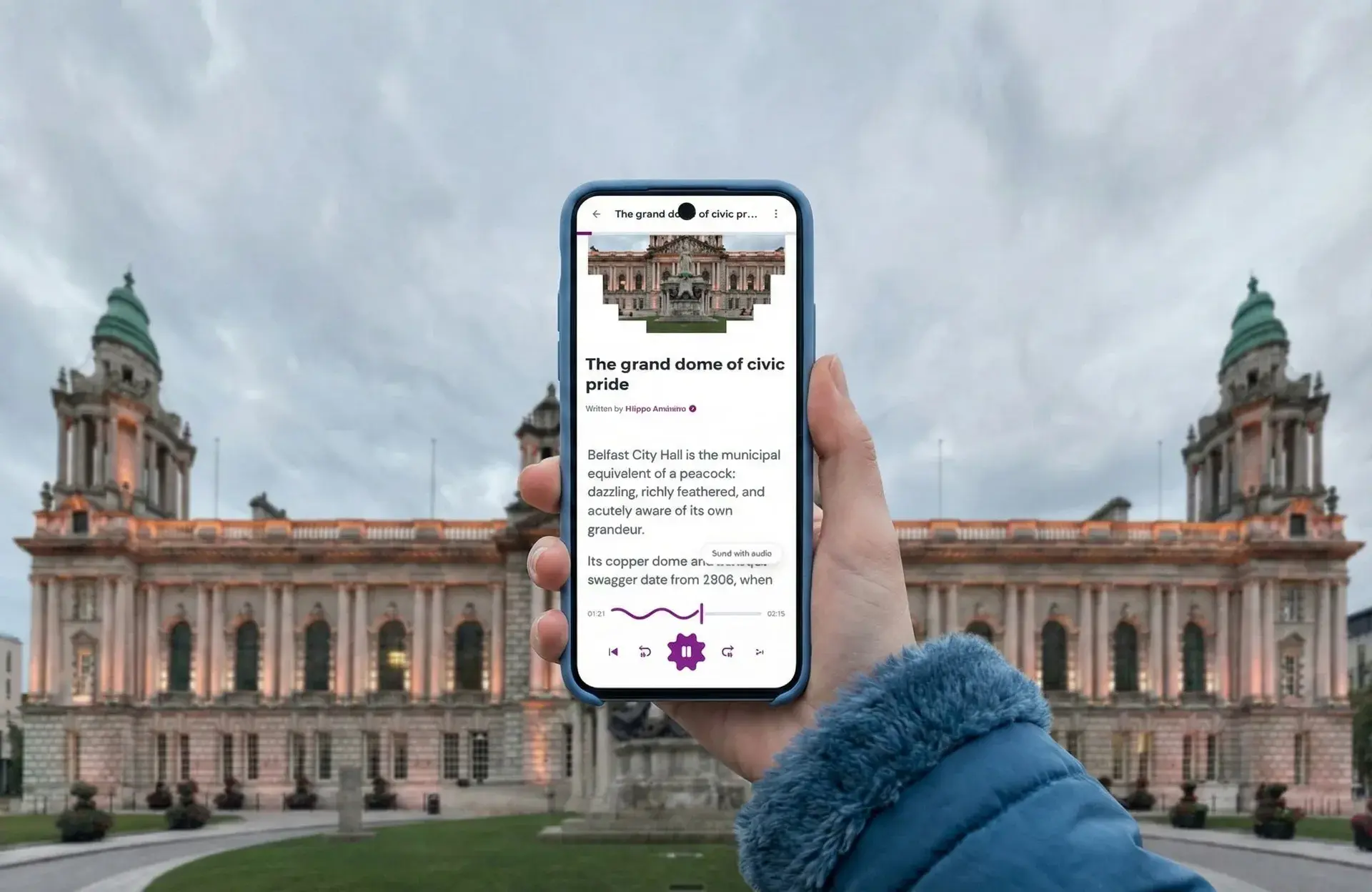
La grande coupole de la fierté civique

Belfast City Hall is the municipal equivalent of a peacock: dazzling, richly feathered, and acutely aware of its own grandeur. Its copper dome and baroque swagger date from 1906, when Belfast’s industrial ego finally matched its finances. The city had just been granted 'city' status by Queen Victoria in 1888; this was its architectural mic drop. Rising on the ashes (well, actual textiles) of the old White Linen Hall, City Hall was built by and for a city swollen with shipyards, linen looms, and Victorian ambition. The building itself is a masterpiece of white Portland stone, but if you look up, you will see the distinctive green copper of the dome rising 173 feet above the street. It has hosted as much political theatre as any proper stage. In 1912, Edward Carson stood on these very steps to sign the Ulster Covenant, swearing resistance to Irish Home Rule with a flourish that would shape the next century. In 2012, the building took center stage again as flag protests rang through its gates, showing that civic symbolism in Belfast remains anything but symbolic. Now, it doubles as a tourist magnet and a civic workspace. It is part museum, part parliament, with gilded murals battling photocopiers for aesthetic dominance. The grounds around you feature a well-manicured garden, statues galore, and, supposedly, a lunar-enhanced wish-granting ritual involving circumnavigation and mild public embarrassment. A hidden gem lies inside that green dome you are looking at: a whispering gallery. The acoustics are so precise that two people standing at opposite ends of the dome's interior can conspire, flirt, or criticize public art directly into each other's ears. It is efficient engineering for covert municipal plotting. Built to impress and occasionally to repress, City Hall remains Belfast’s glittering town crier, poised between grandeur and the grit that built it. From the formal corridors of power, we now duck into something older and far less official—Kelly’s Cellars awaits with low ceilings and high stories.

La cave secrète des rebelles

Kelly’s Cellars looks like a pub that has been dodging modernity since it was old enough to drink. Established in 1720, it squats on Bank Street with the weary charm of a revolutionary in semi-retirement. It has a low profile, a long memory, and an endurance that puts the modern concrete around it to shame. Once the watering hole of the United Irishmen, this was where radical Presbyterians and restless Catholics whispered about overthrowing the British Crown over pints. Henry Joy McCracken, one of the leading voices of the 1798 Rebellion, allegedly laid low here after the uprising failed, though "laying low" in a public bar suggests either bravado or very good ales. Unlike the fancier establishments with chandeliers or soap, Kelly’s has stayed rooted in its stone-and-beam authenticity. There are no television screens here to distract from your political convictions. If you were to step inside, you would find low beams (mind your head), the smell of peat smoke, and the definite possibility of being seated beside a minor local folk legend. Today, it functions as both a pub and a relic. Locals drink beside stained history buffs, and tourists wonder if the beer is supposed to taste this real. It is also a music venue, offering the kind of traditional Irish sessions that might convince you McCracken walked in with a banjo. A ghost story clings to the place, suggesting McCracken returns for one last pint or to mutter unfinished manifestos into forgotten whiskey dregs. Or perhaps it is just draughty. A bonus curiosity regarding the architecture involves those famous low ceilings. Some romantics claim they were designed to encourage conspiracy whispering, but the reality is likely more practical. In the 1700s, keeping the heat in was far more important than headroom. Revolution may simmer, but heat rises. After that smoky pint of insurrection, step outside and follow the alley walls—some of Belfast's most vivid voices now paint rather than plot in the Cathedral Quarter.

Les murs peints du quartier

The Cathedral Quarter didn’t so much evolve as mutate. It is an area once filled with ink-stained printers and whiskey bonders that is now awash in aerosol commentary. These days, you are more likely to spot international street artists than bookbinders. The walls here never learned the phrase “keep it down.” This neighbourhood, anchored by the nearby St. Anne’s Cathedral, turned from post-industrial purgatory into Belfast’s creative cortex thanks to spray cans and stubborn optimism. Post-Troubles, it became a petri dish for a new kind of expression. Unlike the famous "Peace Walls" elsewhere in the city, the street art here is not about sectarian territory or political dogmas. Instead, it is a full-blown soliloquy in pigment that refuses to pick a side. As you walk these streets, you will notice the themes are refreshingly surreal. Instead of paramilitaries or politicians, you are greeted by hyper-realistic portraits, psychedelic animals, and abstract splashes of colour. It is what some call a "third culture," a visual language that transcends the old binary of Green versus Orange. The art shifts regularly, like Belfast’s version of seasonal foliage, with walls painted, overpainted, and repainted as if the entire district is constantly reinventing itself. Local business owners often sponsor the work, making it a rare example of commerce and counter-culture sharing a brick. While some critics argue this gentrification softens the city's edge, historian Feargal Cochrane has noted that this area functions as a "neutral spectacle." It is a space where people of any background can gather without the baggage of history staring down from the gable walls. Still, if you pause, you might just hear the walls whisper back. They speak not of the past, but of a vibrant, slightly chaotic future. One curiosity to note is that many of these striking murals are not permanent. They come, go, and vanish like conversations in the rain. Art here is less object, more moment. So take a good look. Blink and you might miss the masterpiece before it is painted over next week. A few paces onward and upward, the spiritual geometry of Belfast Cathedral brings a shift in both tempo and tone.

La flèche de l'espoir et de la pierre

Belfast Cathedral, or St. Anne’s to its Anglican friends, is the city’s most devout overachiever. Started in 1899 and finally opened in 1904, it is still taking architectural additions like it is on a celestial installment plan. The style is Neo-Romanesque. It is tall, stony, and more serious than a Presbyterian tax audit. Built to replace an older parish church, the cathedral has always held an ambition slightly holier than the local weather. For decades, the nave remained unfinished, which was a kind of holy shrug towards funding issues and political distraction. That changed in 2007 with the arrival of the “Spire of Hope,” a stainless-steel needle puncturing the nave roof and aiming for divine signal reception. During the Troubles, the building hosted memorial services and fragile symbols of civic unity. Neither purely sacred nor purely ceremonial, it has acted as Belfast’s emotional cloister. It absorbs grief, celebration, and periodic architectural envy from less-pointy churches. If you were to step inside, you would find a space that is cool and resonant, with the faint scent of stone and incense hanging in the air like a quiet sermon. Behind those walls, stained-glass windows battle with LED lighting and Gothic arches compete with Instagram filters. There is serious stonework there, but also quiet intimacy. It is a space that might forgive you for your sins if you just quietly sit down. Local legend insists that buried within the foundation is a time capsule from the original builders containing messages, prayers, or perhaps just a note marked "good luck." The Spire itself is 80 meters tall and glows at night like a stainless-steel exclamation mark. Is it unsubtle? Sure. But then, subtlety was never a core tenet of Victorian ecclesiastical architecture. To continue our vertical theme—this time with a pronounced tilt—we make our way to the Albert Memorial Clock.

La tour penchée du prince

The Albert Memorial Clock is Belfast’s most respectable structural flaw. Built in 1869 to honor Queen Victoria’s husband, the tower quickly gained fame as the city’s most literal lean toward royalty. Thanks to soggy wooden foundations, it lists noticeably to one side like a tipsy gentleman leaving the pub he has just passed twelve times a day for a century. Designed in flamboyant French Gothic style by W. J. Barre (because what is a memorial without gargoyles?), the clock was erected near the docks, which were then the city’s bustling financial lung. Sailors met here, traders timed their deals, and presumably street urchins played period-appropriate games involving cholera and hoop sticks. At 34 meters tall, or about 113 feet, the clocktower leans a solid 1.25 meters off-center. That is not quite Pisa, but it is certainly not plumb. Locals have long defended it as having “character,” which is Belfast code for 'it stayed up, didn’t it?' Today, the clock stands largely decorative but remains a handy rendezvous spot. Its recent cleaning efforts scrubbed away decades of soot, possibly to remind people that Prince Albert’s cheeks are, in fact, sculpted and not made of moss. A myth clings to the tower that a wronged fairy cursed it, forcing it to bow eternally in apology. It is a convenient bit of folklore, though perhaps it is just a distraction from the more mundane villainy of swampy soil. The statue of Albert faces the docks as if forever watching ships leave without him. For a man who inspired 19th-century mourning fashion, this leaning Victorian sentinel remains remarkably buoyant. From Victorian leanings to ceramic symbolism, our final stop glistens beside the river—the Big Fish is waiting.

Le saumon de la connaissance

The Big Fish, officially titled ‘The Salmon of Knowledge,’ is Belfast’s largest ceramic animal and quite possibly its most brilliant multitasker. It is part public art, part time capsule, and part aquatic oracle. Installed in 1999, the ten-meter beast stares blankly at the River Lagan as if waiting for something better to swim by. Created by artist John Kindness (his real name, improbably), each of the salmon’s shiny blue-and-white scales tells a slice of Belfast’s history. You will find images ranging from shipbuilding to sectarian struggle to sugar processing, because even dystopia needs dessert. Portraits, clippings, and nuggets of trivia are plastered across its glazed skin. It provides a tactile Wikipedia for cold hands and curious minds. Commissioned as part of the Laganside redevelopment, the Fish arrived right as Belfast was rebranding itself. It marked the shift from a barricaded no-go zone to a cheerful waterfront destination. Strategically placed near the river, which was itself a former industrial artery, it became a symbol of civic optimism with scales. Local lore insists that kissing the Big Fish imparts wisdom, preferably from the correct ceramic tile. This is risky in flu season but appealing to those who think urban planning could use a sprinkle of Celtic legend. Tiled, massive, and cooler than a bronze statue of a long-dead official, the Big Fish swiftly became Belfast’s second-favorite selfie partner, though City Hall likely holds the crown. It is also popular with children who climb it illicitly and adults who pretend not to encourage them. Forget statues of generals. Belfast gave its post-conflict hope a fish. Which is, quite frankly, both absurd and rather perfect. Each city has its own way of telling a story. Belfast tells its tale in sandstone and soot, in chorused whispers over drinks, in extravagant domes and leaning towers, in spray paint and ceramic scales. As we end this journey beside the River Lagan, where a surreal fish guards both memory and myth, it’s clear that this city prefers its symbolism a touch slippery. What emerges from these stops is not just a set of buildings or anecdotes, but a portrait—part stubborn, part soaring, entirely Belfast. Here is a city that doesn't hide its complexities, but lets them molt into murals and monuments, pubs and pews. Thank you for walking through its contradictions with us. May your next visit be equally curious, and may the fish—if you were bold enough to kiss it—have shared a story or two in return.

Votre guide privé, dans la poche

Prêt à aller les voir à pied ?

  • En autonomie, quand vous voulez
  • Audio hors ligne, 7 langues
  • Satisfait ou remboursé 30 jours
  • eSIM mondiale 500 Mo incluse

à partir de

5,00 €

1 visite autonome à Belfast

Voir les visites

Planifier les jours

Combien de jours à Belfast ? L'itinéraire parfait en 1 jours

Jour 1

Cité portuaire de chantiers navals et de musique

Suivez les itinéraires de Belfast pour relier son centre compact au quartier du port, en gardant du temps pour les collines, les caprices de la météo et quelques détours dans les quartiers.

Météo et affluence

Meilleure période pour partir

Au printemps et en été (d'avril à août), le climat s'adoucit et les festivals comme le Belfast Mela battent leur plein, mais l'affluence et les tarifs grimpent. L'automne est plus tranquille malgré un temps vivifiant, tandis que l'hiver, frais et humide, s'illumine avec le marché de Noël continental devant City Hall.

Recommandé

Printemps

mars–mai

3–16°C/ 37–61°F

Ça se remplitPluies occasionnelles
  • Saison fraîche
  • Averses imprévisibles

À ne pas manquer

  • Défilé de la Saint-Patrick

Été

juin–août

10–20°C/ 50–68°F

Haute saisonPluies occasionnelles
  • Saison chaude
  • Rues animées
  • Tarifs d'hébergement plus élevés

À ne pas manquer

  • Belfast Mela

Automne

sept.–oct.

6–18°C/ 43–64°F

Beaucoup de mondeHumide
  • Semi-marathon de Belfast
  • Journées plus courtes
  • Crépuscule précoce

À ne pas manquer

  • Semi-marathon de la ville de Belfast

Hiver

nov.–févr.

2–11°C/ 36–52°F

Peu de visiteursHumide
  • Marché de Noël
  • Températures froides
  • Bruine fréquente

À ne pas manquer

  • Marché de Noël continental de Belfast

Transports

Aller à Belfast et s’y déplacer

Aéroport de Belfast-City

Aller à Belfast et s’y déplacer
Bus Translink Metro 60010 min2,30 £GB

Aéroport Belfast International

Aller à Belfast et s’y déplacer
Bus Translink 30040 min9,00 £GB

Terminal de ferry Stena Line

Aller à Belfast et s’y déplacer
Bus Translink 9615 min2,40 £GB

À pied

Plat et compact

Plat et compact, le centre met City Hall et Cathedral Quarter à moins d'un kilomètre. Attention aux cyclistes et aux voies de bus longeant les trottoirs les plus étroits.

Translink Metro & Glider

Réseau étendu

Les lignes Metro et bus rapides Glider couvrent la ville. Le billet simple coûte 2,30 £ à bord en sans contact. Le pass visiteur journée à 7 £ n'est rentable qu'au-delà de trois trajets.

Translink NI Rail

Train urbain limité

D'est en ouest, le train relie Lanyon Place aux villes côtières, à Dublin et à la gare de Sydenham (aéroport Belfast-City). Cette ligne reste toutefois peu adaptée aux visites dans le centre.

Taxis et VTC

Pratiques la nuit

Les célèbres taxis noirs au compteur et Uber sont omniprésents à Belfast. Pratiques pour traverser la ville en fin de soirée, les petits trajets au centre coûtent généralement de 3 à 5 £.

Explorez le centre compact à pied et prenez les bus Translink Metro ou Glider pour les sites excentrés. Le plafond journalier sans contact avoisine 4 £, les taxis prenant le relais en fin de soirée.

Budget

Quel budget pour visiter Belfast ?

Les prix à Belfast correspondent à la moyenne britannique. Les produits de base et les en-cas au café restent très abordables, tandis que le logement, les restaurants avec service à table et les attractions payantes constituent le gros du budget.

Quel budget pour visiter Belfast ?
Café4,00 £GB–4,50 £GB
Pâtisserie ou viennoiserie3,90 £GB–4,95 £GB
Lait (1 litre)0,80 £GB
Pain (pain de 800 g)1,75 £GB
Bouteille d'eau (500 ml)0,50 £GB–1,00 £GB

Cash or card?

Les cartes bancaires avec paiement sans contact ou puce et code PIN sont acceptées presque partout. Les espèces en livres sterling sont rarement indispensables, même si quelques pièces ou petits billets s'avèrent utiles pour les pourboires et les petits étals indépendants.

Où dormir

Où dormir à Belfast

Centre-ville

Pour un premier séjour

Autour de Donegall Square, il réunit musées, boutiques et grands axes de transport. Très pratique, bien que l'été apporte foule, tarifs hôteliers au sommet et animation nocturne le week-end.

Cathedral Quarter

Vie nocturne et restaurants

Un quartier historique aux ruelles pavées qui regorge de pubs d'époque, de scènes musicales et de galeries. Idéal pour sortir et bien manger, mais les rues peuvent rester bruyantes tard le week-end.

Queen's Quarter

Séjours économiques et cafés

Au sud de Belfast, autour de l'université Queen's et des jardins botaniques. Un secteur verdoyant, décontracté et plus abordable, où l'ambiance étudiante peut devenir festive le week-end.

Titanic Quarter

Modernité au bord de l'eau

Ces chantiers navals réaménagés abritent Titanic Belfast et la SSE Arena. Calme, familial et bien desservi, le quartier offre peu de restaurants et reste éloigné des pubs de la vieille ville.

Les visites

Belfast, une histoire à la fois

Gratte et gagne

Vas-y, gratte

Il y a peut-être quelque chose de bien là-dessous. Si tu gagnes, on te montre comment l'utiliser.

Un lot par voyageur. Valable 2 ans.

Le bouche-à-oreille

L’avis des voyageurs

Sécurité

Belfast est-elle sûre ?

Belfast est une ville globalement sûre pour les visiteurs, avec un taux de criminalité en centre-ville inférieur à la moyenne nationale britannique. Les artères centrales comme Donegall Place et Victoria Square sont bien éclairées et régulièrement patrouillées, même si la vigilance habituelle reste de mise la nuit en milieu urbain.

Quartiers du centre-ville

Donegall Place, Victoria Square et les rues adjacentes sont très fréquentées et bien surveillées. Gardez vos réflexes habituels de vigilance dans les lieux de fête très fréquentés.

Shankill Road et Falls Road

Ces quartiers peuvent se visiter en toute sécurité en journée pour observer les murs de la paix et les fresques murales, mais évitez d'y traîner à la nuit tombée en raison des tensions historiques qui y persistent.

Maillots de sport et couleurs

Évitez de porter des maillots d'équipes rivales (comme les Rangers ou le Celtic) ou des couleurs confessionnelles dans les espaces publics mixtes, en particulier les jours de match local.

Foules du Cathedral Quarter

Des pickpockets opportunistes sévissent autour des rues animées de pubs les vendredis et samedis soir. Gardez vos objets de valeur dans vos poches de devant et prenez des taxis officiels en fin de soirée.

Bon à savoir

Bon à savoir

Heures de fermeture des pubs

Les pubs traditionnels ferment généralement vers 23 h, mais la législation nord-irlandaise autorise les établissements à servir jusqu'à 2 h du matin lors de 104 soirées spéciales par an, notamment en période de festival.

Billets de banque locaux

L'Irlande du Nord utilise la livre sterling, mais quatre banques locales émettent leurs propres billets. Ils ont cours légal sur tout le territoire nord-irlandais, bien que les commerces de Grande-Bretagne puissent parfois les refuser.

Frontière avec la république d'Irlande

Aucun contrôle systématique des passeports à la frontière terrestre entre Irlande du Nord et république d'Irlande, mais les voyageurs non britanniques et non irlandais doivent détenir une autorisation de voyage valide pour le Royaume-Uni.

Questions

FAQ sur Belfast

Non. L'Irlande du Nord n'applique aucune taxe de séjour ou municipale sur l'hébergement, les tarifs affichés n'incluent donc aucune surtaxe touristique locale.

Prêt à partir ?

Visites audio en autonomie dans tout Belfast.

Voir les visites à Belfast