Petite France

为探索者和旅行者准备的贴士与路线

Strasbourg城市指南

斯特拉斯堡将德法双重底蕴融于一处,水道环绕的大岛与气派非凡的新城交相辉映。穿行在哥特式地标与滨水半木结构房屋之间,只需8分钟的机场铁路快线与四通八达的有轨电车网络,就能将整座城市尽收眼底。

国家
法国
语言
法语
货币
欧元 (EUR)
插头
类型 E
时区
Europe/Paris
紧急电话
112、17、15和18
自来水
可饮用
区号
+33

景点

Strasbourg必做之事

斯特拉斯堡的历史中心小巧紧凑,由伊尔河环抱其中。哥特式地标、滨水防御工事与生机勃勃的广场皆在步行范围之内,彼此近在咫尺。

粉红色砂岩巨人(及其魔鬼)

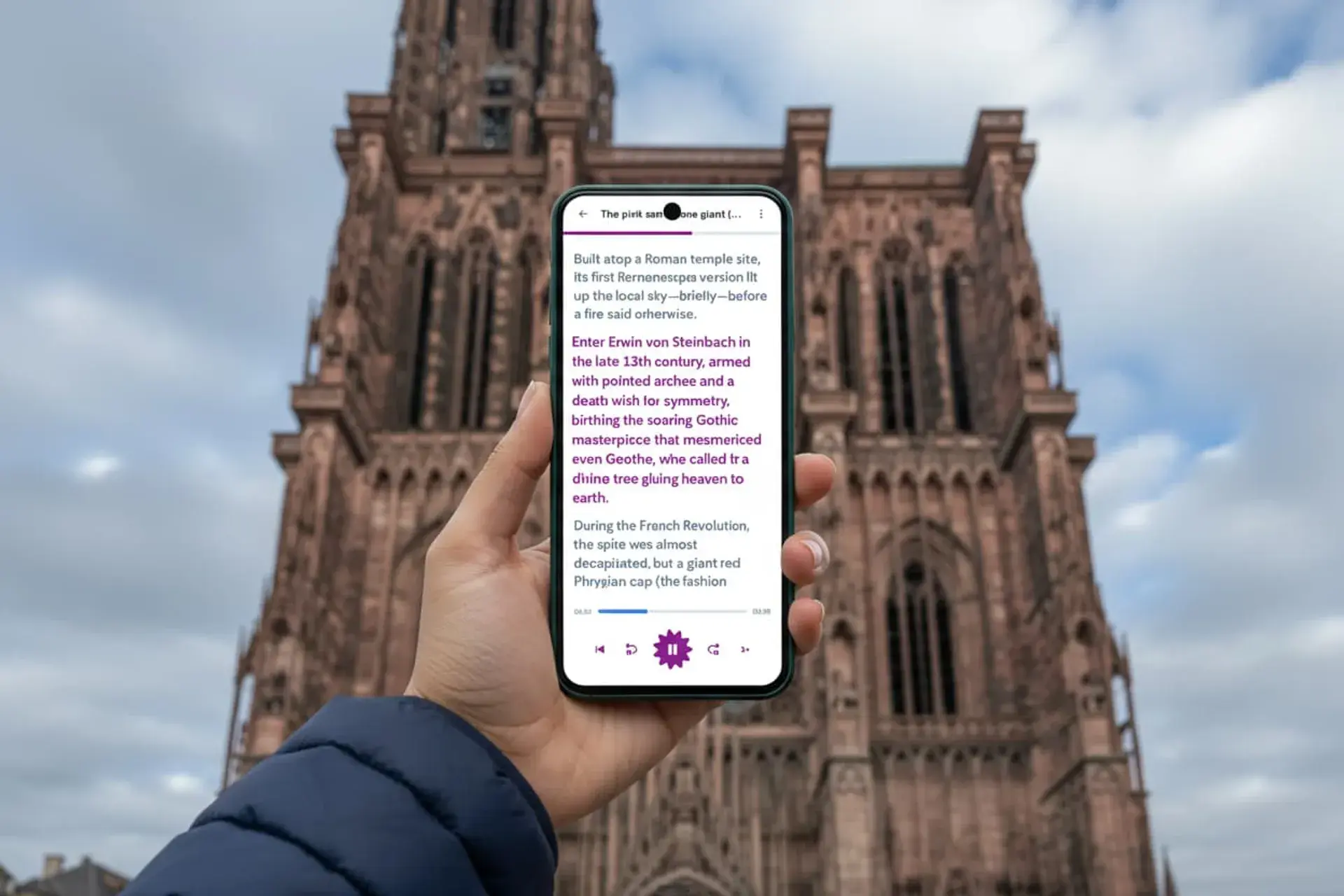
<p>Most cities clear wide avenues to frame their biggest monuments. Strasbourg prefers to ambush you. One minute you’re navigating a tight medieval alley, and the next, you’re standing at the foot of a pink sandstone cliff that refuses to fit in a single photograph. We begin our tour here, at the city’s undeniable center of gravity, where centuries of fire, faith, and architectural ego collided to build something truly impossible.</p> <p>We're not here to simply admire the artistry. We're here to learn what makes this city hum beneath centuries of ornament. Each stop will meet you at the corner of resilience and reinvention. From ecclesiastical power plays to revolutionary flair, Strasbourg’s soul is less a museum and more a palimpsest. We’ll begin amid flying buttresses and biblical tension, where posture and peril are carved into stone. Welcome to Strasbourg: layered, lived-in, and still watching the sky.</p> <p>The Strasbourg Cathedral doesn’t just dominate the skyline; it stalks it. For over 200 years it was the world’s tallest building, its 142-meter spire punching into the clouds like Gothic ambition incarnate. But it wasn’t always so. Built atop a Roman temple site, its first Romanesque version lit up the local sky—briefly—before a fire said otherwise. Enter Erwin von Steinbach in the late 13th century, armed with pointed arches and a death wish for symmetry, birthing the soaring Gothic masterpiece that mesmerized even Goethe, who called it a divine tree gluing heaven to earth.</p> <p>During the French Revolution, the spire was almost decapitated, but a giant red Phrygian cap (the fashion statement of revolutions) saved the day. Yes, the symbol of liberty also happens to be surprisingly wind-resistant. Today, it's still on duty, welcoming Catholics, tourists, and pigeon photographers by the dozen.</p> <p>From where you stand, look closely at the facade. It’s less "building" and more "lace made of sandstone." If you spot the statue of a handsome young man offering an apple to some young women on the portal, that’s "The Tempter." Note the toads and snakes crawling up his back where the women can't see them. A medieval warning about dating apps, carved right into the rock.</p> <p>And for lovers of asymmetry, note that this towering icon only has one spire. Architectural laziness? Budget cuts? Divine choice? Pick your heresy. Just a short walk behind the cathedral, a quieter kind of theater unfolds in Place du Marché Gayot: less spires, more spritzes.</p>
市场作为一个酒吧退休

<p>Place du Marché Gayot is what happens when a medieval market square quits its job and decides to retire as a beer garden. Tucked behind the Strasbourg Cathedral like an extrovert’s secret courtyard, it was once a buzz of commerce: vegetables, textiles, gossip, and probably some under-the-table pig’s feet.</p> <p>Originally a plot neighboring clustered dwellings and workshops, it gradually took on formal squarehood as the city evolved and re-paved its medieval tangles into some semblance of navigability. Merchants and citizens passed through daily, balancing foodstuffs and news in equal measure. No bloodshed, no treaties. Just centuries of everyday capitalism.</p> <p>Today, it’s a nexus of terrazzo tables and espresso steam. Students debate Nietzsche over Aperol spritzes while locals nurse beers under leafy canopies. It may not have the prestige of a palace or the drama of a siege, but it’s where Strasbourg actually exhales.</p> <p>Local lore insists there's a smugglers’ warren beneath the cobblestones, used to dodge taxation and wartime scarcities. Rumors persist that muffled haggling echoes up from the cobbles on quiet nights, which might also be the sound of tourists dragging wheeled luggage.</p> <p>The square’s name, "Gayot," might sound cheerful to modern ears, but the etymology is likely more barnyard than ballroom. It probably derives from a diminutive for "sow." Yes, a female pig. It is a fitting, if slightly unglamorous, nod to the livestock that once grunted where students now sip.</p> <p>Once a marketplace, now a cocktail-facing amphitheater, the square hasn’t strayed too far from its roots. It’s still where people come to trade stories, calories, and small change. Strasbourg may wear its Cathedral like a crown, but squares like Gayot are the city’s pockets: where personality hides and spills out when the sun decides to stick around.</p> <p>From this convivial pocket of city life, glide toward the more formal finery of the Palais Rohan, where décor and diplomacy once shared lavish walls.</p>

主教的“朴素”凡尔赛

<p>Palais Rohan is the kind of place where ghosts wear powdered wigs and roam around muttering in Louis XV French. Commissioned by Armand Gaston Maximilien de Rohan (the kind of name that needs two business cards), it was completed in 1742 to house the Archbishop of Strasbourg. He, naturally, required 100 rooms to prove his humility.</p> <p>Architect Robert de Cotte, chief aesthetic enabler to King Louis XV, ladled on all the French classical grandeur a bishop could wish for: symmetry, marble, and ceilings that dare you to look up and sprain your neck. The palace played hotel to history: Louis XV, Marie Antoinette, and even Napoleon passed through, leaving behind muddy boots, political intrigue, or perhaps just complaints about the draft.</p> <p>During the French Revolution, the ecclesiastical decorum took a hit. Robes out, republic in. The palace was nationalized. Today, it's a three-in-one museum complex. Think of it as Strasbourg's answer to a very opulent layer cake: archaeology in the basement, decorative arts on the ground floor, and fine art above.</p> <p>According to city whispers, a tunnel once connected Palais Rohan directly to the Cathedral. Whether this was for pious convenience or sneaky Sunday escapes is left to speculation. And if the façade looks too perfect, squint harder. Small variances reveal that even 18th-century architects occasionally improvised.</p> <p>The palace isn’t just architecture; it’s performance. Behind these walls, baroque wallpaper competes for attention with silk-covered armchairs which dare you to sit (don't). And if you’re the type who likes stables with style, know this: the palace’s former horse quarters were so finely engineered they could house nobility on four legs in haute-couture hay.</p> <p>A few steps away, another name carries weight: Gutenberg. His quiet experiments in this city helped ignite a noisy new age of knowledge.</p>

印刷未来的广场

<p>Place Gutenberg is what happens when revolutionary technology meets 15th-century real estate. Before it took the name of a tech giant, this square went by more utilitarian titles like the Place du Marché aux Herbes (Herb Market) or Place Saint-Martin. It was Strasbourg’s mercantile muscle: the place where coins clinked and city edicts echoed.</p> <p>Gutenberg didn’t invent movable type here, but he did test-drive the idea in the 1430s with local investors who probably didn’t realize they were bankrolling the end of the Middle Ages. His statue now presides with stubbled calm, gripping a page with the Latin words of Genesis, taunting passersby with the original startup script.</p> <p>Prior to its literary glow-up, the square was likely more fragrant than famous. Think bundles of herbs, casks of fish, arguments over units of millet. It saw executions, proclamations, and the slow alchemy of urban change. Over time, the roar of commerce gave way to the pleasant din of café chatter.</p> <p>Today, tourists stand under the watchful eyes of the 1840 bronze Gutenberg while queuing for Alsatian pretzels. From time to time, a Christmas market flares up, further layering the square with cheer and overpriced mulled wine.</p> <p>There’s a charming legend that Gutenberg buried an early version of the press beneath the square, a mechanical time capsule awaiting rediscovery. So far, treasure hunters have turned up only cobbles and disappointment.</p> <p>The real surprise hides in plain view: a modest building at number 10 is rumored to have housed one of his experimental shops. History doesn’t always march with trumpets. It sometimes quietly rents office space.</p> <p>Strasbourg owes much to its most famous side hustle. Without Gutenberg, it’s just another pretty medieval town. With him, it helped ignite the age of mass information, and the endless pleasure (and pain) of printing errors.</p> <p>From printed beginnings to musical prayers, continue on to Église Saint-Thomas, where theology trades grandeur for gravitas.</p>

信仰的堡垒(以及一个失误的将军)

<p>If Strasbourg Cathedral is the city’s loud, extroverted sibling, Église Saint-Thomas is the wispy intellectual: Protestant, precise, and quietly historic. Often dubbed the "Protestant Cathedral," it started life in the 6th century as a trusted Catholic standby, only to pivot in the early 16th century when Martin Bucer and his reformist entourage moved in.</p> <p>Things got spicy in 1529, when the church officially switched sides during the Reformation. Bucer dreamed of compromise, shaping Lutheranism to fit Strasbourg’s temperament. His ideas helped nudge Calvinism toward that thorny thing called tolerance. Sadly, Bucer’s tomb didn’t survive the religious pendulum swings that followed, but his sermons still echo faintly in theological footnotes.</p> <p>Architecturally, the church means business. There are no elaborate rose windows, just solid Alsatian Gothic and a central nave that holds itself like it's been through a few breakups. The interior discipline, however, hides one major theatrical flourish: the mausoleum of Marshal Maurice de Saxe. It’s a baroque fever dream. Death is depicted literally reaching for him as he descends into the tomb, heroism in full dramatic tilt.</p> <p>Saxe was a hero of France, but because he was a stubborn Protestant, he couldn't be buried in Catholic Paris. So he lies here instead, exiled in glory. A French Marshal in a German-style church, forever proving that politics follows you even into the grave.</p> <p>Aren’t sure if you’ve entered a church or an existential art installation? The Silbermann organ inside would remind you. Mozart liked it. That’s not hyperbole. He actually played it.</p> <p>Local mystery: the occasional late-night hymn, sung by no one visible, supposedly wafts through the nave. Ghost choir? Faulty acoustics? Or just Strasbourg adding reverb to its layered history? Even from the outside, Église Saint-Thomas offers a pocket-sized Reformation with a side of baroque melodrama. A Lutheran church that whisper-sings Catholic opera. The building is nothing if not ecumenical.</p> <p>If Strasbourg’s soul is split between reflection and spectacle, Petite France generously indulges the latter. Follow the winding lanes and let the river show you why.</p>

明信片、天花板、和半木结构的秘密

<p>Petite France has a name that whispers romance, but its origins shout syphilis. In the 16th century, the French disease (venereal, not cultural) earned this district its name when a hospital was set up here for afflicted soldiers. So yes, pastel-colored canals and geranium-draped windows sit atop a history of unmentionables.</p> <p>Despite its inauspicious branding, the neighborhood evolved into a bustling quartier of tradesmen: tanners, millers, and fishermen. The smell would’ve been character-building. The houses reflect the trades. Look for low river-level openings where animal hides once met dubious hygiene standards.</p> <p>Today, Petite France is Strasbourg's tourist engine. Instagram’s favorite district, it dons half-timbered facades like it invented quaint. The Ill River snakes between alleys, reflecting centuries-old construction and selfie sticks in equal measure.</p> <p>Had enough sugar-coating? Let's talk about the neighbors. For centuries, this area wasn't just for tanners and the sick; it was also the domain of the city executioner. He lived right on the edge of the district, a grim reminder that justice in old Strasbourg was swift and usually happened just a bridge away.</p> <p>And regarding those perfect medieval streets, don't let the vintage look fool you. Petite France didn't dodge the bombs of 1944. Much of what you see was painstakingly rebuilt from the rubble after World War II. It’s a miracle of reconstruction, not just preservation.</p> <p>Beneath the creak of tour boats and camera shutters lies the DNA of working life. Redolent with sweat, fish, and economic survival. Petite France may look like a gingerbread theme park now, but history here had muddy fingernails. It just finally got a manicure.</p> <p>To understand how fiercely Strasbourg guarded this charm, head to the Ponts Couverts, where medieval grit still spans the water.</p>

未覆盖的桥梁

<p>The Ponts Couverts are a trio of medieval bridges with a misleading name and a serious past. Once topped with wooden roofs (hence "covered"), those shelters are long gone, but the name stuck like old graffiti.</p> <p>Built in the 13th century, these stone spans formed the aquatic backbone of Strasbourg’s defenses. Anchoring the bridges are massive square towers. They stand straight-backed and grim-faced, like sentinels who never got the memo about retirement. Back then, you didn’t just cross the river; you asked politely and hoped arrows didn’t answer. Soldiers patrolled above while water-driven commerce trickled below.</p> <p>The engineering is pure medieval pragmatism: bridges that moonlight as fortresses. Defensible positions, control points, a way to glare at invaders without ever leaving your posts. Eventually, as gunpowder made pointed towers less intimidating, they were downgraded from military assets to historical curiosities.</p> <p>Today, the Ponts Couverts are strictly photo ops. They frame postcard-perfect views of Petite France and the Barrage Vauban just behind, which replaced them defensively but never stylistically. The towers’ interiors hint at their former military might but now answer to foot traffic and the occasional history nerd on a mission.</p> <p>Of course, there’s the obligatory ghost story: defenders reportedly return during moments of peril, spectral archers revisiting their haunts with incorporeal crossbows. If Strasbourg ever faces supernatural invasion, it’s covered.</p> <p>Do note: while these bridges aren’t covered anymore, their purpose still looms large. They represent a time when bridges weren’t about connectivity. They were about control. Today, they’re just trying to survive the endless march of tourists with better shoes.</p> <p>For one final vantage point and a last turn of the historical screw, ascend to the Barrage Vauban: water, war, and wonder rolled into one.</p>

淹没敌人的浪漫艺术

<p>We have reached the final stop of our tour. The Barrage Vauban wears many hats: fortress, dam, observation deck. Built between 1686 and 1690, it’s the hydraulic lovechild of Sébastien Le Prestre de Vauban, Louis XIV’s master of défense avec flair. While other dams prevent floods, this one was designed to start them. Deliberately.</p> <p>Its constipated stone bulk hides a clever secret: a network of sluice gates that, when opened, could raise the Ill River’s level by six feet, turning Strasbourg’s southern approach into an impassable swamp. Military strategy by waterlogging. It is just as romantic as it sounds.</p> <p>And this wasn't just a theory. In 1870, during the Siege of Strasbourg, the city actually pulled the lever. The resulting flood turned the southern fields into a muddy nightmare for the Prussian army. It turns out that making your enemy wet and miserable is a surprisingly effective tactic.</p> <p>Inside, a long, dimly lit corridor now houses plaster casts of former Strasbourg statues, like a retirement home for displaced deities. Today, the top floor doubles as one of the city's best photo spots. From its terrace, you get panoramic views of the Ponts Couverts, Petite France, and, on clear days, you might even spot Strasbourg Cathedral brooding in the distance.</p> <p>Local legend suggests that Vauban’s ghost inspects the place periodically, adjusting sluice gates and tutting about construction tolerances. It’s probably just wind, or a particularly detail-oriented pigeon.</p> <p>Officially obsolete as a defense mechanism, the Barrage now functions as a tribute to mad military genius. Vauban didn't merely build fortifications; he bent water to his militarized will. If Strasbourg ever floods charmingly, you’ll know whom to thank.</p> <p>We’ve covered a lot of ground today. From the dizzying heights of the Cathedral to the wet strategic genius of this dam, Strasbourg has proved it’s not just a pretty face. It’s a complex, sometimes contradictory place where French style and German grit have been bumping shoulders for centuries. Hopefully, seeing the smugglers' corners and the executioner’s neighborhood gave you a better feel for the real city, not just the postcard version.</p> <p>From all of us at Ciceru, thank you for letting us share Strasbourg's secrets with you. We hope you loved the stories, the spires, and the unexpected twists. We can't wait to walk with you again soon. À bientôt!</p>

你的私人导游,就在口袋里

这些地方,准备好去走一趟了吗?

  • 自助导览,现在出发或改天再走
  • 离线音频,7 种语言
  • 30 天内不满意可退款
  • 含 500MB 全球 eSIM 流量

€5.00

Strasbourg的 1 条自助导览

查看全部导览

规划行程

Strasbourg要待几天?1天完美行程

第1天

漫步斯特拉斯堡大岛与小法兰西

沿着斯特拉斯堡大岛的步行街穿行历史核心区,随后搭乘CTS交通网络展开环线探索,尽揽中心岛屿之外的风光。

天气与人流

最佳旅行时间

斯特拉斯堡在6月至8月气温最高,常年最高温在24.4至26.4°C之间;5月至8月降雨较多,月降水量达61.3至77.2毫米。在已公布的2023年过夜旅客统计中,1月至2月最为清幽,12月则迎来全年峰值。

推荐

冬季

1月–2月

0–7°C/ 32–45°F

游客较少偶有降雨
  • Strasbourg Mon Amour爱在斯特拉斯堡节
  • 全年过夜住宿低谷

不容错过

  • Strasbourg Mon Amour爱在斯特拉斯堡节

春季

3月–5月

3–21°C/ 37–70°F

游客渐多偶有降雨
  • 4月游客人数回升

夏季

6月–8月

13–26°C/ 56–80°F

人多拥挤偶有降雨

秋季至圣诞季

9月–12月

1–22°C/ 33–71°F

旅游旺季偶有降雨
  • 圣诞季
  • 12月迎来客流高峰

不容错过

  • 斯特拉斯堡圣诞之都集市

交通

Strasbourg到达与交通

斯特拉斯堡机场

Strasbourg到达与交通
TER机场火车8分钟€3.20
TER火车加CTS公共交通联程8分钟火车加市内交通€4.60

步行

核心区游览首选

大岛高度适宜步行,但有轨电车轨道仍会穿过中心步行区域,因此步行街并不意味着完全没有机动车辆穿行。

有轨电车

主力出行方式

CTS运营贯穿斯特拉斯堡的A至F线有轨电车。单程票2.20欧元,24小时单人通票(24H SOLO)4.60欧元,72小时单人通票(72H SOLO)10.20欧元。上车前请务必打票验票。

公交车

填补电车空缺

CTS公交车与有轨电车站票通用。若直接在车上向司机购票,单程票价为2.50欧元,高于车站自动售票机2.20欧元的标准票价。

Vélhop公共自行车

骑行便利但有门道

有桩自行车短途租借为1.20欧元,24小时7欧元,48小时14欧元。车辆必须归还至初始取车站,异地还车需缴纳25欧元调度费。

在大岛内随心漫步,较远行程搭乘CTS有轨电车。如果预计在24小时内至少乘坐3次付费交通,购买24小时单人通票最为划算。

预算

游览Strasbourg需要多少钱?

经核实的固定交通开销包括:CTS标准单程乘车2.20欧元、24小时单人通票4.60欧元、机场轨道快线3.20欧元。由于缺乏可靠的权威数据源,暂无法提供全市统一的咖啡、午餐及啤酒价格参考区间。

游览Strasbourg需要多少钱?
CTS单程票€2.20–€2.50
CTS 24小时单人通票€4.60
CTS 72小时单人通票€10.20
斯特拉斯堡机场直达火车€3.20
Vélhop短途至48小时租借€1.20–€14.00
CTS停车换乘联票€4.20

Cash or card?

法国商家若设有刷卡最低消费限制,需明确张贴说明。刷卡支付在公共交通和零售店非常普遍,但依然建议备好少量现金应急。

住宿

Strasbourg住宿区域

大岛

初访首选

这座历史底蕴深厚的中心岛屿是步行探索与体验CTS核心网络的绝佳大本营。不过在圣诞季期间会有门禁管控,11月至12月出行可能不如平时顺畅。

火车站-莱特里-莱阿勒区

火车抵达旅客之选

该官方辖区涵盖中央火车站,可直接搭乘CTS有轨电车A线和D线直通市中心。对于需要赶清晨或深夜火车的旅客而言,住在这里最为便捷。

交易所-克鲁特瑙-滨海大道区

市中心以东

斯特拉斯堡将交易所、克鲁特瑙和滨海大道整合为一个官方行政片区,位于历史核心区正东及东南侧,步行可达性极佳。

新城

核心区外的历史瑰宝

新城与大岛毗邻,在2017年教科文组织扩展保护范围后正式列入世界遗产名录,靠近市中心且遍布宏伟华丽的建筑。

诺伊多夫-施卢斯费尔德区

非中心区落脚点

此官方行政片区是替代大岛住宿的理想选择,既能远离喧嚣,又可通过斯特拉斯堡便捷的城市交通网顺畅往返。

导览

一步一故事,探索Strasbourg

刮刮乐

来刮一刮

涂层下面也许藏着好东西。中奖的话,我们会告诉你怎么用。

每位旅行者限一份奖品,有效期 2 年。

口碑

旅行者评价

安全

Strasbourg安全吗?

法国官方安全指引并未将斯特拉斯堡列入高风险目的地。日常需要注意的主要是在拥挤的交通枢纽防范顺手牵羊、留意中心区有轨电车与自行车的混行冲突,以及适应圣诞季期间特殊的安保措施。

斯特拉斯堡城站

在斯特拉斯堡城站及客流密集的CTS车辆上,请牢记法国官方发布的公共交通防扒建议:保管好随身手机与包袋,上下车时尤需提高警惕。

圣诞客流

2026年“斯特拉斯堡圣诞之都”集市将于11月26日至12月24日举办。届时大岛周边将设置安保防线并开展开包检查,前往核心区前请务必确认官方通行指引。

穿行电车轨道

斯特拉斯堡的有轨电车会直接驶过步行街。在铁人广场一带穿过铁轨时务必左右观察,切不可默认铺砌地面的步行区域就没有电车通行。

医疗求助

综合紧急求助请拨打112,报警拨打17,医疗急救拨打15,火警拨打18。若在大东部大区非工作时间需要非紧急医疗咨询,可拨打116 117。

实用信息

实用提示

12月26日为法定假日

斯特拉斯堡地处下莱茵省,依照阿尔萨斯-摩泽尔地方劳动法,12月26日为法定公休日。当天暂停营业的商家和机构会远多于法国其他地区。

Vélhop自行车须原借原还

Vélhop有桩自行车并非单程共享单车。用户必须将车归还至取车的初始站点,否则运营商将加收25欧元的调度罚款。

圣诞集市于12月24日收官

2026年“斯特拉斯堡圣诞之都”集市定于11月26日至12月24日举行。所有小木屋摊位在平安夜闭市撤档,不会跨年延续至元旦之后。

机场火车仅需8分钟

斯特拉斯堡机场乘坐TER区域列车约8分钟即可直达中央火车站,单程票价为3.20欧元。

问题

Strasbourg常见问题

在机场火车站搭乘直达TER机场列车即可,约8分钟便能抵达斯特拉斯堡城站。单程火车票为3.20欧元,包含机场铁路与CTS市内交通的联程票售价为4.60欧元。

准备出发?

遍布Strasbourg的自助语音路线。

查看Strasbourg的路线