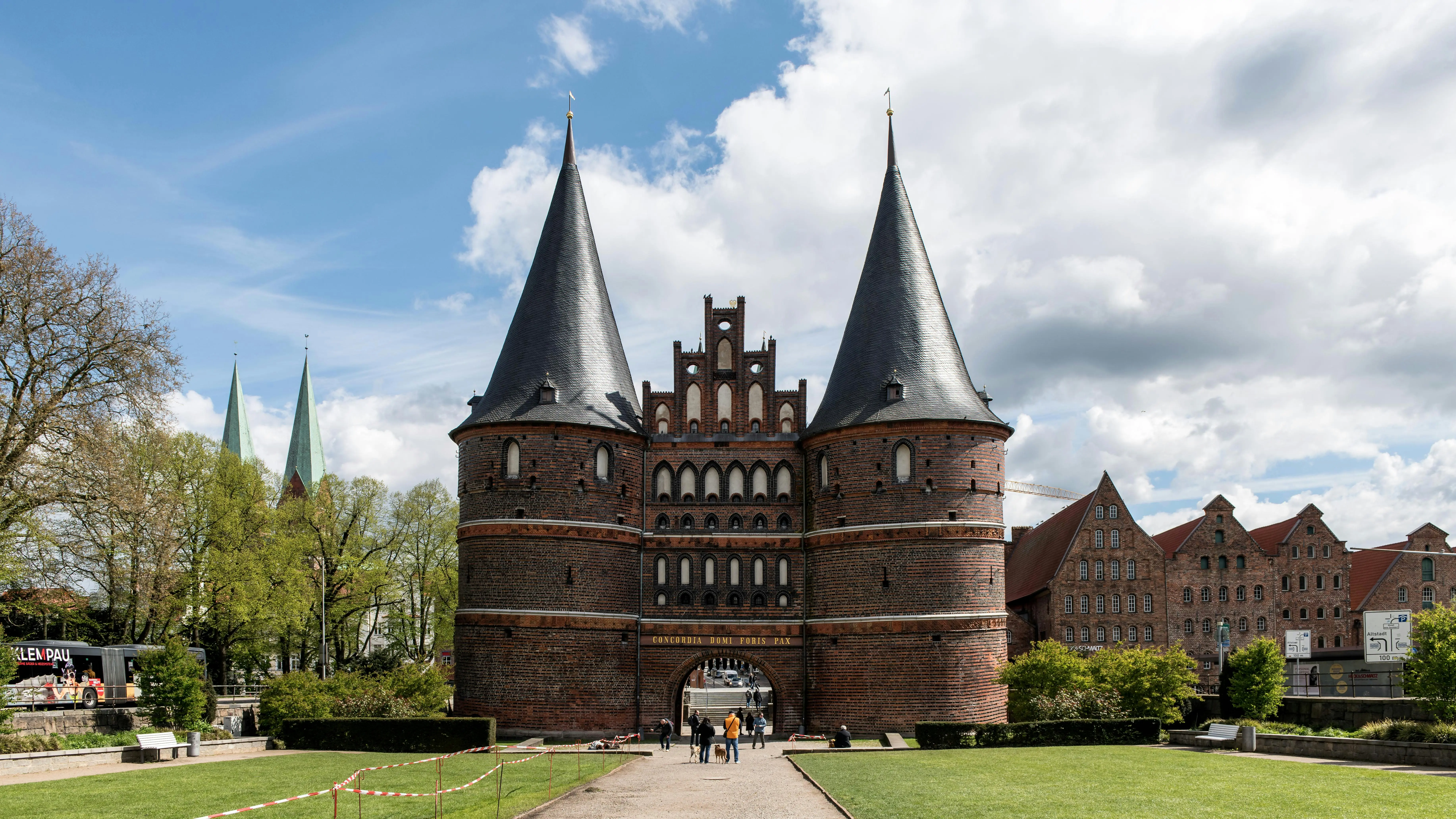
Museum Holstentor

为探索者和旅行者准备的贴士与路线

Lübeck城市指南

探索以老城岛为核心的吕贝克,沉浸于红砖哥特建筑,流连于港湾水岸,一路向外延伸至迷人的海滨。

国家
德国
语言
德语
货币
欧元 (EUR)
插头
类型 F
时区
Europe/Berlin
紧急电话
112
自来水
通常可饮用
区号
+49

景点

Lübeck必做之事

穿行于红砖哥特教堂、幽静巷弄与河心岛屿之间;若要前往火车站、特拉弗明德或更开阔的港区,跳上当地公交即可。

Holstentor

<p>Welcome to Lübeck, a city steeped in history and brimming with stories waiting to be discovered. Your journey begins here, at the iconic Holstentor.</p> <img src="https://storage.googleapis.com/ciceru-assets-stg/eafcae58-0ee2-4e5f-9464-f3b13c38a32a/HQAmry4T-Nuremberg_chronicles_f_265-66_%28Lubeca%29.webp" alt="undefined" style="height: auto;width: 320px"/> <blockquote>Illustration of Lübeck in 1493 from the Nuremberg Chronicle - From Wikipedia</blockquote> <p>Picture yourself in the heart of medieval Lübeck. The air is filled with the chatter of merchants and the creak of wagon wheels on cobblestone streets. As you approach the city, the first thing you see is the Holstentor—two imposing towers of red brick rising boldly against the northern sky. Built in 1464, this gate wasn’t just a barrier; it was Lübeck’s way of announcing its power and prosperity to the world.</p> <img src="https://storage.googleapis.com/ciceru-assets-stg/eafcae58-0ee2-4e5f-9464-f3b13c38a32a/K8gHGxVu-fabian-kleiser-pSC9wUt29F0-unsplash.webp" alt="undefined" style="height: auto;width: 320px"/> <blockquote>The two imposing towers seen from the west</blockquote> <p>The Holstentor’s thick walls, nearly 3.5 meters deep, were designed to impress as much as to protect. The Gothic architecture, with its formidable towers and narrow slits for windows, spoke of strength and confidence. But if you look closely, you’ll notice something curious. The south tower leans, just slightly, like a northern cousin of the leaning tower of Pisa. This wasn’t a mistake by the builders—it was the inevitable result of constructing such a massive structure on the marshy ground near the river Trave. Even in the 15th century, they knew the earth would shift beneath them, but they pressed on, creating a landmark that would defy both nature and time.</p> <img src="https://storage.googleapis.com/ciceru-assets-stg/eafcae58-0ee2-4e5f-9464-f3b13c38a32a/dO3K8ZnL-wolfgang-weiser-VnojFnI_Cos-unsplash.webp" alt="undefined" style="height: auto;width: 320px"/> <blockquote>Holstentor seen from the east</blockquote> <p>Surprisingly, despite its formidable appearance, the Holstentor never faced a major siege. Its true challenges came from the steady march of time and the pressures of modernization. Yet, it stood firm, surviving to become the proud symbol of Lübeck’s enduring spirit—a gateway not just to a city, but to history itself, now honored as a UNESCO World Heritage Site.</p>
Salzspeicher

<p>From across the Trave River, your eyes are drawn to a striking row of six historic brick buildings—the Salzspeicher, or Salt Warehouses. These formidable structures, standing next to the Holstentor, are not just relics of the past; they are silent witnesses to Lübeck’s golden age. Built between the 16th and 18th centuries, these warehouses were once filled with one of the most valuable commodities of the time: salt.</p> <img src="https://storage.googleapis.com/ciceru-assets-stg/eafcae58-0ee2-4e5f-9464-f3b13c38a32a/mzQkdjp8-Salzspeicher_in_Lu%CC%88beck-msu-2021-39-8124.webp" alt="undefined" style="height: auto;width: 320px"/> <blockquote>Salzspeicher in Lübeck</blockquote> <p>The salt stored here was mined near Lüneburg and transported over the Stecknitz Canal, a remarkable feat of engineering for its time. From Lübeck, it was shipped to various ports across the Baltic region. As you gaze at the robust Gothic architecture and distinctive stepped gables from your vantage point across the river, you might wonder—how did something as simple as salt contribute to the rise of a powerful city like Lübeck?</p>

市政厅

<p>Standing in Lübeck’s bustling market square, surrounded by the hum of daily life, your eyes are drawn to a structure that dominates the scene—the Lübeck Town Hall, or Rathaus. Built beginning in 1230, this isn’t just any administrative building; it’s a vivid tapestry of Lübeck’s history, woven into the very bricks and stones that form its walls.</p> <img src="https://storage.googleapis.com/ciceru-assets-stg/eafcae58-0ee2-4e5f-9464-f3b13c38a32a/yjWo27PB-Lu%CC%88beck_Lu%CC%88becker_Rathaus_%2850228526292%29.webp" alt="undefined" style="height: auto;width: 320px"/> <blockquote>Long House and New Chamber (right) from the market, coats of arms made of sheet metal cover Gothic originals made of oak - From Wikipedia</blockquote> <p>At first glance, the dark Gothic arcades draw you into Lübeck’s medieval past, where the city began its ascent as a major player in the Hanseatic League. The grand façade reflects the city's prominence, standing as a testament to centuries of governance and civic pride.</p> <img src="https://storage.googleapis.com/ciceru-assets-stg/eafcae58-0ee2-4e5f-9464-f3b13c38a32a/TY1uJxrd-HL_Damals_%E2%80%93_Senat.webp" alt="undefined" style="height: auto;width: 320px"/> <blockquote>Before the start of a senate meeting in Lübeck - From Wikipedia</blockquote> <p>Picture the square centuries ago: merchants unloading their wares, townsfolk gathering for proclamations, and city officials debating decisions that would ripple across Northern Europe. The Rathaus was more than just a seat of power—it was the heart of Lübeck’s civic life, pulsing with the energy of a city that shaped the course of history.</p>

玛丽恩教堂

<p>Walking through Lübeck’s historic center, it’s impossible to miss the towering twin spires of St. Mary’s Church, or Marienkirche. These majestic brick Gothic structures rise confidently above the city skyline, standing as a symbol of Lübeck’s ambition and prosperity during the height of the Hanseatic League.</p> <img src="https://storage.googleapis.com/ciceru-assets-stg/eafcae58-0ee2-4e5f-9464-f3b13c38a32a/JxkoT0AP-Marienkirche-HL-Baugeschichte.webp" alt="undefined" style="height: auto;width: 320px"/> <blockquote>Building history of St. Mary's Church in Lübeck, permanent exhibition in the church - From Wikipedia</blockquote> <p>Construction of St. Mary’s began in 1250 and continued for nearly a century, reflecting the city’s immense wealth and dedication to architectural grandeur. The church’s soaring nave and intricate vaulted ceilings became a blueprint for many other brick Gothic churches in the Baltic region, influencing architectural trends far beyond Lübeck’s borders. As you stand near the southern wall, beneath the shadow of its towering façade, imagine the medieval merchants and townsfolk who once gathered here, their voices mingling with the solemn chants that echoed within these sacred walls.</p> <img src="https://storage.googleapis.com/ciceru-assets-stg/eafcae58-0ee2-4e5f-9464-f3b13c38a32a/PXNLxpGl-building-4038933_1280.webp" alt="undefined" style="height: auto;width: 320px"/> <blockquote>Marienkirche towers</blockquote> <p>But Marienkirche isn’t just a testament to medieval craftsmanship; it’s also a canvas marked by history’s trials. From grand celebrations to moments of devastation, the church has witnessed the full spectrum of Lübeck’s past.</p>

巴登布鲁克楼

<p>In the heart of Lübeck’s old town, amidst narrow cobblestone streets and the hum of daily life, stands a house that quietly tells the story of an entire era—the Buddenbrook House. Its unassuming white facade, crowned with a classic gabled roof, may seem modest at first glance. Yet, within these walls lies a cornerstone of German literary heritage, immortalized by Thomas Mann in his Nobel Prize-winning novel <em>Buddenbrooks: The Decline of a Family</em>.</p> <img src="https://storage.googleapis.com/ciceru-assets-stg/eafcae58-0ee2-4e5f-9464-f3b13c38a32a/tjUELCsw-Thomas_Mann_1900.webp" alt="undefined" style="height: auto;width: 320px"/> <blockquote>Thomas Mann in 1900 - From Wikipedia</blockquote> <p>Published in 1901, the novel paints a vivid, semi-autobiographical portrait of a wealthy merchant family’s rise and fall in Lübeck. The Mann family’s own story is intricately woven into this narrative, and standing before the house, you can almost feel the weight of the past pressing against the present. The 19th-century world of bustling trade, shifting societal expectations, and the quiet struggles between tradition and progress comes alive, echoing through the streets and into the soul of the city.</p> <img src="https://storage.googleapis.com/ciceru-assets-stg/eafcae58-0ee2-4e5f-9464-f3b13c38a32a/24GboBiN-1901_Thomas_Mann_Buddenbrooks.webp" alt="undefined" style="height: auto;width: 320px"/> <blockquote>The two-volume first edition in 1901 - From Wikipedia</blockquote> <img src="https://storage.googleapis.com/ciceru-assets-stg/eafcae58-0ee2-4e5f-9464-f3b13c38a32a/pZAeiyTv-Thomas_Mann_Buddenbrooks_1904.webp" alt="undefined" style="height: auto;width: 320px"/> <blockquote>Thomas Mann Buddenbrooks 1904 - From Wikipedia</blockquote>

海利根-盖斯特医院

<p>In the heart of Lübeck’s old town, nestled among winding medieval streets, stands the Hospital of the Holy Spirit, or Heiligen-Geist-Hospital. Founded in 1286 with the support of Lübeck’s prosperous merchants and city council, it is one of the oldest charitable institutions in Europe. For centuries, this hospital provided more than medical care—it was a sanctuary for the elderly, the sick, and the poor, offering shelter and dignity in a time when such support was rare.</p> <img src="https://storage.googleapis.com/ciceru-assets-stg/eafcae58-0ee2-4e5f-9464-f3b13c38a32a/gqGbMwei-2560px-Lu%CC%88beck_Heilig-Geist-Hospital_%2803%29.webp" alt="undefined" style="height: auto;width: 320px"/> <blockquote>Corridor in the hospital, small rooms on the left and right - From Wikipedia</blockquote> <p>The hospital’s establishment during Lübeck’s height as the "Queen of the Hanseatic League" reflects the city’s unique blend of economic power and civic responsibility. While the wealth of Lübeck’s merchants drove its commercial success, it also fueled initiatives like the Heiligen-Geist-Hospital, ensuring that the city’s prosperity extended to its most vulnerable citizens. This balance between commerce and care became a defining characteristic of Lübeck’s legacy.</p>

Burgtor

<p>As we reach the final stop of our journey through Lübeck’s old town, we stand before the "Burgtor"—the northern gateway that has watched over the city for centuries. Built in 1444, this late Gothic stronghold was not designed to impress, but to protect. Its solid brick walls and defensive towers once formed a critical part of Lübeck’s fortifications, controlling who could enter and leave this thriving Hanseatic city.</p> <img src="https://storage.googleapis.com/ciceru-assets-stg/eafcae58-0ee2-4e5f-9464-f3b13c38a32a/Vq5DALMG-Luebeck-Burgkloster-1-1.webp" alt="undefined" style="height: auto;width: 320px"/> <blockquote>Lübeck castle monastery - From placesofgermany</blockquote> <p>The gate takes its name from the "Burg", the old Lübeck castle that once overlooked the Trave River. After the Danish defeat at the Battle of Bornhöved in 1227, the fortress gradually lost its strategic importance and was later converted into a monastery. Yet, as Lübeck’s wealth and influence grew, so did its need for stronger defenses. By the 15th century, the city reinforced its northern perimeter, and the Burgtor became a vital checkpoint for trade and security.</p> <img src="https://storage.googleapis.com/ciceru-assets-stg/eafcae58-0ee2-4e5f-9464-f3b13c38a32a/5KaEeboT-Luebeck_Burgtor_1900.jpg" alt="undefined" style="height: auto;width: 320px"/> <blockquote>Burgtor between 1890 und 1905 - From Wikipedia</blockquote> <p>Through this very gate, merchants passed with goods from across the Baltic, messengers carried urgent news, and soldiers stood ready to defend Lübeck’s sovereignty. Over the centuries, it has seen both prosperity and war, standing as a silent witness to the city's changing fortunes.</p>

你的私人导游,就在口袋里

这些地方,准备好去走一趟了吗?

  • 自助导览,现在出发或改天再走
  • 离线音频,7 种语言
  • 30 天内不满意可退款
  • 含 500MB 全球 eSIM 流量

€7.00

Lübeck的 1 条自助导览

查看全部导览

规划行程

Lübeck要待几天?1天完美行程

第1天

漫步吕贝克老城岛与港湾

穿过座座桥梁细细游赏老城;当特拉弗河与波罗的海召唤你走向远方,搭上公交或区域列车即可继续探索。

€7.00

天气与人流

最佳旅行时间

五月、六月和九月最适宜漫步老城与港口。七八月份白昼最长,但周末的人潮也最为拥挤。

推荐

冬春时节

1月–6月

0–21°C/ 32–70°F

游客较少
  • 幽静的红砖巷弄与博物馆

夏秋时节

7月–12月

5–23°C/ 41–73°F

游客较少
  • 港湾光影与海滨漫步

导览

一步一故事,探索Lübeck

刮刮乐

来刮一刮

涂层下面也许藏着好东西。中奖的话,我们会告诉你怎么用。

每位旅行者限一份奖品,有效期 2 年。

口碑

旅行者评价

安全

Lübeck安全吗?

吕贝克整体治安良好。雨后湿滑的鹅卵石路、穿行的自行车与公交,以及港口水边都需要多加留心;市集与夏季周末人流密集时需防范扒手。医疗或火警急救请拨打112,报警请拨打110。

湿滑的鹅卵石路

雨后途经老城的桥梁和巷弄请放慢脚步,光滑的砖石路面拖着行李极易打滑。

港口边缘

在特拉弗河沿岸及轮渡码头切勿翻越护栏,大风、夜色与湿滑路面都会增加跌落风险。

特拉弗明德之行

从海滨返程前务必查好末班公交或火车时刻,在非夏季时刻表期间尤其要留心。

问题

Lübeck常见问题

老城区非常适合漫步;若要前往火车站、特拉弗明德或老城岛以外的区域,搭乘公交即可。

准备出发?

遍布Lübeck的自助语音路线。

查看Lübeck的路线