Hauptmarkt Nürnberg

为探索者和旅行者准备的贴士与路线

Nuremberg城市指南

纽伦堡把1050年的中世纪建城史、德国铁路先驱的过往,以及适合漫步的老城区巧妙融合在一起。这里有受欧盟地理标志保护的著名烤肠和姜饼,还有直达中央火车站、车程仅需12分钟的地铁。

景点

Nuremberg必做之事

探索纽伦堡的最佳方式是徒步,沿着从中央火车站贯穿老城区的步行主轴漫步,一路领略中世纪地标、街头集市,以及法兰克尼亚地区数百年沉淀的商业辉煌。

手工餐厅

<p>Wlcome to Nuremberg—a city of contrasts, where the grandeur of the Holy Roman Empire meets the sobering lessons of the 20th century.</p> <p>Let’s step through the gates of history to begin our journey at the Handwerkerhof, a living homage to Nuremberg’s craftsmanship. Created in 1971, this charming recreation of a medieval craftsman’s quarter is tucked within the city’s ancient walls, right by the Königstor, or King’s Gate. This space was designed not just as a nostalgic nod to the past but as a vibrant showcase for the traditional crafts that once made Nuremberg the pride of Europe.</p> <img src="https://storage.googleapis.com/ciceru-assets-stg/c41a7fde-337d-4db9-a1df-bd755d7ab549/izCUSWyN-810px-Nu%CC%88rnberg_Maxtormauer_Turm_schwarzes_H_2%20%281%29.jpg" alt="undefined" style="height: auto;width: 320px"/> <blockquote>Ancient city wall tower in Nuremberg. Photo by Andreas Praefcke.</blockquote> <p>In 1219, Emperor Frederick II—a ruler celebrated for his intellect and innovations—granted Nuremberg the "Großen Freiheitsbrief," a decree that secured the city’s independence. This freedom unleashed a wave of creativity among local artisans, leading to iconic creations like the famed Nuremberg eggs.</p> <img src="https://storage.googleapis.com/ciceru-assets-stg/c41a7fde-337d-4db9-a1df-bd755d7ab549/HUBh83fu-Frederick_II_and_eagle%20%281%29.jpg" alt="undefined" style="height: auto;width: 320px"/> <blockquote>Frederick II with his falcon, depicted in De arte venandi cum avibus (The Art of Hunting with Birds), late 13th century. Manuscript from Biblioteca Vaticana.</blockquote> <p>Today, as you wander through its cobblestone lanes and admire the timber-framed houses, you’ll see artisans practicing age-old trades. Glassblowers, metalworkers, and potters bring the medieval marketplace to life, connecting past and present in a way that feels almost magical.</p>
洛伦茨教堂

<p>As we leave the bustling Handwerkerhof, the towering spires of St. Lorenz Church draw us into a realm where faith and artistry converge. Built in the 15th century, this Gothic masterpiece stands as a symbol of Nuremberg’s cultural and spiritual significance. Its construction spans centuries, with the nave completed around 1400 and the choir finished by 1477 in the ornate German Sondergotik style of Gothic architecture. The soaring west façade, dominated by two imposing towers and a sharp, intricate portal, features a 9-meter-wide rose window—a striking element that ties it to the city’s architectural lineage.</p> <img src="https://storage.googleapis.com/ciceru-assets-stg/c41a7fde-337d-4db9-a1df-bd755d7ab549/FPIzBGWL-Nu%CC%88rnberg_St._Lorenz_Tu%CC%88rme_Totale%20%281%29.jpg" alt="undefined" style="height: auto;width: 320px"/> <blockquote>West facade of the Lorenzkirche with its towering spires. Photo by Jailbird.</blockquote> <p>Inside, the treasures of St. Lorenz reveal themselves. The Angelic Salutation, a renowned carving by Veit Stoss—a master sculptor of the late Gothic period—hangs delicately in the choir, depicting the Annunciation with unmatched detail and emotion. Nearby stands the monumental tabernacle by Adam Kraft, an eminent late Gothic sculptor known for his intricate stonework. This tabernacle showcases the craftsmanship and devotion of its era.</p> <img src="https://storage.googleapis.com/ciceru-assets-stg/c41a7fde-337d-4db9-a1df-bd755d7ab549/KV1N6rGc-kraft-adam--11-_o%20%281%29.jpg" alt="undefined" style="height: auto;width: 320px"/> <blockquote>Tabernacle by Adam Kraft inside the Lorenzkirche, a stunning example of late Gothic craftsmanship.</blockquote> <p>Despite Nuremberg’s adoption of Lutheranism during the Reformation in 1525, the city’s affluent citizens preserved these treasures, honoring their ancestors’ artistic legacy. This decision reflects a deep respect for the artistic achievements that define the city’s identity.</p> <img src="https://storage.googleapis.com/ciceru-assets-stg/c41a7fde-337d-4db9-a1df-bd755d7ab549/LmEPvWA4-Matthias_Ank%20%281%29.jpg" alt="undefined" style="height: auto;width: 320px"/> <blockquote>Lorenzkantor (Choir Director of St. Lorenz) Matthias Ank, serving from 1996 to 2023. Photo by Tobias Bär.</blockquote> <p>The church’s musical heritage is equally profound. Housing three organs, each with its own storied past, St. Lorenz continues to resonate with its cultural significance. The main organ, originally built in 1937 by Steinmeyer and rebuilt in 2003 by Klais Orgelbau, boasts five manuals and stands as a marvel of engineering. The Stephans Organ, constructed by Steinmeyer in 1862 and restored in 2002, and the Laurentius Organ, built by Klais Orgelbau in 2005, complement this rich legacy. For over 500 years, the church has employed organists, including notable figures like Johann Gottlieb Frör and Carl Christian Mattäus, who left indelible marks on its musical tradition.</p>

Fleischbrücke

<p>Spanning the Pegnitz River with effortless grace, the Fleischbrücke, or Meat Bridge, is a masterpiece of late Renaissance engineering. Built between 1596 and 1598, it was designed to withstand the ravages of floods that had destroyed its wooden predecessors. At its core is an elegant single arch, with a span of 27 meters and a rise of just 4.2 meters, a flat and groundbreaking profile for its time. This design achieved an innovative span-to-rise ratio of 6.4 to 1, supported by over 2,000 wooden piles driven into the riverbed, with 400 angled to counter lateral thrusts. These techniques made the Fleischbrücke one of the most advanced structures of its era.</p> <img src="https://storage.googleapis.com/ciceru-assets-stg/c41a7fde-337d-4db9-a1df-bd755d7ab549/lGUJ0jmi-Nu%CC%88rnberg_-_Fleischbru%CC%88cke_2%20%281%29.jpg" alt="undefined" style="height: auto;width: 320px"/> <blockquote>Postcard of the Fleischbrücke, dated 1918.</blockquote> <p>Its name, "Meat Bridge," comes from its proximity to the Fleischhaus, or Meat House, which anchored the city’s thriving meat market. By connecting the districts of St. Sebald and St. Lorenz, it became a vital artery of commerce, ensuring the smooth flow of goods, livestock, and people.</p> <img src="https://storage.googleapis.com/ciceru-assets-stg/c41a7fde-337d-4db9-a1df-bd755d7ab549/tJYUZkCn-Nu%CC%88rnberg_-_Fleischbru%CC%88cke%20%281%29.jpg" alt="undefined" style="height: auto;width: 320px"/> <blockquote>Postcard of the Fleischbrücke, dated 1915.</blockquote> <p>Today, the Fleischbrücke stands as a symbol of Nuremberg’s ingenuity and resilience. Despite floods, wars, and the passage of time, it has retained much of its original structure, a testament to the skill of its creators and the foresight of its design. Its picturesque views of the Pegnitz River and the surrounding historic quarter continue to captivate visitors and photographers alike.</p>

豪普特马克特

<p>The Hauptmarkt, Nuremberg’s historic and cultural hub, has been the city’s beating heart since the 14th century. Before its establishment, this area housed Nuremberg’s Jewish community, who were tragically displaced during the Black Death pogroms of 1349—a series of violent attacks fueled by fear and scapegoating during the spread of the plague.</p> <img src="https://storage.googleapis.com/ciceru-assets-stg/c41a7fde-337d-4db9-a1df-bd755d7ab549/bR4jk8lF-Screenshot%202025-01-23%20alle%2015.50.49.jpg" alt="undefined" style="height: auto;width: 320px"/> <blockquote>Jews being tortured and killed (woodcut, 1475), from The Medieval Holocaust: The Approach of the Plague and the Destruction of Jews in Germany, 1348-1349. Paper published by Winkler, A. in 2005.</blockquote> <p>Emperor Charles IV, a ruler known for his ambitious reforms and dedication to the Holy Roman Empire, envisioned the square as a focal point of the city’s life, both commercial and ceremonial. Dominating this vibrant space is the Frauenkirche, a Gothic masterpiece completed in 1368 under his orders. It was built as a site for imperial ceremonies, including the display of the Imperial Regalia and the baptism of his son, Wenceslas.</p> <img src="https://storage.googleapis.com/ciceru-assets-stg/c41a7fde-337d-4db9-a1df-bd755d7ab549/jsiy6JrK-818px-Nuernberg-Frauenkirche-gp%20%281%29.jpg" alt="undefined" style="height: auto;width: 320px"/> <blockquote>West facade of the Frauenkirche. Photo by Kolossos.</blockquote> <p>Architectural gems surround the Hauptmarkt. The Schöner Brunnen, or Beautiful Fountain, graces the northeastern corner with its intricate 14th-century carvings and the iconic golden ring that locals and visitors alike turn for luck. We’ll explore this magnificent fountain in the next chapter. The Frauenkirche itself stands as a Gothic marvel, overseeing the square with its elaborate west façade and rich history.</p> <img src="https://storage.googleapis.com/ciceru-assets-stg/c41a7fde-337d-4db9-a1df-bd755d7ab549/pqX9ou6D-Christkindlesmarkt_nuernberg%20%281%29.jpg" alt="undefined" style="height: auto;width: 320px"/> <blockquote>The Christkindlesmarkt in Nuremberg at the Hauptmarkt (2008). Photo by Roland Berger.</blockquote> <p>The Hauptmarkt also thrives as a living space. The Christkindlesmarkt, held during Advent, transforms the square into a festive wonderland. This centuries-old market is one of the most renowned Christmas markets in the world, featuring wooden stalls, traditional decorations, and the Nuremberg Christkind, who opens the event with a prologue from the church balcony. On weekdays, the square hosts bustling markets where vendors sell fresh produce, flowers, and local specialties, ensuring its continued role as a commercial hub.</p>

Schöner Brunnen

<p>Among the treasures of Nuremberg’s Hauptmarkt stands the Schöner Brunnen, or Beautiful Fountain, a masterpiece of medieval artistry crafted in the 14th century. Built between 1385 and 1396 by stonemason Heinrich Beheim, the fountain was initially designed to adorn the Frauenkirche (Church of Our Lady). However, it was deemed too magnificent for the church and found its rightful place in the market square, where it became a symbol of civic pride.</p> <img src="https://storage.googleapis.com/ciceru-assets-stg/c41a7fde-337d-4db9-a1df-bd755d7ab549/aPiK6ghs-kristijan-arsov-CEy_E8fIBDc-unsplash%20%281%29.jpg" alt="undefined" style="height: auto;width: 320px"/> <blockquote>Closer view of the Schöne Brunnen. Photo by Kristijan Arsov.</blockquote> <p>The fountain, standing approximately 19 meters tall, is designed as a Gothic spire with three tiers, each adorned with 40 intricately carved figures. These figures represent the worldview of the Holy Roman Empire, featuring philosophers, saints, and allegorical characters that embody harmony and unity.</p> <img src="https://storage.googleapis.com/ciceru-assets-stg/c41a7fde-337d-4db9-a1df-bd755d7ab549/V6anw1Uh-758px-Nuernberg_Schoener_Brunnen_005.jpg" alt="undefined" style="height: auto;width: 320px"/> <blockquote>Sculpture of Ptolemy as a symbol of astronomy, 2010. Photo by Janericloebe.</blockquote> <p>Encircling the fountain is an ornate iron fence and particular feature on it has drawn the curiosity of visitors for centuries.</p>

凯泽堡

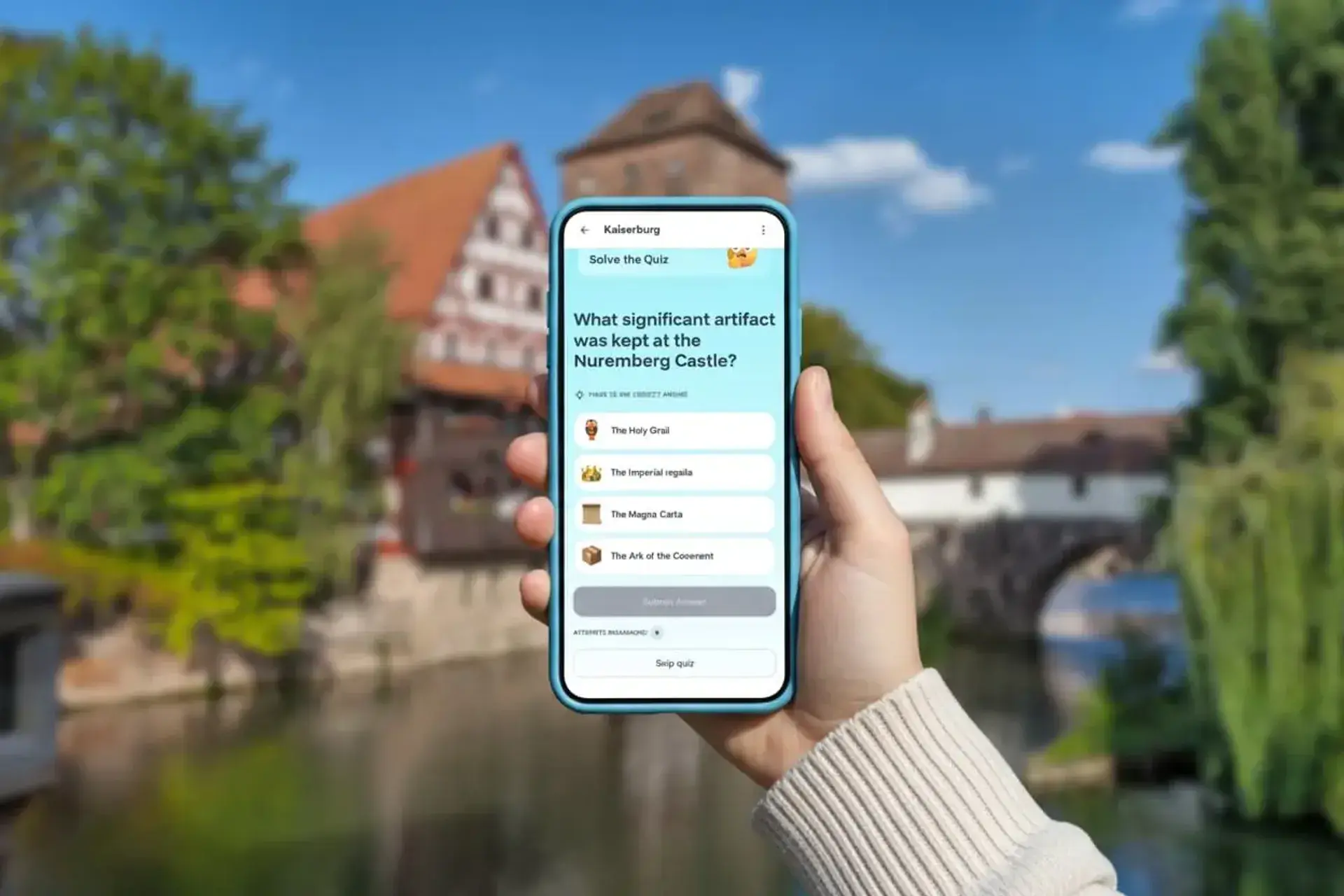
<p>Perched high above Nuremberg’s Old Town, the Kaiserburg—or Nuremberg Castle—has stood as a sentinel of power and prestige since its first documentation in 1050. This fortress was more than a military stronghold; it was a symbol of the Holy Roman Empire’s influence, serving as a residence for kings and emperors. Its strategic position overlooking trade routes and the city below underscored its importance within the empire.</p> <img src="https://storage.googleapis.com/ciceru-assets-stg/c41a7fde-337d-4db9-a1df-bd755d7ab549/LgkrEq7t-1920px-Nu%CC%88rnberg_Burg_ArM%20%281%29.jpg" alt="undefined" style="height: auto;width: 320px"/> <blockquote>Nuremberg Castle: Palas, Imperial Chapel, and Heathens' Tower on the right; Sinwell Tower in the middle left; Pentagonal Tower, Imperial Stables, and Luginsland Tower on the far right. Photo by ArtMechanic.</blockquote> <p>The castle played a pivotal role in 1356 when Emperor Charles IV issued the Golden Bull, declaring Nuremberg the site of the first Imperial Diet for newly elected kings. This decree solidified the city’s place in Imperial politics, and the castle became a repository for the Imperial regalia—crowns, swords, and orbs—from 1423 to 1796, further cementing its significance.</p> <img src="https://storage.googleapis.com/ciceru-assets-stg/c41a7fde-337d-4db9-a1df-bd755d7ab549/CAhE7fn4-Goldene_Bulle_Handschrift%20%281%29.jpg" alt="undefined" style="height: auto;width: 320px"/> <blockquote>Page from the Golden Bull manuscript of King Wenceslaus, circa 1400. Preserved in the Austrian National Library.</blockquote> <p>Inside, the Deep Well and the Sinwell Tower remain engineering marvels of their time, providing not just defense but also vital resources during sieges. The castle’s walls whisper stories of royal banquets, political negotiations, and the lives of those who called it home.</p>

历史艺术地堡

<p>Beneath the streets of Nuremberg lies a hidden sanctuary—the Historischer Kunstbunker. Built during World War II, this underground bunker was designed to protect something priceless. Can you guess what it was?</p>

阿尔布雷希特-丢勒故居

<p>This final stop on our tour brings us to the home of Albrecht Dürer, which we briefly encountered in the previous stop at the Historischer Kunstbunker, where some of his priceless works were safeguarded during World War II.</p> <img src="https://storage.googleapis.com/ciceru-assets-stg/c41a7fde-337d-4db9-a1df-bd755d7ab549/mUfYScqI-807px-Albrecht-self%20%281%29.jpg" alt="undefined" style="height: auto;width: 320px"/> <blockquote>Albrecht Dürer, Self-Portrait with Eryngium (1493). Preserved in the Louvre.</blockquote> <p>Nestled within Nuremberg’s historic Old Town, this meticulously preserved half-timbered house served as both his home and workshop.</p> <img src="https://storage.googleapis.com/ciceru-assets-stg/c41a7fde-337d-4db9-a1df-bd755d7ab549/LrUIlDYp-810px-Albrecht-Du%CC%88rer-Haus%2C_interno_07_cucina.jpg" alt="undefined" style="height: auto;width: 320px"/> <blockquote>Interior: Kitchen of the Albrecht Dürer House in Nuremberg.</blockquote> <p>Dürer lived here from 1509 until his death in 1528. The house itself is a masterpiece of 15th-century architecture, reflecting the wealth and status of its illustrious owner. The house also serves as a museum, offering a window into the life and legacy of an artist whose influence is still felt today.</p>

你的私人导游,就在口袋里

这些地方,准备好去走一趟了吗?

  • 自助导览,现在出发或改天再走
  • 离线音频,7 种语言
  • 30 天内不满意可退款
  • 含 500MB 全球 eSIM 流量

€7.00

Nuremberg的 1 条自助导览

查看全部导览

规划行程

Nuremberg要待几天?1天完美行程

第1天

从火车站起步,漫步纽伦堡老城

从纽伦堡中央火车站出发,沿着国王大街穿行于老城区的步行街区,若要前往更远的地方,随时可换乘A区公共交通。

天气与人流

最佳旅行时间

若想避开拥挤人群并享受宜人天气,5月至6月或9月至10月是最佳时机:前者的最高气温在18.8至22.0°C之间,后者在14.2至20.0°C之间。2025年7月至12月的单月过夜旅客量创下历史新高,其中12月更是首次突破40万人次。

推荐

气候寒冷,游客较少

1月–2月

-4–4°C/ 25–40°F

游客较少偶有降雨
  • 纽伦堡客流最低谷
  • 1月平均最低气温仅为-4.0°C。

春意渐浓

3月–4月

-1–14°C/ 31–56°F

游客渐多偶有降雨
  • 纽伦堡春季嘉年华
  • 4月平均最高气温仅为13.6°C。

不容错过

  • 纽伦堡民俗节,春季嘉年华

气候温和,多雨时节

5月–6月

7–22°C/ 45–72°F

人多拥挤多雨
  • 纽伦堡春暖花开
  • 6月是降水最多的常规月份,降水量达75毫米。

夏季客流高峰

7月–8月

12–24°C/ 54–75°F

旅游旺季多雨
  • 纽伦堡夏日高温
  • 7月和8月的平均降水量分别为69毫米和67毫米。

不容错过

  • 纽伦堡民俗节,秋季嘉年华

天气宜人,游人如织

9月–11月

1–20°C/ 33–68°F

人多拥挤偶有降雨
  • 纽伦堡秋季集市
  • 2025年10月过夜旅客量达354,916人次。

不容错过

  • 纽伦堡秋季集市

  • 纽伦堡圣婴市集

圣诞客流巅峰

12月

-2–3°C/ 28–38°F

旅游旺季偶有降雨
  • 圣婴市集季
  • 2025年12月过夜旅客量突破40万人次。

不容错过

  • 纽伦堡圣婴市集

交通

Nuremberg到达与交通

纽伦堡机场

Nuremberg到达与交通
地铁U2线12分钟€3.90

纽伦堡中央火车站

Nuremberg到达与交通
经国王大街步行约5分钟€0.00

地铁、有轨电车与巴士

A区车票即已足够

A区单程票线上购买3.65欧元,纸质票3.90欧元,90分钟内有效;4次票14.60欧元,单人日票10.60欧元。搭乘VAG公交车车上购票须使用非现金支付。

步行

火车站至核心区仅需5分钟

据公交公司VAG测算,纽伦堡中央火车站距离市中心仅约5分钟路程;国王大街是核心步行街。目前圣洛伦茨教堂前的国王大街斜坡通道处于封闭状态。

VAG共享单车

短途经济实惠

基础起步费0.10欧元,之后每分钟0.10欧元,24小时封顶10欧元。普通VAG单车须归还至指定停车点或弹性区域;在区域外违规还车将面临至少20欧元的罚款。

共享电动滑板车

停车极易踩坑

在纽伦堡联邦公路环线内,滑板车只能归还至划线的指定停放区;在该区域内停在其他地方将无法结束计费。环线之外则依然允许随停随锁。

出租车

打表计费,支持刷卡

纽伦堡出租车起步价为4.90欧元;3公里预估运价为15.40欧元。根据运营规定,司机若遇乘客要求,必须支持刷卡支付。

建议以步行为主,辅以A区交通票。纽伦堡卡售价为48小时38欧元;买两张单人日票只需21.20欧元,若仅用于乘车,纽伦堡卡要贵出16.80欧元。

预算

游览Nuremberg需要多少钱?

核实费用如下:短途出行1.90至2.10欧元,A区单程出行3.65至3.90欧元,单人日票10.60欧元,3至5公里出租车预估运价为15.40至20.80欧元。餐饮价格区间暂无数据。

游览Nuremberg需要多少钱?
A区单程票,成人€3.65–€3.90
短途单程票€1.90–€2.10
A区单人日票€10.60
VAG共享单车,10分钟€1.10
出租车预估运价,3至5公里€15.40–€20.80

Cash or card?

自2026年5月1日起,搭乘VAG公交车车上购票全面实行无现金支付;自动售票机和人工网点仍支持现金。纽伦堡出租车若遇乘客要求,必须支持刷卡。

住宿

Nuremberg住宿区域

圣洛伦茨老城区

初访首选,邻近车站

最核心的步行街大都位于圣洛伦茨区,国王大街直接通往中央火车站。目前洛伦茨过道的施工对圣洛伦茨教堂周边的无障碍通行有所影响。

戈斯滕霍夫

充满活力,跳出老城

官方称戈斯滕霍夫充满生机;规划资料显示这里街区紧凑,各类文化场所与餐饮小店吸引着大量游客。不过,建筑密集、街巷狭窄是随之而来的特点。

圣约翰尼斯

闹中取静,靠近核心

圣约翰尼斯区位于老城以西、佩格尼茨河以北;老建筑群密集,相比圣洛伦茨区,前往市中心需要多走一段路或换乘交通。

导览

一步一故事,探索Nuremberg

刮刮乐

来刮一刮

涂层下面也许藏着好东西。中奖的话,我们会告诉你怎么用。

每位旅行者限一份奖品,有效期 2 年。

口碑

旅行者评价

安全

Nuremberg安全吗?

纽伦堡总体十分安全:在2025年德国20万以上人口城市的治安评比中,警方将其列为第五安全的城市。盗窃是最大的一类案件,共13,573起;扒窃案则降至447起。

中央火车站周边

2025年警方在纽伦堡中央火车站周边记录了1,526起违法案件,其中包含696起涉毒案件。北侧治安稳定后,南出口成为新出现的关注重点。

圣诞人潮

警方提醒在圣婴市集拥挤的人群中注意防范扒手:请将现金、银行卡和手机分开放入带拉链的贴身口袋,背包尽量背在胸前。

全天禁酒区

纽伦堡在火车站广场、国王门地下通道和奥夫塞斯广场实行全天候禁酒;当街饮酒或携带开封酒水准备饮用,最高可被罚款1,000欧元。

行人与电动滑板车

国王大街南段全天允许骑行,但在海关大楼以北的路段必须下车推行;电动滑板车严禁驶入人行道或步行区。若酒驾达到0.5‰,骑滑板车最高可面临500欧元罚款。

医疗救助

如遇非危及生命的非门诊时间求医,纽伦堡可拨打116117,或前往火车站街11a号值班诊所;紧急救援请拨打112。拨打112是否必定提供英语服务暂无确切信息。

实用信息

实用提示

公交车实行非现金支付

自2026年5月1日起,搭乘VAG公交车上车购票必须使用非现金支付;自动售票机、线下合作代售点及VAG客服中心仍接受现金。

电动滑板车指定还车点

在纽伦堡联邦公路环线内,共享电动滑板车只能归还至划线的指定停放区;停在其他地方将无法结束租借,费用会持续扣除。

纽伦堡卡计时规则

纽伦堡卡自所选起始日期和时间起,有效期精准计算为48小时;没有24小时或72小时版本,生效后也不支持更改时段。

老城区街头饮酒规定

除火车站周边和奥夫塞斯广场等禁酒区外,老城区及步行街的公共路段仅允许在持有合法露天外摆许可的区域内饮酒。

问题

Nuremberg常见问题

精确按48小时计算。购买时需选定生效日期与具体时间;纽伦堡不提供24小时或72小时版本。

准备出发?

遍布Nuremberg的自助语音路线。

查看Nuremberg的路线