Balbi Arch: Rovinj's Historic Venetian Gateway
Este contenido aún no está disponible en español. Mostramos la versión en inglés.
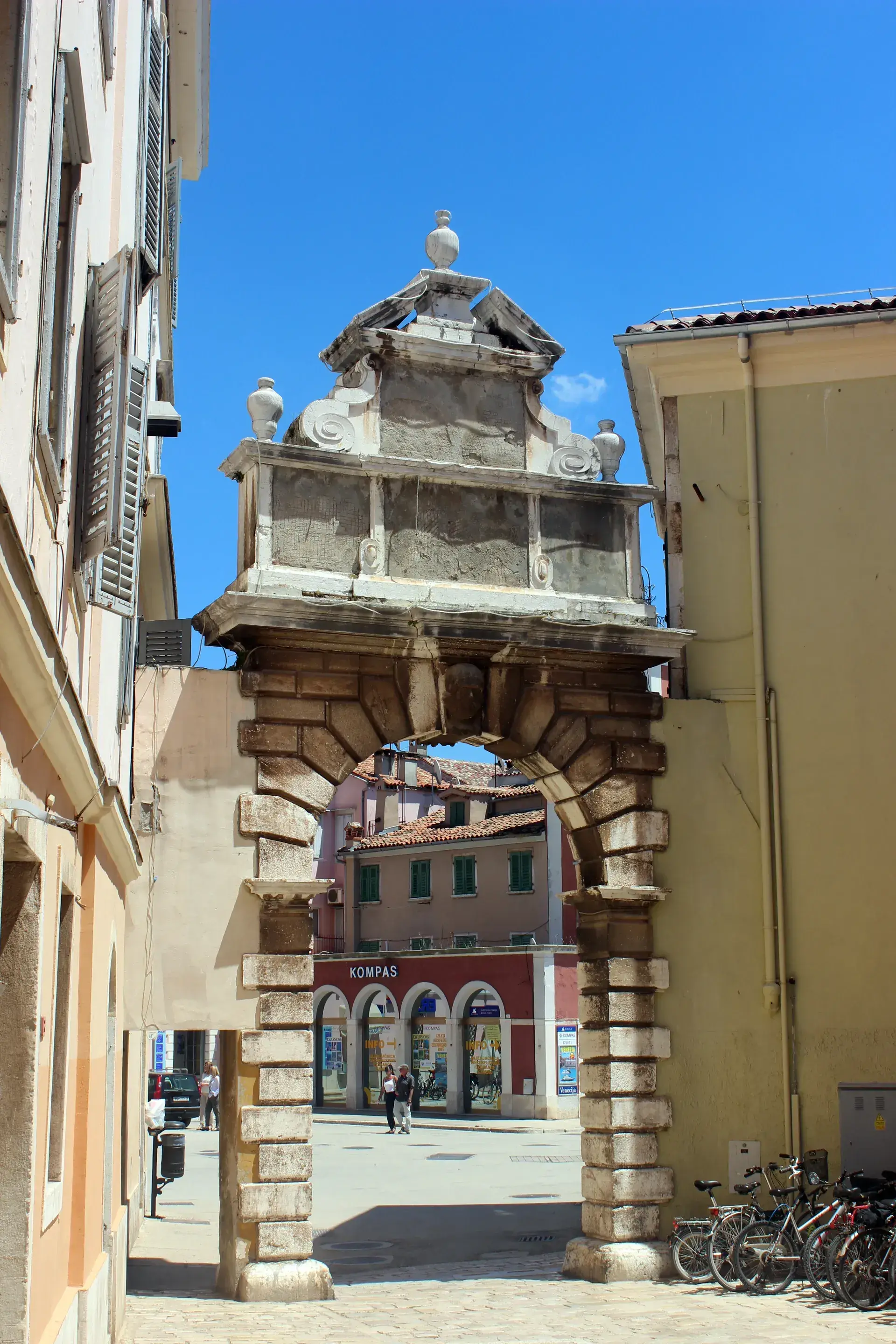
Pass beneath two contrasting faces of stone to cross the threshold of a former island. Balbi's Arch, known locally as Balbijev luk or Arco dei Balbi, acts as the essential connective link between Rovinj's modern harbor and its historic center. Located near the former channel that once separated the historic island from the mainland, the arch marks a spatial transition from the wide, open waterfront of Marshall Tito Square to the narrow, inclined cobblestones of the Old Town.
A Monument to Venetian Rule
Medieval Rovinj was a heavily fortified island settlement surrounded by defensive walls featuring seven original city gates. Balbi's Arch was constructed on the exact site of the original main entrance, the Fish Market Gate (Porton della pescheria), which was demolished in 1678.
Commissioned by Venetian Mayor Daniel Balbi, the Baroque stone gateway was built between 1678 and 1679. Today, the arch remains a prominent architectural legacy of the Venetian Republic, an empire that governed Rovinj from 1283 until 1797. Between April 2018 and June 2019, the Croatian Restoration Institute conducted a comprehensive 13-month restoration to remove centuries of pollution and organic growth, returning the stone to its original bright appearance.
Symbols Carved in Stone
The archway is heavily decorated with historical iconography, including an inscribed stone board and the Balbi family coats of arms. Notably, the structure features two distinct faces carved into its keystones. The outer-facing side depicts a turban-clad Turk, while the inner-facing side looking toward the Old Town features a Venetian head. These carvings symbolize the historic boundaries, conflicts, and diplomacy between the Venetian Republic and the Ottoman Empire.
Atop the arch sits the winged Lion of Saint Mark, a classic symbol of Venice. Local tradition dictates that the lion holds an open book, rather than a closed book or a sword, to signify that Rovinj accepted Venetian rule peacefully without war. The open book bears the Latin inscription, "Victoria Tibi Marce Evengelista Mevs" (Victory to you, Mark, my Evangelist). Additionally, travel sources occasionally note that this carved lion is an unusual depiction because it features visible genitalia.
Gateway to the Old Town
The arch serves as the principal, freely accessible pedestrian gateway into Rovinj's historic core. It operates as a highly utilized photography landmark and the starting point for visitors traversing the gallery-lined Grisia Street, the classic route that climbs to the city's highest landmark, the Church of St. Euphemia.
FAQ
When was Balbi's Arch built?
Balbi's Arch was constructed between 1678 and 1679. Commissioned by Venetian Mayor Daniel Balbi, the Baroque stone gateway was built on the site of Rovinj's original main entrance, the demolished Fish Market Gate.
What do the two stone heads on Balbi Arch represent?
The arch features two distinct carved heads on its keystones: an outer-facing turban-clad Turk and an inner-facing Venetian head. These carvings symbolize the historic boundaries and diplomacy between the Venetian Republic and the Ottoman Empire.
Why does the Venetian lion on the arch hold an open book?
According to local tradition, the winged Lion of Saint Mark holds an open book to signify that Rovinj accepted Venetian rule peacefully without war. The open book displays the Latin phrase "Victoria Tibi Marce Evengelista Mevs" (Victory to you, Mark, my Evangelist).