Château Frontenac

Consejos y tours para exploradores y viajeros

Guía de la ciudad de Québec City

Quebec aúna las calles históricas de la Haute-Ville y la Basse-Ville, unidas por empinadas escaleras públicas, barrios con vida propia, festivales y duros inviernos. El francés es el idioma oficial y explorarla exige alternar paseos a pie con las líneas de autobús de la RTC.

País
Canadá
Idioma
francés
Moneda
dólar canadiense (CAD)
Enchufe
tipo A/B
Zona horaria
America/Toronto
Emergencias
911
Agua del grifo
Potable
Prefijo
+1

Las paradas

Qué hacer en Québec City

Explorar Quebec implica salvar los desniveles entre la Haute-Ville y la Basse-Ville, recorrer murallas históricas y descubrir barrios con carácter propio, comunicados por escaleras públicas y líneas de transporte de la RTC.

Antes de caminar: introducción a la ciudad de Québec

<p>Before you set off, know this: Québec City isn’t a museum piece—it’s a negotiation between centuries. Perched on a cliff above the St. Lawrence River, it remains the only fortified city north of Mexico still intact, which tells you everything about its temperament. Stone walls, copper roofs, and French street names coexist with espresso machines and Wi-Fi, and somehow none of it feels forced. The city doesn’t perform history; it inhabits it.</p> <p>This tour follows that layered rhythm—from the modern heights of the <strong>Observatoire de la Capitale</strong> down to the waterfront markets of the <strong>Old Port</strong>. Along the way you’ll encounter fortresses that never fought, churches that refused to die, prisons turned libraries, and murals that turned history into architecture. Think of it less as sightseeing and more as time travel without the paradoxes.</p> <p><strong>Distance:</strong> about 4.5 kilometers (roughly 2 hours).<br><strong>Terrain:</strong> steep in places—Upper Town is confident in its elevation.<br><strong>Pace:</strong> unhurried. Every leg is under 10 minutes; linger freely.<br><strong>Essentials:</strong> good shoes, layered clothing, and curiosity. You won’t need to enter any buildings; every story can be read from the street.</p> <p>Québec’s weather changes its mind often—sun, mist, drizzle, sometimes all before lunch. Treat it as part of the narrative. The same sky that once watched over Champlain’s wooden settlement now shades buskers, bureaucrats, and the odd ghost tour.</p> <p>You’re about to walk through a city fluent in time, where survival doubles as an art form. Open the app near the <strong>Observatoire de la Capitale</strong>, take in the skyline, and let the city begin its argument with eternity.</p>
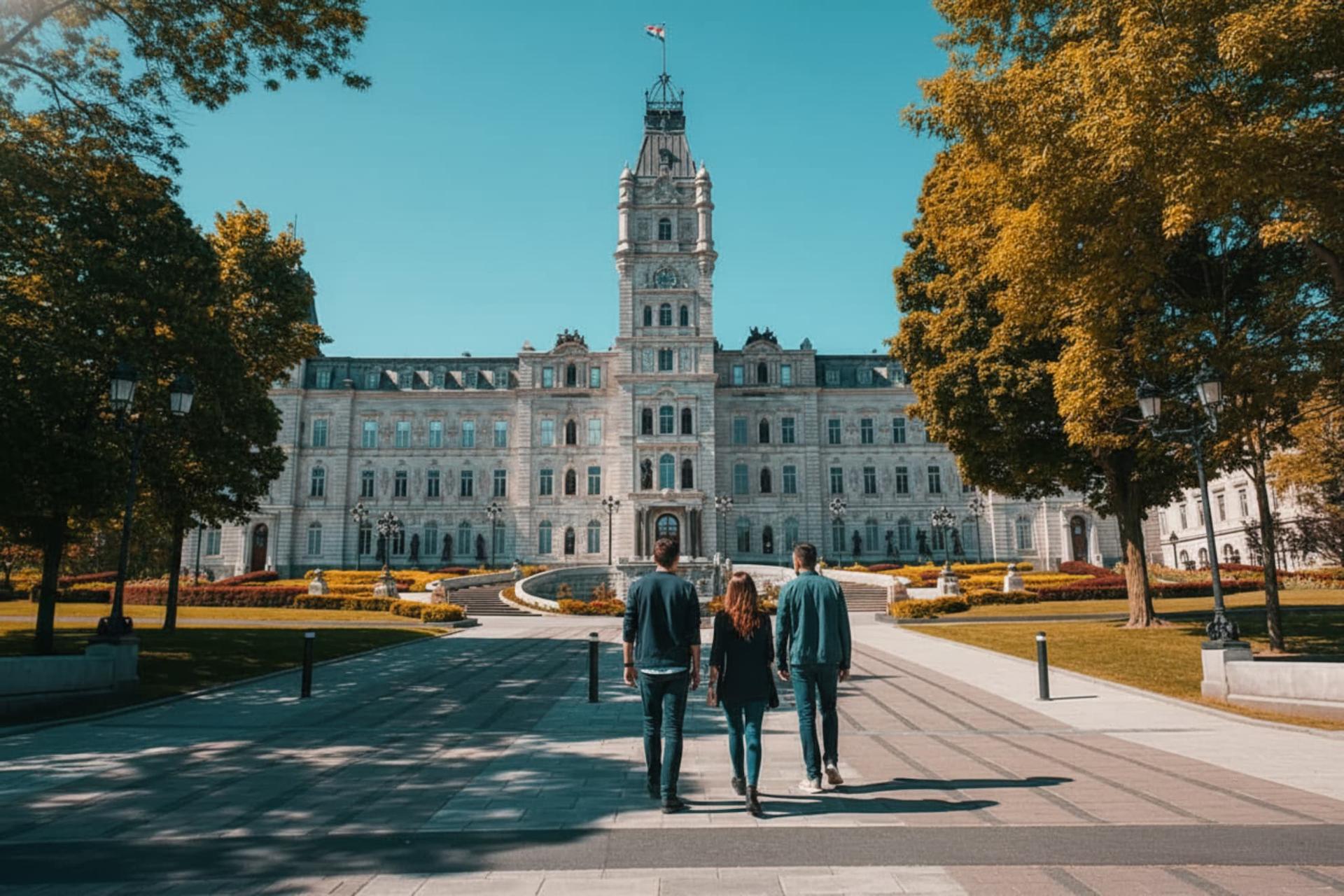
Política esculpida en piedra

La fortaleza que nunca vio batalla

<p>Don’t be fooled by the quiet. The Citadelle was built for a war that refused to arrive. Between 1820 and 1850, British engineers carved this star-shaped fortress into Cap Diamant, a cliff so steep that Samuel de Champlain once mistook its glittering quartz for diamonds. When the stones proved worthless, the French coined a proverb: <em>“false as a Canadian diamond.”</em> The fortress inherited both the sparkle and the irony.</p> <p>After the War of 1812, Britain feared the Americans might try again, so the Duke of Wellington ordered a stronghold “to discourage ambition.” Lieutenant-Colonel Elias Walker Durnford obliged, hauling stone by barge and horse hoist up 360 feet of cliff to form what became North America’s largest British-built fortress. It was designed as a “last refuge” during siege or uprising—complete with rainwater reservoirs, barracks, and paranoia in five-point symmetry. The rebellion never came, but the bills did.</p> <p>History compensated with theatrics. In 1943 and 1944, Winston Churchill and Franklin D. Roosevelt met here to plan the Allied invasions of Europe and Asia. The D-Day calendar was finalized in rooms meant for musket drills. The same bastions that once braced for cannon fire now hosted secretaries, interpreters, and the faint smell of pipe tobacco. Not bad for a fort that never saw a battle.</p> <p>Today, the Citadelle serves three masters: Canada’s Governor General, the Royal 22e Régiment (the “Van Doos”), and two hundred thousand annual visitors. At 10 a.m. sharp in summer, the Changing of the Guard fills the parade ground with scarlet uniforms, bear-fur hats, and Batisse the goat—descendant of a Persian gift to Queen Victoria. When the noon gun fires, car alarms across town respond like an unplanned salute.</p> <p>At night, guides whisper of phantom footsteps on the ramparts—soldiers who died of duty or frost, or maybe just echoes of all that discipline. Either way, the ghosts are punctual; you could set your watch by them.</p> <p>Wind needles your skin along these granite walls, cold as empire. Look down at the river, glittering where Champlain’s “diamonds” once fooled a dreamer. For four centuries, Cap Diamant has defended many things—some real, some imagined. Mostly, it defends the idea that vigilance itself is a kind of heritage.</p> <p>Next stop: the Morrin Centre — where the fortress walls turn inward, and Québec trades gunpowder for grammar.</p>

Donde las paredes cambian de opinión

<p>From the outside, the Morrin Centre looks polite—Victorian stone symmetry, wrought-iron balconies, and a library’s hush. You’d never guess it began as Québec’s most notorious jail. Architect François Baillairgé built it in 1812 on the new model of “moral reform”: thick limestone walls, solitary cells, and the belief that silence could civilize. The windows you see now once opened onto isolation. Between 1812 and 1867, thieves, rebels, and debtors were confined behind them; sixteen left by way of the gallows that once stood above the front door. In 1823, half the city crowded these streets to watch a public hanging—a civic ritual that passed for justice.</p> <p>When the last prisoners were transferred to a newer facility, the building reinvented itself as Morrin College. The new purpose came courtesy of Dr. Joseph Morrin, a Scottish-born physician and twice mayor who believed education could rescue what punishment couldn’t. The façade you’re facing hides an improbable metamorphosis: prison cells converted into lecture halls, and gallows replaced by Greek Revival trim. Behind those windows, Québec’s first English-language degrees were earned—including one by a woman in the 1880s, proof that the walls were learning too.</p> <p>Look closely and you’ll spot the contrast between the original stone blocks and later Victorian masonry—architectural layers of repentance. The balcony railings where guards once paced now frame the library windows of the Literary and Historical Society of Québec, the province’s oldest English cultural institution. Inside those shelves rest volumes older than the city itself, rescued from two fires and a century of bilingual politics.</p> <p>Locals still claim that on quiet evenings, the sound of footsteps drifts from the basement vents—a faint echo of chains or maybe applause from a poetry reading. From out here, it’s hard to tell which would be stranger.</p> <p>The building stands as proof that walls, like people, can outgrow their original sentence. A place once designed to suppress voices now preserves them in ink and memory.</p> <p>Next stop: Château Frontenac — where penitence gives way to opulence, and the ghosts finally get room service.</p>

La fe reconstruida - una y otra vez

El hotel que se vendió Canadá a sí mismo

<p>Stand here and look up: this isn’t just a hotel; it’s Canada’s most successful sales pitch in stone. The Château Frontenac was born in 1893 from the Canadian Pacific Railway’s belief that tourism could be industrialized. If Europe had castles, Canada would simply build better ones. Architect Bruce Price borrowed his blueprints from the Loire Valley, added turrets for theatrical effect, and let the whole structure loom over the St. Lawrence like a medieval fortress that accidentally joined a marketing campaign.</p> <p>The result was a fairytale built on capitalism. CPR president William Van Horne—who quipped, “If we can’t export the scenery, we’ll import the tourists”—named it after Louis de Buade, Comte de Frontenac, the 17th-century governor who once ruled New France and refused to surrender to the British. Fittingly, the hotel now rules every postcard rack in the country.</p> <p>The site beneath those copper roofs has hosted four centuries of authority. The Château Frontenac replaced a line of vanished powerhouses: the French Château Saint-Louis, the British Château Haldimand, then, finally, this baronial hybrid where empire met expense account. Each rebuild erased the previous occupant while pretending to preserve it—a tradition Québec has perfected.</p> <p>During the Second World War, the hotel briefly doubled as Allied headquarters. Inside, Churchill and Roosevelt drafted the plans for D-Day while Canada’s own Prime Minister Mackenzie King played the role of polite host, excluded from most conversations. Outside, locals simply noted that the lights stayed on past curfew.</p> <p>The copper roof above you—replaced entirely between 2011 and 2014—still wears its green patina like aged armor. In winter, the air carries a hint of metal and salt from the river; in summer, the turrets flare orange at sunset, as if the building remembers its 1926 fire. Rumor has it that Frontenac’s ghost still patrols his namesake tower, not out of torment but because he refuses to give up the view.</p> <p>The Château’s silhouette tells you everything about Québec’s self-esteem: half fortress, half fantasy, always photogenic. You don’t need to stay the night to feel its pull—the façade already performs hospitality on a civic scale.</p> <p>Next stop: Dufferin Terrace — the wooden promenade that turned defense into leisure and keeps the river company year-round.</p>

Donde la fortaleza se convirtió en un paseo marítimo

<p>If you ever needed proof that history can loosen its collar, this is it. Dufferin Terrace began as the governor’s private patio—an off-limits platform for lords to admire the river in solitude. Today, it’s 430 meters of democracy on timber, where anyone with shoes can walk the same edge once reserved for aristocracy.</p> <p>Look down through the glass skylights and you’ll see the bones of the old Château Saint-Louis, the 17th-century seat of New France. That château burned in 1834, leaving a literal power vacuum. Five years later, Lord Durham—British governor, reformist, and part-time controversy magnet—ordered the ruins turned into a public promenade. It was a radical idea: let commoners enjoy the governor’s view. The result was Durham Terrace, a short wooden platform with a railing and a message—“authority can afford transparency.”</p> <p>Four decades later, Lord Dufferin took the concept personally. In the 1870s he arrived in Québec, fell hopelessly in love with the city, and stopped municipal engineers from demolishing the fortifications. Instead, he doubled down on preservation and spectacle. Between 1878 and 1879, the terrace stretched to its current length, with six green-and-white gazebos named after the usual suspects—Frontenac, Victoria, Princess Louise, Dufferin himself. On June 28, 1879, Princess Louise cut the ribbon. The British Empire had just inaugurated Canada’s most photogenic boardwalk.</p> <p>Then came 1885, when 34 arc lamps flickered on along this very railing—electric light beamed 30 kilometers from Montmorency Falls. For one week, Dufferin Terrace was North America’s most modern boulevard, glowing over a 200-year-old cliff. Québec had officially entered the future without leaving its past.</p> <p>In winter, this place belongs to the toboggan slide, a 140-year-old wooden rocket run where riders hit 70 kilometers an hour screaming patriotic nonsense into the wind. In summer, street performers juggle and mimes mime while tourists photograph the Champlain monument—whose sculptor, Paul Chevré, later survived the Titanic. Québec never wastes a good plot twist.</p> <p>Listen for the whistle of river wind around Château Frontenac’s turrets, the wood creaking under millions of footsteps, the faint smell of cedar and brine. This boardwalk is more than a viewpoint; it’s a declaration that history doesn’t have to hide behind walls.</p> <p>Next stop: Rue du Petit-Champlain — where the view descends to street level, and commerce becomes the city’s native language again.</p>

La calle más antigua que se niega a envejecer

El muro que lo recuerda todo

Tu guía privado, en el bolsillo

¿Listo para recorrerlo todo a pie?

  • Autoguiado, cuando tú quieras
  • Audio sin conexión, 7 idiomas
  • Garantía de devolución
  • eSIM de 500 MB incluida

desde

5,00 €

1 tour autoguiado en Québec City

Ver los tours

Planifica los días

¿Cuántos días en Québec City? El itinerario perfecto de 1 días

Día 1

Pasea por la Haute-Ville y la Basse-Ville de Quebec

Conecta la histórica Haute-Ville con la Basse-Ville a través de callejuelas empinadas, plazas emblemáticas y escalinatas públicas, y recurre a los autobuses de la RTC para los trayectos más largos.

5,00 €

Clima y afluencia

Mejor época para visitar

Julio es el mes más cálido de media en Quebec, con 25,0°C, pero el periodo de junio a octubre es el más lluvioso. Mayo y septiembre ofrecen el mejor equilibrio; de enero a marzo el frío es riguroso, mientras que el verano y la agenda festiva de diciembre disparan la afluencia de visitantes.

Recomendado

Pleno invierno

ene–mar

-17–0°C/ 2–33°F

Mucha genteLluvioso
  • Carnaval de invierno, Quebec
  • La mínima media de enero es de -16,7°C.

No te lo pierdas

  • Carnaval de invierno de Quebec

Deshielo de entretiempo

abr–may

-1–18°C/ 30–64°F

Se va llenandoLluvioso
  • Mayo: hasta 17,5°C de día
  • La precipitación media de abril es de 94,4 mm.

Festivales de verano

jun–sept

8–25°C/ 47–77°F

Temporada altaLluvioso
  • Festival d’été de Québec
  • La precipitación media de julio es de 118,7 mm.

No te lo pierdas

  • Festival d’été de Québec

Colores y final de otoño

oct–dic

-11–11°C/ 11–52°F

Mucha genteLluvioso
  • Mercado navideño alemán
  • La máxima media de diciembre es de -3,3°C.

No te lo pierdas

  • Mercado navideño alemán de Quebec

Transporte

Cómo llegar y moverse por Québec City

Aeropuerto de Quebec

Cómo llegar y moverse por Québec City
Línea 80 de la RTC al centroNo publicado3,85 CAD
Línea 76 de la RTC a Sainte-FoyMenos de 30 min3,85 CAD

Autobuses de la RTC

Mejor opción general

La tarifa RTC 2026 es de 3,85 CAD con billete o 4,00 CAD en efectivo; el pase de 1 día cuesta 10,50 CAD y el de 5 días, 34,75 CAD. Las líneas 800 y 801 son las más prácticas de alta frecuencia.

A pie

Ideal por el centro

El Vieux-Québec y los barrios céntricos se recorren bien a pie, pero hay muchas escaleras públicas, cuestas empinadas entre la Haute-Ville y la Basse-Ville, y hielo o nieve en invierno.

Bicicleta

Solo en verano

Ir en bici es cómodo con buen tiempo por sus carriles, pero las cuestas, escaleras, nieve y cruces la desaconsejan en invierno. No hay tarifas oficiales publicadas de alquiler para visitantes.

Taxi o VTC

Noche o periferia

Usa taxi o VTC para ir a YQB a deshoras o a distritos periféricos. El aeropuerto confirma su servicio, pero no publica una tarifa oficial fija para visitantes en su web de transporte.

Camina por el Vieux-Québec y el centro, y toma las líneas 800, 801, 76 y 80 de RTC para más distancia. El pase de 1 día renta frente a tres billetes; el de 5 días compensa a partir de diez viajes.

Presupuesto

¿Cuánto cuesta visitar Québec City?

Las tarifas oficiales del transporte público de Quebec son moderadas: el pase de 1 día cuesta 10,50 CAD y el de 5 días, 34,75 CAD. No se han encontrado horquillas de precios actuales y representativas de cafés, comidas, cervezas o taxis en fuentes oficiales fiables, así que no tomes estos datos como un presupuesto cerrado para manutención.

¿Cuánto cuesta visitar Québec City?
Billete de la RTC, digital o en papel3,85 CAD
Tarifa de la RTC en efectivo4,00 CAD
Pase de 1 día de la RTC10,50 CAD
Pase de 5 días de la RTC34,75 CAD
Fin de semana ilimitado de la RTC19,00 CAD

Cash or card?

La máquina de la RTC de la terminal de YQB acepta las principales tarjetas y pagos móviles. La página de tarifas municipal distingue entre pago con billete y en efectivo; conviene llevar algo de efectivo en dólares canadienses por si te desplazas fuera de los puntos que admiten pago electrónico.

Dónde alojarse

Dónde alojarse en Québec City

Vieux-Québec

Primera visita

El casco histórico es ideal para ir a pie por las cuestas entre Haute-Ville y Basse-Ville y tomar buses céntricos. Tiene escaleras, adoquines, mucho trajín de eventos y poco sosiego vecinal.

Saint-Jean-Baptiste

Cafés, tardes en el centro

Saint-Jean-Baptiste está junto a las murallas, con calles animadas y acceso a pie al Vieux-Québec. Su desnivel y los tramos de escaleras son un claro inconveniente en invierno.

Saint-Roch

Vida nocturna, ambiente local

Saint-Roch, en la parte baja, ofrece servicios y buenos enlaces de autobús. Es más diverso y menos de postal que el Vieux-Québec, lo que supone una gran ventaja para estancias largas.

Montcalm

Más tranquilo, cultura

Montcalm es un barrio residencial céntrico con parques, cafés y calles tranquilas. Volver al Vieux-Québec cuesta arriba implica una caminata más larga o recurrir al autobús.

Sainte-Foy

Aeropuerto, espacio y enlaces

Sainte-Foy es una base práctica al oeste, cerca del aeropuerto y de autobuses clave como la línea 76 directa a la terminal. No conviene si planeas pasar tardes y noches en el casco antiguo.

Los tours

Québec City, historia a historia

Rasca y gana

Rasca a ver

Debajo podría haber algo bueno. Si ganas, te decimos cómo usarlo.

Un premio por viajero. Válido 2 años.

El boca a boca

Lo que dicen los viajeros

Seguridad

¿Es seguro Québec City?

Quebec es un destino cómodo y seguro. Conviene prever el hielo y la nieve invernales, las empinadas escaleras entre la Haute-Ville y la Basse-Ville, los cruces con tráfico y buses, y las aglomeraciones en grandes eventos de verano e invierno. Llama al 911 para emergencias policiales, sanitarias o de bomberos; el 811 es el servicio oficial de salud para consultas no urgentes.

Hielo y escaleras en invierno

Las escaleras públicas y cuestas entre la Haute-Ville y la Basse-Ville resbalan mucho tras nevar o con lluvia engelante. Usa el pasamanos, calzado con buen agarre y opta por el autobús si las escaleras están en malas condiciones.

Aglomeraciones en festivales

En citas como el Carnaval de invierno, el Festival d’été de Québec o el Mercado navideño alemán de diciembre, vigila tus pertenencias en bolsillos o mochilas cerrados durante las colas o al subir a los autobuses cerca de los recintos.

Cruces de calles y autobuses

No bajes del bordillo mirando el móvil, sobre todo en las avenidas anchas que conectan el Vieux-Québec con Saint-Roch y Saint-Jean-Baptiste. Comprueba siempre si vienen autobuses o coches girando antes de cruzar.

Cambios repentinos de tiempo

La estación Quebec/Jean Lesage marca medias de 25,0°C en julio y mínimas medias de -16,7°C en enero. Viste por capas y lleva agua y calzado impermeable si combinas la orilla del río con tramos de escaleras y miradores al aire libre.

Atención médica de urgencia

Llama al 911 ante emergencias. Para dudas de salud no urgentes, Info-Santé 811 te atiende con personal de enfermería; la documentación oficial no garantiza que la asistencia esté disponible en inglés en todos los casos.

Información útil

Conviene saber

El francés es el idioma común

El francés es la única lengua oficial y de uso habitual. Decir «bonjour» y usar topónimos locales facilita el día a día, las señales y los servicios públicos, aunque en el sector turístico muchos trabajadores se defienden en inglés.

Seis distritos municipales

Quebec cuenta con seis distritos: Beauport, Charlesbourg, La Cité-Limoilou, La Haute-Saint-Charles, Les Rivières y Sainte-Foy-Sillery-Cap-Rouge. Por eso, una dirección en la ciudad puede quedar muy lejos del Vieux-Québec.

La ciudad de las escaleras

Las escaleras públicas son parte del patrimonio oficial local. Asume el trayecto entre la Haute-Ville y la Basse-Ville como una ruta vertical y revisa el tiempo en invierno antes de fiarte de la ruta más corta en el mapa.

Preguntas

Preguntas sobre Québec City

La línea 80 de la RTC conecta el aeropuerto (YQB) con el centro de Quebec pasando por Les Saules. La línea 76 une el aeropuerto con Sainte-Foy en menos de media hora, y desde allí las frecuentes líneas 800 y 801 continúan hacia el centro.

¿Listo para salir?

Tours de audio autoguiados por toda Québec City.

Ver los tours en Québec City