Hauptmarkt Nürnberg

Consejos y tours para exploradores y viajeros

Guía de la ciudad de Nuremberg

Núremberg combina su fundación medieval en 1050 y su pasado pionero en el ferrocarril con un Altstadt perfecto para recorrer a pie, sus famosas salchichas y pan de jengibre con denominación de origen protegida por la UE, y un trayecto directo de doce minutos en metro hasta la estación central.

Las paradas

Qué hacer en Nuremberg

Núremberg se disfruta mejor a pie, recorriendo el eje peatonal que va desde la Hauptbahnhof hasta el Altstadt, entre monumentos medievales, mercados locales y siglos de historia comercial de Franconia.

Handwerkerhof

<p>Wlcome to Nuremberg—a city of contrasts, where the grandeur of the Holy Roman Empire meets the sobering lessons of the 20th century.</p> <p>Let’s step through the gates of history to begin our journey at the Handwerkerhof, a living homage to Nuremberg’s craftsmanship. Created in 1971, this charming recreation of a medieval craftsman’s quarter is tucked within the city’s ancient walls, right by the Königstor, or King’s Gate. This space was designed not just as a nostalgic nod to the past but as a vibrant showcase for the traditional crafts that once made Nuremberg the pride of Europe.</p> <img src="https://storage.googleapis.com/ciceru-assets-stg/c41a7fde-337d-4db9-a1df-bd755d7ab549/izCUSWyN-810px-Nu%CC%88rnberg_Maxtormauer_Turm_schwarzes_H_2%20%281%29.jpg" alt="undefined" style="height: auto;width: 320px"/> <blockquote>Ancient city wall tower in Nuremberg. Photo by Andreas Praefcke.</blockquote> <p>In 1219, Emperor Frederick II—a ruler celebrated for his intellect and innovations—granted Nuremberg the "Großen Freiheitsbrief," a decree that secured the city’s independence. This freedom unleashed a wave of creativity among local artisans, leading to iconic creations like the famed Nuremberg eggs.</p> <img src="https://storage.googleapis.com/ciceru-assets-stg/c41a7fde-337d-4db9-a1df-bd755d7ab549/HUBh83fu-Frederick_II_and_eagle%20%281%29.jpg" alt="undefined" style="height: auto;width: 320px"/> <blockquote>Frederick II with his falcon, depicted in De arte venandi cum avibus (The Art of Hunting with Birds), late 13th century. Manuscript from Biblioteca Vaticana.</blockquote> <p>Today, as you wander through its cobblestone lanes and admire the timber-framed houses, you’ll see artisans practicing age-old trades. Glassblowers, metalworkers, and potters bring the medieval marketplace to life, connecting past and present in a way that feels almost magical.</p>
Lorenzkirche

<p>As we leave the bustling Handwerkerhof, the towering spires of St. Lorenz Church draw us into a realm where faith and artistry converge. Built in the 15th century, this Gothic masterpiece stands as a symbol of Nuremberg’s cultural and spiritual significance. Its construction spans centuries, with the nave completed around 1400 and the choir finished by 1477 in the ornate German Sondergotik style of Gothic architecture. The soaring west façade, dominated by two imposing towers and a sharp, intricate portal, features a 9-meter-wide rose window—a striking element that ties it to the city’s architectural lineage.</p> <img src="https://storage.googleapis.com/ciceru-assets-stg/c41a7fde-337d-4db9-a1df-bd755d7ab549/FPIzBGWL-Nu%CC%88rnberg_St._Lorenz_Tu%CC%88rme_Totale%20%281%29.jpg" alt="undefined" style="height: auto;width: 320px"/> <blockquote>West facade of the Lorenzkirche with its towering spires. Photo by Jailbird.</blockquote> <p>Inside, the treasures of St. Lorenz reveal themselves. The Angelic Salutation, a renowned carving by Veit Stoss—a master sculptor of the late Gothic period—hangs delicately in the choir, depicting the Annunciation with unmatched detail and emotion. Nearby stands the monumental tabernacle by Adam Kraft, an eminent late Gothic sculptor known for his intricate stonework. This tabernacle showcases the craftsmanship and devotion of its era.</p> <img src="https://storage.googleapis.com/ciceru-assets-stg/c41a7fde-337d-4db9-a1df-bd755d7ab549/KV1N6rGc-kraft-adam--11-_o%20%281%29.jpg" alt="undefined" style="height: auto;width: 320px"/> <blockquote>Tabernacle by Adam Kraft inside the Lorenzkirche, a stunning example of late Gothic craftsmanship.</blockquote> <p>Despite Nuremberg’s adoption of Lutheranism during the Reformation in 1525, the city’s affluent citizens preserved these treasures, honoring their ancestors’ artistic legacy. This decision reflects a deep respect for the artistic achievements that define the city’s identity.</p> <img src="https://storage.googleapis.com/ciceru-assets-stg/c41a7fde-337d-4db9-a1df-bd755d7ab549/LmEPvWA4-Matthias_Ank%20%281%29.jpg" alt="undefined" style="height: auto;width: 320px"/> <blockquote>Lorenzkantor (Choir Director of St. Lorenz) Matthias Ank, serving from 1996 to 2023. Photo by Tobias Bär.</blockquote> <p>The church’s musical heritage is equally profound. Housing three organs, each with its own storied past, St. Lorenz continues to resonate with its cultural significance. The main organ, originally built in 1937 by Steinmeyer and rebuilt in 2003 by Klais Orgelbau, boasts five manuals and stands as a marvel of engineering. The Stephans Organ, constructed by Steinmeyer in 1862 and restored in 2002, and the Laurentius Organ, built by Klais Orgelbau in 2005, complement this rich legacy. For over 500 years, the church has employed organists, including notable figures like Johann Gottlieb Frör and Carl Christian Mattäus, who left indelible marks on its musical tradition.</p>

Fleischbrücke

<p>Spanning the Pegnitz River with effortless grace, the Fleischbrücke, or Meat Bridge, is a masterpiece of late Renaissance engineering. Built between 1596 and 1598, it was designed to withstand the ravages of floods that had destroyed its wooden predecessors. At its core is an elegant single arch, with a span of 27 meters and a rise of just 4.2 meters, a flat and groundbreaking profile for its time. This design achieved an innovative span-to-rise ratio of 6.4 to 1, supported by over 2,000 wooden piles driven into the riverbed, with 400 angled to counter lateral thrusts. These techniques made the Fleischbrücke one of the most advanced structures of its era.</p> <img src="https://storage.googleapis.com/ciceru-assets-stg/c41a7fde-337d-4db9-a1df-bd755d7ab549/lGUJ0jmi-Nu%CC%88rnberg_-_Fleischbru%CC%88cke_2%20%281%29.jpg" alt="undefined" style="height: auto;width: 320px"/> <blockquote>Postcard of the Fleischbrücke, dated 1918.</blockquote> <p>Its name, "Meat Bridge," comes from its proximity to the Fleischhaus, or Meat House, which anchored the city’s thriving meat market. By connecting the districts of St. Sebald and St. Lorenz, it became a vital artery of commerce, ensuring the smooth flow of goods, livestock, and people.</p> <img src="https://storage.googleapis.com/ciceru-assets-stg/c41a7fde-337d-4db9-a1df-bd755d7ab549/tJYUZkCn-Nu%CC%88rnberg_-_Fleischbru%CC%88cke%20%281%29.jpg" alt="undefined" style="height: auto;width: 320px"/> <blockquote>Postcard of the Fleischbrücke, dated 1915.</blockquote> <p>Today, the Fleischbrücke stands as a symbol of Nuremberg’s ingenuity and resilience. Despite floods, wars, and the passage of time, it has retained much of its original structure, a testament to the skill of its creators and the foresight of its design. Its picturesque views of the Pegnitz River and the surrounding historic quarter continue to captivate visitors and photographers alike.</p>

Hauptmarkt

<p>The Hauptmarkt, Nuremberg’s historic and cultural hub, has been the city’s beating heart since the 14th century. Before its establishment, this area housed Nuremberg’s Jewish community, who were tragically displaced during the Black Death pogroms of 1349—a series of violent attacks fueled by fear and scapegoating during the spread of the plague.</p> <img src="https://storage.googleapis.com/ciceru-assets-stg/c41a7fde-337d-4db9-a1df-bd755d7ab549/bR4jk8lF-Screenshot%202025-01-23%20alle%2015.50.49.jpg" alt="undefined" style="height: auto;width: 320px"/> <blockquote>Jews being tortured and killed (woodcut, 1475), from The Medieval Holocaust: The Approach of the Plague and the Destruction of Jews in Germany, 1348-1349. Paper published by Winkler, A. in 2005.</blockquote> <p>Emperor Charles IV, a ruler known for his ambitious reforms and dedication to the Holy Roman Empire, envisioned the square as a focal point of the city’s life, both commercial and ceremonial. Dominating this vibrant space is the Frauenkirche, a Gothic masterpiece completed in 1368 under his orders. It was built as a site for imperial ceremonies, including the display of the Imperial Regalia and the baptism of his son, Wenceslas.</p> <img src="https://storage.googleapis.com/ciceru-assets-stg/c41a7fde-337d-4db9-a1df-bd755d7ab549/jsiy6JrK-818px-Nuernberg-Frauenkirche-gp%20%281%29.jpg" alt="undefined" style="height: auto;width: 320px"/> <blockquote>West facade of the Frauenkirche. Photo by Kolossos.</blockquote> <p>Architectural gems surround the Hauptmarkt. The Schöner Brunnen, or Beautiful Fountain, graces the northeastern corner with its intricate 14th-century carvings and the iconic golden ring that locals and visitors alike turn for luck. We’ll explore this magnificent fountain in the next chapter. The Frauenkirche itself stands as a Gothic marvel, overseeing the square with its elaborate west façade and rich history.</p> <img src="https://storage.googleapis.com/ciceru-assets-stg/c41a7fde-337d-4db9-a1df-bd755d7ab549/pqX9ou6D-Christkindlesmarkt_nuernberg%20%281%29.jpg" alt="undefined" style="height: auto;width: 320px"/> <blockquote>The Christkindlesmarkt in Nuremberg at the Hauptmarkt (2008). Photo by Roland Berger.</blockquote> <p>The Hauptmarkt also thrives as a living space. The Christkindlesmarkt, held during Advent, transforms the square into a festive wonderland. This centuries-old market is one of the most renowned Christmas markets in the world, featuring wooden stalls, traditional decorations, and the Nuremberg Christkind, who opens the event with a prologue from the church balcony. On weekdays, the square hosts bustling markets where vendors sell fresh produce, flowers, and local specialties, ensuring its continued role as a commercial hub.</p>

Schöner Brunnen

<p>Among the treasures of Nuremberg’s Hauptmarkt stands the Schöner Brunnen, or Beautiful Fountain, a masterpiece of medieval artistry crafted in the 14th century. Built between 1385 and 1396 by stonemason Heinrich Beheim, the fountain was initially designed to adorn the Frauenkirche (Church of Our Lady). However, it was deemed too magnificent for the church and found its rightful place in the market square, where it became a symbol of civic pride.</p> <img src="https://storage.googleapis.com/ciceru-assets-stg/c41a7fde-337d-4db9-a1df-bd755d7ab549/aPiK6ghs-kristijan-arsov-CEy_E8fIBDc-unsplash%20%281%29.jpg" alt="undefined" style="height: auto;width: 320px"/> <blockquote>Closer view of the Schöne Brunnen. Photo by Kristijan Arsov.</blockquote> <p>The fountain, standing approximately 19 meters tall, is designed as a Gothic spire with three tiers, each adorned with 40 intricately carved figures. These figures represent the worldview of the Holy Roman Empire, featuring philosophers, saints, and allegorical characters that embody harmony and unity.</p> <img src="https://storage.googleapis.com/ciceru-assets-stg/c41a7fde-337d-4db9-a1df-bd755d7ab549/V6anw1Uh-758px-Nuernberg_Schoener_Brunnen_005.jpg" alt="undefined" style="height: auto;width: 320px"/> <blockquote>Sculpture of Ptolemy as a symbol of astronomy, 2010. Photo by Janericloebe.</blockquote> <p>Encircling the fountain is an ornate iron fence and particular feature on it has drawn the curiosity of visitors for centuries.</p>

Kaiserburg

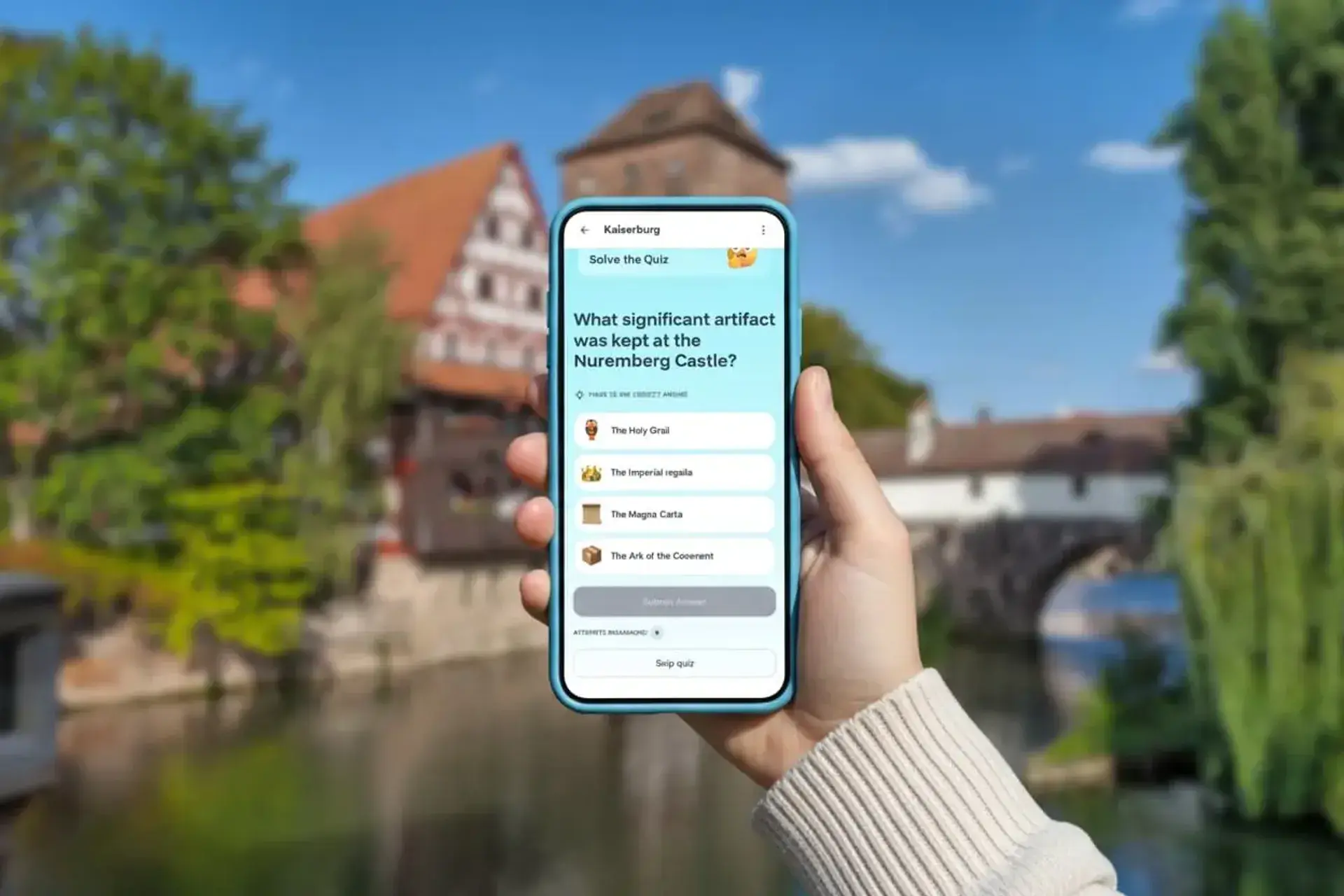
<p>Perched high above Nuremberg’s Old Town, the Kaiserburg—or Nuremberg Castle—has stood as a sentinel of power and prestige since its first documentation in 1050. This fortress was more than a military stronghold; it was a symbol of the Holy Roman Empire’s influence, serving as a residence for kings and emperors. Its strategic position overlooking trade routes and the city below underscored its importance within the empire.</p> <img src="https://storage.googleapis.com/ciceru-assets-stg/c41a7fde-337d-4db9-a1df-bd755d7ab549/LgkrEq7t-1920px-Nu%CC%88rnberg_Burg_ArM%20%281%29.jpg" alt="undefined" style="height: auto;width: 320px"/> <blockquote>Nuremberg Castle: Palas, Imperial Chapel, and Heathens' Tower on the right; Sinwell Tower in the middle left; Pentagonal Tower, Imperial Stables, and Luginsland Tower on the far right. Photo by ArtMechanic.</blockquote> <p>The castle played a pivotal role in 1356 when Emperor Charles IV issued the Golden Bull, declaring Nuremberg the site of the first Imperial Diet for newly elected kings. This decree solidified the city’s place in Imperial politics, and the castle became a repository for the Imperial regalia—crowns, swords, and orbs—from 1423 to 1796, further cementing its significance.</p> <img src="https://storage.googleapis.com/ciceru-assets-stg/c41a7fde-337d-4db9-a1df-bd755d7ab549/CAhE7fn4-Goldene_Bulle_Handschrift%20%281%29.jpg" alt="undefined" style="height: auto;width: 320px"/> <blockquote>Page from the Golden Bull manuscript of King Wenceslaus, circa 1400. Preserved in the Austrian National Library.</blockquote> <p>Inside, the Deep Well and the Sinwell Tower remain engineering marvels of their time, providing not just defense but also vital resources during sieges. The castle’s walls whisper stories of royal banquets, political negotiations, and the lives of those who called it home.</p>

Historischer Kunstbunker

<p>Beneath the streets of Nuremberg lies a hidden sanctuary—the Historischer Kunstbunker. Built during World War II, this underground bunker was designed to protect something priceless. Can you guess what it was?</p>

Casa de Alberto Durero

<p>This final stop on our tour brings us to the home of Albrecht Dürer, which we briefly encountered in the previous stop at the Historischer Kunstbunker, where some of his priceless works were safeguarded during World War II.</p> <img src="https://storage.googleapis.com/ciceru-assets-stg/c41a7fde-337d-4db9-a1df-bd755d7ab549/mUfYScqI-807px-Albrecht-self%20%281%29.jpg" alt="undefined" style="height: auto;width: 320px"/> <blockquote>Albrecht Dürer, Self-Portrait with Eryngium (1493). Preserved in the Louvre.</blockquote> <p>Nestled within Nuremberg’s historic Old Town, this meticulously preserved half-timbered house served as both his home and workshop.</p> <img src="https://storage.googleapis.com/ciceru-assets-stg/c41a7fde-337d-4db9-a1df-bd755d7ab549/LrUIlDYp-810px-Albrecht-Du%CC%88rer-Haus%2C_interno_07_cucina.jpg" alt="undefined" style="height: auto;width: 320px"/> <blockquote>Interior: Kitchen of the Albrecht Dürer House in Nuremberg.</blockquote> <p>Dürer lived here from 1509 until his death in 1528. The house itself is a masterpiece of 15th-century architecture, reflecting the wealth and status of its illustrious owner. The house also serves as a museum, offering a window into the life and legacy of an artist whose influence is still felt today.</p>

Tu guía privado, en el bolsillo

¿Listo para recorrerlo todo a pie?

  • Autoguiado, cuando tú quieras
  • Audio sin conexión, 7 idiomas
  • Garantía de devolución
  • eSIM de 500 MB incluida

desde

7,00 €

1 tour autoguiado en Nuremberg

Ver los tours

Planifica los días

¿Cuántos días en Nuremberg? El itinerario perfecto de 1 días

Día 1

Recorre el Altstadt de Núremberg desde la Hbf

Sigue la Königstraße desde Nürnberg Hbf cruzando el Altstadt peatonal, con la Zona A a mano para los trayectos más largos.

Clima y afluencia

Mejor época para visitar

Para encontrar el mejor equilibrio entre buen tiempo y afluencia, apunta a mayo-junio o septiembre-octubre, con máximas de 18,8-22,0 °C y 14,2-20,0 °C. De julio a diciembre de 2025 se batieron récords mensuales de pernoctaciones, con diciembre como el primer mes en superar las 400 000 estancias.

Recomendado

Frío y menor afluencia

ene–feb

-4–4°C/ 25–40°F

Pocos visitantesLluvia ocasional
  • Época calma en Núremberg
  • En enero, las mínimas medias rondan los -4,0 °C.

Despertar primaveral

mar–abr

-1–14°C/ 31–56°F

Se va llenandoLluvia ocasional
  • Feria primaveral en la urbe
  • En abril, las máximas medias apenas alcanzan los 13,6 °C.

No te lo pierdas

  • Nürnberger Volksfest, feria de primavera

Época cálida y lluviosa

may–jun

7–22°C/ 45–72°F

Mucha genteLluvioso
  • Primavera cálida en la urbe
  • Junio es el mes más lluvioso de media, con 75 mm.

Temporada alta de verano

jul–ago

12–24°C/ 54–75°F

Temporada altaLluvioso
  • Máximas de verano en la urbe
  • Julio y agosto promedian 69 y 67 mm de lluvia.

No te lo pierdas

  • Nürnberger Volksfest, feria de otoño

Meses suaves y animados

sept–nov

1–20°C/ 33–68°F

Mucha genteLluvia ocasional
  • Nürnberger Herbstmarkt
  • En octubre de 2025 se registraron 354 916 pernoctaciones.

No te lo pierdas

  • Nürnberger Herbstmarkt

  • Nürnberger Christkindlesmarkt

Pico navideño

dic

-2–3°C/ 28–38°F

Temporada altaLluvia ocasional
  • Época del Christkindlesmarkt
  • En diciembre de 2025 hubo más de 400 000 pernoctaciones.

No te lo pierdas

  • Nürnberger Christkindlesmarkt

Transporte

Cómo llegar y moverse por Nuremberg

Nürnberg Flughafen

Cómo llegar y moverse por Nuremberg
U212 min3,90 €

Nürnberg Hbf

Cómo llegar y moverse por Nuremberg
A pie por KönigstraßeUnos 5 min0,00 €

Metro, tranvía y autobús

Basta con la Zona A

El billete de Zona A vale 3,65 € online o 3,90 € en papel (90 min); el bono de 4 viajes cuesta 14,60 € y el pase diario Solo 10,60 €. En bus VAG solo se paga sin efectivo.

A pie

Hbf al centro: 5 min

Según VAG, Nürnberg Hbf queda a unos cinco minutos del centro; Königstraße es el eje peatonal. La rampa de Lorenzkirche hacia Königstraße está cerrada actualmente.

VAG_Rad

Rutas breves

Tarifa base: 0,10 € de desbloqueo más 0,10 €/min (tope 10 €/24 h). Deja las bicis VAG_Rad normales en estación o zona flex; aparcar fuera de zona cuesta al menos 20 €.

Patinetes de alquiler

Atento al aparcar

En el Bundesstraßenring de Núremberg se aparca solo en plazas marcadas o la tarifa sigue sumando. Fuera de este anillo el estacionamiento es libre.

Taxi

Taxímetro y tarjeta

La bajada de bandera en Núremberg cuesta 4,90 €; su tabla de tarifas cerradas marca 15,40 € por 3 km. Por normativa, están obligados a aceptar tarjeta si lo pides.

Conviene andar y comprar billetes de Zona A puntuales. La NÜRNBERG CARD vale 38 €/48 h; dos pases diarios Solo salen a 21,20 € (+16,80 € si solo usas el transporte).

Presupuesto

¿Cuánto cuesta visitar Nuremberg?

Los precios confirmados son de 1,90-2,10 € para trayectos cortos, 3,65-3,90 € para un viaje sencillo en Zona A, 10,60 € para un abono diario y 15,40-20,80 € para una tarifa cerrada de taxi de 3 a 5 km. Los rangos de comida y bebida siguen como NO DISPONIBLES.

¿Cuánto cuesta visitar Nuremberg?
Billete sencillo de Zona A, adulto3,65 €–3,90 €
Billete sencillo de trayecto corto1,90 €–2,10 €
Billete diario Solo de Zona A10,60 €
VAG_Rad, 10 minutos1,10 €
Tarifa cerrada de taxi, 3-5 km15,40 €–20,80 €

Cash or card?

En los autobuses de VAG, la venta a bordo solo admite pago sin efectivo desde el 1 de mayo de 2026; el efectivo sigue aceptándose en máquinas expendedoras y puntos de venta. Los taxis de Núremberg deben aceptar tarjeta si se solicita.

Dónde alojarse

Dónde alojarse en Nuremberg

Altstadt St. Lorenz

Primera visita y paso a la Hbf

Gran parte de las calles peatonales están en St. Lorenz, con Königstraße hacia la Hbf. Las obras del Lorenzer Passage complican hoy el acceso sin peldaños en Lorenzkirche.

Gostenhof

Vida fuera del Altstadt

El municipio define Gostenhof como un barrio vibrante: muy denso y con oferta cultural y culinaria atractiva. A cambio, su trama urbana resulta muy compacta.

St. Johannis

Residencial y cerca del centro

St. Johannis queda al oeste del casco antiguo y al norte del río Pegnitz; sus manzanas de edificios antiguos exigen una caminata extra o un tramo en transporte público en comparación con St. Lorenz.

Los tours

Nuremberg, historia a historia

Rasca y gana

Rasca a ver

Debajo podría haber algo bueno. Si ganas, te decimos cómo usarlo.

Un premio por viajero. Válido 2 años.

El boca a boca

Lo que dicen los viajeros

Seguridad

¿Es seguro Nuremberg?

Núremberg es una ciudad segura en general: la policía la situó en 2025 como la quinta más segura entre las ciudades alemanas de más de 200 000 habitantes. Los hurtos y robos fueron la categoría delictiva principal, con 13 573 casos, mientras que los carteristas descendieron a 447 incidentes.

Zona de la Hauptbahnhof

La policía registró 1526 delitos alrededor de Nürnberg Hbf en 2025, incluidos 696 casos relacionados con drogas. La salida sur se ha convertido en el nuevo foco problemático tras estabilizarse la zona norte.

Aglomeraciones navideñas

La policía alerta sobre los carteristas entre la multitud del Christkindlesmarkt: reparte el dinero, las tarjetas y el móvil en bolsillos interiores con cremallera y lleva la mochila o bolso por delante.

Áreas sin alcohol

Núremberg prohíbe el alcohol las 24 horas del día en Bahnhofsplatz/Königstorpassage y Aufseßplatz; beber o llevar alcohol para consumo inmediato puede acarrear una multa de hasta 1000 €.

Peatones y patinetes

Königstraße sur admite bicis a toda hora; al norte de Mauthalle van a pie. Se prohíbe ir en patinete por aceras y zonas peatonales. Con 0,5 ‰ de alcohol o más, la multa en patinete sube hasta 500 €.

Asistencia médica

Para urgencias médicas fuera del horario habitual que no pongan en peligro la vida, Núremberg remite al 116117 y a Bahnhofstraße 11a; para emergencias graves, llama al 112. NO CONSTA que atiendan en inglés de forma garantizada en el 112.

Información útil

Conviene saber

Sin efectivo en los autobuses de VAG

Desde el 1 de mayo de 2026, los billetes a bordo de los autobuses de VAG deben pagarse sin efectivo; el dinero en metálico sigue admitiéndose en máquinas expendedoras, puntos de venta privados y el centro de atención al cliente de VAG.

Aparcamiento de patinetes eléctricos

Dentro del Bundesstraßenring de Núremberg, los patinetes eléctricos de alquiler solo pueden estacionarse en las plazas de recogida señalizadas; en cualquier otro sitio el alquiler no se cerrará y la tarifa seguirá subiendo.

Validez horaria de la NÜRNBERG CARD

La NÜRNBERG CARD es válida exactamente durante 48 horas a partir de la fecha y hora seleccionadas; no existen versiones de 24 o 72 horas y su periodo de validez no se puede modificar a posteriori.

Consumo de alcohol en el casco antiguo

Fuera de las zonas de la Hbf y Aufseßplatz, el consumo de alcohol en la vía pública dentro del Altstadt y las áreas peatonales solo está permitido en las terrazas autorizadas de los locales.

Preguntas

Preguntas sobre Nuremberg

Exactamente 48 horas. Elige la fecha y hora de inicio al comprarla; Núremberg no ofrece opciones de 24 ni de 72 horas.

¿Listo para salir?

Tours de audio autoguiados por toda Nuremberg.

Ver los tours en Nuremberg