Petite France

Conseils et visites pour explorateurs et voyageurs

Guide de la ville de Strasbourg

Strasbourg marie héritages germanique et français, de la Grande Île ceinturée de canaux à la majestueuse Neustadt impériale. Flânez entre chefs-d'œuvre gothiques et façades à pans de bois au fil de l'eau, reliés en huit minutes chrono à l'aéroport et desservis par un remarquable réseau de tramways.

Pays
France
Langue
français
Devise
euro (EUR)
Prise
type E
Fuseau horaire
Europe/Paris
Urgences
112, 17, 15 et 18
Eau du robinet
Potable
Indicatif
+33

Les étapes

Que faire à Strasbourg

Enserré par l'Ill, le cœur historique de Strasbourg se parcourt aisément à pied, réunissant joyaux gothiques, fortifications au bord de l'eau et places animées dans un mouchoir de poche.

Le géant de grès rose (et son diable)

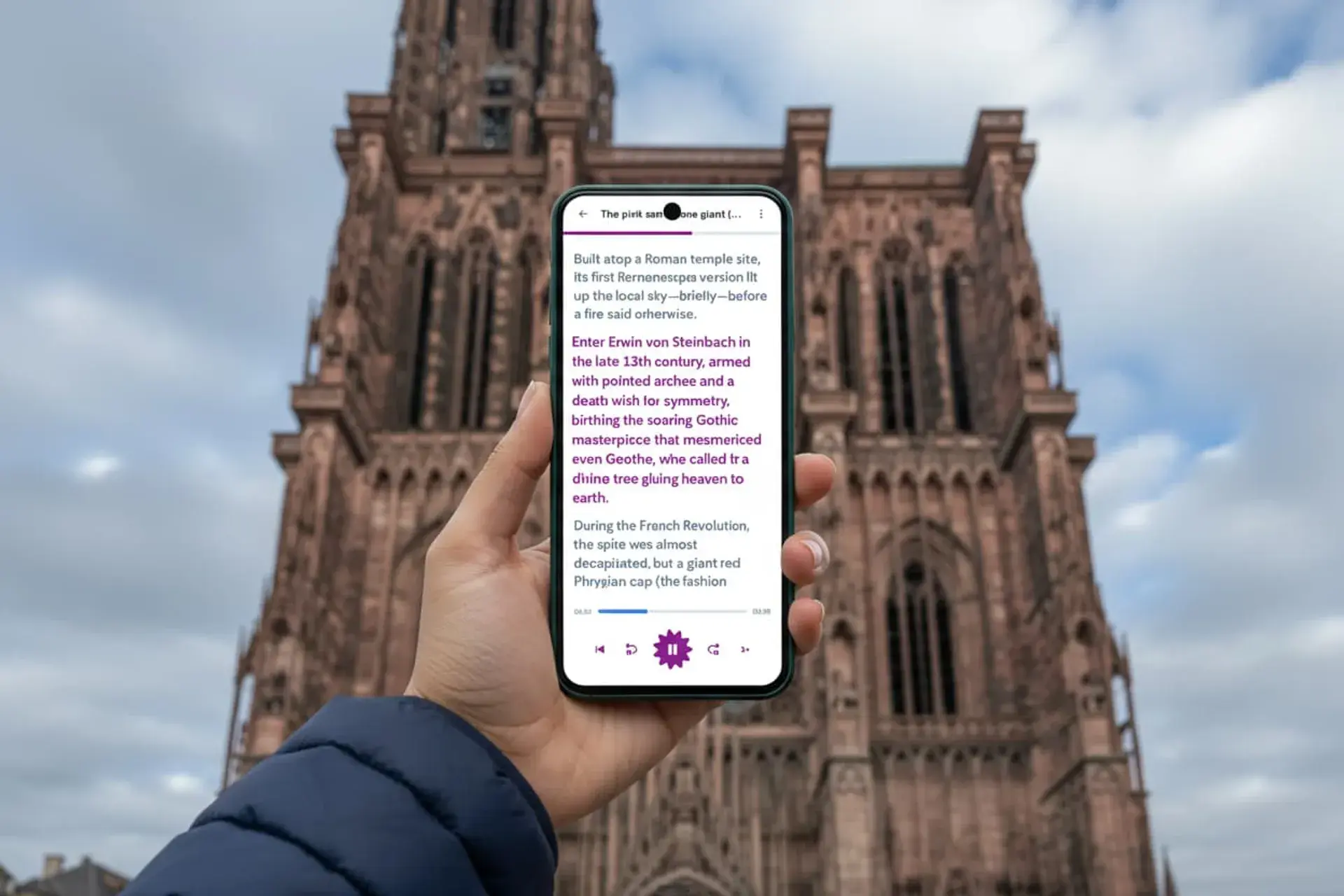
<p>Most cities clear wide avenues to frame their biggest monuments. Strasbourg prefers to ambush you. One minute you’re navigating a tight medieval alley, and the next, you’re standing at the foot of a pink sandstone cliff that refuses to fit in a single photograph. We begin our tour here, at the city’s undeniable center of gravity, where centuries of fire, faith, and architectural ego collided to build something truly impossible.</p> <p>We're not here to simply admire the artistry. We're here to learn what makes this city hum beneath centuries of ornament. Each stop will meet you at the corner of resilience and reinvention. From ecclesiastical power plays to revolutionary flair, Strasbourg’s soul is less a museum and more a palimpsest. We’ll begin amid flying buttresses and biblical tension, where posture and peril are carved into stone. Welcome to Strasbourg: layered, lived-in, and still watching the sky.</p> <p>The Strasbourg Cathedral doesn’t just dominate the skyline; it stalks it. For over 200 years it was the world’s tallest building, its 142-meter spire punching into the clouds like Gothic ambition incarnate. But it wasn’t always so. Built atop a Roman temple site, its first Romanesque version lit up the local sky—briefly—before a fire said otherwise. Enter Erwin von Steinbach in the late 13th century, armed with pointed arches and a death wish for symmetry, birthing the soaring Gothic masterpiece that mesmerized even Goethe, who called it a divine tree gluing heaven to earth.</p> <p>During the French Revolution, the spire was almost decapitated, but a giant red Phrygian cap (the fashion statement of revolutions) saved the day. Yes, the symbol of liberty also happens to be surprisingly wind-resistant. Today, it's still on duty, welcoming Catholics, tourists, and pigeon photographers by the dozen.</p> <p>From where you stand, look closely at the facade. It’s less "building" and more "lace made of sandstone." If you spot the statue of a handsome young man offering an apple to some young women on the portal, that’s "The Tempter." Note the toads and snakes crawling up his back where the women can't see them. A medieval warning about dating apps, carved right into the rock.</p> <p>And for lovers of asymmetry, note that this towering icon only has one spire. Architectural laziness? Budget cuts? Divine choice? Pick your heresy. Just a short walk behind the cathedral, a quieter kind of theater unfolds in Place du Marché Gayot: less spires, more spritzes.</p>
Le marché qui a pris sa retraite en tant que bar

<p>Place du Marché Gayot is what happens when a medieval market square quits its job and decides to retire as a beer garden. Tucked behind the Strasbourg Cathedral like an extrovert’s secret courtyard, it was once a buzz of commerce: vegetables, textiles, gossip, and probably some under-the-table pig’s feet.</p> <p>Originally a plot neighboring clustered dwellings and workshops, it gradually took on formal squarehood as the city evolved and re-paved its medieval tangles into some semblance of navigability. Merchants and citizens passed through daily, balancing foodstuffs and news in equal measure. No bloodshed, no treaties. Just centuries of everyday capitalism.</p> <p>Today, it’s a nexus of terrazzo tables and espresso steam. Students debate Nietzsche over Aperol spritzes while locals nurse beers under leafy canopies. It may not have the prestige of a palace or the drama of a siege, but it’s where Strasbourg actually exhales.</p> <p>Local lore insists there's a smugglers’ warren beneath the cobblestones, used to dodge taxation and wartime scarcities. Rumors persist that muffled haggling echoes up from the cobbles on quiet nights, which might also be the sound of tourists dragging wheeled luggage.</p> <p>The square’s name, "Gayot," might sound cheerful to modern ears, but the etymology is likely more barnyard than ballroom. It probably derives from a diminutive for "sow." Yes, a female pig. It is a fitting, if slightly unglamorous, nod to the livestock that once grunted where students now sip.</p> <p>Once a marketplace, now a cocktail-facing amphitheater, the square hasn’t strayed too far from its roots. It’s still where people come to trade stories, calories, and small change. Strasbourg may wear its Cathedral like a crown, but squares like Gayot are the city’s pockets: where personality hides and spills out when the sun decides to stick around.</p> <p>From this convivial pocket of city life, glide toward the more formal finery of the Palais Rohan, where décor and diplomacy once shared lavish walls.</p>

Le "modeste" Versailles de l'évêque

<p>Palais Rohan is the kind of place where ghosts wear powdered wigs and roam around muttering in Louis XV French. Commissioned by Armand Gaston Maximilien de Rohan (the kind of name that needs two business cards), it was completed in 1742 to house the Archbishop of Strasbourg. He, naturally, required 100 rooms to prove his humility.</p> <p>Architect Robert de Cotte, chief aesthetic enabler to King Louis XV, ladled on all the French classical grandeur a bishop could wish for: symmetry, marble, and ceilings that dare you to look up and sprain your neck. The palace played hotel to history: Louis XV, Marie Antoinette, and even Napoleon passed through, leaving behind muddy boots, political intrigue, or perhaps just complaints about the draft.</p> <p>During the French Revolution, the ecclesiastical decorum took a hit. Robes out, republic in. The palace was nationalized. Today, it's a three-in-one museum complex. Think of it as Strasbourg's answer to a very opulent layer cake: archaeology in the basement, decorative arts on the ground floor, and fine art above.</p> <p>According to city whispers, a tunnel once connected Palais Rohan directly to the Cathedral. Whether this was for pious convenience or sneaky Sunday escapes is left to speculation. And if the façade looks too perfect, squint harder. Small variances reveal that even 18th-century architects occasionally improvised.</p> <p>The palace isn’t just architecture; it’s performance. Behind these walls, baroque wallpaper competes for attention with silk-covered armchairs which dare you to sit (don't). And if you’re the type who likes stables with style, know this: the palace’s former horse quarters were so finely engineered they could house nobility on four legs in haute-couture hay.</p> <p>A few steps away, another name carries weight: Gutenberg. His quiet experiments in this city helped ignite a noisy new age of knowledge.</p>

La place qui a imprimé l'avenir

<p>Place Gutenberg is what happens when revolutionary technology meets 15th-century real estate. Before it took the name of a tech giant, this square went by more utilitarian titles like the Place du Marché aux Herbes (Herb Market) or Place Saint-Martin. It was Strasbourg’s mercantile muscle: the place where coins clinked and city edicts echoed.</p> <p>Gutenberg didn’t invent movable type here, but he did test-drive the idea in the 1430s with local investors who probably didn’t realize they were bankrolling the end of the Middle Ages. His statue now presides with stubbled calm, gripping a page with the Latin words of Genesis, taunting passersby with the original startup script.</p> <p>Prior to its literary glow-up, the square was likely more fragrant than famous. Think bundles of herbs, casks of fish, arguments over units of millet. It saw executions, proclamations, and the slow alchemy of urban change. Over time, the roar of commerce gave way to the pleasant din of café chatter.</p> <p>Today, tourists stand under the watchful eyes of the 1840 bronze Gutenberg while queuing for Alsatian pretzels. From time to time, a Christmas market flares up, further layering the square with cheer and overpriced mulled wine.</p> <p>There’s a charming legend that Gutenberg buried an early version of the press beneath the square, a mechanical time capsule awaiting rediscovery. So far, treasure hunters have turned up only cobbles and disappointment.</p> <p>The real surprise hides in plain view: a modest building at number 10 is rumored to have housed one of his experimental shops. History doesn’t always march with trumpets. It sometimes quietly rents office space.</p> <p>Strasbourg owes much to its most famous side hustle. Without Gutenberg, it’s just another pretty medieval town. With him, it helped ignite the age of mass information, and the endless pleasure (and pain) of printing errors.</p> <p>From printed beginnings to musical prayers, continue on to Église Saint-Thomas, where theology trades grandeur for gravitas.</p>

La forteresse de la foi (et un général mal placé)

<p>If Strasbourg Cathedral is the city’s loud, extroverted sibling, Église Saint-Thomas is the wispy intellectual: Protestant, precise, and quietly historic. Often dubbed the "Protestant Cathedral," it started life in the 6th century as a trusted Catholic standby, only to pivot in the early 16th century when Martin Bucer and his reformist entourage moved in.</p> <p>Things got spicy in 1529, when the church officially switched sides during the Reformation. Bucer dreamed of compromise, shaping Lutheranism to fit Strasbourg’s temperament. His ideas helped nudge Calvinism toward that thorny thing called tolerance. Sadly, Bucer’s tomb didn’t survive the religious pendulum swings that followed, but his sermons still echo faintly in theological footnotes.</p> <p>Architecturally, the church means business. There are no elaborate rose windows, just solid Alsatian Gothic and a central nave that holds itself like it's been through a few breakups. The interior discipline, however, hides one major theatrical flourish: the mausoleum of Marshal Maurice de Saxe. It’s a baroque fever dream. Death is depicted literally reaching for him as he descends into the tomb, heroism in full dramatic tilt.</p> <p>Saxe was a hero of France, but because he was a stubborn Protestant, he couldn't be buried in Catholic Paris. So he lies here instead, exiled in glory. A French Marshal in a German-style church, forever proving that politics follows you even into the grave.</p> <p>Aren’t sure if you’ve entered a church or an existential art installation? The Silbermann organ inside would remind you. Mozart liked it. That’s not hyperbole. He actually played it.</p> <p>Local mystery: the occasional late-night hymn, sung by no one visible, supposedly wafts through the nave. Ghost choir? Faulty acoustics? Or just Strasbourg adding reverb to its layered history? Even from the outside, Église Saint-Thomas offers a pocket-sized Reformation with a side of baroque melodrama. A Lutheran church that whisper-sings Catholic opera. The building is nothing if not ecumenical.</p> <p>If Strasbourg’s soul is split between reflection and spectacle, Petite France generously indulges the latter. Follow the winding lanes and let the river show you why.</p>

Cartes postales, variole et secrets à colombages

<p>Petite France has a name that whispers romance, but its origins shout syphilis. In the 16th century, the French disease (venereal, not cultural) earned this district its name when a hospital was set up here for afflicted soldiers. So yes, pastel-colored canals and geranium-draped windows sit atop a history of unmentionables.</p> <p>Despite its inauspicious branding, the neighborhood evolved into a bustling quartier of tradesmen: tanners, millers, and fishermen. The smell would’ve been character-building. The houses reflect the trades. Look for low river-level openings where animal hides once met dubious hygiene standards.</p> <p>Today, Petite France is Strasbourg's tourist engine. Instagram’s favorite district, it dons half-timbered facades like it invented quaint. The Ill River snakes between alleys, reflecting centuries-old construction and selfie sticks in equal measure.</p> <p>Had enough sugar-coating? Let's talk about the neighbors. For centuries, this area wasn't just for tanners and the sick; it was also the domain of the city executioner. He lived right on the edge of the district, a grim reminder that justice in old Strasbourg was swift and usually happened just a bridge away.</p> <p>And regarding those perfect medieval streets, don't let the vintage look fool you. Petite France didn't dodge the bombs of 1944. Much of what you see was painstakingly rebuilt from the rubble after World War II. It’s a miracle of reconstruction, not just preservation.</p> <p>Beneath the creak of tour boats and camera shutters lies the DNA of working life. Redolent with sweat, fish, and economic survival. Petite France may look like a gingerbread theme park now, but history here had muddy fingernails. It just finally got a manicure.</p> <p>To understand how fiercely Strasbourg guarded this charm, head to the Ponts Couverts, where medieval grit still spans the water.</p>

Les ponts qui ne sont pas couverts

<p>The Ponts Couverts are a trio of medieval bridges with a misleading name and a serious past. Once topped with wooden roofs (hence "covered"), those shelters are long gone, but the name stuck like old graffiti.</p> <p>Built in the 13th century, these stone spans formed the aquatic backbone of Strasbourg’s defenses. Anchoring the bridges are massive square towers. They stand straight-backed and grim-faced, like sentinels who never got the memo about retirement. Back then, you didn’t just cross the river; you asked politely and hoped arrows didn’t answer. Soldiers patrolled above while water-driven commerce trickled below.</p> <p>The engineering is pure medieval pragmatism: bridges that moonlight as fortresses. Defensible positions, control points, a way to glare at invaders without ever leaving your posts. Eventually, as gunpowder made pointed towers less intimidating, they were downgraded from military assets to historical curiosities.</p> <p>Today, the Ponts Couverts are strictly photo ops. They frame postcard-perfect views of Petite France and the Barrage Vauban just behind, which replaced them defensively but never stylistically. The towers’ interiors hint at their former military might but now answer to foot traffic and the occasional history nerd on a mission.</p> <p>Of course, there’s the obligatory ghost story: defenders reportedly return during moments of peril, spectral archers revisiting their haunts with incorporeal crossbows. If Strasbourg ever faces supernatural invasion, it’s covered.</p> <p>Do note: while these bridges aren’t covered anymore, their purpose still looms large. They represent a time when bridges weren’t about connectivity. They were about control. Today, they’re just trying to survive the endless march of tourists with better shoes.</p> <p>For one final vantage point and a last turn of the historical screw, ascend to the Barrage Vauban: water, war, and wonder rolled into one.</p>

L'art romantique d'inonder vos ennemis

<p>We have reached the final stop of our tour. The Barrage Vauban wears many hats: fortress, dam, observation deck. Built between 1686 and 1690, it’s the hydraulic lovechild of Sébastien Le Prestre de Vauban, Louis XIV’s master of défense avec flair. While other dams prevent floods, this one was designed to start them. Deliberately.</p> <p>Its constipated stone bulk hides a clever secret: a network of sluice gates that, when opened, could raise the Ill River’s level by six feet, turning Strasbourg’s southern approach into an impassable swamp. Military strategy by waterlogging. It is just as romantic as it sounds.</p> <p>And this wasn't just a theory. In 1870, during the Siege of Strasbourg, the city actually pulled the lever. The resulting flood turned the southern fields into a muddy nightmare for the Prussian army. It turns out that making your enemy wet and miserable is a surprisingly effective tactic.</p> <p>Inside, a long, dimly lit corridor now houses plaster casts of former Strasbourg statues, like a retirement home for displaced deities. Today, the top floor doubles as one of the city's best photo spots. From its terrace, you get panoramic views of the Ponts Couverts, Petite France, and, on clear days, you might even spot Strasbourg Cathedral brooding in the distance.</p> <p>Local legend suggests that Vauban’s ghost inspects the place periodically, adjusting sluice gates and tutting about construction tolerances. It’s probably just wind, or a particularly detail-oriented pigeon.</p> <p>Officially obsolete as a defense mechanism, the Barrage now functions as a tribute to mad military genius. Vauban didn't merely build fortifications; he bent water to his militarized will. If Strasbourg ever floods charmingly, you’ll know whom to thank.</p> <p>We’ve covered a lot of ground today. From the dizzying heights of the Cathedral to the wet strategic genius of this dam, Strasbourg has proved it’s not just a pretty face. It’s a complex, sometimes contradictory place where French style and German grit have been bumping shoulders for centuries. Hopefully, seeing the smugglers' corners and the executioner’s neighborhood gave you a better feel for the real city, not just the postcard version.</p> <p>From all of us at Ciceru, thank you for letting us share Strasbourg's secrets with you. We hope you loved the stories, the spires, and the unexpected twists. We can't wait to walk with you again soon. À bientôt!</p>

Votre guide privé, dans la poche

Prêt à aller les voir à pied ?

  • En autonomie, quand vous voulez
  • Audio hors ligne, 7 langues
  • Satisfait ou remboursé 30 jours
  • eSIM mondiale 500 Mo incluse

à partir de

5,00 €

1 visite autonome à Strasbourg

Voir les visites

Planifier les jours

Combien de jours à Strasbourg ? L'itinéraire parfait en 1 jours

Jour 1

Flânerie sur la Grande Île et dans la Petite France

Explorez le cœur piéton de la Grande Île, puis empruntez le réseau CTS pour élargir la boucle au-delà de l'île centrale.

Météo et affluence

Meilleure période pour partir

Strasbourg connaît ses journées les plus chaudes de juin à août, avec des maximales moyennes entre 24,4 et 26,4 °C, tandis que mai à août est plus arrosé (61,3 à 77,2 mm de pluie par mois). Selon la fréquentation hôtelière 2023, janvier et février restent les mois les plus calmes, avant l'effervescence de décembre.

Recommandé

Hiver

janv.–févr.

0–7°C/ 32–45°F

Peu de visiteursPluies occasionnelles
  • Strasbourg mon amour
  • Creux annuel des nuitées

À ne pas manquer

  • Strasbourg mon amour

Printemps

mars–mai

3–21°C/ 37–70°F

Ça se remplitPluies occasionnelles
  • Hausse des visiteurs dès avril

Été

juin–août

13–26°C/ 56–80°F

Beaucoup de mondePluies occasionnelles

De l'automne à Noël

sept.–déc.

1–22°C/ 33–71°F

Haute saisonPluies occasionnelles
  • Saison de Noël
  • Pic de fréquentation en décembre

À ne pas manquer

  • Strasbourg Capitale de Noël

Transports

Aller à Strasbourg et s’y déplacer

Aéroport de Strasbourg

Aller à Strasbourg et s’y déplacer
Train TER aéroport8 min3,20 €
Liaison TER et CTSTrain 8 min + réseau4,60 €

À pied

Idéal dans le centre

La Grande Île fait la part belle aux piétons, mais les rames de tramway sillonnent toujours le centre. Restez vigilant, zone piétonne ne rime pas avec absence totale de trafic.

Tramway

Le réflexe transport

La CTS dessert Strasbourg via six lignes de tram (A à F). Le ticket unitaire coûte 2,20 €, le pass 24H SOLO 4,60 € et le pass 72H SOLO 10,20 €. Compostez sur le quai avant d'embarquer.

Bus

Complément du tram

Les bus de la CTS partagent la même tarification que le tramway. Acheter votre ticket à bord auprès du chauffeur coûte toutefois 2,50 €, contre 2,20 € aux distributeurs en station.

Vélhop

Utile, mais piégeux

Les vélos en station coûtent 1,20 € le court trajet, 7 € pour 24 h ou 14 € pour 48 h. Il faut impérativement ramener le vélo à sa station de départ sous peine d'une pénalité de 25 €.

Privilégiez la marche sur la Grande Île et les trams CTS pour les trajets plus longs. Dès le troisième trajet dans la même journée, le pass 24H SOLO est déjà rentabilisé.

Budget

Quel budget pour visiter Strasbourg ?

Côté tarifs confirmés, comptez 2,20 € pour un trajet simple CTS, 4,60 € pour un pass 24H SOLO et 3,20 € pour la navette ferroviaire de l'aéroport. Aucune source officielle fiable ne permet d'établir une fourchette de prix moyenne pour un café, un déjeuner ou une bière à l'échelle de la ville.

Quel budget pour visiter Strasbourg ?
Ticket unitaire CTS2,20 €–2,50 €
Pass CTS 24H SOLO4,60 €
Pass CTS 72H SOLO10,20 €
Navette train aéroport vers Strasbourg3,20 €
Location Vélhop d'une heure à 48 h1,20 €–14,00 €
Parking relais P+R CTS4,20 €

Cash or card?

En France, les commerçants peuvent fixer un montant minimum pour les paiements par carte bancaire à condition de l'afficher clairement. La carte est acceptée presque partout dans les transports et les commerces, mais garder un peu d'espèces sur soi reste prudent.

Où dormir

Où dormir à Strasbourg

Grande Île

premier séjour

L'île centrale historique est idéale pour tout explorer à pied et profiter du cœur du réseau CTS. En novembre et décembre, les contrôles du marché de Noël compliquent toutefois les allées et venues.

Gare-Laiterie-Les Halles

arrivées en train

Ce quartier officiel englobe la gare centrale, d'où les lignes de tram A et D filent tout droit vers le centre. Une option très pratique pour attraper un train aux aurores ou tard le soir.

Bourse-Krutenau-Esplanade

à l'est du centre

Strasbourg réunit la Bourse, la Krutenau et l'Esplanade au sein d'un même ensemble de quartiers, juste à l'est et au sud-est de l'hyper-centre, à quelques minutes de marche.

Neustadt

patrimoine hors hypercentre

Attenante à la Grande Île, la Neustadt fait partie du périmètre inscrit à l'UNESCO depuis son extension en 2017, dévoilant son architecture impériale monumentale à deux pas du centre.

Neudorf-Schluthfeld

alternative hors du centre

Un secteur de quartier officiel qui constitue une excellente alternative à la Grande Île, tout en restant parfaitement connecté au centre grâce aux transports en commun.

Les visites

Strasbourg, une histoire à la fois

Gratte et gagne

Vas-y, gratte

Il y a peut-être quelque chose de bien là-dessous. Si tu gagnes, on te montre comment l'utiliser.

Un lot par voyageur. Valable 2 ans.

Le bouche-à-oreille

L’avis des voyageurs

Sécurité

Strasbourg est-elle sûre ?

Les consignes officielles de sécurité ne signalent aucun quartier à éviter absolument à Strasbourg. Les seules vraies précautions concernent les vols à la tire dans les transports bondés, la cohabitation parfois sportive entre piétons, vélos et tramways dans le centre, et les contrôles renforcés lors du marché de Noël.

Strasbourg-Ville

À la gare de Strasbourg-Ville comme dans les rames de tram bien remplies, appliquez les recommandations d'usage contre les pickpockets, gardez téléphones et sacs sous bonne garde, particulièrement au moment de monter à bord.

Foule de Noël

L'événement Strasbourg Capitale de Noël se tiendra du 26 novembre au 24 décembre 2026. Des périmètres de sécurité et des fouilles de sacs filtrent l'accès à la Grande Île, pensez donc à consulter les consignes officielles avant d'y entrer.

Traversées des voies de tram

À Strasbourg, les tramways traversent de plain-pied les zones piétonnes. Près de l'Homme de Fer, regardez bien des deux côtés avant de franchir les rails et ne partez jamais du principe qu'un pavé piétonnier garantit l'absence de tram.

Urgences et santé

Composez le 112 pour les urgences générales, le 17 pour la police, le 15 pour le SAMU et le 18 pour les pompiers. Pour joindre un médecin de garde hors des horaires d'ouverture dans le Grand Est, composez le 116 117.

Bon à savoir

Bon à savoir

Le 26 décembre est férié

Strasbourg se trouve dans le Bas-Rhin, où le droit local d'Alsace-Moselle fait du 26 décembre un jour férié chômé. Attendez-vous à trouver bien plus de rideaux baissés que dans le reste de la France.

Retour obligatoire pour Vélhop

Les Vélhop en station ne fonctionnent pas en trajet simple. Vous devez impérativement restituer votre vélo à sa borne d'emprunt d'origine, faute de quoi l'opérateur prélèvera des frais de rapatriement de 25 €.

Fin du marché le 24 décembre

L'édition 2026 de Strasbourg Capitale de Noël est prévue du 26 novembre au 24 décembre. Les chalets ferment leurs volets le soir du réveillon de Noël et ne jouent pas les prolongations au Nouvel An.

Train aéroport en 8 minutes

L'aéroport de Strasbourg est relié directement à la gare centrale en 8 minutes environ par train TER, pour un tarif de 3,20 € l'aller simple.

Questions

FAQ sur Strasbourg

Empruntez la navette TER directe depuis la gare de l'aéroport. Elle rejoint la gare de Strasbourg-Ville en 8 minutes environ. Le billet de train simple s'élève à 3,20 €, et le billet combiné train plus réseau CTS local est à 4,60 €.

Prêt à partir ?

Visites audio en autonomie dans tout Strasbourg.

Voir les visites à Strasbourg