Hauptmarkt Nürnberg

Conseils et visites pour explorateurs et voyageurs

Guide de la ville de Nuremberg

Entre sa fondation médiévale en 1050 et son rôle de pionnière du rail, Nuremberg conjugue une Altstadt taillée pour la marche, de célèbres saucisses grillées et du pain d'épices sous AOP européenne, le tout à seulement douze minutes de métro direct de la gare centrale.

Les étapes

Que faire à Nuremberg

Pour apprivoiser Nuremberg, rien ne vaut la marche le long de l'axe piéton reliant la Hauptbahnhof à l'Altstadt, au fil de ses monuments médiévaux, de ses marchés animés et de plusieurs siècles d'histoire commerciale franconienne.

Handwerkerhof

<p>Wlcome to Nuremberg—a city of contrasts, where the grandeur of the Holy Roman Empire meets the sobering lessons of the 20th century.</p> <p>Let’s step through the gates of history to begin our journey at the Handwerkerhof, a living homage to Nuremberg’s craftsmanship. Created in 1971, this charming recreation of a medieval craftsman’s quarter is tucked within the city’s ancient walls, right by the Königstor, or King’s Gate. This space was designed not just as a nostalgic nod to the past but as a vibrant showcase for the traditional crafts that once made Nuremberg the pride of Europe.</p> <img src="https://storage.googleapis.com/ciceru-assets-stg/c41a7fde-337d-4db9-a1df-bd755d7ab549/izCUSWyN-810px-Nu%CC%88rnberg_Maxtormauer_Turm_schwarzes_H_2%20%281%29.jpg" alt="undefined" style="height: auto;width: 320px"/> <blockquote>Ancient city wall tower in Nuremberg. Photo by Andreas Praefcke.</blockquote> <p>In 1219, Emperor Frederick II—a ruler celebrated for his intellect and innovations—granted Nuremberg the "Großen Freiheitsbrief," a decree that secured the city’s independence. This freedom unleashed a wave of creativity among local artisans, leading to iconic creations like the famed Nuremberg eggs.</p> <img src="https://storage.googleapis.com/ciceru-assets-stg/c41a7fde-337d-4db9-a1df-bd755d7ab549/HUBh83fu-Frederick_II_and_eagle%20%281%29.jpg" alt="undefined" style="height: auto;width: 320px"/> <blockquote>Frederick II with his falcon, depicted in De arte venandi cum avibus (The Art of Hunting with Birds), late 13th century. Manuscript from Biblioteca Vaticana.</blockquote> <p>Today, as you wander through its cobblestone lanes and admire the timber-framed houses, you’ll see artisans practicing age-old trades. Glassblowers, metalworkers, and potters bring the medieval marketplace to life, connecting past and present in a way that feels almost magical.</p>
Église de Lorenz

<p>As we leave the bustling Handwerkerhof, the towering spires of St. Lorenz Church draw us into a realm where faith and artistry converge. Built in the 15th century, this Gothic masterpiece stands as a symbol of Nuremberg’s cultural and spiritual significance. Its construction spans centuries, with the nave completed around 1400 and the choir finished by 1477 in the ornate German Sondergotik style of Gothic architecture. The soaring west façade, dominated by two imposing towers and a sharp, intricate portal, features a 9-meter-wide rose window—a striking element that ties it to the city’s architectural lineage.</p> <img src="https://storage.googleapis.com/ciceru-assets-stg/c41a7fde-337d-4db9-a1df-bd755d7ab549/FPIzBGWL-Nu%CC%88rnberg_St._Lorenz_Tu%CC%88rme_Totale%20%281%29.jpg" alt="undefined" style="height: auto;width: 320px"/> <blockquote>West facade of the Lorenzkirche with its towering spires. Photo by Jailbird.</blockquote> <p>Inside, the treasures of St. Lorenz reveal themselves. The Angelic Salutation, a renowned carving by Veit Stoss—a master sculptor of the late Gothic period—hangs delicately in the choir, depicting the Annunciation with unmatched detail and emotion. Nearby stands the monumental tabernacle by Adam Kraft, an eminent late Gothic sculptor known for his intricate stonework. This tabernacle showcases the craftsmanship and devotion of its era.</p> <img src="https://storage.googleapis.com/ciceru-assets-stg/c41a7fde-337d-4db9-a1df-bd755d7ab549/KV1N6rGc-kraft-adam--11-_o%20%281%29.jpg" alt="undefined" style="height: auto;width: 320px"/> <blockquote>Tabernacle by Adam Kraft inside the Lorenzkirche, a stunning example of late Gothic craftsmanship.</blockquote> <p>Despite Nuremberg’s adoption of Lutheranism during the Reformation in 1525, the city’s affluent citizens preserved these treasures, honoring their ancestors’ artistic legacy. This decision reflects a deep respect for the artistic achievements that define the city’s identity.</p> <img src="https://storage.googleapis.com/ciceru-assets-stg/c41a7fde-337d-4db9-a1df-bd755d7ab549/LmEPvWA4-Matthias_Ank%20%281%29.jpg" alt="undefined" style="height: auto;width: 320px"/> <blockquote>Lorenzkantor (Choir Director of St. Lorenz) Matthias Ank, serving from 1996 to 2023. Photo by Tobias Bär.</blockquote> <p>The church’s musical heritage is equally profound. Housing three organs, each with its own storied past, St. Lorenz continues to resonate with its cultural significance. The main organ, originally built in 1937 by Steinmeyer and rebuilt in 2003 by Klais Orgelbau, boasts five manuals and stands as a marvel of engineering. The Stephans Organ, constructed by Steinmeyer in 1862 and restored in 2002, and the Laurentius Organ, built by Klais Orgelbau in 2005, complement this rich legacy. For over 500 years, the church has employed organists, including notable figures like Johann Gottlieb Frör and Carl Christian Mattäus, who left indelible marks on its musical tradition.</p>

Fleischbrücke

<p>Spanning the Pegnitz River with effortless grace, the Fleischbrücke, or Meat Bridge, is a masterpiece of late Renaissance engineering. Built between 1596 and 1598, it was designed to withstand the ravages of floods that had destroyed its wooden predecessors. At its core is an elegant single arch, with a span of 27 meters and a rise of just 4.2 meters, a flat and groundbreaking profile for its time. This design achieved an innovative span-to-rise ratio of 6.4 to 1, supported by over 2,000 wooden piles driven into the riverbed, with 400 angled to counter lateral thrusts. These techniques made the Fleischbrücke one of the most advanced structures of its era.</p> <img src="https://storage.googleapis.com/ciceru-assets-stg/c41a7fde-337d-4db9-a1df-bd755d7ab549/lGUJ0jmi-Nu%CC%88rnberg_-_Fleischbru%CC%88cke_2%20%281%29.jpg" alt="undefined" style="height: auto;width: 320px"/> <blockquote>Postcard of the Fleischbrücke, dated 1918.</blockquote> <p>Its name, "Meat Bridge," comes from its proximity to the Fleischhaus, or Meat House, which anchored the city’s thriving meat market. By connecting the districts of St. Sebald and St. Lorenz, it became a vital artery of commerce, ensuring the smooth flow of goods, livestock, and people.</p> <img src="https://storage.googleapis.com/ciceru-assets-stg/c41a7fde-337d-4db9-a1df-bd755d7ab549/tJYUZkCn-Nu%CC%88rnberg_-_Fleischbru%CC%88cke%20%281%29.jpg" alt="undefined" style="height: auto;width: 320px"/> <blockquote>Postcard of the Fleischbrücke, dated 1915.</blockquote> <p>Today, the Fleischbrücke stands as a symbol of Nuremberg’s ingenuity and resilience. Despite floods, wars, and the passage of time, it has retained much of its original structure, a testament to the skill of its creators and the foresight of its design. Its picturesque views of the Pegnitz River and the surrounding historic quarter continue to captivate visitors and photographers alike.</p>

Hauptmarkt

<p>The Hauptmarkt, Nuremberg’s historic and cultural hub, has been the city’s beating heart since the 14th century. Before its establishment, this area housed Nuremberg’s Jewish community, who were tragically displaced during the Black Death pogroms of 1349—a series of violent attacks fueled by fear and scapegoating during the spread of the plague.</p> <img src="https://storage.googleapis.com/ciceru-assets-stg/c41a7fde-337d-4db9-a1df-bd755d7ab549/bR4jk8lF-Screenshot%202025-01-23%20alle%2015.50.49.jpg" alt="undefined" style="height: auto;width: 320px"/> <blockquote>Jews being tortured and killed (woodcut, 1475), from The Medieval Holocaust: The Approach of the Plague and the Destruction of Jews in Germany, 1348-1349. Paper published by Winkler, A. in 2005.</blockquote> <p>Emperor Charles IV, a ruler known for his ambitious reforms and dedication to the Holy Roman Empire, envisioned the square as a focal point of the city’s life, both commercial and ceremonial. Dominating this vibrant space is the Frauenkirche, a Gothic masterpiece completed in 1368 under his orders. It was built as a site for imperial ceremonies, including the display of the Imperial Regalia and the baptism of his son, Wenceslas.</p> <img src="https://storage.googleapis.com/ciceru-assets-stg/c41a7fde-337d-4db9-a1df-bd755d7ab549/jsiy6JrK-818px-Nuernberg-Frauenkirche-gp%20%281%29.jpg" alt="undefined" style="height: auto;width: 320px"/> <blockquote>West facade of the Frauenkirche. Photo by Kolossos.</blockquote> <p>Architectural gems surround the Hauptmarkt. The Schöner Brunnen, or Beautiful Fountain, graces the northeastern corner with its intricate 14th-century carvings and the iconic golden ring that locals and visitors alike turn for luck. We’ll explore this magnificent fountain in the next chapter. The Frauenkirche itself stands as a Gothic marvel, overseeing the square with its elaborate west façade and rich history.</p> <img src="https://storage.googleapis.com/ciceru-assets-stg/c41a7fde-337d-4db9-a1df-bd755d7ab549/pqX9ou6D-Christkindlesmarkt_nuernberg%20%281%29.jpg" alt="undefined" style="height: auto;width: 320px"/> <blockquote>The Christkindlesmarkt in Nuremberg at the Hauptmarkt (2008). Photo by Roland Berger.</blockquote> <p>The Hauptmarkt also thrives as a living space. The Christkindlesmarkt, held during Advent, transforms the square into a festive wonderland. This centuries-old market is one of the most renowned Christmas markets in the world, featuring wooden stalls, traditional decorations, and the Nuremberg Christkind, who opens the event with a prologue from the church balcony. On weekdays, the square hosts bustling markets where vendors sell fresh produce, flowers, and local specialties, ensuring its continued role as a commercial hub.</p>

Schöner Brunnen

<p>Among the treasures of Nuremberg’s Hauptmarkt stands the Schöner Brunnen, or Beautiful Fountain, a masterpiece of medieval artistry crafted in the 14th century. Built between 1385 and 1396 by stonemason Heinrich Beheim, the fountain was initially designed to adorn the Frauenkirche (Church of Our Lady). However, it was deemed too magnificent for the church and found its rightful place in the market square, where it became a symbol of civic pride.</p> <img src="https://storage.googleapis.com/ciceru-assets-stg/c41a7fde-337d-4db9-a1df-bd755d7ab549/aPiK6ghs-kristijan-arsov-CEy_E8fIBDc-unsplash%20%281%29.jpg" alt="undefined" style="height: auto;width: 320px"/> <blockquote>Closer view of the Schöne Brunnen. Photo by Kristijan Arsov.</blockquote> <p>The fountain, standing approximately 19 meters tall, is designed as a Gothic spire with three tiers, each adorned with 40 intricately carved figures. These figures represent the worldview of the Holy Roman Empire, featuring philosophers, saints, and allegorical characters that embody harmony and unity.</p> <img src="https://storage.googleapis.com/ciceru-assets-stg/c41a7fde-337d-4db9-a1df-bd755d7ab549/V6anw1Uh-758px-Nuernberg_Schoener_Brunnen_005.jpg" alt="undefined" style="height: auto;width: 320px"/> <blockquote>Sculpture of Ptolemy as a symbol of astronomy, 2010. Photo by Janericloebe.</blockquote> <p>Encircling the fountain is an ornate iron fence and particular feature on it has drawn the curiosity of visitors for centuries.</p>

Kaiserburg

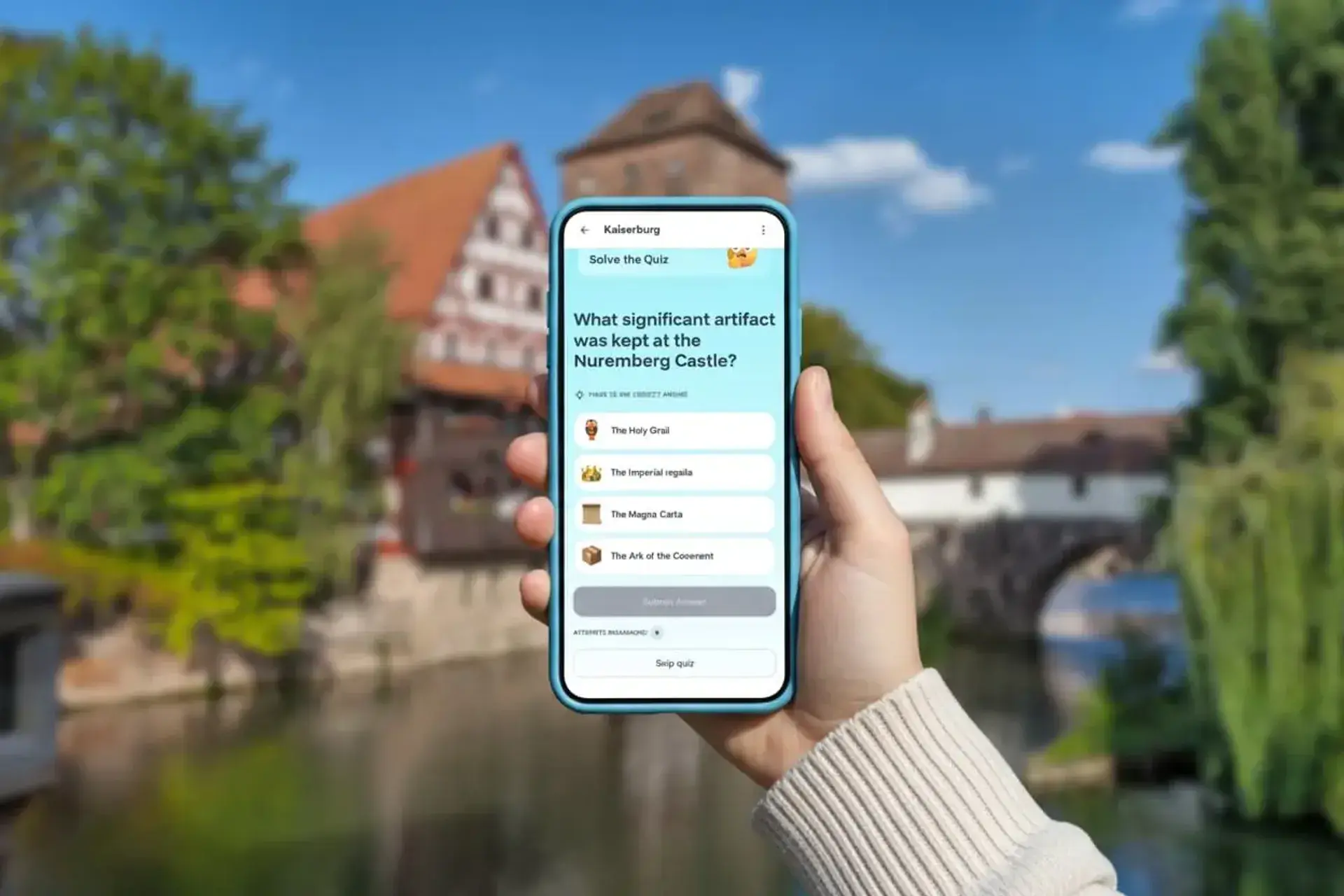
<p>Perched high above Nuremberg’s Old Town, the Kaiserburg—or Nuremberg Castle—has stood as a sentinel of power and prestige since its first documentation in 1050. This fortress was more than a military stronghold; it was a symbol of the Holy Roman Empire’s influence, serving as a residence for kings and emperors. Its strategic position overlooking trade routes and the city below underscored its importance within the empire.</p> <img src="https://storage.googleapis.com/ciceru-assets-stg/c41a7fde-337d-4db9-a1df-bd755d7ab549/LgkrEq7t-1920px-Nu%CC%88rnberg_Burg_ArM%20%281%29.jpg" alt="undefined" style="height: auto;width: 320px"/> <blockquote>Nuremberg Castle: Palas, Imperial Chapel, and Heathens' Tower on the right; Sinwell Tower in the middle left; Pentagonal Tower, Imperial Stables, and Luginsland Tower on the far right. Photo by ArtMechanic.</blockquote> <p>The castle played a pivotal role in 1356 when Emperor Charles IV issued the Golden Bull, declaring Nuremberg the site of the first Imperial Diet for newly elected kings. This decree solidified the city’s place in Imperial politics, and the castle became a repository for the Imperial regalia—crowns, swords, and orbs—from 1423 to 1796, further cementing its significance.</p> <img src="https://storage.googleapis.com/ciceru-assets-stg/c41a7fde-337d-4db9-a1df-bd755d7ab549/CAhE7fn4-Goldene_Bulle_Handschrift%20%281%29.jpg" alt="undefined" style="height: auto;width: 320px"/> <blockquote>Page from the Golden Bull manuscript of King Wenceslaus, circa 1400. Preserved in the Austrian National Library.</blockquote> <p>Inside, the Deep Well and the Sinwell Tower remain engineering marvels of their time, providing not just defense but also vital resources during sieges. The castle’s walls whisper stories of royal banquets, political negotiations, and the lives of those who called it home.</p>

Historischer Kunstbunker

<p>Beneath the streets of Nuremberg lies a hidden sanctuary—the Historischer Kunstbunker. Built during World War II, this underground bunker was designed to protect something priceless. Can you guess what it was?</p>

Maison d'Albrecht Dürer

<p>This final stop on our tour brings us to the home of Albrecht Dürer, which we briefly encountered in the previous stop at the Historischer Kunstbunker, where some of his priceless works were safeguarded during World War II.</p> <img src="https://storage.googleapis.com/ciceru-assets-stg/c41a7fde-337d-4db9-a1df-bd755d7ab549/mUfYScqI-807px-Albrecht-self%20%281%29.jpg" alt="undefined" style="height: auto;width: 320px"/> <blockquote>Albrecht Dürer, Self-Portrait with Eryngium (1493). Preserved in the Louvre.</blockquote> <p>Nestled within Nuremberg’s historic Old Town, this meticulously preserved half-timbered house served as both his home and workshop.</p> <img src="https://storage.googleapis.com/ciceru-assets-stg/c41a7fde-337d-4db9-a1df-bd755d7ab549/LrUIlDYp-810px-Albrecht-Du%CC%88rer-Haus%2C_interno_07_cucina.jpg" alt="undefined" style="height: auto;width: 320px"/> <blockquote>Interior: Kitchen of the Albrecht Dürer House in Nuremberg.</blockquote> <p>Dürer lived here from 1509 until his death in 1528. The house itself is a masterpiece of 15th-century architecture, reflecting the wealth and status of its illustrious owner. The house also serves as a museum, offering a window into the life and legacy of an artist whose influence is still felt today.</p>

Votre guide privé, dans la poche

Prêt à aller les voir à pied ?

  • En autonomie, quand vous voulez
  • Audio hors ligne, 7 langues
  • Satisfait ou remboursé 30 jours
  • eSIM mondiale 500 Mo incluse

à partir de

7,00 €

1 visite autonome à Nuremberg

Voir les visites

Planifier les jours

Combien de jours à Nuremberg ? L'itinéraire parfait en 1 jours

Jour 1

Arpenter l'Altstadt de Nuremberg depuis la Hbf

Suivez la Königstraße depuis Nürnberg Hbf à travers l'Altstadt piétonne, tout en gardant les transports de la zone A sous la main pour les sauts de puce plus lointains.

Météo et affluence

Meilleure période pour partir

Pour concilier météo clémente et affluence raisonnable, visez mai-juin ou septembre-octobre, avec des maximales oscillant entre 18,8 et 22,0 °C, puis entre 14,2 et 20,0 °C. De juillet à décembre 2025, les records de nuitées sont tombés chaque mois, décembre franchissant pour la première fois le cap des 400 000 séjours.

Recommandé

Froid et basse saison

janv.–févr.

-4–4°C/ 25–40°F

Peu de visiteursPluies occasionnelles
  • Basse saison à Nuremberg
  • En janvier, les minimales moyennes avoisinent -4,0 °C.

L'essor printanier

mars–avr.

-1–14°C/ 31–56°F

Ça se remplitPluies occasionnelles
  • Foire printanière locale
  • En avril, les maximales plafonnent en moyenne à 13,6 °C.

À ne pas manquer

  • Nürnberger Volksfest, foire de printemps

Douceur et averses

mai–juin

7–22°C/ 45–72°F

Beaucoup de mondeHumide
  • Douceur à Nuremberg
  • Juin est le plus arrosé, avec 75 mm de précipitations.

Pic estival

juil.–août

12–24°C/ 54–75°F

Haute saisonHumide
  • Chaleurs estivales locales
  • Juillet et août comptent 69 et 67 mm de pluie en moyenne.

À ne pas manquer

  • Nürnberger Volksfest, foire d'automne

Mois doux et animés

sept.–nov.

1–20°C/ 33–68°F

Beaucoup de mondePluies occasionnelles
  • Nürnberger Herbstmarkt
  • En octobre 2025, la ville a comptabilisé 354 916 nuitées.

À ne pas manquer

  • Nürnberger Herbstmarkt

  • Nürnberger Christkindlesmarkt

Pic de Noël

déc.

-2–3°C/ 28–38°F

Haute saisonPluies occasionnelles
  • Le Christkindlesmarkt
  • En décembre 2025, le cap des 400 000 nuitées a été franchi.

À ne pas manquer

  • Nürnberger Christkindlesmarkt

Transports

Aller à Nuremberg et s’y déplacer

Nürnberg Flughafen

Aller à Nuremberg et s’y déplacer
U212 min3,90 €

Nürnberg Hbf

Aller à Nuremberg et s’y déplacer
À pied par la KönigstraßeEnviron 5 min0,00 €

U-Bahn, tram et bus

La zone A suffit

Le billet zone A (90 min) coûte 3,65 € en ligne et 3,90 € sur papier. Le carnet de 4 vaut 14,60 €, le pass Solo 10,60 €. Dans les bus VAG, seul le paiement par carte bancaire est accepté.

À pied

Hbf-centre en 5 min

D'après la VAG, la gare Nürnberg Hbf se trouve à cinq minutes du centre. La Königstraße sert d'axe piéton central. La rampe d'accès de la Lorenzkirche côté Königstraße est actuellement fermée.

VAG_Rad

Courts trajets éco

Le tarif de base est de 0,10 € de prise en charge puis 0,10 €/min (max 10 €/24 h). Les vélos VAG_Rad doivent être rendus en station ou zone flex, sous peine d'au moins 20 € d'amende hors zone.

Trottinettes partagées

Parking piégeux

Dans le Bundesstraßenring, les trajets finissent aux seuls spots dédiés ; ailleurs, le tarif continue de courir. Passé ce périphérique, la dépose libre reste permise.

Taxi

Compteur et carte CB

La prise en charge est fixée à 4,90 € à Nuremberg. Comptez environ 15,40 € pour 3 km. La loi oblige le chauffeur à accepter la carte bancaire sur simple demande.

Privilégiez la marche et les billets zone A. La NÜRNBERG CARD coûte 38 € pour 48 h, contre 21,20 € pour deux pass Solo. Pour les seuls transports, elle revient 16,80 € plus cher.

Budget

Quel budget pour visiter Nuremberg ?

Les tarifs vérifiés sont de 1,90 à 2,10 € pour un trajet court, de 3,65 à 3,90 € pour un aller simple en zone A, de 10,60 € pour un pass journalier et de 15,40 à 20,80 € pour une course de taxi de 3 à 5 km. Les fourchettes de prix pour la restauration restent non renseignées.

Quel budget pour visiter Nuremberg ?
Billet unitaire zone A, adulte3,65 €–3,90 €
Billet courte distance1,90 €–2,10 €
Pass journalier Solo zone A10,60 €
VAG_Rad, 10 minutes1,10 €
Tarif taxi estimé, 3 à 5 km15,40 €–20,80 €

Cash or card?

À bord des bus VAG, les billets s'achètent exclusivement sans contact depuis le 1er mai 2026. Les espèces restent acceptées aux distributeurs automatiques et dans les points de vente. Les taxis de Nuremberg sont quant à eux tenus d'accepter les cartes bancaires si vous le demandez.

Où dormir

Où dormir à Nuremberg

Altstadt St. Lorenz

Première visite et accès Hbf

St. Lorenz concentre la plupart des rues piétonnes, dont la Königstraße vers la Hbf. Les travaux du Lorenzer Passage compliquent toutefois l'accès de plain-pied à la Lorenzkirche.

Gostenhof

Vivant et hors de l'Altstadt

Quartier animé selon la ville, Gostenhof séduit par sa culture, ses bars et ses tables. Mais ce secteur très dense présente un tissu urbain particulièrement serré.

St. Johannis

Calme et proche du centre

Situé à l'ouest de la vieille ville et au nord de la Pegnitz, St. Johannis et son habitat ancien et dense imposent un peu de marche ou un trajet en transports de plus par rapport à St. Lorenz.

Les visites

Nuremberg, une histoire à la fois

Gratte et gagne

Vas-y, gratte

Il y a peut-être quelque chose de bien là-dessous. Si tu gagnes, on te montre comment l'utiliser.

Un lot par voyageur. Valable 2 ans.

Le bouche-à-oreille

L’avis des voyageurs

Sécurité

Nuremberg est-elle sûre ?

Nuremberg est globalement une ville sûre : en 2025, la police l'a classée au cinquième rang des villes allemandes de plus de 200 000 habitants les plus sûres. Les vols représentaient la catégorie d'infraction la plus courante avec 13 573 cas, tandis que les vols à la tire ont chuté à 447 faits.

Le secteur de la Hauptbahnhof

La police a recensé 1 526 infractions aux abords de Nürnberg Hbf en 2025, dont 696 liées aux stupéfiants. Alors que la situation s'est stabilisée côté nord, les tensions se sont déplacées vers la sortie sud.

Foules de Noël

La police met en garde contre les pickpockets dans les allées bondées du Christkindlesmarkt : gardez votre argent, vos cartes et votre téléphone dans des poches intérieures fermées distinctes, et portez vos sacs sur le devant.

Zones sans alcool

L'interdiction de consommer de l'alcool s'applique 24h/24 sur la Bahnhofsplatz, le passage de la Königstor et l'Aufseßplatz. Boire ou transporter de l'alcool destiné à une consommation immédiate peut vous valoir jusqu'à 1 000 € d'amende.

Piétons et trottinettes

Le sud de la Königstraße est ouvert aux vélos tout le jour ; pied à terre au nord de la Mauthalle. Trottinettes interdites sur trottoirs et voies piétonnes. Dès 0,5 g/l d'alcoolémie, l'amende à trottinette peut atteindre 500 €.

Urgences médicales

Hors urgences et après les heures d'ouverture, appelez le 116117 ou allez au 11a Bahnhofstraße. Pour une urgence vitale, composez le 112. L'assistance en anglais au 112 n'a pas pu être confirmée.

Bon à savoir

Bon à savoir

Paiement sans contact dans les bus VAG

Depuis le 1er mai 2026, les billets achetés à bord des bus VAG doivent obligatoirement être réglés sans contact. Le liquide reste accepté aux distributeurs automatiques, dans les points de vente agréés et à l'espace clients de la VAG.

Zones de restitution des trottinettes

À l'intérieur du Bundesstraßenring de Nuremberg, les trottinettes de location doivent obligatoirement être garées sur les emplacements marqués. Ailleurs, la course ne peut pas être clôturée et le compteur continue de tourner.

Validité de la NÜRNBERG CARD

La NÜRNBERG CARD est valable très exactement 48 heures à compter de la date et de l'heure choisies. Il n'existe pas de formule 24 ou 72 heures, et la période de validité ne peut plus être modifiée après coup.

Alcool dans la vieille ville

Au-delà des zones de la Hbf et de l'Aufseßplatz, boire de l'alcool sur la voie publique dans l'Altstadt et les rues piétonnes n'est autorisé qu'aux terrasses de consommation prévues à cet effet.

Questions

FAQ sur Nuremberg

Très exactement 48 heures. Définissez la date et l'heure de début au moment de l'achat. Nuremberg ne propose aucune formule 24 ou 72 heures.

Prêt à partir ?

Visites audio en autonomie dans tout Nuremberg.

Voir les visites à Nuremberg