
Dicas e tours para exploradores e viajantes
Guia da cidade de Berlin
Berlim é uma capital ampla, talhada por bairros, onde a zona C é essencial para o Aeroporto BER e cada bairro dita o seu próprio ritmo ao cair da noite.
- País
- Alemanha
- Idioma
- alemão
- Moeda
- Euro (EUR)
- Tomada
- tipo F
- Fuso horário
- Europe/Berlin
- Emergência
- 112
- Água da torneira
- Geralmente potável
- Indicativo
- +49
As paragens
O que fazer em Berlin
Explora a rica história de Berlim ao visitar marcos emblemáticos como o edifício do Reichstag, a Porta de Brandemburgo e o histórico bairro de Nikolaiviertel.
Origens medievais
A capital da Prússia
Primeira Guerra Mundial
Propaganda nazi
Frederico II
Um portão de triunfo
Take a look up at those twin stone towers and the five rings suspended between them. You are standing before the Olympiastadion, a structure that manages to be both magnificent and deeply unsettling at the same time. This is not just a sports venue. It is a massive, limestone-clad ghost story. Built for the 1936 Olympics under the orders of Adolf Hitler, it was designed as a neoclassical titan, drawing inspiration from both modernism and ancient Greek architecture. But notice how it doesn't tower over you like a typical stadium. To achieve that ancient, grounded feeling, the architects actually dug the field thirty-three feet into the earth. You are standing above a sunken bowl of history, designed to project a strength intended to last a thousand years. The man responsible for this austere look was Werner March, who chose the limestone casing you see to evoke a sense of permanence and the 'master race' narrative. Even the Marathon Gate on the western side was carefully placed to maintain a military-style sightline to the nearby Bell Tower. As you walk along the facade, feel the coldness of the architecture. It was built during a dark era when construction companies were forced to hire only 'Aryan' workers, explicitly excluding the Jewish community from the very soil you are standing on. It was a space designed to prove a point about racial superiority to the rest of the world. But the best part of the story is how that narrative backfired right here on these grounds. In 1936, a Black American athlete named Jesse Owens stepped into this arena and shredded the Nazi script. He didn't just win, he dominated, taking home four gold medals in front of a stunned Hitler. There is a persistent legend that Hitler refused to shake his hand out of spite. In reality, Hitler had been told to shake everyone's hand or no one's, and he conveniently chose 'none' after the first day. But the image of Owens standing on the podium, surrounded by Nazi iconography while the crowd roared for him, remains the ultimate middle finger to the regime that built this place. The locals were so fascinated by Owens that he became an overnight celebrity, captivating the German public despite the hateful ideology of the state. Since the war, Berlin has faced a difficult choice: keep it or tear it down. They chose 'vergangenheitsaufarbeitung,' which is a quintessentially German word for 'working through the past.' They de-Nazified the site by stripping the swastikas and lowering the height of the honorary stand where Hitler once sat. Since then, the stadium has been reclaimed. It has hosted the British military, the 2006 World Cup final, and Usain Bolt’s legendary world records. It is no longer a monument to a regime, but a place where the world actually comes together, regardless of what the original architects intended. Today, the Olympiastadion serves as a massive, functional reminder that you can build a monument to last a millennium, but you cannot control the spirit of the people who fill it. It is a place where the echoes of a dark past meet the cheers of a modern, diverse Europe. As you head off, take one last look at that limestone. It was meant to be a wall, but today, it is just a backdrop for the next chapter of Berlin’s story.
A noite dos vidros partidos
A reunificação alemã
O teu guia particular, no bolso
Pronto para percorrer estas paragens?
- Autoguiado, começa quando quiseresAutoguiado, começa agora ou depois e faz uma pausa quando quiseres
- Áudio offline, 7 idiomasHistórias áudio offline em 7 idiomas
- Reembolso garantido em 30 diasGarantia de reembolso de 30 dias
- eSIM global de 500 MB incluídoeSIM global de 500 MB incluído
a partir de
€ 7,00
1 tour autoguiado em Berlin
Planear os dias
Quantos dias em Berlin? O itinerário perfeito de 1 dias
Percorre os bairros de Berlim sobre carris e a pé
Liga os bairros de Berlim através do U-Bahn e do S-Bahn, e depois abranda o ritmo num bairro de cada vez, à medida que a cidade se revela em parques, canais e vida noturna.
€ 7,00 →Tempo e multidões
Melhor altura para visitar
Maio, junho e setembro são, no geral, os melhores meses para caminhar por Berlim. Julho e agosto são os mais quentes e movimentados; janeiro e fevereiro, os mais calmos.
Inverno e primavera
jan.–jun.-2–24°C/ 28–75°F
Poucos visitantes
- Museus e passeios em parques
Verão e outono
jul.–dez.5–25°C/ 41–77°F
Poucos visitantes
- Cultura e noites ao ar livre
Os tours
Berlin, uma história de cada vez
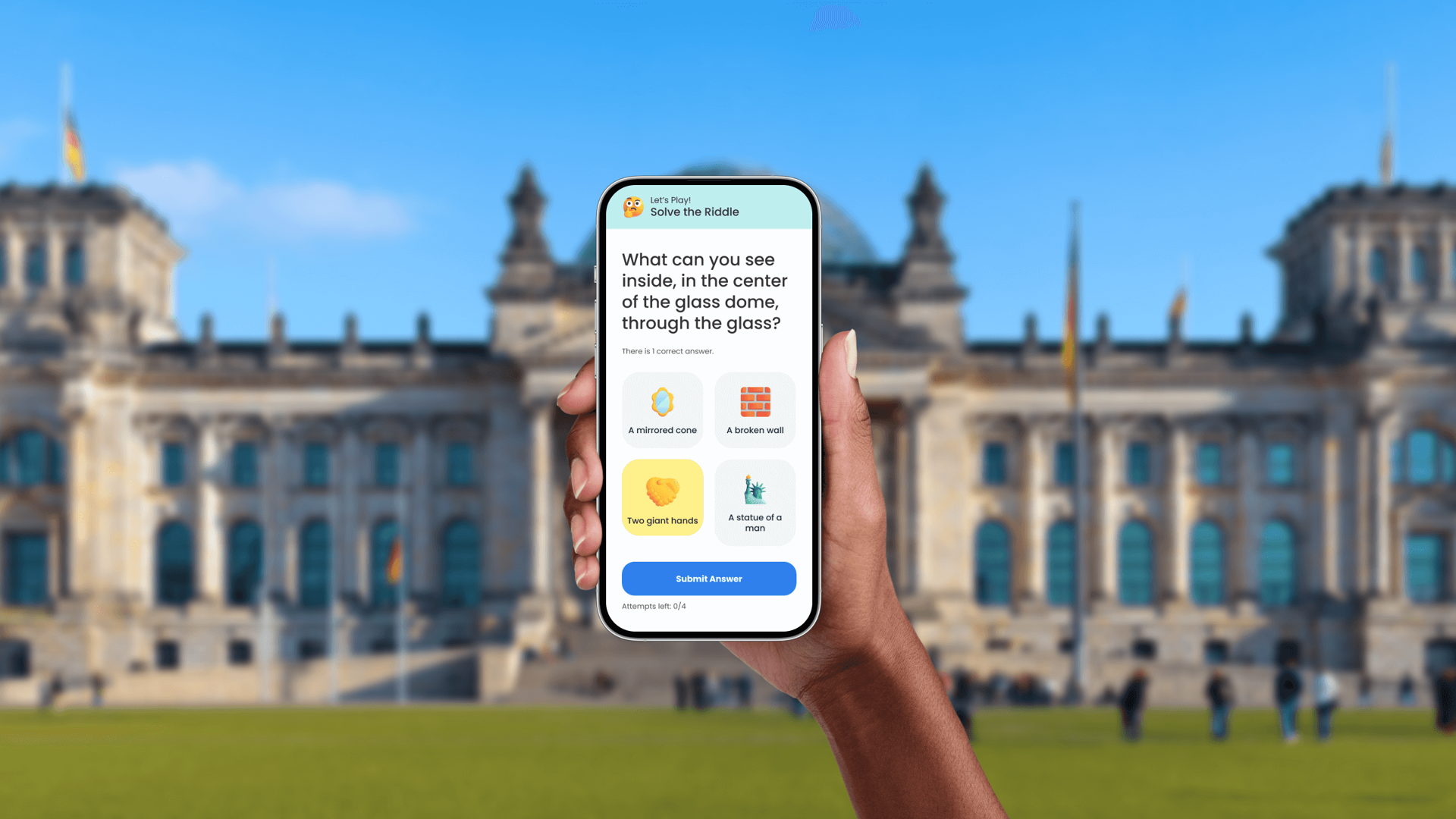
€ 72 horas
Berlim através dos tempos
 Andrea Rabinelli
- Áudio
- Questionários
- Multijogador
- eSIM grátis
Raspa e ganha
Raspa lá
Aí por baixo pode estar algo bom. Se ganhares, dizemos-te como usá-lo.
Um prémio por viajante. Válido 2 anos.
O passa-palavra
O que dizem os viajantes

Segurança
Berlin é segura?
Berlim é geralmente segura para quem a visita, mas é uma grande capital com furtos concentrados em certas zonas, riscos na vida noturna e trânsito complexo. Tem cuidado perto de estações, linhas de elétrico e caminhos em parques após o anoitecer. Liga o 112 para emergências médicas ou bombeiros e o 110 para a polícia.
Furtos nas estações
Mantém telemóveis e carteiras em segurança na Hauptbahnhof, na Alexanderplatz, no Zoologischer Garten e nas estações de ligação do S-Bahn com maior afluência.
Vida noturna
Prefere ruas iluminadas perto de Warschauer Straße e Kottbusser Tor; não aceites bebidas nem boleias de desconhecidos.
Trânsito de elétricos
Atravessa os carris apenas nas passagens assinaladas e mantém a atenção em zonas partilhadas entre peões e bicicletas.
Para ler
Lê mais sobre Berlin

História16 min de leitura
Passeios a pé autoguiados na Alemanha: escolha o seu percurso
Última atualização: setembro de 2026
Ler maisHistória13 min de leitura
O que está fechado na Alemanha? Domingos e regras para 2027
Última atualização: agosto de 2026
Ler maisHistória8 min de leitura
Controlos de fronteira na Europa: o que levar consigo
Controlos temporários, documentos de viagem e sistemas de entrada na UE, verificados a 31 de agosto de 2026.
Ler maisHistória4 min de leitura
As 5 melhores discotecas techno de Berlim em 2025: a batida continua
Em 2025, Berlim continua a reinar como a capital do techno - mesmo quando a cidade enfrenta o aumento das rendas, o encerramento de discotecas e a tensão sempre presente entre a…
Ler maisPerguntas
Perguntas sobre Berlin
Sim, o BER fica na zona tarifária C, pelo que qualquer viagem do aeroporto para o centro de Berlim exige um bilhete ABC.
Sim, utiliza o comboio para viagens longas pela cidade e explora cada bairro a pé; confirma sempre a zona antes de comprar o bilhete.
Liga o 112 para emergências médicas ou bombeiros e o 110 para a polícia.