Bath Abbey

Dicas e tours para exploradores e viajantes

Guia da cidade de Bath

Bath é a única cidade do Reino Unido classificada na totalidade como Património Mundial da UNESCO, célebre pela pedra dourada de Bath que esculpe o Royal Crescent e The Circus, a par das suas ancestrais termas romanas.

País
Reino Unido
Idioma
inglês
Moeda
Libra esterlina (GBP)
Tomada
tipo G
Fuso horário
Europe/London
Emergência
112, 101 e 999
Água da torneira
Potável
Indicativo
+44

As paragens

O que fazer em Bath

O centro histórico de Bath, protegido pela UNESCO, une arqueologia romana e urbanismo georgiano numa cidade desenhada para ser percorrida a pé. Das Termas Romanas e da Abadia de Bath às curvas monumentais do Royal Crescent, as suas referências mais célebres ligam-se facilmente num curto passeio.

Água quente e alta sociedade

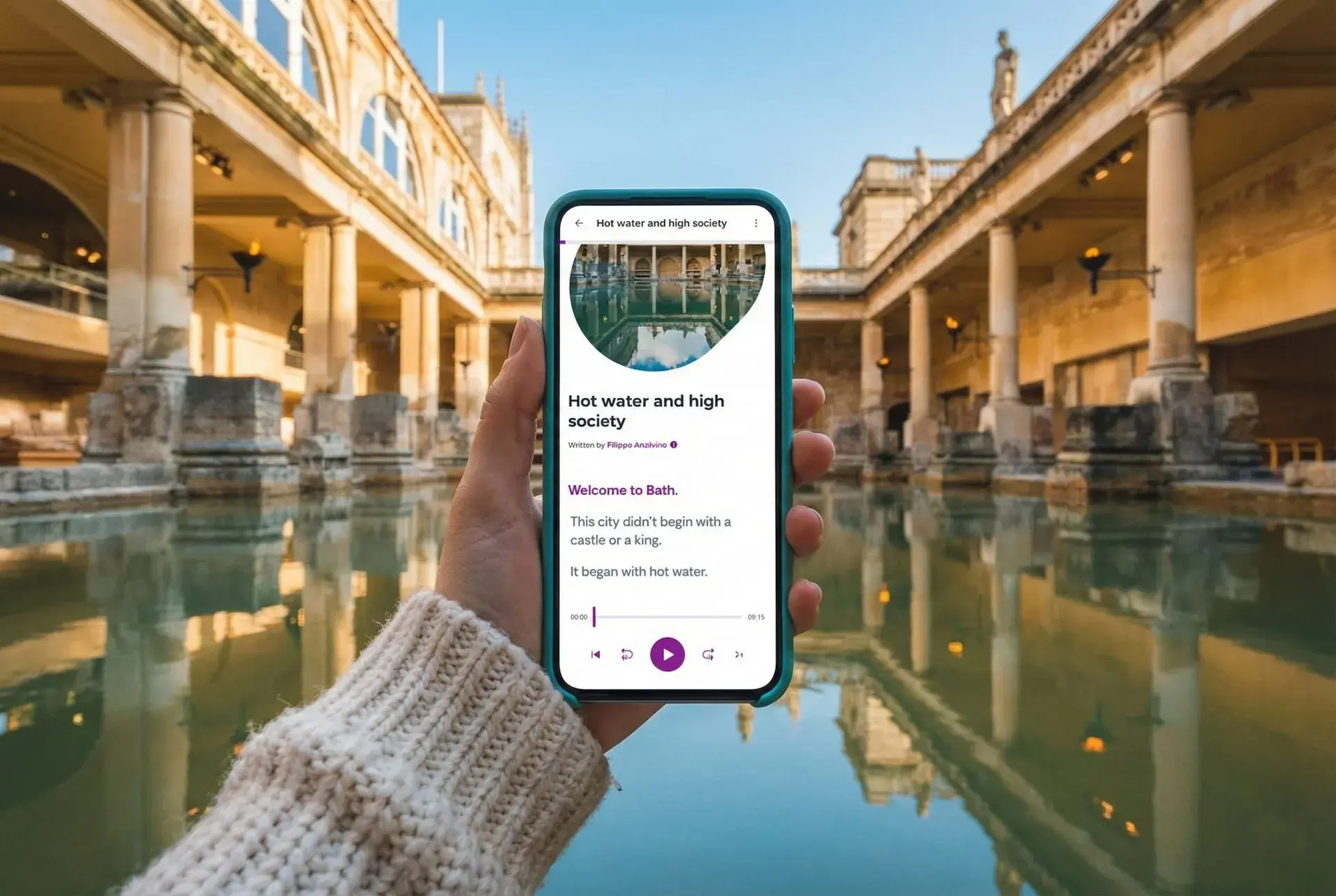
<p>Welcome to Bath.</p> <p>This city didn't begin with a castle or a king. It began with hot water.</p> <p>On this Ciceru tour, we are going to trace the city's rise, both literally and socially. We will walk from the ancient river level up to the exclusive heights of the Royal Crescent. It is a journey through Roman engineering, Medieval grit, and the golden architecture of the Georgian era.</p> <p>I’ll be your guide to the stories hidden in the limestone. We have a lot of ground to cover, so let’s get moving.</p> <p>We start our journey here in the Abbey Churchyard. While the queue next to you might be long, the history beneath your feet is even longer.</p> <p>You are currently standing on top of Aquae Sulis. This was the Roman name for the city, meaning "The Waters of Sulis." When Roman engineers arrived here around 70 AD, they found a hot, swampy spring revered by the locals. But the Romans didn't just conquer the site. They translated it.</p> <p>They took the local Celtic goddess, Sulis, and identified her with their own goddess, Minerva. This wasn't a crude mash-up of a nature spirit and a war deity. It was a sophisticated theological merger based on their shared power of healing and wisdom. The result was Sulis Minerva, a powerful figure who presided over a complex of pools that were as much a hospital as they were a place of worship.</p> <p>The building you see in front of you is the Grand Pump Room. It is much newer, built in the 1790s. This is where high-society Georgians would come to drink the water rather than swim in it. If you look at the Greek inscription above the columns, it reads Ariston Men Hydor, or "Water is Best."</p> <p>Although you are standing on the dry pavement of the 21st century, the ancient plumbing is still hard at work below you. The spring gushes over a million liters of water every day at a steaming 46°C.</p> <p>Beneath the museum floor, the original Roman drain still functions. It carries the waste water out to the river just as it did two thousand years ago. We call that heritage hydraulics.</p> <p>But it wasn't all wellness and relaxation down there. The Romans also used the sacred spring to air their grievances. Archaeologists have found lead "curse tablets" thrown into the water, inscribed with angry messages to the goddess. They usually asked for revenge against thieves or unfaithful lovers. It seems that even in the first century, people loved leaving a bad review.</p> <p>This spot is the thermal heart of the city. Everything we will see next, from the Abbey to the grand houses on the hill, only exists because the Romans decided to stop here for a soak.</p> <p>Now, turn your attention to the massive stone structure looming right next to the Baths. It is time to look at the Medieval layer of the city.</p>
A escada dos anjos

<p>At first glance, Bath Abbey looks like a Gothic cathedral that has learned to smile politely. Its lacy stone facade and sprawling windows catch the sunlight with improbable optimism. This is especially impressive for a building that has been sacked, neglected, and rebuilt more times than your average Tudor table.</p> <p>It began in the 7th century as a monastery, but the structure standing before you is a 15th-century reboot in the Perpendicular Gothic style. Note the high ceilings and the massive tall windows. The walls seem unsure whether they are structural or merely decorative frames for the glass.</p> <p>Now, let’s address a local myth. You will often hear that this site hosted the coronation of England’s "first" King, Edgar, in 973 AD. That is not entirely true.</p> <p>Athelstan, his uncle, was actually crowned King of the Anglo-Saxons nearly fifty years earlier in 925 AD. However, Bath still holds a vital place in royal history. Edgar’s ceremony here introduced a specific service and liturgy that created the template for every British coronation that followed. So while he wasn't the first, he set the style that Charles III used over a thousand years later.</p> <p>Turning your eyes to the stone facade itself, the West Front demands a pause. Look closely at the turrets flanking the main window. You will see angels climbing up and tumbling down stone ladders.</p> <p>This unique design was inspired by a dream allegedly sent to Bishop Oliver King in 1499. It was possibly a divine epiphany, or possibly the result of questionable wine. Regardless of the source, the imagery stuck. It makes for a compelling sermon carved directly into the limestone.</p> <p>Because we are staying outside, you can't smell the beeswax or hear the choir, but you can appreciate why this building is nicknamed the "Lantern of the West." The walls are more glass than stone. If you were to step inside, you would find yourself surrounded by over 1,000 memorial tablets on the walls. It serves as a densely annotated "Who's Who" of Georgian grief. It is part church and part vertical graveyard.</p> <p>It is easy to be distracted by the grandeur. Yet the Abbey’s most enduring trait is continuity. Despite regimes, reforms, and restorations, it persists in holy matrimony with its historic setting.</p> <p>Tucked around the corner, a humbler structure claims both culinary fame and medieval roots. Let’s go sample the famous Bath Bun at one of the city's oldest houses.</p>

Uma mordida de 1482

<p>Few buildings dare to boast both medieval architecture and a menu. Sally Lunn’s pulls it off.</p> <p>You are standing in front of one of the oldest houses in Bath. Dating back to 1482, this structure was already old before Henry VIII had his first heartbreak. If you look at the rough stone masonry and the way the house sits slightly lower than the modern street level, you can see how much the city has risen around it over the centuries.</p> <p>Now, let’s talk about the legend. You might hear a romantic story about a French Huguenot refugee named "Solange Luyon" who fled to Bath in 1680 to bake brioche.</p> <p>I hate to ruin a good story, but that is likely a fabrication. Historical records suggest the "Solange" character was invented in 1937 by the tea shop owner, Marie Byng-Johnson, to add a little French flair to her marketing. The real "Sally Lunn" was more likely a hawker selling buns in the streets of Bath in the late 1700s.</p> <p>But while the baker might be a myth, the bun is very real. It is a golden, airy carb-cloud that tourists queue for daily.</p> <p>There is another secret here that you cannot see from the alley. Beneath the floorboards of the dining room lies a Roman hypocaust system.</p> <p>This was the ancient version of central heating. Hot air from a furnace was circulated through empty spaces under the floor, keeping the Romans warm in the damp British winter. It is a literal "hot plate" of the Empire resting right beneath the modern bakehouse.</p> <p>Locals treat this place like a mildly eccentric aunt. It is loved, a bit theatrical, and possibly stretching the truth, but it is part of the family regardless. Because in Bath, even your bun tells a story.</p> <p>After a bite steeped in legend, let’s retreat to a quieter pleasure. We will head to the riverside gardens for a view of the famous weir.</p>

Flertando sob supervisão

<p>Look down over the stone balustrade into the manicured green space below. This is Parade Gardens.</p> <p>In the 18th century, this was the answer to a specific social problem. The city planners needed a place where the wealthy could flirt under supervision.</p> <p>Planted with both flowers and strict codes of Georgian decorum, it quickly became Bath’s open-air ballroom. It was a genteel promenade for spa-goers to dry off after their morning plunge.</p> <p>Today, the gardens feed packed lunches and selfie sticks rather than scandalous glances. But the fragrance of precisely arranged blooms still wafts up with practiced grace.</p> <p>They may look like just another park, but dig a little and you will find the past refusing to stay buried.</p> <p>In 1997, an archaeological excavation took place right beneath those neat flower beds. You might hear rumors that they discovered a lost Roman temple precinct here.</p> <p>That is a lovely thought, but it is untrue.</p> <p>What they actually found was the "Great Drain". This was the massive Roman culvert designed to carry waste and overflow away from the Baths and into the river.</p> <p>It seems we often go looking for sacred architecture and find plumbing instead. But in Bath, the plumbing is just as impressive as the temples.</p> <p>Back in the Georgian heyday, entry into these lawns required the right pedigree and a subscription fee. Today you still have to pay a small fee to enter, but the only pedigree required is a tolerance for goose prints.</p> <p>Nothing mythic springs from Parade Gardens today unless you count high-society gossip. But its role endures as a pause button in a city built for display.</p> <p>From this vantage point, turn your head to the left. You are perfectly positioned to see our next stop. It is one of only a few bridges worldwide with shops built into its structure.</p>

A ponte florentina

<p>Pulteney Bridge might be the closest Bath gets to theatrical overkill. It is a graceful Georgian structure draped in boutiques and strewn across the Avon like a limestone doily.</p> <p>Built in 1774 by Robert Adam, it is often said that this bridge was built to rival the Ponte Vecchio in Florence. That is a nice story, but the truth is more local and mercenary.</p> <p>The bridge was actually a piece of aggressive real estate marketing. The landowner, William Pulteney, wanted to connect his estate in Bathwick to the city center. He wasn't trying to outshine Florence. He was trying to compete with the fashionable west side of Bath.</p> <p>Adam’s design is technically a copy of a copy. He based it on Andrea Palladio’s rejected design for the Rialto Bridge in Venice.</p> <p>You might hear a rumor that Adam originally wanted a massive central dome here but was rejected due to cost. That is a case of mistaken identity. Adam never planned a central dome. He designed a temple-like pediment for the center and placed small saucer domes on the pavilions at the far ends. Furthermore, his design wasn't rejected for being too expensive. In fact, his expensive plan was chosen over a cheaper rival.</p> <p>As you walk across, you will notice shops lining both sides. Unless you lean over the parapet to look at the roaring weir below, you might not notice you have crossed water at all. This was exactly the sort of sleight of hand Georgian planners delighted in.</p> <p>Legend also whispers of secret rooms and passageways hidden in the bridge's underbelly.</p> <p>In reality, these "secrets" are well-documented shop cellars and structural voids designed to handle floods. It turns out that in Bath, even the mysteries have practical explanations.</p> <p>Now, let's head uphill to where tailoring once met literary cameos. We are going to window shop along the street favored by Jane Austen's characters.</p>

O desfile de moda

<p>Milsom Street has always known its angles.</p> <p>Laid out in the mid-18th century with a gentle curve and a hint of architectural swagger, it was Bath’s catwalk long before that meant flashing cameras. Here, wealth wasn’t hidden. It was tailored, perfumed, and on public display. Think Fitzwilliam Darcy with a pocket watch addiction.</p> <p>During the Georgian era, this was the epicenter of polite consumerism. It was packed with tailors, milliners, bookstores, and jewelers.</p> <p>Jane Austen, never one to miss a detail, made Milsom Street a recurring character in her novels. You might read in some guidebooks that she described this as Bath’s "principal street of entrance." That is actually a misquote. In Northanger Abbey, her characters usually stayed in Great Pulteney Street or the Paragon. However, Milsom Street was the undisputed social hub where they went to check the windows, track down fashionable hats, and accidentally-on-purpose run into eligible bachelors.</p> <p>Today, it remains a retail thoroughfare, albeit one dressed in Zara rather than muslin. The architecture is still the star. Look at the restrained facades in Bath stone. Notice the bow windows on the upper floors that seem to watch passersby like silent chaperones.</p> <p>Under the cobbles, rumor has it there are clandestine passageways. Locals might tell you these were Georgian shortcuts for illicit affairs. That is probably untrue. They were likely just service vaults for coal and deliveries. But the idea that fashion once required escape routes is, in itself, delightfully on-brand for Milsom Street.</p> <p>The rhythmic clack of shoes still echoes here. It confirms that style in Bath has never really gone out of fashion. It just updates seasonally.</p> <p>Just a few doors away awaits the city’s most famous reluctant resident. Let’s go see where the legend of Jane Austen meets the souvenir shop.</p>

O residente relutante

<p>The Jane Austen Centre has a simple premise. What if we took a woman known for social satire and turned her into a waxwork?</p> <p>It is housed in this classic Georgian townhouse here on Gay Street. This is just a stone’s throw from where Austen actually lived. She resided higher up the hill at number 25 after her father died.</p> <p>If you are lucky, you will see a staff member in full Regency costume standing right here by the door. It is proof that top hats and petticoats never go out of fashion if you ignore the weather forecast.</p> <p>Austen lived in Bath from 1801 to 1806. She did not love it. In fact, she found it noisy, hot, and expensive. But she mined it for material. She used the streets you have just walked as the social petri dishes for her novels Northanger Abbey and Persuasion.</p> <p>There is no great myth here, unless you count the persistent rumor that Austen adored Bath. She didn't. But locals have embraced her anyway. They have effectively turned her mild disdain into excellent marketing.</p> <p>Even if you don't go inside, the building itself is a perfect example of the architecture she would have known. Gay Street acts as a connector. It links the commercial buzz of Milsom Street below to the exclusive residential heights above.</p> <p>Now, let's make that climb ourselves. Turn from fiction to geometry. We are going to marvel at a masterpiece of Georgian architecture comprised of three curved segments of townhouses.</p>

O Coliseu do Druida

<p>Designed by John Wood the Elder and finished by his son in 1768, the Circus is a platinum example of what happens when British eccentricity meets Roman obsession.</p> <p>From above, the layout looks like a key. Some say it is a Masonic symbol. Others say it represents the eye of a serpent.</p> <p>You will often hear guides claim that the diameter of this circle is the same as the Colosseum in Rome. That is a myth. The Colosseum is nearly double the size of this space.</p> <p>The diameter here is exactly 318 feet. That number was chosen deliberately to match the outer earth bank of Stonehenge. John Wood was obsessed with the Druids. He believed Bath was a lost British Troy.</p> <p>However, the design of the houses is definitely Roman. Wood modeled the facades on the Colosseum but turned inside out. He didn't do this because he loved Rome. He did it because he believed the Romans had plagiarized the style from the Jewish Temple of Solomon and the British Druids. He was trying to reclaim the architecture for its "original" owners.</p> <p>Look closely at the three tiers of columns.</p> <p>They progress in complexity as they go up. The bottom is plain Doric. The middle is scrolled Ionic. The top is flowery Corinthian. It represents the ascent of civilization.</p> <p>On the roofline, you will see stone acorns. This is another nod to the Druids who worshipped the oak tree.</p> <p>In the center of the grassy circle, you see massive London Plane trees. Locals might tell you these were planted to match the height of the buildings. That is also untrue.</p> <p>The original design had no trees at all. It was a paved open theatre. Today, these trees tower over the rooftops and completely dwarf the Georgian architecture. They are beautiful, but they are very much an accident of history rather than a piece of precision planning.</p> <p>Whether or not the Circus forms a geomantic key, it unlocks a curious truth. Bath’s past was never just about order. It was about spectacle, belief, and the audacity of geometry.</p> <p>Step just beyond the circus arc to behold the finale. We are heading to the iconic crescent of 30 Grade I listed terraced houses.</p>

O triunfo arquitetônico

<p>We have arrived at our final stop. The Royal Crescent looks like it landed here during a particularly elegant apocalypse.</p> <p>Thirty townhouses in a perfect curl, designed by John Wood the Younger and built between 1767 and 1774, it was less "housing" and more of a real estate mic drop. Executed in the Palladian style with a dramatic sweep of Ionic columns, the Crescent was Bath’s answer to Versailles. It just came without the fountains and with more sheep.</p> <p>If you look at the lawn, you might notice a sunken fence line. This is called a "Ha-Ha." It was a clever landscape trick designed to keep the livestock out of the garden without interrupting the view from the drawing room windows.</p> <p>Behind the uniform front facade, however, lies chaos. Each owner finished their interior and rear as they pleased. If you were to see the back of the building, it looks like a row of rowdy cousins dressed for different occasions.</p> <p>Originally, this street was simply called "The Crescent." It did not gain the "Royal" prefix from Queen Charlotte, as rumors often claim. She visited later. The honorific was actually adopted around 1795 to celebrate a visit by Prince Frederick, the Duke of York.</p> <p>This is Bath at its most theatrical. It is a building that performs even when it is doing absolutely nothing.</p> <p>If you are not quite ready to end your exploration here, the city has a few more secrets tucked away. You might wander down Great Pulteney Street to find the Holburne Museum, which served as a grand estate in Bridgerton and houses a fantastic art collection. For a greener escape, the Skyline Walk offers panoramic views, or you can find the authentic Palladian Bridge in Prior Park Landscape Garden. And if all this history has made you hungry, you are in luck. You could return to the Pump Room for a traditional afternoon tea with a side of classical music, or for something less formal but equally legendary, seek out The Scallop Shell for what many claim is the best fish and chips in the country.</p> <p>From all of us at Ciceru, thank you for letting us share Bath’s social climb with you. We hope you enjoyed the Romans, the rumors, and the architecture. We cannot wait to walk with you again soon. Goodbye!</p>

O teu guia particular, no bolso

Pronto para percorrer estas paragens?

  • Autoguiado, começa quando quiseres
  • Áudio offline, 7 idiomas
  • Reembolso garantido em 30 dias
  • eSIM global de 500 MB incluído

a partir de

€ 5,00

1 tour autoguiado em Bath

Ver os tours

Planear os dias

Quantos dias em Bath? O itinerário perfeito de 1 dias

Dia 1

Estância termal romana nas margens do Avon

Percorre o compacto centro histórico de Bath com o catálogo do itinerário e reserva tempo para as subidas junto ao rio e as amplas avenidas georgianas da cidade.

Tempo e multidões

Melhor altura para visitar

O verão traz o melhor tempo e festivais vibrantes, mas também enchentes e preços mais altos. De abril a maio e de setembro a outubro, as meias-estações garantem dias amenos e menos visitantes. O inverno é a época mais calma e económica para visitar, embora fria e chuvosa, com as ruas a encherem-se brevemente para o Mercado de Natal.

Recomendado

Inverno

dez.–fev.

2–8°C/ 36–46°F

Poucos visitantesChuvoso
  • Estação fresca
  • Tempo frio e chuvoso
  • Dias curtos

Não perca

  • Mercado de Natal de Bath

Primavera

mar.–mai.

4–17°C/ 38–63°F

Vai enchendoChuva ocasional
  • Estação amena
  • Aguaceiros imprevisíveis

Não perca

  • Festival de Literatura de Bath

Verão

jun.–ago.

11–22°C/ 51–71°F

Época altaChuva ocasional
  • Tempo mais quente
  • Época de festivais de verão
  • Grandes multidões
  • Preços de alojamento mais altos

Não perca

  • Bath Pride

Outono

set.–nov.

5–19°C/ 41–66°F

Muito movimentadoChuvoso
  • Festival Jane Austen
  • Chuva frequente
  • Anoitecer cedo

Não perca

  • Festival Jane Austen

Transportes

Como chegar e circular em Bath

Aeroporto de Bristol (BRS)

Como chegar e circular em Bath
Autocarro First Bus A4 Airport Flyer~60 min~£ 9,50

London Paddington (LON)

Como chegar e circular em Bath
Comboio GWR para Bath Spa85 min~£ 45,00

Autocarro local

Arredores e colinas

A First West of England opera autocarros na cidade e arredores (2,60 £ a viagem simples). Paga-se por contactless, via app ou com dinheiro exato. O cartão Oyster de Londres não é aceite.

A pé

Melhor para explorar

Compacta, Bath tem os pontos principais a menos de 1 km. A calçada histórica no centro exige calçado confortável; tem atenção à passagem de autocarros nas ruelas mais estreitas.

Táxi e TVDE

À noite ou à pressa

Táxis com taxímetro e Uber partem das 2 £, somando 2 £ a 3 £/km. Práticos à noite ou com bagagem pesada, custam bem mais do que andar a pé ou de autocarro.

Bicicletas partilhadas

Só para residentes

As bicicletas partilhadas de Bath exigem cupões de residente, excluindo turistas. Com poucas ciclovias e colinas íngremes, pedalar pela cidade é pouco prático para visitantes.

Caminhar é ideal no centro compacto de Bath, com os monumentos a menos de 1 km entre si. Há autocarros para a periferia, mas dificilmente precisarás de transportes no centro histórico.

Orçamento

Quanto custa visitar Bath?

Bath está entre as cidades mais caras do Reino Unido, em quarto lugar nacional. O alojamento e a restauração absorvem a maior fatia do orçamento, com refeições e bebidas de pub acima da média britânica. Os restaurantes costumam sugerir uma taxa de serviço de 10% a 15%, devendo contar-se com 20 £ a 40 £ por dia para alimentação.

Quanto custa visitar Bath?
Café (cappuccino)£ 1,89–£ 4,75
Sanduíche (menu meal deal)£ 2,75–£ 4,25
Cerveja (pint de pub, 0,5 l)£ 6,00
Bilhete simples de autocarro local£ 2,60
Água engarrafada (0,5 l)£ 0,22–£ 1,20

Cash or card?

Os cartões de débito e crédito são aceites quase em todo o lado em Bath, com contactless vulgar em autocarros, lojas e restaurantes. As bancas de mercado mais pequenas aceitam cartão e numerário. Há caixas automáticos por todo o centro sem taxas locais adicionais.

Onde ficar

Onde ficar em Bath

Centro de Bath

Primeira visita

Junto às Termas Romanas, à Abadia e às lojas, numa zona predominantemente pedonal. Os monumentos ficam à porta, embora os preços dos hotéis atinjam valores máximos e o ruído de rua se faça sentir.

Walcot e Green Park

Ambiente boémio e cafés

A Walcot Street junta galerias de autor, mercados animados e pubs com identidade própria a dez minutos a pé do centro. As ruas podem ser apertadas e o estacionamento à superfície é quase inexistente.

Combe Down

Ambiente de aldeia

Colina histórica e calma, com traço de aldeia, comércio local e estadias para famílias. Voltar do centro de Bath exige uma subida a pé considerável ou 20 a 30 minutos de autocarro.

Larkhall

Pubs locais e mercearias finas

Localizado a sul do centro, tem uma artéria cheia de vida local e guesthouses acessíveis. Fica fora do raio a pé dos monumentos e o trânsito da via rápida vizinha pode ouvir-se.

Os tours

Bath, uma história de cada vez

Raspa e ganha

Raspa lá

Aí por baixo pode estar algo bom. Se ganhares, dizemos-te como usá-lo.

Um prémio por viajante. Válido 2 anos.

O passa-palavra

O que dizem os viajantes

Segurança

Bath é segura?

Bath é uma cidade segura para os padrões do Reino Unido, apresentando índices gerais de criminalidade bastante baixos. As ocorrências mais frequentes são pequenos furtos e carteiristas em zonas com muita afluência e nas imediações dos transportes. Tomar as precauções habituais e ter atenção nas ruas históricas mais cheias é suficiente para garantir uma estadia sem sobressaltos.

Carteiristas e furtos

Furtos pontuais e carteiristas ocorrem em zonas concorridas como as Termas Romanas, Mercado de Natal e estações de comboio e autocarro. Guarda bem os valores e mantém mochilas e carteiras sempre fechadas na multidão.

Trânsito em ruas estreitas

As ruas históricas acumulam frequentemente autocarros, táxis e ciclistas a disputar faixas de rodagem estreitas. Usa as passadeiras em vias movimentadas como a Milsom Street ou junto ao Victoria Park e vigia a passagem dos veículos.

Zona de Emissões Reduzidas

Bath tem uma Clean Air Zone no centro que taxa comerciais, carrinhas e táxis mais antigos. Embora viaturas particulares estejam isentas, convém verificar o enquadramento do veículo antes de entrar no perímetro.

Serviços de emergência

Marca o 999 ou o 112 para assistência urgente de polícia, bombeiros ou ambulância. Para questões de saúde não urgentes, liga para o NHS 111. Os serviços hospitalares de referência encontram-se no Royal United Hospital (RUH Bath).

Informações úteis

Bom saber

Provar um Bath bun tradicional

Criado no século XVIII, o Bath bun é um pão doce briochado coberto com pérolas de açúcar granulado. Prova um ainda morno ao chá da manhã numa confeitaria tradicional ou na célebre Sally Lunn's Historic Eating House.

Horário comercial reduzido ao domingo

Muitos negócios e cafés independentes de Bath fecham as portas mais cedo ao domingo, habitualmente pelas 17h00. Restaurantes e pubs permanecem abertos até mais tarde, mas convém resolver compras e recados mais cedo no fim de semana.

Pavimento histórico irregular

Os edifícios georgianos e os templos históricos de Bath conservam frequentemente lajes de pedra gastas e desníveis no chão. Recomenda-se calçado firme e confortável para circular sem esforço pela calçada e pelas salas de época.

A pedra protegida de Bath

O calcário dourado cor de mel que define Bath está protegido por lei, com multas pesadas para quem danificar as superfícies de pedra. Os edifícios ganham o seu brilho mais caloroso ao nascer e ao pôr do sol.

Perguntas

Perguntas sobre Bath

O autocarro First Bus A4 Airport Flyer parte a cada hora entre a zona de chegadas do Aeroporto de Bristol e o centro de Bath, demorando cerca de 60 minutos. O bilhete simples custa aproximadamente 9,50 £ e pode ser comprado a bordo.

Pronto para ir?

Tours de áudio autoguiados por toda a Bath.

Ver os tours em Bath