Aljafería Palace: Zaragoza's UNESCO Treasure
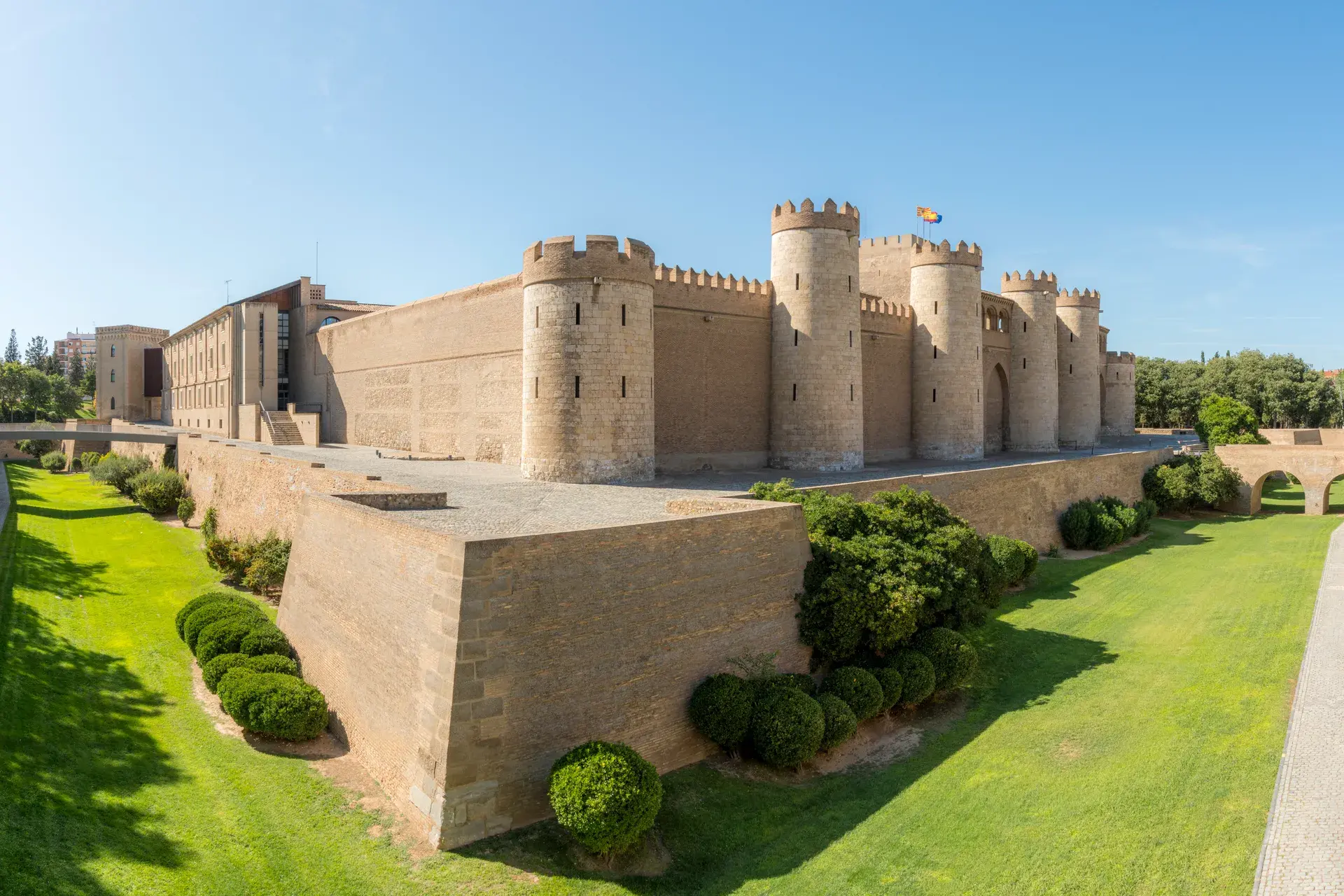
The Aljafería Palace in Zaragoza, Spain, is an extraordinary 11th-century fortified palace whose ancient walls now house the Aragonese Parliament. As one of the preeminent examples of Hispano-Muslim architecture, its Mudéjar elements are recognized as a UNESCO World Heritage Site. The structure stands as a testament to centuries of shifting cultural and political power, uniquely blending its past as an Islamic pleasure palace, Christian royal residence, and Inquisition prison with its present role as a modern democratic institution.
A Palace of Joy and Power
Originally named 'Qasr al-Surur' or 'Palace of Joy,' the Aljafería was constructed between 1065 and 1081. It was commissioned by Abú Ja'far Ahmad ibn Sulaymán al-Muqtadir Billah, the second monarch of the Banu Hud dynasty, to symbolize the power and opulence of the Taifa of Zaragoza. It is considered the most luxurious and best-preserved Muslim palace from the Taifa era in Europe.
The palace's oldest section is the Troubadour Tower (Torre del Trovador), which dates to the late 9th century. The cultured King Al-Muqtadir used this tower as a personal astronomical observatory to study the movement of planets and stars.
Centuries of Transformation
Following the Christian reconquest of Zaragoza in 1118 by Alfonso I of Aragón, the Aljafería was converted into a residence for Christian monarchs. Over the centuries, it underwent significant alterations. In the 14th century, Peter IV of Aragón expanded the royal quarters, adding structures like the Chapel of San Martín.
In 1492, the Catholic Monarchs, Ferdinand and Isabella, commissioned a new palace within the existing structure, adding a grand Throne Room in the Gothic and Renaissance styles. The palace also took on a darker role starting in 1486, when it became a seat and prison for the Holy Office of the Inquisition, with the Troubadour Tower serving as its main dungeon.
Fortress and Cultural Icon
To adapt the palace for artillery and suppress potential revolts, Philip II transformed it into a military fortress in 1593. This project, designed by engineer Tiburcio Spanocchi, added a moat, pentagonal bastions, and reinforced walls. The palace suffered significant damage during the Sieges of Zaragoza in the 19th-century War of Independence.
The Aljafería's formidable Troubadour Tower later achieved global fame. It served as the setting for Antonio García Gutiérrez's 1836 romantic drama, 'El Trovador,' which was subsequently adapted by renowned Italian composer Giuseppe Verdi into his famous 1853 opera, 'Il Trovatore'.
Restoration and Modern Governance
A major restoration effort to return the palace to its former glory was initiated in 1947 by architect Francisco Iñiguez Almech. This extensive work paved the way for its modern function. Since 1987, the Aljafería has served as the permanent seat of the Cortes of Aragon, the regional parliament.
Today, the Aljafería Palace is the only Islamic palace in the world that houses a functioning parliament. It maintains a dual role as a center of governance and as a museum open to the public, allowing visitors to explore its rich, layered history. In 2001, its Mudéjar elements were inscribed on the UNESCO World Heritage list as part of the 'Mudéjar Architecture of Aragon'.
FAQ
What is the Aljafería Palace used for today?
The Aljafería Palace has a dual function: it is the permanent seat of the Cortes of Aragon, the regional parliament, and it operates as a museum open to the public.
Why is the Aljafería Palace a UNESCO World Heritage site?
The palace's Mudéjar architectural elements were designated a UNESCO World Heritage Site in 2001, as part of the larger inscription of 'Mudéjar Architecture of Aragon'.
Who originally built the Aljafería Palace?
The main palace was constructed between 1065 and 1081 by order of Al-Muqtadir, the second monarch of the Banu Hud dynasty, who ruled the Taifa of Zaragoza.
What is the oldest part of the Aljafería Palace?
The oldest component is the Troubadour Tower (Torre del Trovador), which dates back to the late 9th century, predating the main 11th-century palace construction.