Peristyle: Heart of Diocletian's Palace in Split
Este conteúdo ainda não está disponível em português. Mostramos a versão em inglês.
Architectural Design and Imperial Origins
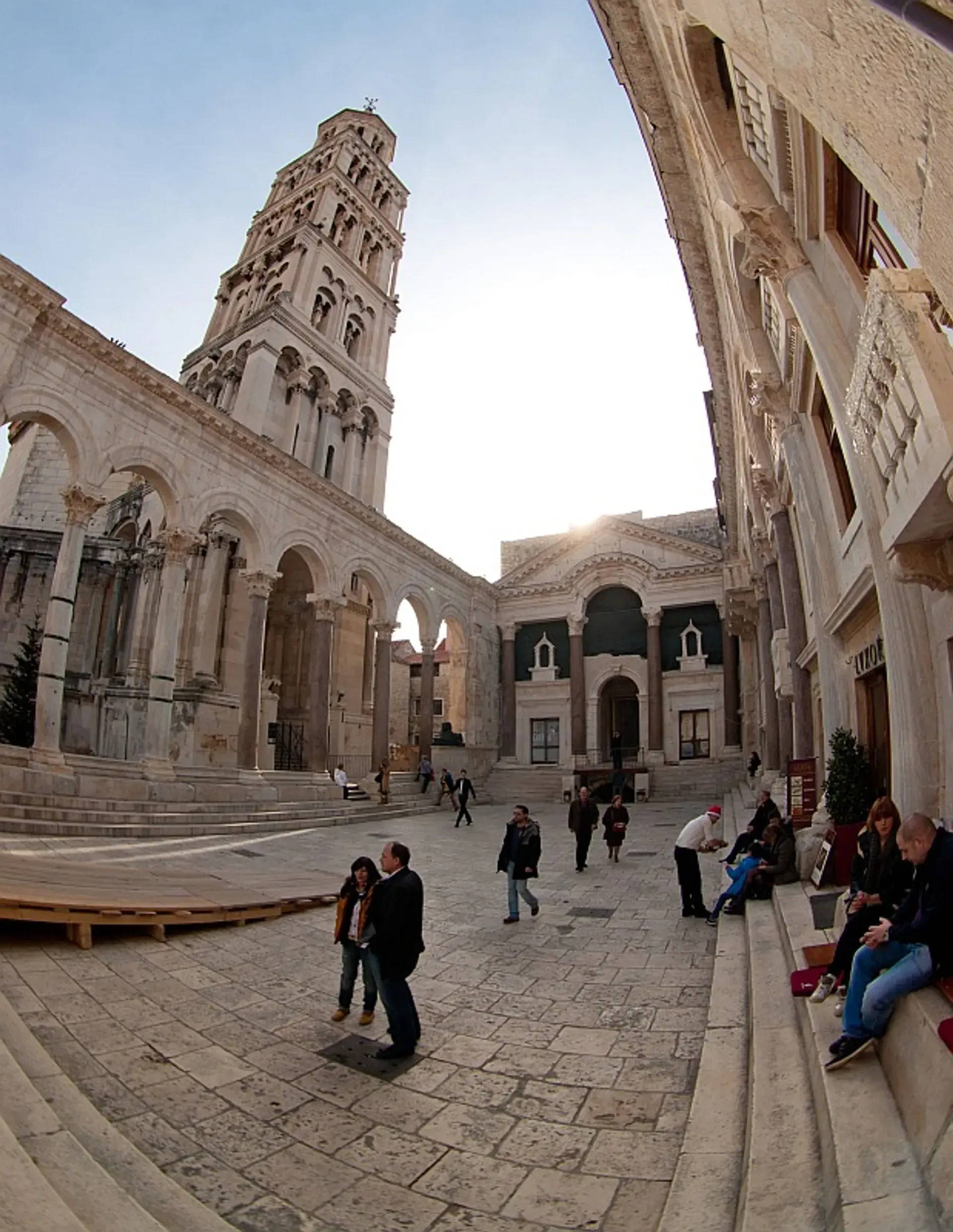
Constructed between approximately 295 and 305 CE, the Peristyle is a sunken, rectangular open-air courtyard that formed the monumental core of Diocletian's Palace in Split. Flanked on its eastern and western perimeters by colonnades of Corinthian columns supporting rounded arches, the courtyard was designed as an architectural apparatus of imperial authority. Red granite columns imported from Egypt were placed deliberately within the colonnades to establish a visual connection to imperial purple, the symbolic color of the Roman emperor.
The southern end of the square is anchored by the Protyron, a ceremonial portico crowned with a triangular pediment and a central Syrian arch. Beneath this arch, Diocletian appeared before dignitaries, guards, and palace residents as the divine earthly representative of Jupiter. The Protyron opened directly into the circular, domed Vestibule and the private imperial residential quarters beyond.

Visita a pé por Split com áudio e quizzes: Palácio de Diocleciano
2 horas10 paragensAudioguiaComece em qualquer dia, ao seu ritmoBilhete no telemóvel · reembolso em 30 diasMedieval Evolution and Neighboring Monuments
Following the 7th-century arrival of refugees from nearby Salona, the abandoned palace became a residential settlement, and private dwellings began encroaching into the ancient colonnades. Over the course of the Middle Ages, civic affairs shifted westward to People's Square (Pjaca), and the Peristyle transitioned into a religious hub centered on Diocletian's former octagonal mausoleum, which was converted into the Cathedral of Saint Domnius along the eastern colonnade.
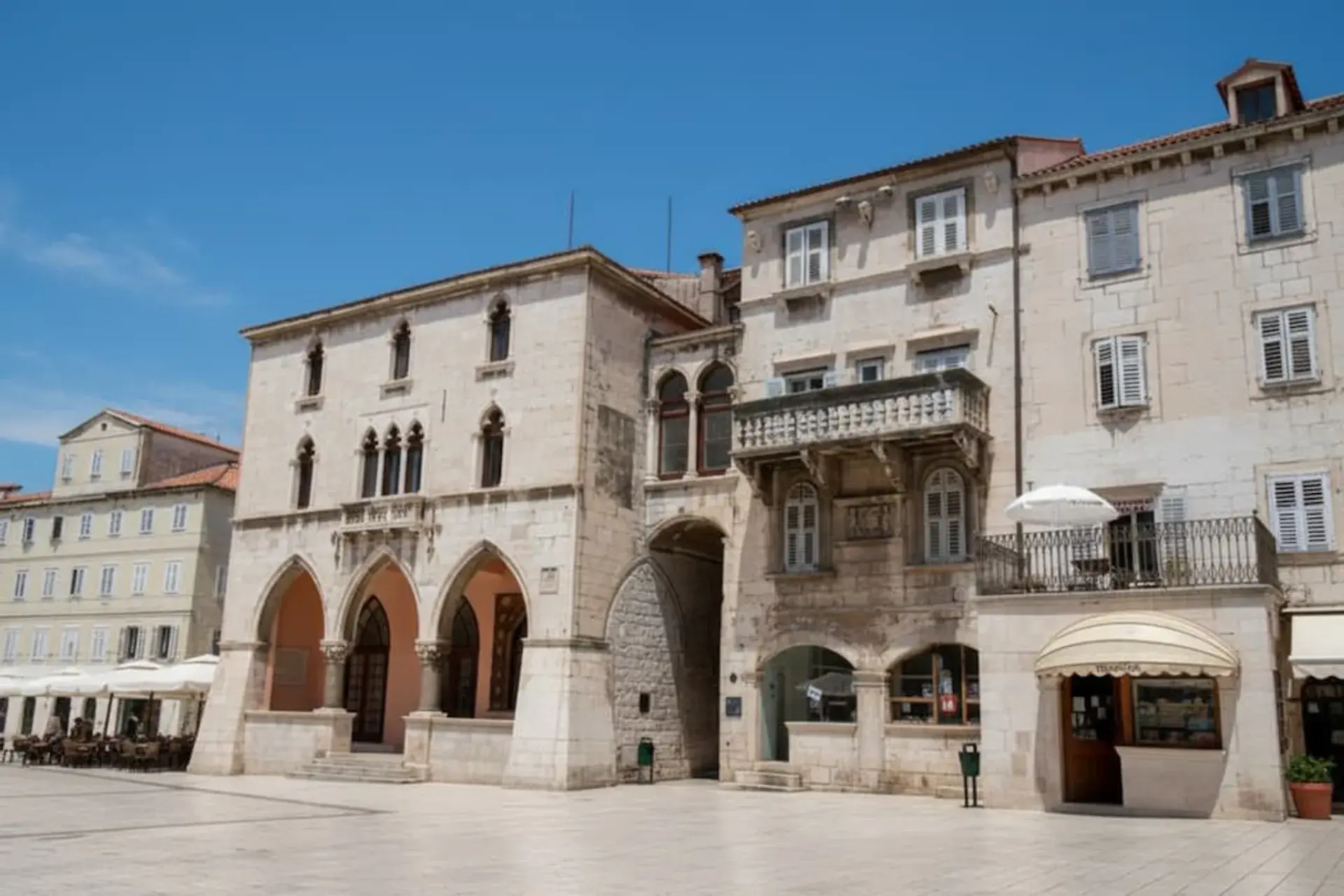
Resting beside the eastern colonnade is an approximately 3,500-year-old black granite Egyptian sphinx dating to the reign of Pharaoh Thutmose III. The sculpture, which holds an offering bowl between its front paws, is one of the few surviving Egyptian sphinxes brought to the complex that avoided destruction during early Christian removals of pagan symbols. Across the courtyard, the western colonnade features aristocratic Gothic and Renaissance residences—including the Grisogono, Cipci, and Skočibušić palaces—built directly into the Roman arches. These structures showcase ancient columns that were sliced through to insert domestic windows. To the west, the narrow lane of Kraj Svetog Ivana extends away from the courtyard, leading directly to the Temple of Jupiter at its end.
The Red Peristyle of 1968
On the morning of January 11, 1968, the Peristyle became the site of a celebrated event in Croatian conceptual art. Citizens awoke to discover that the ancient limestone flagstones of the courtyard had been painted bright red overnight. The unauthorized intervention was executed secretly by an informal collective of young artists, startling local authorities who initially opened an investigation into criminal vandalism and ideological provocation. The incident, known as the Red Peristyle, is now regarded as an important milestone in Croatian urban conceptual art.
Modern Life, Resonance, and Events
Today, the Peristyle serves as the central pedestrian crossroads of Split. Positioned where the ancient north-south cardo meets the approaches to the east-west decumanus, it links the subterranean palace cellars below, the cathedral bell tower above, and pathways leading to the waterfront Riva.
The square possesses distinct acoustic resonance produced by its non-porous limestone paving and enclosing vertical stone facades, which trap and reflect sound waves rather than absorbing them. This natural amplification allows unamplified vocalists and acoustic guitars to project throughout the courtyard. Capitalizing on this environment, Café Lvxor arranges cushions and tables along the perimeter stone steps, where free nightly acoustic music performances occur from April through October. The courtyard also acts as an open-air venue for theatrical and operatic works during the annual Split Summer Festival and serves as a regular gathering area for reenactors dressed in Roman soldier attire.
FAQ
When was the Peristyle built?
The Peristyle was constructed between approximately 295 and 305 CE as the central ceremonial courtyard of Roman Emperor Diocletian's Palace.
What is the history of the sphinx in the Peristyle?
The black granite sphinx dates to the reign of Pharaoh Thutmose III, approximately 3,500 years ago. Brought from Egypt by Diocletian, it features an offering bowl between its paws and survived the early Christian destruction of pagan imagery.
Why does acoustic music resonate so clearly in the Peristyle?
The hard, non-porous limestone pavement and tall stone walls trap and reflect sound waves rather than absorbing them, providing natural amplification for unamplified instruments and voices.
What was the 1968 Red Peristyle incident?
On January 11, 1968, a group of young artists painted the stone courtyard pavement bright red overnight. Initially investigated by authorities as vandalism, the action is now recognized as a historic milestone in Croatian conceptual art.