Château Frontenac

Dicas e tours para exploradores e viajantes

Guia da cidade de Québec City

A Cidade do Quebeque une as ruas históricas da Cidade Alta e Baixa, ligadas por escadarias íngremes, à vida dos seus bairros, festivais e invernos rigorosos. O francês é a língua oficial, e visitá-la pede um equilíbrio entre passeios a pé panorâmicos e as linhas de autocarro da RTC.

País
Canadá
Idioma
francês
Moeda
Dólar canadense (CAD)
Tomada
tipo A/B
Fuso horário
America/Toronto
Emergência
911
Água da torneira
Potável
Indicativo
+1

As paragens

O que fazer em Québec City

Explorar a Cidade do Quebeque implica enfrentar um terreno vertical entre a Cidade Alta e a Cidade Baixa, muralhas históricas e bairros com personalidade própria, ligados por escadarias públicas e linhas de transportes da RTC.

Antes de caminhar: uma introdução à cidade de Quebec

<p>Before you set off, know this: Québec City isn’t a museum piece—it’s a negotiation between centuries. Perched on a cliff above the St. Lawrence River, it remains the only fortified city north of Mexico still intact, which tells you everything about its temperament. Stone walls, copper roofs, and French street names coexist with espresso machines and Wi-Fi, and somehow none of it feels forced. The city doesn’t perform history; it inhabits it.</p> <p>This tour follows that layered rhythm—from the modern heights of the <strong>Observatoire de la Capitale</strong> down to the waterfront markets of the <strong>Old Port</strong>. Along the way you’ll encounter fortresses that never fought, churches that refused to die, prisons turned libraries, and murals that turned history into architecture. Think of it less as sightseeing and more as time travel without the paradoxes.</p> <p><strong>Distance:</strong> about 4.5 kilometers (roughly 2 hours).<br><strong>Terrain:</strong> steep in places—Upper Town is confident in its elevation.<br><strong>Pace:</strong> unhurried. Every leg is under 10 minutes; linger freely.<br><strong>Essentials:</strong> good shoes, layered clothing, and curiosity. You won’t need to enter any buildings; every story can be read from the street.</p> <p>Québec’s weather changes its mind often—sun, mist, drizzle, sometimes all before lunch. Treat it as part of the narrative. The same sky that once watched over Champlain’s wooden settlement now shades buskers, bureaucrats, and the odd ghost tour.</p> <p>You’re about to walk through a city fluent in time, where survival doubles as an art form. Open the app near the <strong>Observatoire de la Capitale</strong>, take in the skyline, and let the city begin its argument with eternity.</p>
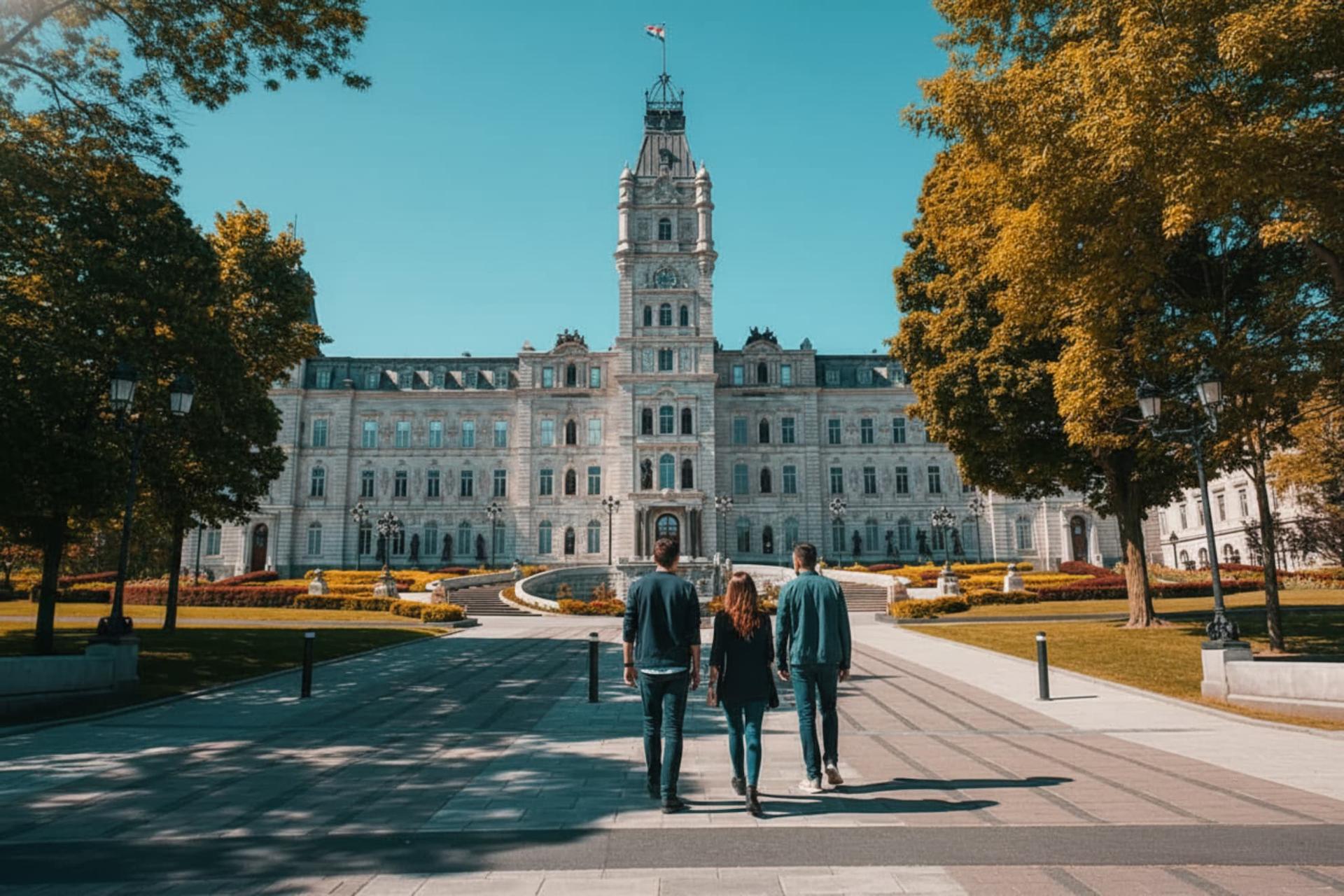
Política gravada na pedra

A fortaleza que nunca viu uma batalha

<p>Don’t be fooled by the quiet. The Citadelle was built for a war that refused to arrive. Between 1820 and 1850, British engineers carved this star-shaped fortress into Cap Diamant, a cliff so steep that Samuel de Champlain once mistook its glittering quartz for diamonds. When the stones proved worthless, the French coined a proverb: <em>“false as a Canadian diamond.”</em> The fortress inherited both the sparkle and the irony.</p> <p>After the War of 1812, Britain feared the Americans might try again, so the Duke of Wellington ordered a stronghold “to discourage ambition.” Lieutenant-Colonel Elias Walker Durnford obliged, hauling stone by barge and horse hoist up 360 feet of cliff to form what became North America’s largest British-built fortress. It was designed as a “last refuge” during siege or uprising—complete with rainwater reservoirs, barracks, and paranoia in five-point symmetry. The rebellion never came, but the bills did.</p> <p>History compensated with theatrics. In 1943 and 1944, Winston Churchill and Franklin D. Roosevelt met here to plan the Allied invasions of Europe and Asia. The D-Day calendar was finalized in rooms meant for musket drills. The same bastions that once braced for cannon fire now hosted secretaries, interpreters, and the faint smell of pipe tobacco. Not bad for a fort that never saw a battle.</p> <p>Today, the Citadelle serves three masters: Canada’s Governor General, the Royal 22e Régiment (the “Van Doos”), and two hundred thousand annual visitors. At 10 a.m. sharp in summer, the Changing of the Guard fills the parade ground with scarlet uniforms, bear-fur hats, and Batisse the goat—descendant of a Persian gift to Queen Victoria. When the noon gun fires, car alarms across town respond like an unplanned salute.</p> <p>At night, guides whisper of phantom footsteps on the ramparts—soldiers who died of duty or frost, or maybe just echoes of all that discipline. Either way, the ghosts are punctual; you could set your watch by them.</p> <p>Wind needles your skin along these granite walls, cold as empire. Look down at the river, glittering where Champlain’s “diamonds” once fooled a dreamer. For four centuries, Cap Diamant has defended many things—some real, some imagined. Mostly, it defends the idea that vigilance itself is a kind of heritage.</p> <p>Next stop: the Morrin Centre — where the fortress walls turn inward, and Québec trades gunpowder for grammar.</p>

Onde as paredes mudam de ideias

<p>From the outside, the Morrin Centre looks polite—Victorian stone symmetry, wrought-iron balconies, and a library’s hush. You’d never guess it began as Québec’s most notorious jail. Architect François Baillairgé built it in 1812 on the new model of “moral reform”: thick limestone walls, solitary cells, and the belief that silence could civilize. The windows you see now once opened onto isolation. Between 1812 and 1867, thieves, rebels, and debtors were confined behind them; sixteen left by way of the gallows that once stood above the front door. In 1823, half the city crowded these streets to watch a public hanging—a civic ritual that passed for justice.</p> <p>When the last prisoners were transferred to a newer facility, the building reinvented itself as Morrin College. The new purpose came courtesy of Dr. Joseph Morrin, a Scottish-born physician and twice mayor who believed education could rescue what punishment couldn’t. The façade you’re facing hides an improbable metamorphosis: prison cells converted into lecture halls, and gallows replaced by Greek Revival trim. Behind those windows, Québec’s first English-language degrees were earned—including one by a woman in the 1880s, proof that the walls were learning too.</p> <p>Look closely and you’ll spot the contrast between the original stone blocks and later Victorian masonry—architectural layers of repentance. The balcony railings where guards once paced now frame the library windows of the Literary and Historical Society of Québec, the province’s oldest English cultural institution. Inside those shelves rest volumes older than the city itself, rescued from two fires and a century of bilingual politics.</p> <p>Locals still claim that on quiet evenings, the sound of footsteps drifts from the basement vents—a faint echo of chains or maybe applause from a poetry reading. From out here, it’s hard to tell which would be stranger.</p> <p>The building stands as proof that walls, like people, can outgrow their original sentence. A place once designed to suppress voices now preserves them in ink and memory.</p> <p>Next stop: Château Frontenac — where penitence gives way to opulence, and the ghosts finally get room service.</p>

Fé reconstruída - uma e outra vez

O hotel que vendeu o Canadá a si próprio

<p>Stand here and look up: this isn’t just a hotel; it’s Canada’s most successful sales pitch in stone. The Château Frontenac was born in 1893 from the Canadian Pacific Railway’s belief that tourism could be industrialized. If Europe had castles, Canada would simply build better ones. Architect Bruce Price borrowed his blueprints from the Loire Valley, added turrets for theatrical effect, and let the whole structure loom over the St. Lawrence like a medieval fortress that accidentally joined a marketing campaign.</p> <p>The result was a fairytale built on capitalism. CPR president William Van Horne—who quipped, “If we can’t export the scenery, we’ll import the tourists”—named it after Louis de Buade, Comte de Frontenac, the 17th-century governor who once ruled New France and refused to surrender to the British. Fittingly, the hotel now rules every postcard rack in the country.</p> <p>The site beneath those copper roofs has hosted four centuries of authority. The Château Frontenac replaced a line of vanished powerhouses: the French Château Saint-Louis, the British Château Haldimand, then, finally, this baronial hybrid where empire met expense account. Each rebuild erased the previous occupant while pretending to preserve it—a tradition Québec has perfected.</p> <p>During the Second World War, the hotel briefly doubled as Allied headquarters. Inside, Churchill and Roosevelt drafted the plans for D-Day while Canada’s own Prime Minister Mackenzie King played the role of polite host, excluded from most conversations. Outside, locals simply noted that the lights stayed on past curfew.</p> <p>The copper roof above you—replaced entirely between 2011 and 2014—still wears its green patina like aged armor. In winter, the air carries a hint of metal and salt from the river; in summer, the turrets flare orange at sunset, as if the building remembers its 1926 fire. Rumor has it that Frontenac’s ghost still patrols his namesake tower, not out of torment but because he refuses to give up the view.</p> <p>The Château’s silhouette tells you everything about Québec’s self-esteem: half fortress, half fantasy, always photogenic. You don’t need to stay the night to feel its pull—the façade already performs hospitality on a civic scale.</p> <p>Next stop: Dufferin Terrace — the wooden promenade that turned defense into leisure and keeps the river company year-round.</p>

Onde a fortaleza se tornou um passeio marítimo

<p>If you ever needed proof that history can loosen its collar, this is it. Dufferin Terrace began as the governor’s private patio—an off-limits platform for lords to admire the river in solitude. Today, it’s 430 meters of democracy on timber, where anyone with shoes can walk the same edge once reserved for aristocracy.</p> <p>Look down through the glass skylights and you’ll see the bones of the old Château Saint-Louis, the 17th-century seat of New France. That château burned in 1834, leaving a literal power vacuum. Five years later, Lord Durham—British governor, reformist, and part-time controversy magnet—ordered the ruins turned into a public promenade. It was a radical idea: let commoners enjoy the governor’s view. The result was Durham Terrace, a short wooden platform with a railing and a message—“authority can afford transparency.”</p> <p>Four decades later, Lord Dufferin took the concept personally. In the 1870s he arrived in Québec, fell hopelessly in love with the city, and stopped municipal engineers from demolishing the fortifications. Instead, he doubled down on preservation and spectacle. Between 1878 and 1879, the terrace stretched to its current length, with six green-and-white gazebos named after the usual suspects—Frontenac, Victoria, Princess Louise, Dufferin himself. On June 28, 1879, Princess Louise cut the ribbon. The British Empire had just inaugurated Canada’s most photogenic boardwalk.</p> <p>Then came 1885, when 34 arc lamps flickered on along this very railing—electric light beamed 30 kilometers from Montmorency Falls. For one week, Dufferin Terrace was North America’s most modern boulevard, glowing over a 200-year-old cliff. Québec had officially entered the future without leaving its past.</p> <p>In winter, this place belongs to the toboggan slide, a 140-year-old wooden rocket run where riders hit 70 kilometers an hour screaming patriotic nonsense into the wind. In summer, street performers juggle and mimes mime while tourists photograph the Champlain monument—whose sculptor, Paul Chevré, later survived the Titanic. Québec never wastes a good plot twist.</p> <p>Listen for the whistle of river wind around Château Frontenac’s turrets, the wood creaking under millions of footsteps, the faint smell of cedar and brine. This boardwalk is more than a viewpoint; it’s a declaration that history doesn’t have to hide behind walls.</p> <p>Next stop: Rue du Petit-Champlain — where the view descends to street level, and commerce becomes the city’s native language again.</p>

A rua mais antiga que se recusa a envelhecer

A parede que se lembra de tudo

O teu guia particular, no bolso

Pronto para percorrer estas paragens?

  • Autoguiado, começa quando quiseres
  • Áudio offline, 7 idiomas
  • Reembolso garantido em 30 dias
  • eSIM global de 500 MB incluído

a partir de

€ 5,00

1 tour autoguiado em Québec City

Ver os tours

Planear os dias

Quantos dias em Québec City? O itinerário perfeito de 1 dias

Dia 1

A pé pela Cidade Alta e Baixa do Quebeque

Liga a histórica Cidade Alta à Cidade Baixa através de ruelas íngremes, praças emblemáticas e escadarias públicas, recorrendo depois aos autocarros da RTC para deslocações mais longas.

€ 5,00

Tempo e multidões

Melhor altura para visitar

Julho é habitualmente o mês mais quente na Cidade do Quebeque, com médias de 25,0 °C, mas o período de junho a outubro é o mais chuvoso. Maio e setembro são os meses ideais de equilíbrio; de janeiro a março o frio aperta a sério, enquanto o verão e o calendário de eventos em dezembro atraem multidões.

Recomendado

Pleno inverno

jan.–mar.

-17–0°C/ 2–33°F

Muito movimentadoChuvoso
  • Carnaval de Inverno local
  • A média mínima em janeiro ronda os -16,7 °C.

Não perca

  • Carnaval de Inverno do Quebeque

Degelo e primavera

abr.–mai.

-1–18°C/ 30–64°F

Vai enchendoChuvoso
  • Maio chega a 17,5 °C de dia
  • A precipitação média em abril é de 94,4 mm.

Festivais e tempo quente

jun.–set.

8–25°C/ 47–77°F

Época altaChuvoso
  • Festival d’été de Québec
  • A precipitação média em julho é de 118,7 mm.

Não perca

  • Festival d’été de Québec

Cores e final de outono

out.–dez.

-11–11°C/ 11–52°F

Muito movimentadoChuvoso
  • Mercado de Natal alemão
  • A média máxima em dezembro é de -3,3 °C.

Não perca

  • Mercado de Natal alemão da Cidade do Quebeque

Transportes

Como chegar e circular em Québec City

Aeroporto do Quebeque

Como chegar e circular em Québec City
Linha 80 da RTC para o centroNão divulgadoCA$ 3,85
Linha 76 da RTC para Sainte-Foymenos de 30 minCA$ 3,85

Autocarros da RTC

A melhor opção base

A tarifa RTC em 2026 é 3,85 CAD em bilhete ou 4,00 CAD a dinheiro; o passe diário custa 10,50 CAD e o de 5 dias fica por 34,75 CAD. As linhas 800 e 801 são os eixos frequentes mais práticos.

A pé

Ideal no centro

Vieux-Québec e os bairros centrais convidam a caminhar, mas a cidade tem muitas escadarias públicas, fortes declives entre a Cidade Alta e a Baixa e, no inverno, piso com gelo ou neve.

Bicicleta

Apenas no verão

Andar de bicicleta é prático no tempo ameno com ciclovias sinalizadas; no inverno há colinas, neve e escadas. As fontes da cidade não indicam tarifas turísticas de bicicleta.

Táxi ou TVDE

Noite e rotas longas

Usa táxi ou TVDE para o aeroporto YQB à noite ou para a periferia. O aeroporto tem táxis e plataformas disponíveis, mas a página de transportes não indica tarifa turística fixa.

Explora Vieux-Québec e o centro a pé e usa as linhas 800, 801, 76 e 80 da RTC para viagens maiores. O passe de 1 dia compensa ao fim de 3 viagens; o de 5 dias compensa a partir de 10 viagens.

Orçamento

Quanto custa visitar Québec City?

As tarifas oficiais de transportes públicos na Cidade do Quebeque são moderadas: o passe de 1 dia custa 10,50 CAD e o de 5 dias fica por 34,75 CAD. Não foram encontrados valores de referência oficiais para despesas correntes de café, almoço, cerveja ou táxi, pelo que estes valores não cobrem um orçamento de alimentação completo.

Quanto custa visitar Québec City?
Bilhete RTC, digital ou em papelCA$ 3,85
Tarifa RTC, numerárioCA$ 4,00
Passe de 1 dia RTCCA$ 10,50
Passe de 5 dias RTCCA$ 34,75
Fim de semana ilimitado RTCCA$ 19,00

Cash or card?

A máquina da RTC no terminal do aeroporto YQB aceita os principais cartões e carteiras digitais. A tabela tarifária em vigor distingue tarifas em bilhete e em numerário; tem consigo alguns dólares canadianos se viajares para fora do sistema de pagamentos suportado no aeroporto.

Onde ficar

Onde ficar em Québec City

Vieux-Québec

primeira visita

O centro histórico é ideal para andar a pé entre a Cidade Alta e a Baixa e apanhar autocarros centrais. Tem degraus, calçada, tráfego ligado a eventos e menor sossego no dia a dia.

Saint-Jean-Baptiste

cafés e noites no centro

Saint-Jean-Baptiste fica logo fora das muralhas, com um traçado urbano animado e acesso fácil a pé a Vieux-Québec. A inclinação acentuada e as escadarias continuam a ser desvantagens reais no inverno.

Saint-Roch

vida noturna e ambiente local

Saint-Roch fica na cidade baixa, com lojas, serviços e ótimos autocarros. É mais eclético e menos turístico que Vieux-Québec, o que é a sua grande mais-valia em estadias longas.

Montcalm

tranquilidade e cultura

Montcalm é uma zona residencial central com parques, cafés e ambiente calmo longe da confusão turística. O regresso a subir até Vieux-Québec exige caminhar mais ou ir de autocarro.

Sainte-Foy

aeroporto, espaço e autocarro

Sainte-Foy é uma base prática a poente, perto do aeroporto e de eixos de autocarro como a linha 76. É contudo menos indicada para quem tenciona passar todos os serões na zona histórica.

Os tours

Québec City, uma história de cada vez

Raspa e ganha

Raspa lá

Aí por baixo pode estar algo bom. Se ganhares, dizemos-te como usá-lo.

Um prémio por viajante. Válido 2 anos.

O passa-palavra

O que dizem os viajantes

Segurança

Québec City é segura?

A Cidade do Quebeque é segura e acolhedora. Atenção à neve e gelo no inverno, às escadarias íngremes entre a Cidade Alta e a Baixa, ao trânsito de autocarros e às multidões nos festivais. Liga para o 911 em caso de polícia, bombeiros ou emergência médica; o número da linha de saúde oficial do Quebeque para casos não urgentes é o 811.

Escadas de inverno e gelo

As escadarias públicas entre a Cidade Alta e Baixa ficam escorregadias com neve ou gelo. Usa os corrimões, calça solas aderentes e prefere o autocarro a subir ou descer escadas com mau tempo.

Multidões em festivais

A agenda local destaca o Carnaval de Inverno, o Festival d’été de Québec e a feira natalícia alemã em dezembro. Protege os objetos de valor nas filas e nos autocarros junto aos recintos.

Travessias e autocarros

Não desças do passeio a olhar para o telemóvel, em especial nas avenidas largas que ligam Vieux-Québec a Saint-Roch e a Saint-Jean-Baptiste. Olha bem para ver se vêm autocarros ou carros a virar antes de atravessar.

Mudanças bruscas de tempo

Em Jean-Lesage, as médias chegam a 25,0 °C em julho e caem a -16,7 °C em janeiro. Veste camadas, bebe água e usa calçado impermeável se o dia incluir passagens no rio, escadas e miradouros ao vento.

Assistência médica urgente

Em caso de emergência, liga para o 911. Para questões de saúde não urgentes, a linha Info-Santé 811 do Quebeque põe-te em contacto com um enfermeiro; a informação oficial consultada não assegura atendimento em inglês em todas as chamadas.

Informações úteis

Bom saber

O francês é a língua de uso público

O francês é a única língua oficial do Quebeque. Dizer "bonjour" e usar nomes franceses facilita o dia a dia e os serviços públicos, embora quase todo o setor do turismo fale inglês.

Seis bairros da cidade

A cidade do Quebeque tem seis arrondissements: Beauport, Charlesbourg, La Cité-Limoilou, La Haute-Saint-Charles, Les Rivières e Sainte-Foy–Sillery–Cap-Rouge. Por isso, uma morada na «cidade do Quebeque» pode ficar bem longe do Vieux-Québec.

A cidade das escadas

A cidade destaca as suas muitas escadarias. Encare o trajeto entre a Haute-Ville e a Basse-Ville como um percurso vertical e não plano, e consulte o tempo no inverno antes de seguir o mapa.

Perguntas

Perguntas sobre Québec City

A linha 80 da RTC liga o YQB ao centro da cidade do Quebeque através de Les Saules. A linha 76 faz a ligação entre o aeroporto e Sainte-Foy em menos de 30 minutos, onde as frequentes linhas 800 e 801 seguem viagem em direção ao centro.

Pronto para ir?

Tours de áudio autoguiados por toda a Québec City.

Ver os tours em Québec City