Hauptmarkt Nürnberg

Dicas e tours para exploradores e viajantes

Guia da cidade de Nuremberg

Nuremberga alia a sua fundação medieval em 1050 e o pioneirismo ferroviário histórico a uma Altstadt perfeita para percorrer a pé, às famosas bratwurst e pão de especiarias protegidos pela UE, e a uma viagem direta de U-Bahn de apenas doze minutos até à estação central.

As paragens

O que fazer em Nuremberg

A melhor forma de explorar Nuremberga é a pé, seguindo o eixo pedonal que vai da Hauptbahnhof até ao coração da Altstadt, entre monumentos medievais, mercados locais e séculos de história comercial da Francónia.

Handwerkerhof

<p>Wlcome to Nuremberg—a city of contrasts, where the grandeur of the Holy Roman Empire meets the sobering lessons of the 20th century.</p> <p>Let’s step through the gates of history to begin our journey at the Handwerkerhof, a living homage to Nuremberg’s craftsmanship. Created in 1971, this charming recreation of a medieval craftsman’s quarter is tucked within the city’s ancient walls, right by the Königstor, or King’s Gate. This space was designed not just as a nostalgic nod to the past but as a vibrant showcase for the traditional crafts that once made Nuremberg the pride of Europe.</p> <img src="https://storage.googleapis.com/ciceru-assets-stg/c41a7fde-337d-4db9-a1df-bd755d7ab549/izCUSWyN-810px-Nu%CC%88rnberg_Maxtormauer_Turm_schwarzes_H_2%20%281%29.jpg" alt="undefined" style="height: auto;width: 320px"/> <blockquote>Ancient city wall tower in Nuremberg. Photo by Andreas Praefcke.</blockquote> <p>In 1219, Emperor Frederick II—a ruler celebrated for his intellect and innovations—granted Nuremberg the "Großen Freiheitsbrief," a decree that secured the city’s independence. This freedom unleashed a wave of creativity among local artisans, leading to iconic creations like the famed Nuremberg eggs.</p> <img src="https://storage.googleapis.com/ciceru-assets-stg/c41a7fde-337d-4db9-a1df-bd755d7ab549/HUBh83fu-Frederick_II_and_eagle%20%281%29.jpg" alt="undefined" style="height: auto;width: 320px"/> <blockquote>Frederick II with his falcon, depicted in De arte venandi cum avibus (The Art of Hunting with Birds), late 13th century. Manuscript from Biblioteca Vaticana.</blockquote> <p>Today, as you wander through its cobblestone lanes and admire the timber-framed houses, you’ll see artisans practicing age-old trades. Glassblowers, metalworkers, and potters bring the medieval marketplace to life, connecting past and present in a way that feels almost magical.</p>
Lorenzkirche

<p>As we leave the bustling Handwerkerhof, the towering spires of St. Lorenz Church draw us into a realm where faith and artistry converge. Built in the 15th century, this Gothic masterpiece stands as a symbol of Nuremberg’s cultural and spiritual significance. Its construction spans centuries, with the nave completed around 1400 and the choir finished by 1477 in the ornate German Sondergotik style of Gothic architecture. The soaring west façade, dominated by two imposing towers and a sharp, intricate portal, features a 9-meter-wide rose window—a striking element that ties it to the city’s architectural lineage.</p> <img src="https://storage.googleapis.com/ciceru-assets-stg/c41a7fde-337d-4db9-a1df-bd755d7ab549/FPIzBGWL-Nu%CC%88rnberg_St._Lorenz_Tu%CC%88rme_Totale%20%281%29.jpg" alt="undefined" style="height: auto;width: 320px"/> <blockquote>West facade of the Lorenzkirche with its towering spires. Photo by Jailbird.</blockquote> <p>Inside, the treasures of St. Lorenz reveal themselves. The Angelic Salutation, a renowned carving by Veit Stoss—a master sculptor of the late Gothic period—hangs delicately in the choir, depicting the Annunciation with unmatched detail and emotion. Nearby stands the monumental tabernacle by Adam Kraft, an eminent late Gothic sculptor known for his intricate stonework. This tabernacle showcases the craftsmanship and devotion of its era.</p> <img src="https://storage.googleapis.com/ciceru-assets-stg/c41a7fde-337d-4db9-a1df-bd755d7ab549/KV1N6rGc-kraft-adam--11-_o%20%281%29.jpg" alt="undefined" style="height: auto;width: 320px"/> <blockquote>Tabernacle by Adam Kraft inside the Lorenzkirche, a stunning example of late Gothic craftsmanship.</blockquote> <p>Despite Nuremberg’s adoption of Lutheranism during the Reformation in 1525, the city’s affluent citizens preserved these treasures, honoring their ancestors’ artistic legacy. This decision reflects a deep respect for the artistic achievements that define the city’s identity.</p> <img src="https://storage.googleapis.com/ciceru-assets-stg/c41a7fde-337d-4db9-a1df-bd755d7ab549/LmEPvWA4-Matthias_Ank%20%281%29.jpg" alt="undefined" style="height: auto;width: 320px"/> <blockquote>Lorenzkantor (Choir Director of St. Lorenz) Matthias Ank, serving from 1996 to 2023. Photo by Tobias Bär.</blockquote> <p>The church’s musical heritage is equally profound. Housing three organs, each with its own storied past, St. Lorenz continues to resonate with its cultural significance. The main organ, originally built in 1937 by Steinmeyer and rebuilt in 2003 by Klais Orgelbau, boasts five manuals and stands as a marvel of engineering. The Stephans Organ, constructed by Steinmeyer in 1862 and restored in 2002, and the Laurentius Organ, built by Klais Orgelbau in 2005, complement this rich legacy. For over 500 years, the church has employed organists, including notable figures like Johann Gottlieb Frör and Carl Christian Mattäus, who left indelible marks on its musical tradition.</p>

Fleischbrücke

<p>Spanning the Pegnitz River with effortless grace, the Fleischbrücke, or Meat Bridge, is a masterpiece of late Renaissance engineering. Built between 1596 and 1598, it was designed to withstand the ravages of floods that had destroyed its wooden predecessors. At its core is an elegant single arch, with a span of 27 meters and a rise of just 4.2 meters, a flat and groundbreaking profile for its time. This design achieved an innovative span-to-rise ratio of 6.4 to 1, supported by over 2,000 wooden piles driven into the riverbed, with 400 angled to counter lateral thrusts. These techniques made the Fleischbrücke one of the most advanced structures of its era.</p> <img src="https://storage.googleapis.com/ciceru-assets-stg/c41a7fde-337d-4db9-a1df-bd755d7ab549/lGUJ0jmi-Nu%CC%88rnberg_-_Fleischbru%CC%88cke_2%20%281%29.jpg" alt="undefined" style="height: auto;width: 320px"/> <blockquote>Postcard of the Fleischbrücke, dated 1918.</blockquote> <p>Its name, "Meat Bridge," comes from its proximity to the Fleischhaus, or Meat House, which anchored the city’s thriving meat market. By connecting the districts of St. Sebald and St. Lorenz, it became a vital artery of commerce, ensuring the smooth flow of goods, livestock, and people.</p> <img src="https://storage.googleapis.com/ciceru-assets-stg/c41a7fde-337d-4db9-a1df-bd755d7ab549/tJYUZkCn-Nu%CC%88rnberg_-_Fleischbru%CC%88cke%20%281%29.jpg" alt="undefined" style="height: auto;width: 320px"/> <blockquote>Postcard of the Fleischbrücke, dated 1915.</blockquote> <p>Today, the Fleischbrücke stands as a symbol of Nuremberg’s ingenuity and resilience. Despite floods, wars, and the passage of time, it has retained much of its original structure, a testament to the skill of its creators and the foresight of its design. Its picturesque views of the Pegnitz River and the surrounding historic quarter continue to captivate visitors and photographers alike.</p>

Hauptmarkt

<p>The Hauptmarkt, Nuremberg’s historic and cultural hub, has been the city’s beating heart since the 14th century. Before its establishment, this area housed Nuremberg’s Jewish community, who were tragically displaced during the Black Death pogroms of 1349—a series of violent attacks fueled by fear and scapegoating during the spread of the plague.</p> <img src="https://storage.googleapis.com/ciceru-assets-stg/c41a7fde-337d-4db9-a1df-bd755d7ab549/bR4jk8lF-Screenshot%202025-01-23%20alle%2015.50.49.jpg" alt="undefined" style="height: auto;width: 320px"/> <blockquote>Jews being tortured and killed (woodcut, 1475), from The Medieval Holocaust: The Approach of the Plague and the Destruction of Jews in Germany, 1348-1349. Paper published by Winkler, A. in 2005.</blockquote> <p>Emperor Charles IV, a ruler known for his ambitious reforms and dedication to the Holy Roman Empire, envisioned the square as a focal point of the city’s life, both commercial and ceremonial. Dominating this vibrant space is the Frauenkirche, a Gothic masterpiece completed in 1368 under his orders. It was built as a site for imperial ceremonies, including the display of the Imperial Regalia and the baptism of his son, Wenceslas.</p> <img src="https://storage.googleapis.com/ciceru-assets-stg/c41a7fde-337d-4db9-a1df-bd755d7ab549/jsiy6JrK-818px-Nuernberg-Frauenkirche-gp%20%281%29.jpg" alt="undefined" style="height: auto;width: 320px"/> <blockquote>West facade of the Frauenkirche. Photo by Kolossos.</blockquote> <p>Architectural gems surround the Hauptmarkt. The Schöner Brunnen, or Beautiful Fountain, graces the northeastern corner with its intricate 14th-century carvings and the iconic golden ring that locals and visitors alike turn for luck. We’ll explore this magnificent fountain in the next chapter. The Frauenkirche itself stands as a Gothic marvel, overseeing the square with its elaborate west façade and rich history.</p> <img src="https://storage.googleapis.com/ciceru-assets-stg/c41a7fde-337d-4db9-a1df-bd755d7ab549/pqX9ou6D-Christkindlesmarkt_nuernberg%20%281%29.jpg" alt="undefined" style="height: auto;width: 320px"/> <blockquote>The Christkindlesmarkt in Nuremberg at the Hauptmarkt (2008). Photo by Roland Berger.</blockquote> <p>The Hauptmarkt also thrives as a living space. The Christkindlesmarkt, held during Advent, transforms the square into a festive wonderland. This centuries-old market is one of the most renowned Christmas markets in the world, featuring wooden stalls, traditional decorations, and the Nuremberg Christkind, who opens the event with a prologue from the church balcony. On weekdays, the square hosts bustling markets where vendors sell fresh produce, flowers, and local specialties, ensuring its continued role as a commercial hub.</p>

O teu filho

<p>Among the treasures of Nuremberg’s Hauptmarkt stands the Schöner Brunnen, or Beautiful Fountain, a masterpiece of medieval artistry crafted in the 14th century. Built between 1385 and 1396 by stonemason Heinrich Beheim, the fountain was initially designed to adorn the Frauenkirche (Church of Our Lady). However, it was deemed too magnificent for the church and found its rightful place in the market square, where it became a symbol of civic pride.</p> <img src="https://storage.googleapis.com/ciceru-assets-stg/c41a7fde-337d-4db9-a1df-bd755d7ab549/aPiK6ghs-kristijan-arsov-CEy_E8fIBDc-unsplash%20%281%29.jpg" alt="undefined" style="height: auto;width: 320px"/> <blockquote>Closer view of the Schöne Brunnen. Photo by Kristijan Arsov.</blockquote> <p>The fountain, standing approximately 19 meters tall, is designed as a Gothic spire with three tiers, each adorned with 40 intricately carved figures. These figures represent the worldview of the Holy Roman Empire, featuring philosophers, saints, and allegorical characters that embody harmony and unity.</p> <img src="https://storage.googleapis.com/ciceru-assets-stg/c41a7fde-337d-4db9-a1df-bd755d7ab549/V6anw1Uh-758px-Nuernberg_Schoener_Brunnen_005.jpg" alt="undefined" style="height: auto;width: 320px"/> <blockquote>Sculpture of Ptolemy as a symbol of astronomy, 2010. Photo by Janericloebe.</blockquote> <p>Encircling the fountain is an ornate iron fence and particular feature on it has drawn the curiosity of visitors for centuries.</p>

Kaiserburg

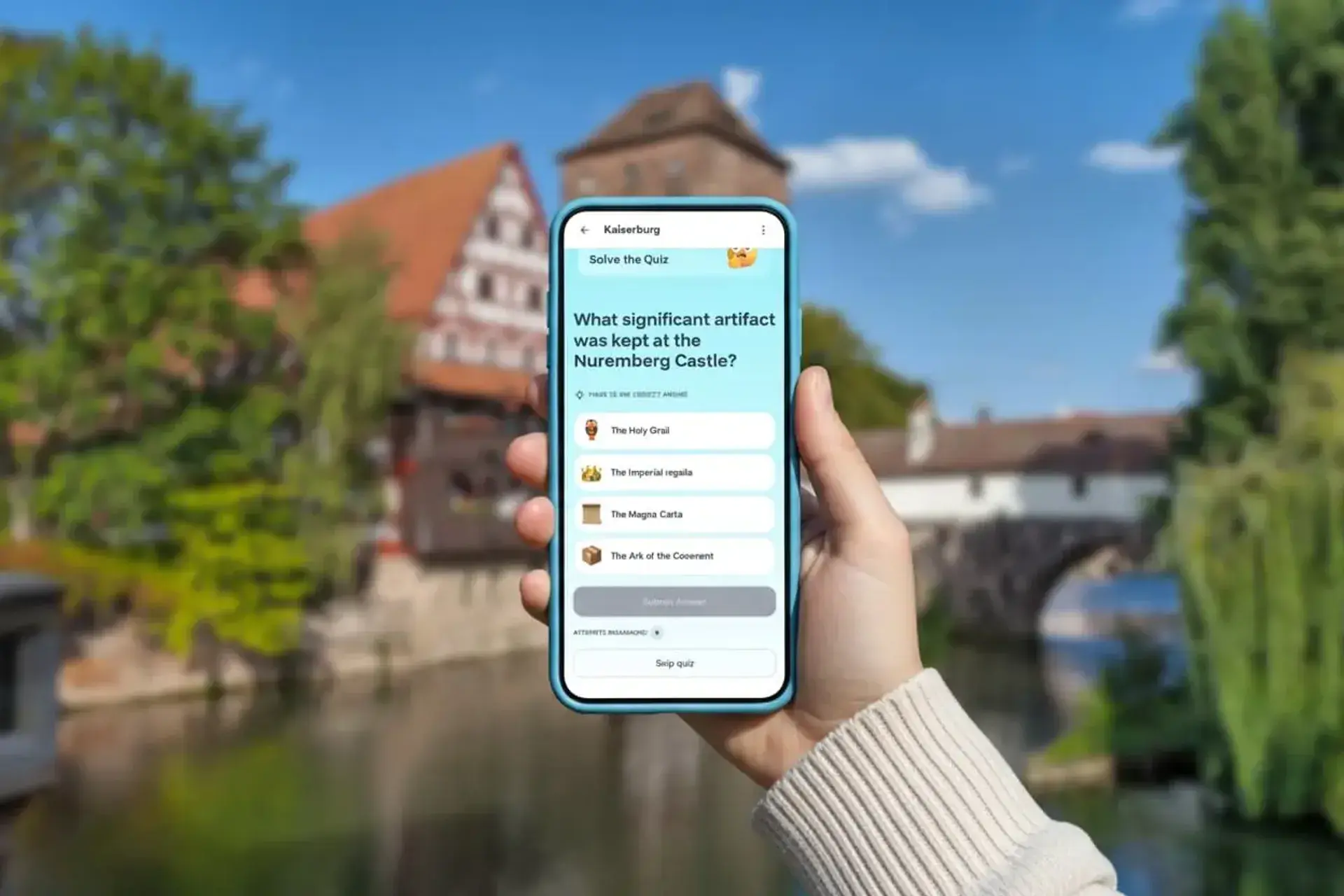
<p>Perched high above Nuremberg’s Old Town, the Kaiserburg—or Nuremberg Castle—has stood as a sentinel of power and prestige since its first documentation in 1050. This fortress was more than a military stronghold; it was a symbol of the Holy Roman Empire’s influence, serving as a residence for kings and emperors. Its strategic position overlooking trade routes and the city below underscored its importance within the empire.</p> <img src="https://storage.googleapis.com/ciceru-assets-stg/c41a7fde-337d-4db9-a1df-bd755d7ab549/LgkrEq7t-1920px-Nu%CC%88rnberg_Burg_ArM%20%281%29.jpg" alt="undefined" style="height: auto;width: 320px"/> <blockquote>Nuremberg Castle: Palas, Imperial Chapel, and Heathens' Tower on the right; Sinwell Tower in the middle left; Pentagonal Tower, Imperial Stables, and Luginsland Tower on the far right. Photo by ArtMechanic.</blockquote> <p>The castle played a pivotal role in 1356 when Emperor Charles IV issued the Golden Bull, declaring Nuremberg the site of the first Imperial Diet for newly elected kings. This decree solidified the city’s place in Imperial politics, and the castle became a repository for the Imperial regalia—crowns, swords, and orbs—from 1423 to 1796, further cementing its significance.</p> <img src="https://storage.googleapis.com/ciceru-assets-stg/c41a7fde-337d-4db9-a1df-bd755d7ab549/CAhE7fn4-Goldene_Bulle_Handschrift%20%281%29.jpg" alt="undefined" style="height: auto;width: 320px"/> <blockquote>Page from the Golden Bull manuscript of King Wenceslaus, circa 1400. Preserved in the Austrian National Library.</blockquote> <p>Inside, the Deep Well and the Sinwell Tower remain engineering marvels of their time, providing not just defense but also vital resources during sieges. The castle’s walls whisper stories of royal banquets, political negotiations, and the lives of those who called it home.</p>

Bunker histórico de arte

<p>Beneath the streets of Nuremberg lies a hidden sanctuary—the Historischer Kunstbunker. Built during World War II, this underground bunker was designed to protect something priceless. Can you guess what it was?</p>

Casa de Albrecht Dürer

<p>This final stop on our tour brings us to the home of Albrecht Dürer, which we briefly encountered in the previous stop at the Historischer Kunstbunker, where some of his priceless works were safeguarded during World War II.</p> <img src="https://storage.googleapis.com/ciceru-assets-stg/c41a7fde-337d-4db9-a1df-bd755d7ab549/mUfYScqI-807px-Albrecht-self%20%281%29.jpg" alt="undefined" style="height: auto;width: 320px"/> <blockquote>Albrecht Dürer, Self-Portrait with Eryngium (1493). Preserved in the Louvre.</blockquote> <p>Nestled within Nuremberg’s historic Old Town, this meticulously preserved half-timbered house served as both his home and workshop.</p> <img src="https://storage.googleapis.com/ciceru-assets-stg/c41a7fde-337d-4db9-a1df-bd755d7ab549/LrUIlDYp-810px-Albrecht-Du%CC%88rer-Haus%2C_interno_07_cucina.jpg" alt="undefined" style="height: auto;width: 320px"/> <blockquote>Interior: Kitchen of the Albrecht Dürer House in Nuremberg.</blockquote> <p>Dürer lived here from 1509 until his death in 1528. The house itself is a masterpiece of 15th-century architecture, reflecting the wealth and status of its illustrious owner. The house also serves as a museum, offering a window into the life and legacy of an artist whose influence is still felt today.</p>

O teu guia particular, no bolso

Pronto para percorrer estas paragens?

  • Autoguiado, começa quando quiseres
  • Áudio offline, 7 idiomas
  • Reembolso garantido em 30 dias
  • eSIM global de 500 MB incluído

a partir de

€ 7,00

1 tour autoguiado em Nuremberg

Ver os tours

Planear os dias

Quantos dias em Nuremberg? O itinerário perfeito de 1 dias

Dia 1

Percorrer a Altstadt de Nuremberga a partir da Hbf

Siga pela Königstraße a partir da Nürnberg Hbf através da Altstadt pedonal, com os transportes da Zona A à mão para percursos mais longos.

Tempo e multidões

Melhor altura para visitar

Para o equilíbrio perfeito entre bom tempo e multidões, aponte para maio-junho ou setembro-outubro, quando as máximas rondam os 18,8–22,0 °C e 14,2–20,0 °C. De julho a dezembro registaram-se recordes mensais de dormidas em 2025, tendo dezembro sido o primeiro mês a ultrapassar as 400 000 estadas.

Recomendado

Frio e menor procura

jan.–fev.

-4–4°C/ 25–40°F

Poucos visitantesChuva ocasional
  • A época calma de Nuremberga
  • As mínimas de janeiro rondam em média os -4,0 °C.

O despertar da primavera

mar.–abr.

-1–14°C/ 31–56°F

Vai enchendoChuva ocasional
  • Feira primaveril da cidade
  • Em abril, as máximas rondam em média apenas os 13,6 °C.

Não perca

  • Nürnberger Volksfest, feira da primavera

Meses quentes e chuvosos

mai.–jun.

7–22°C/ 45–72°F

Muito movimentadoChuvoso
  • Calor de primavera na cidade
  • Junho é habitualmente o mês mais chuvoso, com 75 mm.

Época alta de verão

jul.–ago.

12–24°C/ 54–75°F

Época altaChuvoso
  • Pico de verão em Nuremberga
  • Julho e agosto têm médias de 69 e 67 mm de precipitação.

Não perca

  • Nürnberger Volksfest, feira de outono

Amenos e concorridos

set.–nov.

1–20°C/ 33–68°F

Muito movimentadoChuva ocasional
  • Nürnberger Herbstmarkt
  • Outubro de 2025 somou 354 916 dormidas.

Não perca

  • Nürnberger Herbstmarkt

  • Nürnberger Christkindlesmarkt

Pico natalício

dez.

-2–3°C/ 28–38°F

Época altaChuva ocasional
  • Época do Christkindlesmarkt
  • Dezembro de 2025 ultrapassou as 400 000 dormidas.

Não perca

  • Nürnberger Christkindlesmarkt

Transportes

Como chegar e circular em Nuremberg

Nürnberg Flughafen

Como chegar e circular em Nuremberg
U212 min€ 3,90

Nürnberg Hbf

Como chegar e circular em Nuremberg
A pé pela KönigstraßeCerca de 5 min€ 0,00

U-Bahn, elétrico e bus

A Zona A chega

O bilhete da Zona A custa 3,65 € online ou 3,90 € em papel (90 min); 4 viagens são 14,60 € e o diário Solo 10,60 €. Não se aceita dinheiro a bordo dos autocarros da VAG.

A pé

Hbf ao centro: 5 min

A VAG calcula cerca de cinco minutos entre a Nürnberg Hbf e o centro, sendo a Königstraße a principal artéria pedonal. A rampa da Lorenzkirche na Königstraße encontra-se encerrada de momento.

VAG_Rad

Pequenos trajetos

A tarifa base é de 0,10 € de desbloqueio mais 0,10 €/min, com um teto de 10 €/24h. Devolva uma VAG_Rad normal numa estação ou flexzone; se a deixar fora da zona paga pelo menos 20 €.

Trotinetes partilhadas

Atenção a estacionar

Na Bundesstraßenring, as viagens só terminam em locais assinalados, sob pena de a tarifa continuar a contar. Fora dessa circular de Nuremberga, vigora o estacionamento livre.

Táxi

Taxímetro e cartão

A tarifa em Nuremberga começa nos 4,90 €; a tabela de preços antecipados fixa 15,40 € para 3 km. Pelas regras tarifárias, o pagamento com cartão tem de ser aceite a pedido.

Vale a pena andar a pé e usar a Zona A. O NÜRNBERG CARD custa 38 €/48h; dois diários Solo somam 21,20 €, logo o passe custa mais 16,80 € se for usado só em transportes.

Orçamento

Quanto custa visitar Nuremberg?

Os valores confirmados são de 1,90–2,10 € para viagens curtas, 3,65–3,90 € para o bilhete simples da Zona A, 10,60 € para o bilhete diário e 15,40–20,80 € para uma tarifa antecipada de táxi de 3–5 km. Os preços de comida e bebida permanecem NOT FOUND.

Quanto custa visitar Nuremberg?
Bilhete simples da Zona A, adulto€ 3,65–€ 3,90
Bilhete simples de curta distância€ 1,90–€ 2,10
Bilhete diário Solo da Zona A€ 10,60
VAG_Rad, 10 minutos€ 1,10
Tarifa antecipada de táxi, 3–5 km€ 15,40–€ 20,80

Cash or card?

Nos autocarros da VAG, a compra a bordo faz-se exclusivamente sem numerário desde 1 de maio de 2026; o dinheiro continua a ser aceite nas máquinas e nos postos de venda. Os táxis de Nuremberga são obrigados a aceitar cartões a pedido.

Onde ficar

Onde ficar em Nuremberg

Altstadt St. Lorenz

Primeira visita e acesso à Hbf

A maioria das vias pedonais centrais fica em St. Lorenz, com a Königstraße a ligar à Hbf. As obras na Lorenzer Passage afetam o acesso sem barreiras na estação Lorenzkirche.

Gostenhof

Vibrante e fora da Altstadt

Gostenhof é um bairro animado; a autarquia descreve uma zona densa cuja vida cultural e gastronómica atrai visitantes. A malha urbana apertada é a principal desvantagem.

St. Johannis

Residencial e perto do centro

St. Johannis situa-se a oeste da zona histórica e a norte do Pegnitz; a sua malha habitacional antiga exige uma caminhada ou um trajeto de transportes mais longo em comparação com St. Lorenz.

Os tours

Nuremberg, uma história de cada vez

Raspa e ganha

Raspa lá

Aí por baixo pode estar algo bom. Se ganhares, dizemos-te como usá-lo.

Um prémio por viajante. Válido 2 anos.

O passa-palavra

O que dizem os viajantes

Segurança

Nuremberg é segura?

Nuremberga é genericamente segura: a polícia classificou-a como a quinta cidade mais segura da Alemanha entre as com mais de 200 000 habitantes em 2025. Os furtos constituíram a principal categoria criminal, com 13 573 ocorrências; os carteiristas caíram para 447 casos.

Zona da Hauptbahnhof

A polícia registou 1526 infrações em redor da Nürnberg Hbf em 2025, incluindo 696 casos relacionados com estupefacientes. A saída sul tornou-se o novo foco de preocupação, depois de o lado norte ter estabilizado.

Multidões de Natal

A polícia deixa o alerta para os carteiristas no meio da confusão do Christkindlesmarkt: guarde dinheiro, cartões e telemóvel em bolsos interiores fechados e distintos, e traga as malas viradas para a frente.

Zonas de proibição de álcool

A proibição de álcool em Nuremberga vigora 24 horas por dia na Bahnhofsplatz/Königstorpassage e na Aufseßplatz; beber ou transportar álcool para consumo imediato pode custar uma coima até 1000 €.

Peões e trotinetes elétricas

A sul da Königstraße anda-se de bicicleta a qualquer hora; a norte da Mauthalle é obrigatório desmontar. Trotinetes elétricas não podem circular nos passeios nem em vias pedonais. Com taxa desde 0,5 ‰, a multa pode ir aos 500 €.

Assistência médica

Para urgências sem perigo de vida fora de horas, Nuremberga indica o 116117 e a Bahnhofstraße 11a; ligue para o 112 em situações de socorro e emergência. O atendimento garantido em inglês no 112 permaneceu NOT FOUND.

Informações úteis

Bom saber

Pagamentos digitais nos autocarros VAG

Desde 1 de maio de 2026, os bilhetes nos autocarros da VAG pagam-se só por via eletrónica; o dinheiro continua a ser aceite nas máquinas automáticas, nos postos privados e no balcão de apoio da VAG.

Devolução de trotinetes elétricas

Dentro da circular Bundesstraßenring de Nuremberga, o aluguer de trotinetes só pode terminar nos pontos de recolha identificados; fora deles não é possível fechar o aluguer e a tarifa continua a ser cobrada.

Validade do NÜRNBERG CARD

O NÜRNBERG CARD é válido por exatamente 48 horas a partir da data e hora selecionadas; não existem versões de 24 ou 72 horas e o período de validade não pode ser alterado posteriormente.

Álcool na rua no centro histórico

Além das zonas da Hbf e da Aufseßplatz, o consumo de álcool na via pública na Altstadt e nas áreas pedonais só é permitido em esplanadas licenciadas.

Perguntas

Perguntas sobre Nuremberg

Exatamente 48 horas. A data e hora de início são escolhidas no momento da compra; Nuremberga não disponibiliza opções de 24 nem de 72 horas.

Pronto para ir?

Tours de áudio autoguiados por toda a Nuremberg.

Ver os tours em Nuremberg