Chiesa dei Santi Pietro e Paolo (Caveoso)

Dicas e tours para exploradores e viajantes

Guia da cidade de Matera

Matera é uma cidade esculpida numa ravina, feita de bairros trogloditas e degraus de calcário, onde Bari serve de porta de entrada aérea e o calor dita cada percurso.

País
Itália
Idioma
italiano
Moeda
Euro (EUR)
Tomada
tipo L
Fuso horário
Europe/Rome
Emergência
112
Água da torneira
Geralmente potável
Indicativo
+39

As paragens

O que fazer em Matera

Explora as antigas igrejas rupestres e os miradouros panorâmicos de Matera. Descobre marcos históricos como a Cattedrale di Matera e a Chiesa di Santa Maria di Idris, empoleirada na escarpa.

Piazza Vittorio Veneto

Welcome to Matera. We are standing in the city's living room, a place where the present is quite literally built on top of the past. You are standing on a literal roof, though it feels like a grand Italian plaza. Welcome to Piazza Vittorio Veneto, the pulsing heart of Matera where the modern city and the ancient stone underworld collide. If you listen past the hum of the cafes and the click of heels on limestone, you are hearing the echo of two thousand years of urban survival. This square acts as a massive bridge, a thin lid covering a subterranean world that would make most architects sweat. It is elegant, busy, and slightly deceptive in the best way possible. Scan the perimeter and you will see Matera’s timeline written in stone. To one side sits the Annunziata Palace, a sturdy building that has served as everything from a convent to a cinema. Nearby, the Church of San Domenico stands with its stoic facade, housing the prefecture’s offices. Look for the Luigi Guerricchio Belvedere, that terrace with the three distinct round arches. Even from the square, you can catch the golden hue of the Sassi below, with the Cathedral Basilica peaking over the jumble of cave houses. This square was formerly officialized as Piazza Del Plebiscito, though everyone called it Fountain Square because of the massive Ferdinandea Fountain constructed in 1832. It was renamed again after 1918 to honor a major World War I victory. But the real story is what’s directly beneath your feet. Imagine that the pavement you’re standing on is just a crust. Hidden in the dark below is a five thousand square meter labyrinth. The crown jewel is the Palombaro Lungo, often called the Water Cathedral. It is a gargantuan nineteenth century cistern carved deep into the soft calcarenite rock. It is about eighteen meters deep and can hold five million liters of water. In a city that rarely sees rain, this massive belly of the square was the lifeblood for everyone living nearby. It wasn’t just water, though. The space down there includes ancient storehouses, shops, and even the ruined frescoes of the ninth century Church of the Holy Spirit. The current layout of the square is actually quite new. In 1993, the city decided to rip up the roads and move a war memorial just to reveal these historical skeletons. Before then, people drove cars over a hidden church without even knowing it was there. Now, the square has reclaimed its role as the city’s living room. It’s where the locals meet for an evening stroll, where markets pop up, and where the orange glow of the sunset turns the surrounding buildings into a scene out of a cinematic dream. Piazza Vittorio Veneto is more than just a nice place for an espresso. It is a reminder that in Matera, the present is always built directly on top of a very complex, very ingenious past. You’re standing on the entrance to a city of caves, right at the point where the light of day meets the secrets of the dark. From this grand public square, let's move toward a site that stands alone as a rare detached monument in this city of caves.
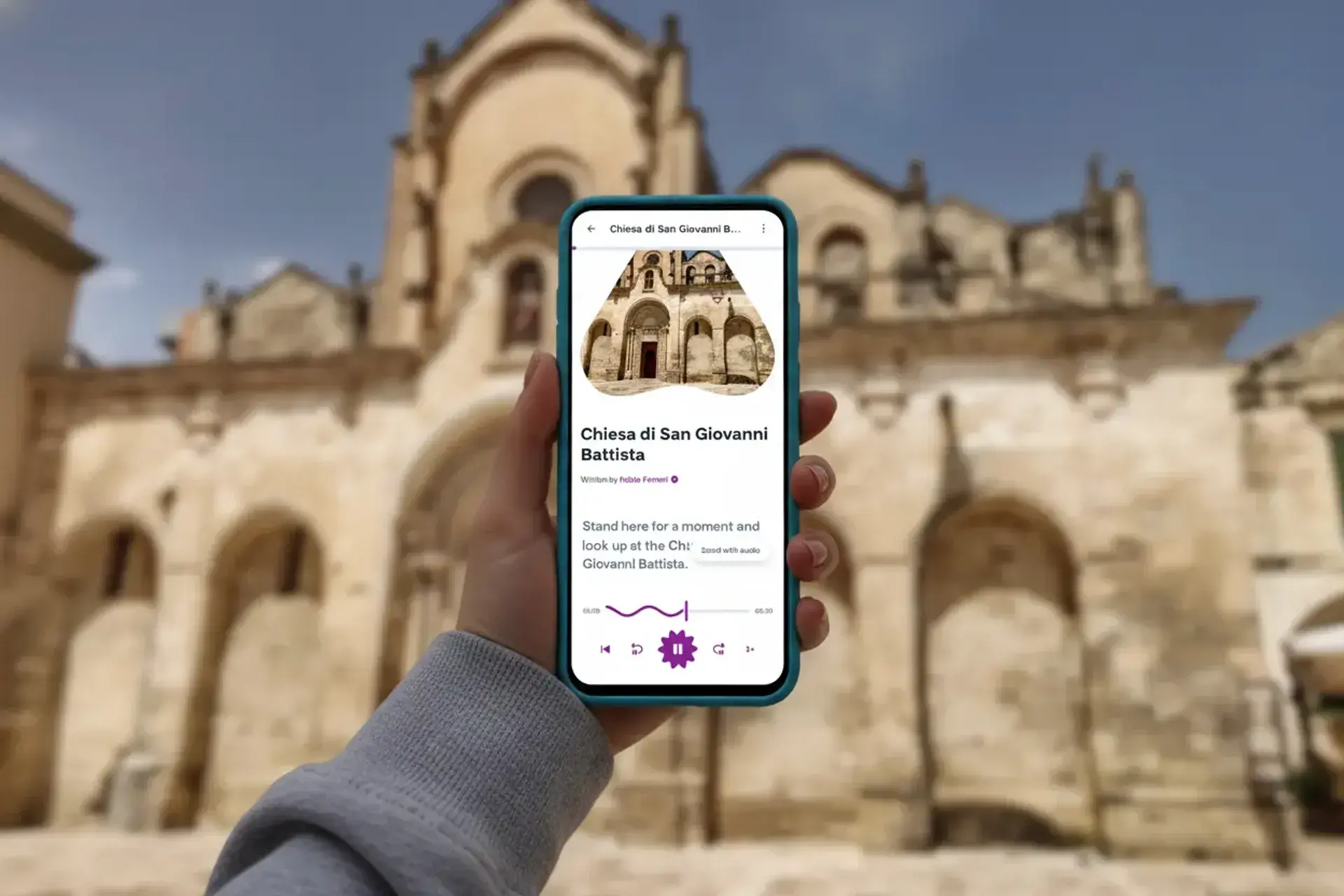
Igreja de São João Batista

Stand here for a moment and look up at the Church of San Giovanni Battista. It is a bit of an outlier, isn't it? In a city famous for homes and churches carved directly into the belly of the earth, this one stands tall and free. It possesses a quiet, stoic dignity that says, 'I have seen everything.' And it has. From 13th-century penitents seeking refuge to 21st-century Hollywood stunt drivers drifting around this very corner, this site has been Matera's silent witness for nearly eight hundred years. Take a look at that facade. You are staring at a medieval mashup. While construction began in 1229, concluding seven years later, the building you see today is a layered record of Matera's survival. The main portal is a masterpiece of the Apulian Romanesque style. If you look closely at the carvings around the entrance, you will see a tangled web of plant volutes, intricate columns, and stone animals that look like they were frozen mid-motion by a medieval mason. Above it all, Saint John the Baptist stands in his niche, weathered by centuries of sun and wind, keeping watch over the piazza. Notice those arches on the exterior? They were actually added much later, in the 18th century, to prop up the building when they updated the roof. It is a bit like architectural scaffolding that became permanent, a reminder that even the strongest stones need a little help as the centuries pile up. The history of this ground is just as layered as the stone. Before it was San Giovanni, it was Santa Maria la Nova, a home for a group of penitent women who arrived here from the Kingdom of Acre. This place has always been a crossroads of the Mediterranean, blending Romanesque structure with subtle Arabic and Gothic flourishes. It has survived the Ottoman invasion of 1480, which left the church abandoned and vulnerable, only to be reclaimed and renamed in 1695. Every time Matera faced a crisis or a shift in power, this church adapted. Inside those walls, which you can imagine are thick with the scent of aged stone and cold incense, are pillars topped with zoomorphic figures, beasts and flowers carved by men who lived in a world of myth and deep faith. But here is the detail that usually surprises people standing exactly where you are. A few years ago, this medieval square was transformed into a high-octane movie set for the James Bond film, No Time to Die. To pull off a cinematic car chase, the crew actually covered parts of the church with false walls and built a dummy bell tower so they could trigger explosive squibs without damaging the 13th-century masonry. Imagine the roar of an Aston Martin DB5 echoing off these ancient stones. It is a strange, modern irony, a sacred space built for silence and prayer being used to hide the pyrotechnics of a global blockbuster. Whether it is hosting a holy mass or a Hollywood stunt team, San Giovanni Battista remains one of Matera's most resilient landmarks. It stands as a bridge between the ancient world and the modern one, reminding us that even the most sacred history isn't static, it is a living, breathing part of the city's future. While this church stands tall above the ground, our next stop shows how the city gracefully hides its largest treasures within the rock itself.

Igreja Rupestre de San Pietro Barisano

Catedral de Matera

Igreja do Purgatório

Take a look at that facade. Most churches try to greet you with visions of celestial glory, but this one? It chooses to stare you right in the eye and remind you that your time here is strictly limited. Welcome to the Chiesa del Purgatorio. Built in the 17th century, it is a masterpiece of the Baroque and Rococo styles, but it is a Rococo that has been stained by the shadow of the grave. It is beautiful, yes, but it is also a bit of a memento mori, a persistent nudge that says, 'Hey, don’t get too comfortable.' Look closely at the stonework as you stand here. Notice the curves of the building, that elegant dance of concave and convex lines. It is a visual symphony designed to draw your eyes upward, yet the details at eye level are much more grounded. You will spot skulls and skeletal motifs carved deep into the local stone. These aren't meant to be macabre for the sake of it, they are signs of the times. In the 18th century, the Counter-Reformation was in full swing, and the concept of Purgatory was a major spiritual preoccupation. This architecture served as a public service announcement for the soul, urging passersby to think of those currently caught in the waiting room of the afterlife. The real story, though, isn't about the architects or the grand bishops. It’s about shepherds. This entire structure was funded and built by a Confraternity of shepherds known as the Souls of Purgatory. Picture these men, coming in from the rugged surroundings of Matera, pooling their hard-earned money to build a monument to the departed. It was a grassroots movement of the common people. While the wealthy were building palaces, the shepherds were focused on the transition between this world and the next. Inside, though you're staying out here for now, those shepherds commissioned art that reflected their devotion, including a wooden dome painted with priests and evangelists that watches over the central floor plan. Even the columns inside are a bit of a trick, they are made of local Matera stone but painted to look like expensive marble and granite. It is a bit of 18th-century 'fake it til you make it' energy. They wanted the best for their souls, even if they had to use local resources to mimic the opulence of Rome. While you find it here today, this church was originally located in the Sasso Caveoso, one of the ancient districts, before being relocated to this spot to be more accessible to the faithful. It was a statement of community identity, a collective insurance policy for the afterlife, fueled by the faith of the men who spent their days tending flocks on the hillsides. The Chiesa del Purgatorio stands today as a reminder that the most enduring landmarks aren't always built by kings. Sometimes, they are built by ordinary people trying to make sense of the great unknown. It is a bit grim, sure, but there is something deeply human about these shepherds carving skulls into stone, ensuring that neither they, nor their loved ones, would ever be forgotten. Leaving the somber skulls of the shepherd's church behind, we head to a balcony that offers the most breathtaking view of the world they once called home.

Belvedere Piazzetta Pascoli

Chiesa di Santa Lucia alle Malve

Stand here for a moment and look at the rock. You aren't just looking at a building, you're looking at a living fossil carved into the Sasso Caveoso. This is Santa Lucia alle Malve, one of the oldest monastic complexes in Italy. It’s a place where the line between geology and architecture completely disappears. If it looks like the cliff is swallowing the church, or perhaps the church is emerging from the cliff, that’s because for over a thousand years, that is exactly what’s been happening. It’s rugged, it’s silent, and it holds a history that is surprisingly complicated. Take a close look at the facade. You’ll see three sculptures of chalices, each slightly different, weathered by centuries of wind coming off the Gravina stream. Those aren't just liturgical ornaments, they are symbols of Saint Lucia’s martyrdom. If you look at the coat of arms above the entrance, you’ll see something even more striking: a goblet containing a pair of eyes. It’s a stark, visceral piece of imagery that tells you exactly who this place belongs to. But this hasn't always been Lucia’s home. Historians debate the exact origin, but it is widely believed that this space was first carved out for Saint Agatha as far back as the 8th or 9th century. It wasn't until later, during the 13th century, that the Benedictine nuns who lived here changed the dedication. There is a peculiar secret hidden in the layout of this stone shell. Many historians think this wasn't originally one church, but two separate religious spaces that were eventually smashed together. This explains why the three naves inside aren't symmetrical. They follow the whims of the limestone rather than the rules of geometry. One side reflects the ancient Byzantine style, while the other shows the later, softer influence of the Benedictine rule. After the nuns moved out in 1283, the church went through a truly Materan transformation. Most of it was divided up and turned into private homes. People lived, cooked, and slept in the side aisles while the right-hand nave remained a place of public worship. It’s a perfect example of how the people of the Sassi never let a good cave go to waste. While you're standing here, look up toward the roof. You are standing directly beneath a city of the dead. Above the church lies the 'Barbaric Cemetery,' a 7th-century necropolis carved into the plateau. The rock you see in front of you doesn't just house a church and former apartments, it supports the weight of ancient tombs. In Matera, the layers of life, worship, and death are literally stacked on top of one another. The same stone that provided a roof for the living nuns also provided a final resting place for the ancestors who came before them. Today, Santa Lucia alle Malve stands as a masterpiece of human resilience. It survived the fall of empires, the departure of the monastics, and even a period where it was chopped up into studio apartments. It’s a testament to the fact that in Matera, nothing is ever truly discarded. It is simply carved, adapted, and reimagined for the next thousand years. Take one last look at those stone eyes on the facade, they’ve seen more history than most cities could hope for. Having seen how people lived within church walls, we now visit a space that reveals exactly how an average family shared their cave with their livestock.

Casa Grotta di Vico Solitario

Look at the archway in front of you. That modest bit of masonry at number eleven is the only part of this home that was actually built. The rest? That’s just nature. You’re standing before the Casa Grotta di Vico Solitario, a place that, until the mid-twentieth century, was less of a home in the modern sense and more of a desperate, ingenious survival pod carved into the tufa rock. It looks quiet now, even charming with its weathered stone, but don’t let the silence fool you. This single cave once pulsed with the heat of a large family and their mule, all living in one damp, subterranean room. From where you’re standing in the Sasso Caveoso district, you can see how the architecture melts into the cliffside. Having been restored to respect its original 18th century layout, the site offers a frozen frame of a lifestyle that the Italian government famously branded a national shame in 1952. Behind that arch lies a single cavern where every inch of space was a tactical choice. Inside, they kept a bed raised high off the floor, not for comfort, but to keep the wool and corn-leaf mattress out of the rising damp. Right across from where the children slept, the family mule would stay in its manger, adding its own warmth to the heat coming from the central brazier during the biting winter months. Look closely at the ground and the surrounding rock. You might spot the faint lines of ancient canals. These were part of a sophisticated, albeit primitive, water system that funneled every drop of rain into underground cisterns. Life here was a masterclass in self-sufficiency and extreme destitution. Behind a small partition, they even had a space for quarrying their own stone and a circular pit for manure. It was a closed loop of human existence. When you look at the neighboring structures, like the 'neviera' or snow house nearby, you begin to realize that this wasn't just a house. It was part of a subterranean machine designed to keep people alive in a landscape that offered almost nothing. There is a peculiar, gritty resilience in the history here. While we see a world-class historical site today, the people who were forcibly evacuated from these caves in the 1950s left behind a life of communal struggle. They lived in these caves well into the middle of the century, with some residents holding out as late as the 1980s, long after the rest of the world had moved on to televisions. The documentary films shown in the neighboring cave gallery reveal the reality of those final years, showing children playing in the dirt of the same floors where the livestock slept. It’s a jarring contrast to the Bed and Breakfasts you see popping up in the Sassi today. The Casa Grotta serves as the ultimate reality check for Matera. It is the bridge between the city's ancient troglodyte roots and its modern revival. It reminds us that before this was a UNESCO site, it was a place where human ingenuity was the only thing standing between a family and the elements. Take a moment to appreciate that stone arch. It’s not just an entrance, it’s a monument to a way of life that refused to disappear. From the humble survival of the cave dwelling, we move to a church perched on a limestone tooth that highlights the spiritual heights of the Sassi.

Igreja de Santa Maria di Idris

Look up. You are standing before the Monterrone rocky spur, a giant limestone tooth jutting out from the heart of the Sasso Caveoso. Perched right on the edge, looking like it was squeezed out of the mountain itself, is the Church of Santa Maria di Idris. It is a place where the line between nature and architecture doesn't just blur, it completely disappears. From here, the view of the Gravina canyon and the chaotic beauty of Matera is enough to make you forget your own name for a second. This isn’t just a building. It's a testament to the Sassi's soul, carved by hand from the very stone we’re standing on. The facade you see today, built from soft tuff stone, isn't actually the original. Back in the 15th century, the front of the church decided it had had enough of gravity and collapsed. The reconstruction gave us this modest, elegant face and that small bell tower that looks out over the valley. If you look at the top of the rock outcrop, you’ll see a massive four-meter-high iron cross. It’s been there since 1937, a silent witness to the Pauline Missions, standing like a lighthouse for the faithful. While the exterior looks like a proper building, remember that most of what lies behind that facade is actually a hollowed-out cave. It’s a hybrid of masonry and ancient limestone, a masterclass in making do with what the earth provides. The church’s name, 'Idris,' likely comes from the Greek 'Odigitria,' meaning 'She who guides the way.' But if you ask a local, they might give you a different name: 'Madonna del Litro,' or the Madonna of the Liter. It’s a bit of Materan wit. Inside, there is a painting of the Virgin with two water containers at her feet. In a city where water was once more precious than gold, praying to a Madonna who looks after your water supply wasn't just religion, it was survival. This deep-rooted connection between faith and the reality of the Sassi is etched into the rock here. Speaking of things etched into the rock, you are actually standing on top of a subterranean complex. Beneath this church lies the older Crypt of San Giovanni in Monterrone, connected by a narrow internal corridor. It’s a layers-of-time situation, with frescoes down there dating back as far as the 12th century. The air coming out of these rock churches always has that same scent, cool, damp, and heavy with the smell of wet earth and centuries of silence. Even the movie industry couldn't resist this dramatic backdrop. If the landscape feels a bit heroic, it might be because this very rock mass served as a filming location for the Warner Bros. Wonder Woman movie. It turns out that ancient spiritual hubs and Amazonian training grounds have a lot in common visually. Santa Maria di Idris remains one of the most iconic silhouettes in Italy, a symbol of human resilience against a landscape that is as beautiful as it is unforgiving. It started as a humble cave for prayer and ended up as a cinematic icon. As you take one last look at that tuff facade, remember that in Matera, the stones have memories. Enjoy that breeze off the canyon, it’s been blowing past this rock for a thousand years. We finish our journey at a landmark that stands as a final bold statement of Matera's resilience, right on the edge of the canyon.

O teu guia particular, no bolso

Pronto para percorrer estas paragens?

  • Autoguiado, começa quando quiseres
  • Áudio offline, 7 idiomas
  • Reembolso garantido em 30 dias
  • eSIM global de 500 MB incluído

a partir de

€ 5,00

1 tour autoguiado em Matera

Ver os tours

Planear os dias

Quantos dias em Matera? O itinerário perfeito de 1 dias

Dia 1

Percorre os Sassi e a parte alta de Matera

Segue pelas ruelas de pedra desde os Sassi até à crista da cidade e faz uma pausa ao fresco antes de enfrentares os trilhos expostos da ravina.

€ 5,00

Tempo e multidões

Melhor altura para visitar

De abril a junho e de setembro a outubro são as épocas mais confortáveis para percorrer a pé os bairros de pedra exposta de Matera. Julho e agosto são os meses mais secos, mas também os mais quentes.

Recomendado

Inverno e primavera

jan.–jun.

2–28°C/ 36–82°F

Poucos visitantesChuva ocasional
  • Sassi frescos e luz suave

Verão e outono

jul.–dez.

11–31°C/ 52–88°F

Muito movimentadoChuva ocasional
  • Tardes quentes face à ravina

Os tours

Matera, uma história de cada vez

Raspa e ganha

Raspa lá

Aí por baixo pode estar algo bom. Se ganhares, dizemos-te como usá-lo.

Um prémio por viajante. Válido 2 anos.

O passa-palavra

O que dizem os viajantes

Segurança

Matera é segura?

Matera é, em geral, uma cidade segura, mas os principais riscos são físicos: degraus de pedra íngremes, calor, caminhos mal iluminados na ravina e trânsito no limite das zonas pedonais. Liga para o 112 em caso de polícia, ambulância ou bombeiros.

Degraus de pedra

Usa calçado com boa aderência nos Sassi; a pedra polida e os degraus irregulares tornam-se escorregadios depois da chuva.

Exposição ao calor

Leva água e evita a ravina desabrigada a meio do dia em julho e agosto; o calcário reflete um calor intenso.

Trilhos da ravina

Não comeces a percorrer trilhos isolados perto do anoitecer sem água, o telemóvel carregado e um caminho de regresso bem definido.

Perguntas

Perguntas sobre Matera

Os Sassi e a crista central percorrem-se bem a pé, mas são íngremes; planeia algumas pausas e apanha autocarros ou táxis se o teu alojamento ficar fora do centro.

Pronto para ir?

Tours de áudio autoguiados por toda a Matera.

Ver os tours em Matera