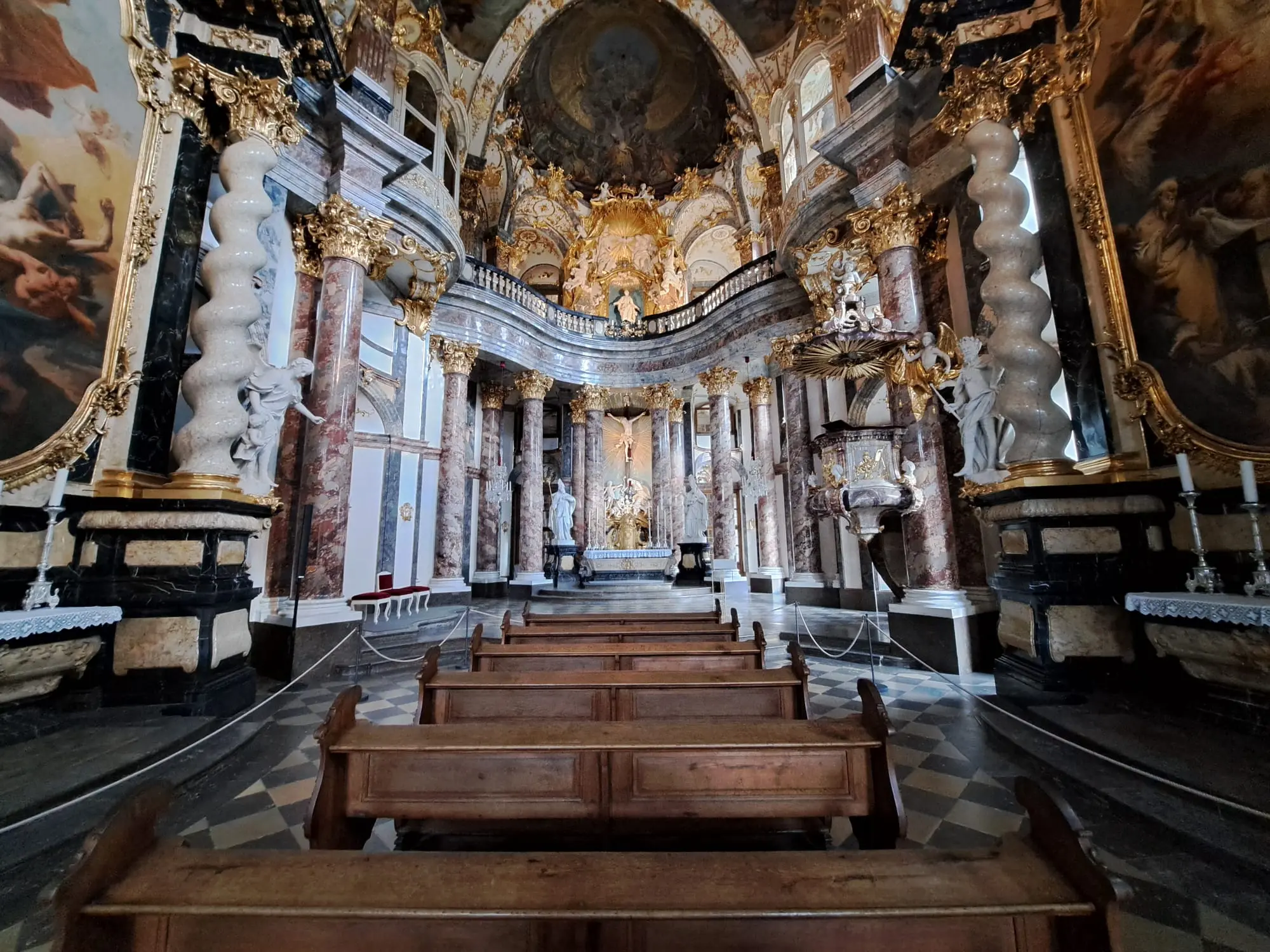
Frankoniabrunnen (Franconia Fountain)
The Frankoniabrunnen, a grand monument prominently placed before the Würzburg Residence, owes its existence to Prince Regent Luitpold's surprising refusal of a direct personal…

Tips and tours for explorers and travellers
Ciceru walks Würzburg through the Prince-Bishops' Baroque stage — the Residenz's UNESCO staircase and ceiling fresco, Marienberg Fortress above the Main, and the saint-lined Alte Mainbrücke joining them. Routes built from our own walks, checked against DWD climate data and WVV transit tables.
The stops
Our Würzburg routes concentrate on two areas: the Prince-Bishops' Baroque stage from the Residenz to the fortress across the river, and the compact Altstadt core around the Marktplatz and its fountains.
The Frankoniabrunnen, a grand monument prominently placed before the Würzburg Residence, owes its existence to Prince Regent Luitpold's surprising refusal of a direct personal…
A Schönborn Family Obsession Before the early 18th century, the Prince-Bishops of Würzburg ruled from the medieval Marienberg Fortress high above the city. Seeking a palace to…
The Hofgarten, seemingly a static monument to Baroque grandeur, secretly housed a complex hydraulic grotto featuring an automatic water organ and mechanical figures, turning a…
The Würzburg Cathedral's post-World War II reconstruction deliberately removed Baroque elements from its central nave to emphasize a Romanesque aesthetic, creating a controversial…
A Stunning Rococo Masterpiece The Haus zum Falken, also known as the Falkenhaus, stands prominently on the market square in Würzburg, directly adjacent to the Marienkapelle. The…
Located at the Unterer Markt in Würzburg, Germany, the Marienkapelle Chapel of St. Mary is an imposing Gothic structure with a complex history. Funded by the citizens, this grand…
The Rathaus Grafeneckart stands as a testament to Würzburg's long and often contentious history of civic self-governance. The complex represents a centuries-long power struggle…
This elegant fountain, where four virtues stand below an obelisk topped by Franconia, was a Baroque update to a civic space, subtly branding the city center with princely…
A Bridge Between Eras and Powers Lined with saints and rulers, the Old Main Bridge Alte Mainbrücke is a stone procession connecting the bishops' old fortress with their new city.…
Your private guide, in your pocket
from
€7.00
1 self-guided tour in Würzburg
Weather & crowds
May and June bring Würzburg's best trade-off: long days and highs of 20-23°C during the Mozartfest and Africa Festival. April is the driest month on record. September stays mild once crowds thin out, while July and August run hottest without being any drier.
-1–6°C/ 29–42°F
Don't miss
Würzburger Weihnachtsmarkt
2–16°C/ 35–60°F
Don't miss
Würzburger Frühjahrsvolksfest
9–23°C/ 48–74°F
Don't miss
Mozartfest Würzburg
Internationales Africa Festival
14–26°C/ 57–78°F
Don't miss
Kiliani-Volksfest
Würzburger Hafensommer
2–20°C/ 36–69°F
Don't miss
Würzburger Christkindlmarkt (opens late Nov)
Transport
Frankfurt Airport (FRA)
| ICE Frankfurt Flughafen to Wurzburg Hbf | 1h 21–22 min | ~€23.99 |
|---|
Nurnberg Airport (NUE)
| U2 to Nurnberg Hbf, then ICE to Wurzburg | 12 min + 51 min+ | ~€17.98 |
|---|
Munich Airport (MUC)
| Rail to Munich Hbf, then ICE to Wurzburg | 2h 06 min+ | ~€51.99 |
|---|
Wurzburg Hbf (main station)
| Tram or bus (WVV) to city centre | varies by stop | €3.60 |
|---|
Great for the compact Altstadt, though the city is still upgrading some crossings and dropped kerbs for accessibility.
Single ride EUR3.60, Tageskarte Solo EUR6.40, 6er carnet EUR17.40. WVV/NVM city network.
Check in and out with the app anywhere in the Grosswabe; it automatically applies the best daily price.
The city lists rental operators and cargo-bike options, but visitor pricing and eligibility are not uniform, so check before you commit.
Minimum EUR5.60, then EUR2.70/km for the first 5km. Cards must be accepted on request.
Rental rates were not verified for this guide. In the centre, walking and transit cover most needs, so a car matters most for trips beyond Wurzburg.
For a city break, use tram/bus plus walking. FAIRTIQ is the easiest default with a smartphone. Save taxis for luggage, odd hours, or limited mobility.
Budget
Wurzburg is not expensive for public transport or supermarket basics, but taxis change the budget fast: EUR6.40 covers a full day of city transport for one person, while a theoretical 5km taxi ride already runs about EUR18.80 with no wait or extras.
| Public transport, single ride | ~€3.60 |
|---|---|
| Water, 1.5L (supermarket) | ~€0.29–~€1.09 |
| Bread, 250g (supermarket) | ~€1.19–~€1.49 |
| Taxi, 5km metered fare | ~€18.80 |
| Taxi, 5km pre-booked fixed fare | ~€16.92–~€22.56 |
In 2025, 55% of tracked payments in Germany were cashless and 45% cash; cash remains the single most-used instrument at checkout. In Wurzburg, taxis must accept card payment on request under the local ordinance.
Where to stay
The most central base, so you rely on transport the least. Trade-off: more evening buzz and bigger crowds whenever a festival or market is on.
A residential district just south of the Altstadt, well served by tram and bus. Good if you want to sleep a little away from the busiest streets.
Handy for the Hauptbahnhof and the university and clinic district. More functional than postcard-pretty, but well linked into the tram and bus network.
A more residential, university-adjacent district, good for sleeping away from the evening core, though you will lean more on buses or walking.
West of the Main and off the obvious first-visit path. A good alternative if you prefer a neighbourhood that locals actually live in.
The tours
 Fabio Ferrari
Scratch to win
Something good might be under there. If you win, we'll show you how to use it.
One prize per traveller. Good for 2 years.
Word of mouth

Safety
We did not find a police or government advisory naming a specific district to avoid, or data solid enough to call any single crime type dominant here. The clearest official guidance instead covers traffic, emergencies and winter transport disruption.
For immediate danger, fire or a medical emergency, call 112; for police call 110. For urgent but non-emergency medical help, the national out-of-hours doctor line is 116117.
Snow and ice can hit the WVV tram and bus network hard; in January 2026 the operator saw major disruptions. Check WVV before relying on a tight connection in winter.
Wurzburg runs active speed enforcement: its three fixed cameras logged about 71,500 violations in their first year, plus an extra mobile unit since. Treat posted urban limits as genuinely enforced.
The city's pedestrian plan flags crossings that are hard to read and kerbs that are not lowered, with a focus on Altstadt, Grombuhl, Sanderau and Zellerau.
Expect ice and snow in winter. Summer days can get properly hot too - July averages a high of 25.5C in the 1991-2020 normals, so do not assume Germany means cool weather.
Good to know
Vehicles and tickets use local terms: Straba (tram), Tageskarte (day pass), Grosswabe (fare zone) and NVM (the transit network). Knowing them makes apps and fare charts much easier to read.
The transit system became NVM in 2025; old VVM tickets stopped working on 31 July 2026. A guide still telling you to buy a "VVM ticket" is out of date.
The FAIRTIQ app's automatic best-price fare only applies inside the Grosswabe (Wurzburg, Hochberg, Gerbrunn). For trips further out on NVM, check which ticket you actually need.
Mozartfest, the Africa Festival, other June festivals and Kiliani-Volksfest run almost back to back from late May to mid-July. Check dates first if you want a quieter, less event-heavy visit.
Questions
Yes. Tap water is safe. WVV regularly tests Wurzburg's drinking water; the local quirk is that it is quite hard, which can leave more limescale, but that hardness does not mean it is unsafe to drink.
Of FRA, NUE and MUC, Frankfurt Airport (FRA) is the simplest by rail: Deutsche Bahn runs direct ICE trains from Flughafen Fernbf to Wurzburg Hbf in about 1h21-22min. Nurnberg works too, but needs the U2 to Nurnberg Hbf first.
For a single trip, the standard fare is EUR3.60. For two rides in one day, the EUR6.40 Tageskarte Solo already beats two singles (EUR7.20). The 6-ride carnet is EUR17.40, or EUR2.90 per ride if fully used. FAIRTIQ auto-applies the best daily price in the Grosswabe.
Under the current municipal tariff, with no wait or extras, the calculation is about EUR18.80: a EUR5.30 base fare plus EUR2.70/km for the first five kilometres. A pre-booked ride can legally be agreed within a -10% to +20% corridor, so roughly EUR16.92-22.56 on this same basis.
Unspecified. We did not find a municipal tax page explicit enough to safely publish either an amount or a formal "no tax." It is better to leave this blank than to turn an absent search result into EUR0.
We did not find official city data that would let us call pickpocketing the dominant crime risk here. Normal precautions in crowded places, especially during big events, are sensible, but there is not enough basis to describe Wurzburg as having a specific pickpocketing problem.
It's sensible to carry some, but electronic payment is now common: the Bundesbank found 55% of transactions were cashless and 45% cash in 2025. Wurzburg taxis are also required by local ordinance to accept credit or debit cards on request.
In the DWD 1991-2020 normals for the Wurzburg station, July is highest with 65.8mm, followed by May with 57.3mm, August with 56.3mm and June with 52.9mm. April is driest at 32.7mm. This doesn't mean constant rain - these are average monthly totals.