Rathaus (Grafeneckart): Würzburg's Civic History
The Rathaus (Grafeneckart) stands as a testament to Würzburg's long and often contentious history of civic self-governance. The complex represents a centuries-long power struggle between the proud burghers of Würzburg and their ecclesiastical overlords, the Prince-Bishops.
The Grafeneckart Tower
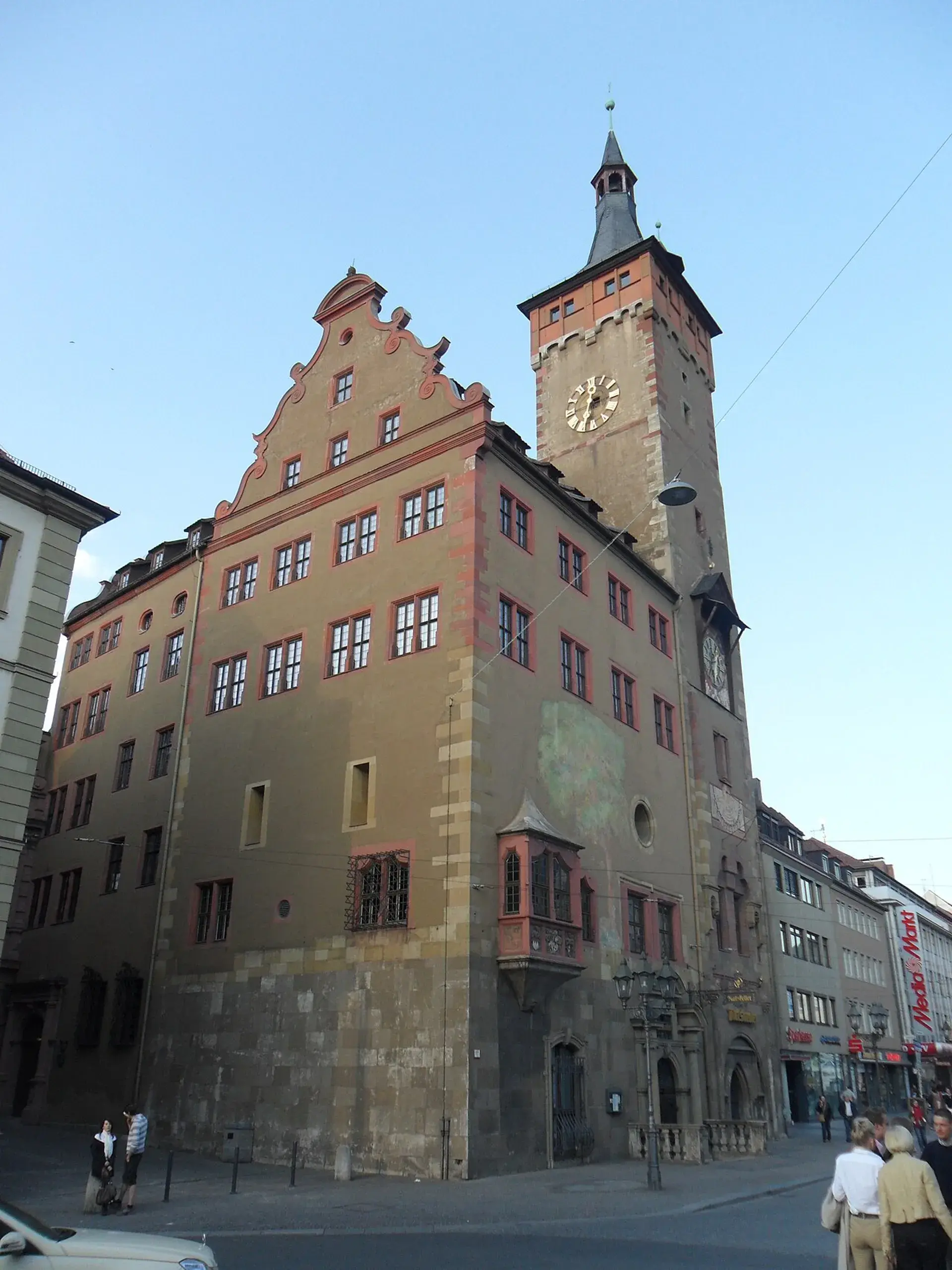
The oldest and most iconic part of the Rathaus complex is the Grafeneckart tower. First mentioned in 1180 as 'Curia Billungi', this Romanesque structure originally served as the residence for a bishop's official, Vize-Burggraf Eckart de Foro. Interestingly, this symbol of civic independence bears the name of an episcopal official who was ultimately murdered within its walls. The original residence was built with formidable walls measuring 1.70 meters thick to withstand attacks. In 1316, the mayor and city council acquired the Grafeneckart, transforming it into the city's administrative center. This marked a pivotal moment in Würzburg's history, symbolizing the citizens' aspiration for independence. In 1456, the tower was heightened to between 55 and 60 meters and equipped with a clock, as well as fire and hour bells.
Medieval Justice and Civic Power
During medieval times, judicial proceedings were conducted under a lime tree in front of the Grafeneckart. Those condemned were subsequently confined to the building's dungeon. Inside the tower lies the 13th-century Wenzelsaal, recognized as the city's oldest secular room and one of the few purely secular Romanesque halls preserved in Germany. It became the primary meeting place for the city council, serving as a direct counterpoint to ecclesiastical power structures. Furthering this symbolic critique, the Ratskapelle (Council Chapel) was consecrated in 1359. It deliberately honored Saints Felix and Adauctus, with its annual feast day commemorating the lifting of an imperial ban in 1303.
Architectural Expansion
Over the centuries, the Rathaus grew, reflecting the evolving identity of Würzburg. The Roter Bau (Red Building), a Late Renaissance addition, was constructed to the west of the Grafeneckart in 1659 and 1660 by architects Philipp Preiss and Sebastian Villinger. In the 19th century, a former Carmelite monastery built in the Baroque style was incorporated into the complex.
World War II and Reconstruction
The Rathaus suffered significant damage during the devastating bombing of Würzburg on March 16, 1945. Despite the destruction, the Grafeneckart's Romanesque core and the gable front of the Roter Bau largely survived. An inscription displayed at the entrance of the Roter Bau's council hall reads 'Stärker als Tod und Vernichtung ist unser Wille zum Leben' (Stronger than death and destruction is our will to live), capturing the resilience of the city in the post-war era. The city council returned to the Roter Bau in 1949.
The Rathaus Today
Today, the Rathaus continues to serve as Würzburg's administrative headquarters. Citizen services are located in a modern extension at the rear, while a 1986 south wing houses the new council chamber, featuring monumental frescoes by Wolfgang Lenz. A memorial room on the ground floor of the Grafeneckart contains an exhibition and a model depicting the 1945 destruction of the city. The historic Ratskeller restaurant operates within the main building, and the Wenzelsaal is frequently utilized for civil wedding ceremonies. The adjacent 'Beim Grafeneckart' square remains a lively public space, hosting the 'Grüner Markt' and providing a venue for live music and outdoor dining.
FAQ
Why is the Rathaus called Grafeneckart?
The oldest part of the building is named after Vize-Burggraf Eckart de Foro, an episcopal official who resided in the tower during the 12th century and was murdered within its walls.
What is the Wenzelsaal?
Located inside the Grafeneckart, the 13th-century Wenzelsaal is Würzburg's oldest secular room and one of the few purely secular Romanesque halls still preserved in Germany.
Did the Rathaus survive World War II?
The complex sustained heavy damage during the bombing of Würzburg on March 16, 1945. However, the Romanesque core of the Grafeneckart tower and the gable front of the Roter Bau largely survived the destruction.