Würzburg's Old Main Bridge: History and Architecture
A Bridge Between Eras and Powers
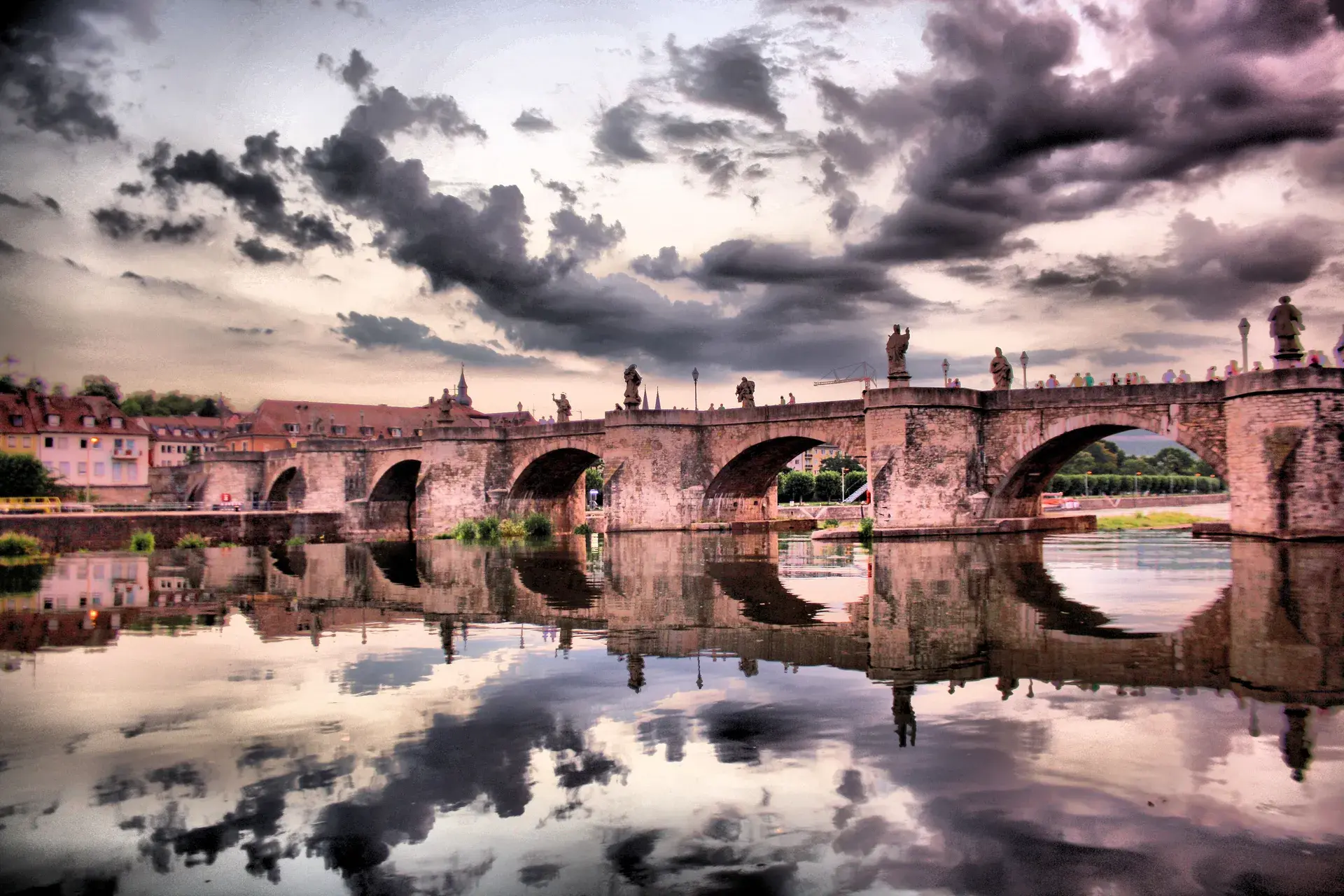
Lined with saints and rulers, the Old Main Bridge (Alte Mainbrücke) is a stone procession connecting the bishops' old fortress with their new city. This structure served as Würzburg's sole river crossing until 1886 and remains a foundational element in the urban landscape, linking the historic core with the Marienberg Fortress.
Medieval Foundations and Architectural Evolution
The current robust Gothic structure was built between 1473 and 1543, initiated by Bishop Johann II von Brunn and continued under Prince-Bishop Rudolf II von Scherenberg. However, it was not the first bridge to span the Main River at this location. Around 1120 AD, cathedral and city architect Enzelin constructed a Romanesque stone bridge to replace an earlier ferry crossing. According to legend, statues from a pagan Freya sanctuary, previously toppled by early Christian missionaries, were discovered during the excavation for these early foundations.
The original Romanesque bridge faced numerous hazards, suffering partial destruction from floods in 1342 and 1442. It was also routinely damaged by "Holländerstämme," or floating Dutch logs transported down the river. The need for a stronger connection to the Marienberg Fortress prompted the construction of the current stone bridge, whose design was considered a model for the famous Charles Bridge in Prague.
The Baroque Statues of the Prince-Bishops
Between 1720 and 1730, the bridge received twelve 4.5-meter-high Baroque statues. Commissioned by Prince-Bishops Christoph Franz von Hutten and Friedrich Carl von Schönborn, the figures were designed by court painter Clemens Lünenschloß in 1725. The designs were executed by sculptors Johann Sebastian Becker, Volkmar Becker, and Claude Curé.
The statues depict prominent saints and imperial rulers, including Würzburg's patron saint, Saint Kilian, alongside Charlemagne and King Pepin the Short. This artistic addition was strategically chosen to visually reinforce the Prince-Bishops' combined religious and secular authority.
Wartime Survival and Modern Transformation
During World War II, the Alte Mainbrücke survived with only partial damage because the explosives planted by retreating German troops in 1945 were faulty. However, the bridge did experience a surprising wartime event when American troops removed the original statue of King Pepin the Short, throwing it into the Main River to create space for an anti-aircraft gun. The bridge was subsequently rebuilt between April and July 1950 and its appearance restored.
In June 1990, the thoroughfare was closed to motor vehicle traffic and has since transformed into a vibrant cultural hub. Today, locals and visitors gather on the pedestrian bridge to enjoy Franconian wine and panoramic views of the Würzburg skyline. The bridge also hosts open-air concerts, city festivals, and a traditional procession on Saint Kilian's day, July 8th.
FAQ
When was the Old Main Bridge in Würzburg built?
The current Gothic stone bridge was constructed between 1473 and 1543. It replaced an earlier Romanesque bridge that was built around 1120 AD by architect Enzelin.
Who are the statues on the Old Main Bridge?
The twelve Baroque statues, added between 1720 and 1730, depict notable saints and historical rulers. Key figures include Saint Kilian, the patron saint of Würzburg, as well as Charlemagne and King Pepin the Short.
Can cars drive on the Old Main Bridge?
No, the Old Main Bridge has been closed to motor vehicle traffic since June 1990. It is currently used exclusively as a thoroughfare for pedestrians and cyclists.