Vierröhrenbrunnen: Würzburg's Baroque Four-Pipe Fountain
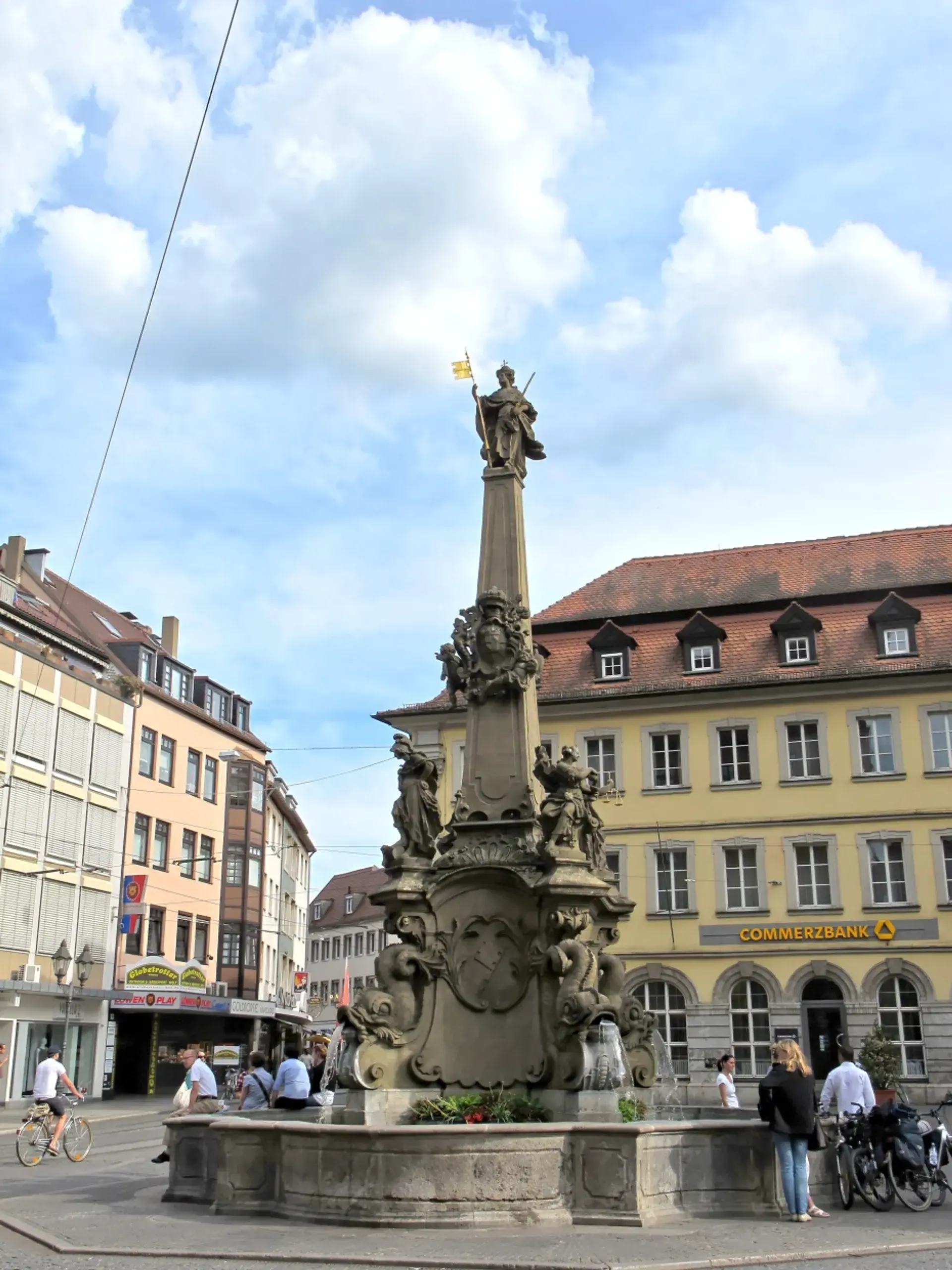
This elegant fountain, where four virtues stand below an obelisk topped by Franconia, was a Baroque update to a civic space, subtly branding the city center with princely symbolism. The Vierröhrenbrunnen (Four-Pipe Fountain) stands as a tangible testament to Würzburg's princely past, beautifully illustrating the architectural grandeur and civic ambitions that characterized the era of its powerful Prince-Bishops.
A Joyous Introduction to Running Water
Before the current structure was erected, a draw-well possibly dating back to the Middle Ages or Renaissance occupied the site. A pivotal moment in Würzburg's civic development occurred in 1733 when acclaimed court architect Balthasar Neumann engineered the city's first public water supply system. Commissioned by Prince-Bishop Friedrich Karl von Schönborn, this initiative brought fresh, running water to the populace and significantly improved urban sanitation.
When Neumann successfully brought the first public supply of fresh running water to Würzburg, citizens were so overwhelmed with joy that a contemporary account described them drinking from the fountain spouts "as if it were wine." The initial structure featured a sandstone column by Jakob van der Auwera, adorned with the Schönborn lion and the coat of arms of the Prince-Bishop, for which the sculptor received a modest payment of 20 Gulden.
The Grand Baroque Redesign
Approximately three decades later, between 1765 and 1766, the fountain underwent a significant redesign and enlargement, evolving into its current elaborate Late Baroque form. Lukas Anton van der Auwera submitted the redesign plans in 1763 and sculpted some of the new figures. Johann Peter Wagner, active in the Auwera workshop since 1756, completed the remaining sculptural work. The redesigned monument proudly displays the coat of arms of Prince-Bishop Adam Friedrich von Seinsheim.
The allegorical figures representing the four cardinal virtues—Fortitudo (Bravery), Prudentia (Wisdom), Temperantia (Temperance), and Justitia (Justice)—were strategically incorporated into the design. Positioned opposite the Town Hall, their presence served as a constant reminder to Würzburg's city councilors to uphold these virtues in their governance and decisions.
Stone, Symbolism, and Preservation
The large basin of the Vierröhrenbrunnen is constructed from Franconian Muschelkalk (shell limestone). This local geological material famously forms the soil for Würzburg's renowned vineyards. In contrast, the central column and detailed figures are carved from sandstone.
Due to extensive weathering, the original 18th-century Baroque sculptures of the cardinal virtues and the crowning Frankonia statue are no longer displayed outdoors. They were replaced with copies in 1927 and again in 1964. The authentic historical figures are now preserved and displayed at the Museum für Franken, housed within the Zeughaus (armory) of the Marienberg Fortress. The fountain still occasionally makes modern history; on April 11, 2015, a harmless substance added to the water temporarily turned the fountain a striking "toxic green."
A Central Gathering Spot
Presently, the Vierröhrenbrunnen functions as a vibrant central gathering spot within Würzburg's pedestrian zone. Located directly opposite the Grafeneckart—the oldest part of the Town Hall—and in close proximity to the Old Main Bridge, it is a popular rendezvous point. The monument frequently serves as the starting location for numerous city tours, where residents and visitors pause to admire its intricate stonework and history.
FAQ
Who designed the Vierröhrenbrunnen?
The initial 1733 fountain was engineered by court architect Balthasar Neumann with a sandstone column carved by Jakob van der Auwera. The 1765-1766 Baroque redesign was planned by Lukas Anton van der Auwera and completed by sculptor Johann Peter Wagner.
Are the statues on the Vierröhrenbrunnen original?
No, the allegorical figures of the four cardinal virtues and the Frankonia statue were replaced with copies in 1927 and 1964 due to weathering. The original 18th-century sculptures are preserved at the Museum für Franken in the Marienberg Fortress.
What materials were used to build the Vierröhrenbrunnen?
The large basin of the fountain is constructed from Franconian Muschelkalk (shell limestone), while the central column and the detailed statues are carved from sandstone.
Where is the Vierröhrenbrunnen located?
The fountain is located in Würzburg's pedestrian zone, directly opposite the Grafeneckart (the oldest part of the Town Hall) and near the Old Main Bridge.