Monte Beach in Rovinj: Swimming Below St. Euphemia
The Wave-Carved Shore of Old Town Rovinj
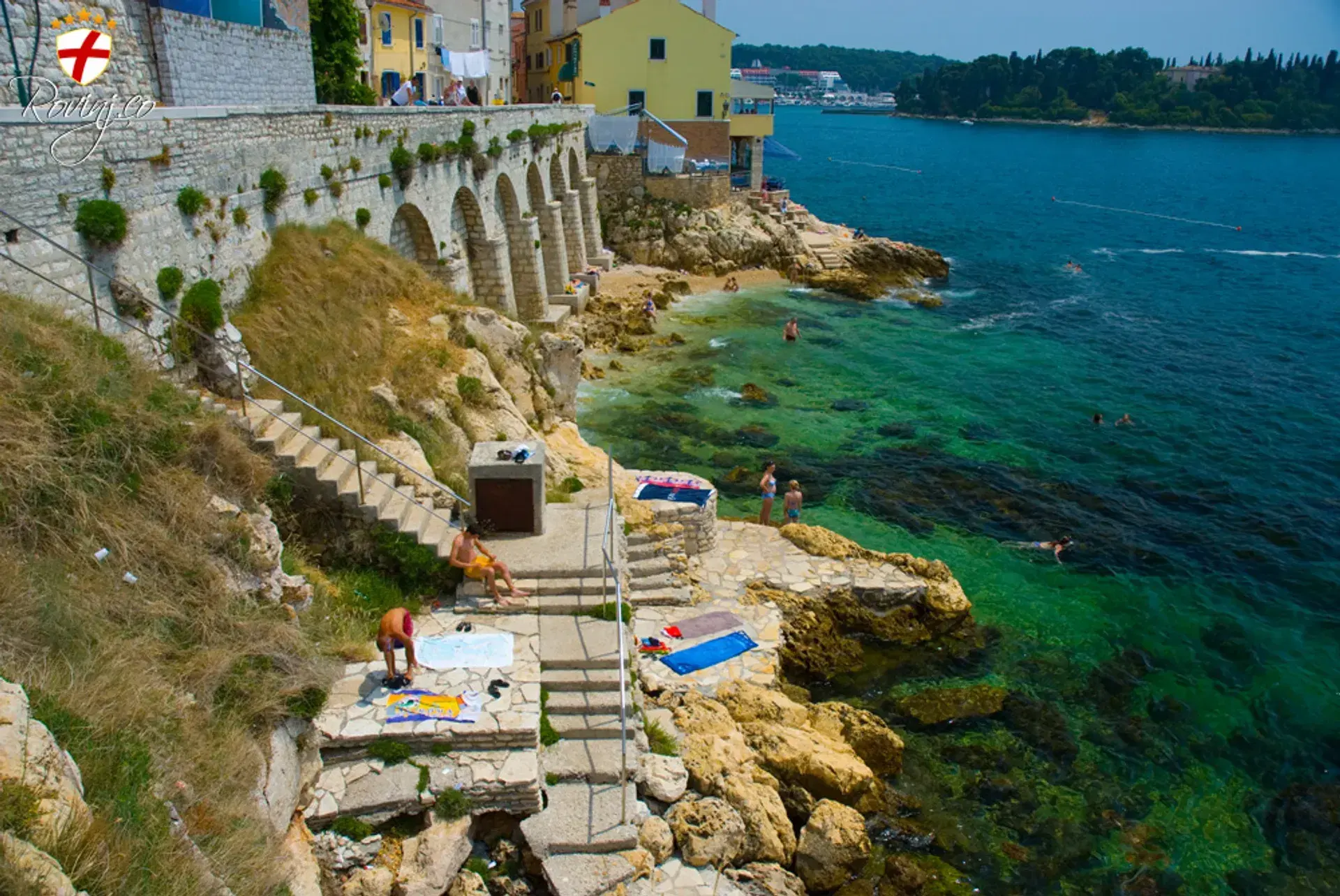
Monte Beach, known locally as Baluota or Plaža Monte, extends along approximately 150 meters of rocky coastline directly beneath the Church of St. Euphemia. Situated on the westernmost edge of Rovinj's historic peninsula, this urban coastal area borders the pedestrianized Brothers Gnot Promenade (Šetalište braće Gnot). Accessible only on foot or by bicycle, it marks the raw marine boundary where the historic town meets the open Adriatic Sea.
The shoreline is characterized by jagged limestone cliffs, flat stone ledges, and deep marine waters. Small breaks in the stone create pocket pebble beaches, notably the inlets known as Velika Gugulijera and Mala Gugulijera. Along the waterline, the sea regularly crashes into natural stone cavities like the Arnolongo cave, producing a distinctive rhythmic booming sound beneath the walking path above.
From Island Fortress to Coastal Promenade
Before 1763, Rovinj was an offshore island separated from the Istrian mainland by a narrow channel. During that era, the steep, wave-swept cliffs of Monte served as a vital natural rampart defending the settlement against naval assaults and pirate incursions. Over time, as the defensive necessity waned, the shoreline was adapted for civic movement. In the second half of the 19th century, the coastal promenade was laid out beneath the church cliffs, connecting the southern street of Sveti Križ with the northern shoreline.
Visible historical layers remain embedded along the waterfront. In 1844, a stone ramp was constructed just above the beach specifically to accommodate the carriage of Austrian Emperor Ferdinand I during his visit to the Church of St. Euphemia. Further along the Lanterna section, visitors can see a 1930s stone lighthouse, which replaced an earlier 19th-century cast-iron beacon. Positioned directly behind this lighthouse is a reinforced concrete bunker built by German armed forces during World War II.
Swimming, Sunsets, and Local Traditions
Today, Monte Beach functions as a popular swimming and sunbathing location just moments from Rovinj's central squares. Because there is virtually no shade on the exposed limestone shelves, the stones absorb significant daytime heat, which is tempered by the afternoon maestral sea breeze and the evening land breeze known in local dialect as the bàva da tièra. Swimmers access the deeper waters via metal ladders bolted directly into the stone or by jumping from flat ledges.
The shore has long held a deep significance for Rovinj's residents. Rovinj's indigenous Istriot-speaking community named distinct outcroppings along the water, using dialect terms such as Fuleîn, Scudièla, Scudeleîn, and Baluòta. Generational traditions endure on these stones, with local families historically returning to the exact same rock perches summer after summer. In earlier decades, local youths proved their daring by diving into the sea from high perches above the Arnolongo cut to attract the attention of women walking along the paths above.
In the late afternoon and evening, the beach serves as a viewing platform facing St. Catherine Island (Otok Sveta Katarina) for sunsets over the Adriatic. The natural amphitheater formed by the rocky shelves also hosts cultural gatherings, including torchlit and acoustic musical performances during the annual Night of St. Lawrence festival.
FAQ
What names are used locally for Monte Beach?
The beach is commonly called Baluota (or Spiaggia Balota) and Plaža Monte. Indigenous Istriot speakers have also assigned dialect names to specific rocks along the shore, such as Baluòta, Fuleîn, Scudièla, and Scudeleîn.
How do visitors access the water at Monte Beach?
Water access is primarily via metal ladders anchored directly into the rock slabs or by leaping from flat ledges into deep water. There are also two small pebble indents, Velika Gugulijera and Mala Gugulijera, which offer shallower entry points.
What historical structures are located at Monte Beach?
The Lanterna area features a 1930s stone lighthouse and a World War II concrete bunker built by German forces. Additionally, a stone ramp paved in 1844 for the carriage of Austrian Emperor Ferdinand I is located just above the beach.