Bath Abbey

Tips and tours for explorers and travellers

Bath City Guide

Bath is the UK's only city wholly designated a UNESCO World Heritage Site, famed for the golden Bath stone of the Royal Crescent and The Circus, alongside its ancient Roman thermal baths.

Country
United Kingdom
Language
English
Currency
British Pound (GBP)
Plug
type G
Time zone
Europe/London
Emergency
112, 101, and 999
Tap water
Safe to drink
Dialling code
+44

The stops

Things to do in Bath

Bath's UNESCO-listed core brings Roman archaeology and Georgian town planning together in a walkable city. From the Roman Baths and Bath Abbey to the sweeping curves of the Royal Crescent, its most celebrated landmarks are easily linked on foot.

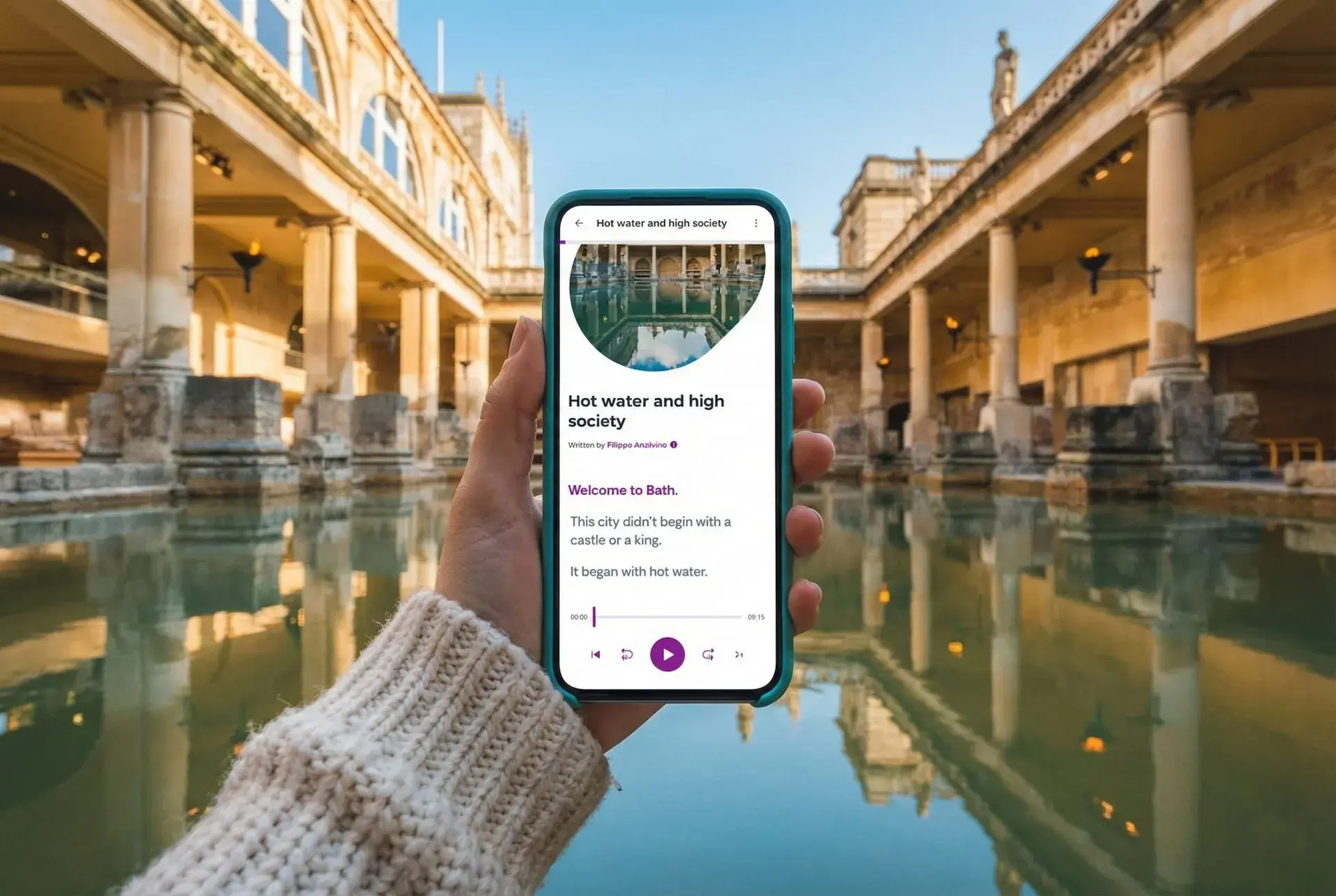
Hot water and high society

<p>Welcome to Bath.</p> <p>This city didn't begin with a castle or a king. It began with hot water.</p> <p>On this Ciceru tour, we are going to trace the city's rise, both literally and socially. We will walk from the ancient river level up to the exclusive heights of the Royal Crescent. It is a journey through Roman engineering, Medieval grit, and the golden architecture of the Georgian era.</p> <p>I’ll be your guide to the stories hidden in the limestone. We have a lot of ground to cover, so let’s get moving.</p> <p>We start our journey here in the Abbey Churchyard. While the queue next to you might be long, the history beneath your feet is even longer.</p> <p>You are currently standing on top of Aquae Sulis. This was the Roman name for the city, meaning "The Waters of Sulis." When Roman engineers arrived here around 70 AD, they found a hot, swampy spring revered by the locals. But the Romans didn't just conquer the site. They translated it.</p> <p>They took the local Celtic goddess, Sulis, and identified her with their own goddess, Minerva. This wasn't a crude mash-up of a nature spirit and a war deity. It was a sophisticated theological merger based on their shared power of healing and wisdom. The result was Sulis Minerva, a powerful figure who presided over a complex of pools that were as much a hospital as they were a place of worship.</p> <p>The building you see in front of you is the Grand Pump Room. It is much newer, built in the 1790s. This is where high-society Georgians would come to drink the water rather than swim in it. If you look at the Greek inscription above the columns, it reads Ariston Men Hydor, or "Water is Best."</p> <p>Although you are standing on the dry pavement of the 21st century, the ancient plumbing is still hard at work below you. The spring gushes over a million liters of water every day at a steaming 46°C.</p> <p>Beneath the museum floor, the original Roman drain still functions. It carries the waste water out to the river just as it did two thousand years ago. We call that heritage hydraulics.</p> <p>But it wasn't all wellness and relaxation down there. The Romans also used the sacred spring to air their grievances. Archaeologists have found lead "curse tablets" thrown into the water, inscribed with angry messages to the goddess. They usually asked for revenge against thieves or unfaithful lovers. It seems that even in the first century, people loved leaving a bad review.</p> <p>This spot is the thermal heart of the city. Everything we will see next, from the Abbey to the grand houses on the hill, only exists because the Romans decided to stop here for a soak.</p> <p>Now, turn your attention to the massive stone structure looming right next to the Baths. It is time to look at the Medieval layer of the city.</p>
The ladder of angels

<p>At first glance, Bath Abbey looks like a Gothic cathedral that has learned to smile politely. Its lacy stone facade and sprawling windows catch the sunlight with improbable optimism. This is especially impressive for a building that has been sacked, neglected, and rebuilt more times than your average Tudor table.</p> <p>It began in the 7th century as a monastery, but the structure standing before you is a 15th-century reboot in the Perpendicular Gothic style. Note the high ceilings and the massive tall windows. The walls seem unsure whether they are structural or merely decorative frames for the glass.</p> <p>Now, let’s address a local myth. You will often hear that this site hosted the coronation of England’s "first" King, Edgar, in 973 AD. That is not entirely true.</p> <p>Athelstan, his uncle, was actually crowned King of the Anglo-Saxons nearly fifty years earlier in 925 AD. However, Bath still holds a vital place in royal history. Edgar’s ceremony here introduced a specific service and liturgy that created the template for every British coronation that followed. So while he wasn't the first, he set the style that Charles III used over a thousand years later.</p> <p>Turning your eyes to the stone facade itself, the West Front demands a pause. Look closely at the turrets flanking the main window. You will see angels climbing up and tumbling down stone ladders.</p> <p>This unique design was inspired by a dream allegedly sent to Bishop Oliver King in 1499. It was possibly a divine epiphany, or possibly the result of questionable wine. Regardless of the source, the imagery stuck. It makes for a compelling sermon carved directly into the limestone.</p> <p>Because we are staying outside, you can't smell the beeswax or hear the choir, but you can appreciate why this building is nicknamed the "Lantern of the West." The walls are more glass than stone. If you were to step inside, you would find yourself surrounded by over 1,000 memorial tablets on the walls. It serves as a densely annotated "Who's Who" of Georgian grief. It is part church and part vertical graveyard.</p> <p>It is easy to be distracted by the grandeur. Yet the Abbey’s most enduring trait is continuity. Despite regimes, reforms, and restorations, it persists in holy matrimony with its historic setting.</p> <p>Tucked around the corner, a humbler structure claims both culinary fame and medieval roots. Let’s go sample the famous Bath Bun at one of the city's oldest houses.</p>

A bite of 1482

<p>Few buildings dare to boast both medieval architecture and a menu. Sally Lunn’s pulls it off.</p> <p>You are standing in front of one of the oldest houses in Bath. Dating back to 1482, this structure was already old before Henry VIII had his first heartbreak. If you look at the rough stone masonry and the way the house sits slightly lower than the modern street level, you can see how much the city has risen around it over the centuries.</p> <p>Now, let’s talk about the legend. You might hear a romantic story about a French Huguenot refugee named "Solange Luyon" who fled to Bath in 1680 to bake brioche.</p> <p>I hate to ruin a good story, but that is likely a fabrication. Historical records suggest the "Solange" character was invented in 1937 by the tea shop owner, Marie Byng-Johnson, to add a little French flair to her marketing. The real "Sally Lunn" was more likely a hawker selling buns in the streets of Bath in the late 1700s.</p> <p>But while the baker might be a myth, the bun is very real. It is a golden, airy carb-cloud that tourists queue for daily.</p> <p>There is another secret here that you cannot see from the alley. Beneath the floorboards of the dining room lies a Roman hypocaust system.</p> <p>This was the ancient version of central heating. Hot air from a furnace was circulated through empty spaces under the floor, keeping the Romans warm in the damp British winter. It is a literal "hot plate" of the Empire resting right beneath the modern bakehouse.</p> <p>Locals treat this place like a mildly eccentric aunt. It is loved, a bit theatrical, and possibly stretching the truth, but it is part of the family regardless. Because in Bath, even your bun tells a story.</p> <p>After a bite steeped in legend, let’s retreat to a quieter pleasure. We will head to the riverside gardens for a view of the famous weir.</p>

Flirting under supervision

<p>Look down over the stone balustrade into the manicured green space below. This is Parade Gardens.</p> <p>In the 18th century, this was the answer to a specific social problem. The city planners needed a place where the wealthy could flirt under supervision.</p> <p>Planted with both flowers and strict codes of Georgian decorum, it quickly became Bath’s open-air ballroom. It was a genteel promenade for spa-goers to dry off after their morning plunge.</p> <p>Today, the gardens feed packed lunches and selfie sticks rather than scandalous glances. But the fragrance of precisely arranged blooms still wafts up with practiced grace.</p> <p>They may look like just another park, but dig a little and you will find the past refusing to stay buried.</p> <p>In 1997, an archaeological excavation took place right beneath those neat flower beds. You might hear rumors that they discovered a lost Roman temple precinct here.</p> <p>That is a lovely thought, but it is untrue.</p> <p>What they actually found was the "Great Drain". This was the massive Roman culvert designed to carry waste and overflow away from the Baths and into the river.</p> <p>It seems we often go looking for sacred architecture and find plumbing instead. But in Bath, the plumbing is just as impressive as the temples.</p> <p>Back in the Georgian heyday, entry into these lawns required the right pedigree and a subscription fee. Today you still have to pay a small fee to enter, but the only pedigree required is a tolerance for goose prints.</p> <p>Nothing mythic springs from Parade Gardens today unless you count high-society gossip. But its role endures as a pause button in a city built for display.</p> <p>From this vantage point, turn your head to the left. You are perfectly positioned to see our next stop. It is one of only a few bridges worldwide with shops built into its structure.</p>

The Florentine bridge

<p>Pulteney Bridge might be the closest Bath gets to theatrical overkill. It is a graceful Georgian structure draped in boutiques and strewn across the Avon like a limestone doily.</p> <p>Built in 1774 by Robert Adam, it is often said that this bridge was built to rival the Ponte Vecchio in Florence. That is a nice story, but the truth is more local and mercenary.</p> <p>The bridge was actually a piece of aggressive real estate marketing. The landowner, William Pulteney, wanted to connect his estate in Bathwick to the city center. He wasn't trying to outshine Florence. He was trying to compete with the fashionable west side of Bath.</p> <p>Adam’s design is technically a copy of a copy. He based it on Andrea Palladio’s rejected design for the Rialto Bridge in Venice.</p> <p>You might hear a rumor that Adam originally wanted a massive central dome here but was rejected due to cost. That is a case of mistaken identity. Adam never planned a central dome. He designed a temple-like pediment for the center and placed small saucer domes on the pavilions at the far ends. Furthermore, his design wasn't rejected for being too expensive. In fact, his expensive plan was chosen over a cheaper rival.</p> <p>As you walk across, you will notice shops lining both sides. Unless you lean over the parapet to look at the roaring weir below, you might not notice you have crossed water at all. This was exactly the sort of sleight of hand Georgian planners delighted in.</p> <p>Legend also whispers of secret rooms and passageways hidden in the bridge's underbelly.</p> <p>In reality, these "secrets" are well-documented shop cellars and structural voids designed to handle floods. It turns out that in Bath, even the mysteries have practical explanations.</p> <p>Now, let's head uphill to where tailoring once met literary cameos. We are going to window shop along the street favored by Jane Austen's characters.</p>

The fashion parade

<p>Milsom Street has always known its angles.</p> <p>Laid out in the mid-18th century with a gentle curve and a hint of architectural swagger, it was Bath’s catwalk long before that meant flashing cameras. Here, wealth wasn’t hidden. It was tailored, perfumed, and on public display. Think Fitzwilliam Darcy with a pocket watch addiction.</p> <p>During the Georgian era, this was the epicenter of polite consumerism. It was packed with tailors, milliners, bookstores, and jewelers.</p> <p>Jane Austen, never one to miss a detail, made Milsom Street a recurring character in her novels. You might read in some guidebooks that she described this as Bath’s "principal street of entrance." That is actually a misquote. In Northanger Abbey, her characters usually stayed in Great Pulteney Street or the Paragon. However, Milsom Street was the undisputed social hub where they went to check the windows, track down fashionable hats, and accidentally-on-purpose run into eligible bachelors.</p> <p>Today, it remains a retail thoroughfare, albeit one dressed in Zara rather than muslin. The architecture is still the star. Look at the restrained facades in Bath stone. Notice the bow windows on the upper floors that seem to watch passersby like silent chaperones.</p> <p>Under the cobbles, rumor has it there are clandestine passageways. Locals might tell you these were Georgian shortcuts for illicit affairs. That is probably untrue. They were likely just service vaults for coal and deliveries. But the idea that fashion once required escape routes is, in itself, delightfully on-brand for Milsom Street.</p> <p>The rhythmic clack of shoes still echoes here. It confirms that style in Bath has never really gone out of fashion. It just updates seasonally.</p> <p>Just a few doors away awaits the city’s most famous reluctant resident. Let’s go see where the legend of Jane Austen meets the souvenir shop.</p>

The reluctant resident

<p>The Jane Austen Centre has a simple premise. What if we took a woman known for social satire and turned her into a waxwork?</p> <p>It is housed in this classic Georgian townhouse here on Gay Street. This is just a stone’s throw from where Austen actually lived. She resided higher up the hill at number 25 after her father died.</p> <p>If you are lucky, you will see a staff member in full Regency costume standing right here by the door. It is proof that top hats and petticoats never go out of fashion if you ignore the weather forecast.</p> <p>Austen lived in Bath from 1801 to 1806. She did not love it. In fact, she found it noisy, hot, and expensive. But she mined it for material. She used the streets you have just walked as the social petri dishes for her novels Northanger Abbey and Persuasion.</p> <p>There is no great myth here, unless you count the persistent rumor that Austen adored Bath. She didn't. But locals have embraced her anyway. They have effectively turned her mild disdain into excellent marketing.</p> <p>Even if you don't go inside, the building itself is a perfect example of the architecture she would have known. Gay Street acts as a connector. It links the commercial buzz of Milsom Street below to the exclusive residential heights above.</p> <p>Now, let's make that climb ourselves. Turn from fiction to geometry. We are going to marvel at a masterpiece of Georgian architecture comprised of three curved segments of townhouses.</p>

The Druid’s Colosseum

<p>Designed by John Wood the Elder and finished by his son in 1768, the Circus is a platinum example of what happens when British eccentricity meets Roman obsession.</p> <p>From above, the layout looks like a key. Some say it is a Masonic symbol. Others say it represents the eye of a serpent.</p> <p>You will often hear guides claim that the diameter of this circle is the same as the Colosseum in Rome. That is a myth. The Colosseum is nearly double the size of this space.</p> <p>The diameter here is exactly 318 feet. That number was chosen deliberately to match the outer earth bank of Stonehenge. John Wood was obsessed with the Druids. He believed Bath was a lost British Troy.</p> <p>However, the design of the houses is definitely Roman. Wood modeled the facades on the Colosseum but turned inside out. He didn't do this because he loved Rome. He did it because he believed the Romans had plagiarized the style from the Jewish Temple of Solomon and the British Druids. He was trying to reclaim the architecture for its "original" owners.</p> <p>Look closely at the three tiers of columns.</p> <p>They progress in complexity as they go up. The bottom is plain Doric. The middle is scrolled Ionic. The top is flowery Corinthian. It represents the ascent of civilization.</p> <p>On the roofline, you will see stone acorns. This is another nod to the Druids who worshipped the oak tree.</p> <p>In the center of the grassy circle, you see massive London Plane trees. Locals might tell you these were planted to match the height of the buildings. That is also untrue.</p> <p>The original design had no trees at all. It was a paved open theatre. Today, these trees tower over the rooftops and completely dwarf the Georgian architecture. They are beautiful, but they are very much an accident of history rather than a piece of precision planning.</p> <p>Whether or not the Circus forms a geomantic key, it unlocks a curious truth. Bath’s past was never just about order. It was about spectacle, belief, and the audacity of geometry.</p> <p>Step just beyond the circus arc to behold the finale. We are heading to the iconic crescent of 30 Grade I listed terraced houses.</p>

The architectural triumph

<p>We have arrived at our final stop. The Royal Crescent looks like it landed here during a particularly elegant apocalypse.</p> <p>Thirty townhouses in a perfect curl, designed by John Wood the Younger and built between 1767 and 1774, it was less "housing" and more of a real estate mic drop. Executed in the Palladian style with a dramatic sweep of Ionic columns, the Crescent was Bath’s answer to Versailles. It just came without the fountains and with more sheep.</p> <p>If you look at the lawn, you might notice a sunken fence line. This is called a "Ha-Ha." It was a clever landscape trick designed to keep the livestock out of the garden without interrupting the view from the drawing room windows.</p> <p>Behind the uniform front facade, however, lies chaos. Each owner finished their interior and rear as they pleased. If you were to see the back of the building, it looks like a row of rowdy cousins dressed for different occasions.</p> <p>Originally, this street was simply called "The Crescent." It did not gain the "Royal" prefix from Queen Charlotte, as rumors often claim. She visited later. The honorific was actually adopted around 1795 to celebrate a visit by Prince Frederick, the Duke of York.</p> <p>This is Bath at its most theatrical. It is a building that performs even when it is doing absolutely nothing.</p> <p>If you are not quite ready to end your exploration here, the city has a few more secrets tucked away. You might wander down Great Pulteney Street to find the Holburne Museum, which served as a grand estate in Bridgerton and houses a fantastic art collection. For a greener escape, the Skyline Walk offers panoramic views, or you can find the authentic Palladian Bridge in Prior Park Landscape Garden. And if all this history has made you hungry, you are in luck. You could return to the Pump Room for a traditional afternoon tea with a side of classical music, or for something less formal but equally legendary, seek out The Scallop Shell for what many claim is the best fish and chips in the country.</p> <p>From all of us at Ciceru, thank you for letting us share Bath’s social climb with you. We hope you enjoyed the Romans, the rumors, and the architecture. We cannot wait to walk with you again soon. Goodbye!</p>

Your private guide, in your pocket

Ready to walk these?

  • Self-guided, start now or later
  • Offline audio, 7 languages
  • 30-day money-back guarantee
  • 500MB global eSIM included

from

€5.00

1 self-guided tour in Bath

See the tours

Plan the days

How many days in Bath? A perfect 1-day itinerary

Day 1

Roman spa city on the Avon

Walk Bath’s compact historic centre with the tour catalogue, then allow time for river climbs and the city’s broad Georgian avenues.

Weather & crowds

Best time to visit

Summer brings the best weather and lively festivals but also peak crowds and higher prices. April to May and September to October offer mild shoulder-season travel with fewer visitors. Winter is the quietest and most affordable time to visit, though it is cold and wet, with crowds surging briefly for the Christmas Market.

Recommended

Winter

Dec–Feb

2–8°C/ 36–46°F

Few visitorsWet
  • Cool season
  • Cold and wet weather
  • Short daylight hours

Don't miss

  • Bath Christmas Market

Spring

Mar–May

4–17°C/ 38–63°F

Getting busierOccasional rain
  • Warm season
  • Unpredictable rain showers

Don't miss

  • Bath Literature Festival

Summer

Jun–Aug

11–22°C/ 51–71°F

Peak seasonOccasional rain
  • Warmest weather
  • Summer festival season
  • Large crowds
  • Higher accommodation prices

Don't miss

  • Bath Pride

Autumn

Sep–Nov

5–19°C/ 41–66°F

BusyWet
  • Jane Austen Festival
  • Frequent rain
  • Early nightfall

Don't miss

  • Jane Austen Festival

Transport

How to get to & around Bath

Bristol Airport (BRS)

How to get to & around Bath
First Bus A4 Airport Flyer~60 min~£9.50

London Paddington (LON)

How to get to & around Bath
GWR Train to Bath Spa85 min~£45.00

Local bus

Suburbs and hills

First West of England operates buses across Bath and outer suburbs with single fares around £2.60. Pay by contactless card, app, or exact cash. Note that London Oyster cards are not accepted.

Walking

Best way to explore

Bath is compact with major sights situated within one kilometre of each other. Central streets are paved with historic cobblestones, so wear sturdy footwear and watch for buses on narrower lanes.

Taxi and rideshare

Late night or rush

Metered taxis and Uber start around £2 plus £2 to £3 per kilometre. They are convenient late at night or when travelling with heavy luggage, but much costlier than walking or buses.

City cycling

Resident scheme only

Bath's short-term bike scheme requires resident vouchers and is not geared toward tourists. Dedicated bike lanes are sparse and steep hills make casual urban cycling difficult for visitors.

Walking is the best way to explore Bath's compact core, where major sights sit within one kilometre. Local buses serve outer suburbs, but you will rarely need public transport in the centre.

Budget

How much does it cost to visit Bath?

Bath is one of the UK's more expensive cities, ranking fourth-highest nationally. Dining and lodging form the bulk of expenses, with meals and pub drinks priced above the national average. Restaurants often add a discretionary 10% to 15% service charge, and travellers should budget roughly £20 to £40 per day for meals.

How much does it cost to visit Bath?
Coffee (cappuccino)£1.89–£4.75
Sandwich (meal deal)£2.75–£4.25
Beer (0.5 L pub pint)£6.00
Local bus single fare£2.60
Bottled water (0.5 L)£0.22–£1.20

Cash or card?

Credit and debit cards are accepted almost everywhere in Bath, with contactless payments widely supported on buses, in shops, and at restaurants. Small market stalls also accept cards alongside cash. ATMs are widely available across the centre without city-specific fees.

Where to stay

Where to stay in Bath

Central Bath

First-time visitors

Located beside the Roman Baths, Abbey, and shops in a pedestrian-friendly core. Sights are steps away, though hotel rates are at their highest and central streets can be noisy.

Walcot and Green Park

Artisan vibe and cafes

Walcot Street features independent galleries, lively markets, and characterful pubs within a ten-minute walk of the centre. Streets can be narrow and street parking is very scarce.

Combe Down

Village atmosphere

A quiet, historic hilltop village offering local shops and family-friendly stays. Visiting central Bath requires a steep uphill return walk or a 20- to 30-minute bus ride.

Larkhall

Local pubs and delis

Situated south of the centre with a bustling local high street and affordable guesthouses. It sits beyond immediate walking distance of major sights, and nearby bypass traffic can be noisy.

The tours

Bath, one story at a time

Scratch to win

Give it a scratch

Something good might be under there. If you win, we'll show you how to use it.

One prize per traveller. Good for 2 years.

Word of mouth

What travellers say

Safety

Is Bath safe?

Bath is considered safe by UK standards with low overall crime. Most offenses are petty thefts and shoplifting concentrated in crowded tourist hubs and transport hubs. Taking basic precautions and staying alert on congested historic streets will keep your visit trouble-free.

Pickpocketing and theft

Petty theft and pickpocketing occur in crowded tourist spots like the Roman Baths, Bath Christmas Market, and around bus and train stations. Keep your valuables secured and zip up bags in crowds.

Traffic on narrow lanes

Historic streets can be congested with buses, taxis, and cyclists sharing narrow lanes. Use marked pedestrian crossings on roads like Milsom Street and near Victoria Park, and watch for passing vehicles.

Clean Air Zone driving

Bath operates a Clean Air Zone in the city centre charging older commercial vehicles, taxis, and vans. While resident private cars are exempt, drivers should verify vehicle compliance before entering.

Emergency services

Dial 999 or 112 for urgent police, fire, or ambulance assistance. For non-urgent medical needs, call NHS 111. Major medical facilities are available locally at the Royal United Hospital (RUH Bath).

Good to know

Good to know

Taste a traditional Bath bun

Invented in the 18th century, the Bath bun is an iconic sweet yeast roll topped with crushed sugar nibs. Sample one warm with morning tea at a local tearoom or Sally Lunn's Historic Eating House.

Limited Sunday shop hours

Many independent shops and cafés in Bath operate on reduced Sunday schedules, often closing by 5:00 pm. Restaurants and pubs stay open later, but plan shopping and errands earlier in the weekend.

Uneven historic paving

Bath's Georgian buildings and church interiors often feature worn, uneven stone floors and historic flagstones. Sturdy walking shoes are recommended when exploring historic properties and cobblestones.

Protected Bath stone

The golden honey-coloured limestone defining Bath's architecture is legally protected. Local bylaws carry strict fines for defacing stone surfaces, and buildings take on their warmest glow around sunrise and sunset.

Questions

Bath FAQ

The First Bus A4 Airport Flyer runs hourly between Bristol Airport arrivals and Bath city centre, taking about 60 minutes. A single ticket costs approximately £9.50 and can be purchased on board.

Ready to go?

Self-guided audio tours across Bath.

See the tours in Bath