Tips and tours for explorers and travellers
Aachen City Guide
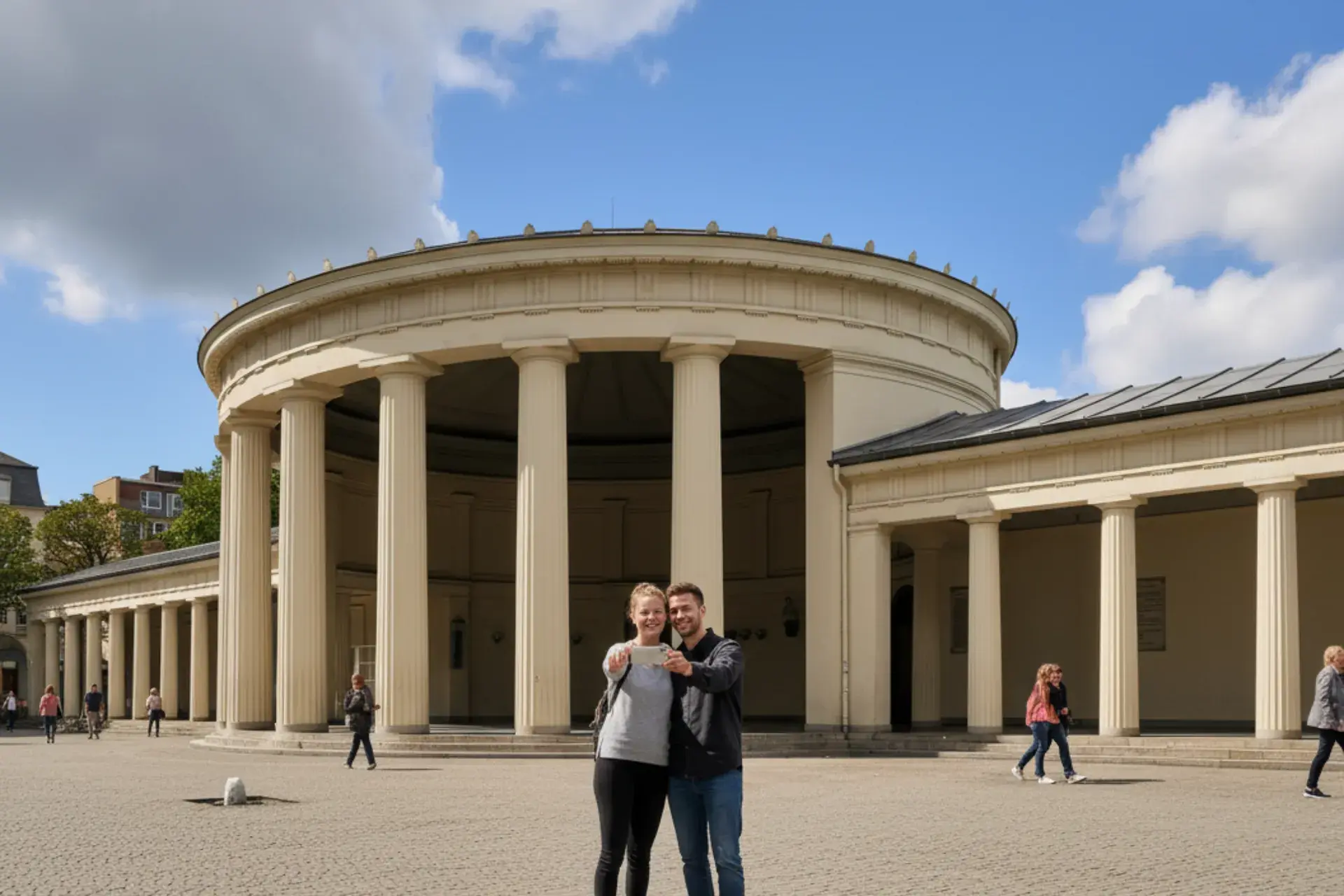
Ciceru's route crosses Aachen's imperial old town: the Carolingian Cathedral and the Domschatzkammer treasury beside it, the Rathaus and Markt built over Charlemagne's palace, and the Elisenbrunnen colonnade above the sulphur springs that fed the city's Roman baths, ending at Printenbäckerei Klein.
- Country
- Germany
- Language
- German
- Currency
- Euro (EUR)
- Plug
- type F
- Time zone
- Europe/Berlin
- Emergency
- 112
- Tap water
- Generally safe
- Dialling code
- +49
The stops
Things to do in Aachen
Our Aachen route concentrates on the Carolingian core around the Dom and Markt, and the short stretch between the Rathaus and the Elisenbrunnen, where the old Roman and medieval baths still surface as public fountains.
Domschatzkammer (Treasury)
Markt (Market Square)
Rathaus (City Hall)
Couven Museum
Hof
Puppenbrunnen (Puppet Fountain)
Elisenbrunnen (Elisa Fountain)
Printenbäckerei Klein
Your private guide, in your pocket
Ready to walk these?
- Self-guided, start now or laterSelf-guided, start now or later and pause whenever you like
- Offline audio, 7 languagesOffline audio stories in 7 languages
- 30-day money-back guarantee30-day money-back guarantee
- 500MB global eSIM included500MB global eSIM included
from
€5.00
1 self-guided tour in Aachen
Weather & crowds
Best time to visit
May, June and September balance mild weather with fewer rainy days than midsummer, when August averages 81 mm, its wettest month. December suits the Christmas market despite average highs of only 5.6°C, and January and February are the quietest months to see the Cathedral without a queue.
Winter
Dec–Feb1–6°C/ 34–43°F
Few visitorsWet
- Christmas market (Dec)
- Cathedral without queues
- Short daylight, grey skies
- Carnival closures mid Feb
Don't miss
Aachener Weihnachtsmarkt (late Nov to 23 Dec)
Rosenmontag Carnival parade (16 Feb 2026)
Spring
Mar–May6–15°C/ 43–58°F
Getting busierOccasional rain
- Mild, fewer crowds
- Cafés reopen terraces
- Rain in short showers, any week
Summer
Jun–Aug14–23°C/ 56–73°F
BusyOccasional rain
- Warmest, longest days
- Humid August afternoons
- RWTH term ends: quieter after July
Autumn
Sep–Nov8–15°C/ 46–58°F
Getting busierOccasional rain
- Comfortable for walking
- Daylight drops fast by November
Transport
How to get to & around Aachen
Cologne Bonn Airport
| Train via Köln Hbf (Rheinlandtarif) | 60-75 min | €13.90 |
|---|
Düsseldorf Airport
| RE1 direct to Aachen Hbf | 70-90 min | ~€27.80 |
|---|
Aachen Hbf
| Bus to Markt, or a 20 min walk | 5-20 min | €2.90 |
|---|
Brussels
| Eurostar (ex-Thalys), direct | 1h 10min | ~€19.00 |
|---|
ASEAG buses
Best defaultAachen has no metro or tram, only buses. A short hop is €2.90, a single ride within the city is €4.00, and a 24hTicket covering the whole day is €9.60, all Rheinlandtarif fares from June 2026.
Walking
Central old townThe Dom, Markt and Elisenbrunnen sit within 500 metres of each other in the pedestrianised centre. Burtscheid and the Frankenberger Viertel add a further 15 to 20 minutes on foot.
Deutschlandticket
Longer staysCovers regional trains and buses nationwide for €63 a month from January 2026. Only worth it if you are combining Aachen with day trips to Cologne, Düsseldorf or Maastricht.
Driving into the centre
Nowhere to parkMost streets inside the Grabenring, the ring road on the old city walls, are a pedestrian zone closed to through traffic. A hire car for sightseeing has nowhere useful to go past the Markt.
Walk the compact old town and take ASEAG buses out to Burtscheid or the station. Skip a car: the centre inside the Grabenring is pedestrianised.
Budget
How much does it cost to visit Aachen?
Aachen is cheaper to eat and drink in than Cologne or Düsseldorf. Transport only stings for a single ride: €2.90 for a short hop, but the €9.60 day ticket pays back after three trips. Since 1 January 2026, hotels add a flat €2.50 per person, per night overnight tax, paid at the property rather than online.
| Coffee at a café | €2.50–€4.20 |
|---|---|
| Weekday lunch, inexpensive restaurant | €8.00–€15.00 |
| Local draught beer, 0.5L | €3.50–€6.00 |
| Bus, short trip (Kurzstrecke) | €2.90 |
| Bus, single ride within Aachen | €4.00 |
| 24hTicket, whole day, Aachen | €9.60 |
| Deutschlandticket, monthly | €63.00 |
| Taxi, short ride across the old town | ~€6.00–~€12.00 |
| Overnight tax (Beherbergungsabgabe) | €2.50 |
Cash or card?
Germany still runs more on cash than most of western Europe. Cards and contactless work in cafés, shops and on ASEAG buses, but small bakeries, market stalls and some Christmas market huts take cash only. Keep €20-30 for the Wochenmarkt and the Printen bakeries in the old town.
Where to stay
Where to stay in Aachen
Altstadt
First visit, all on footEvery Ciceru stop sits within a 10 minute walk of the Markt, from the Dom to the Elisenbrunnen. Hotels here cost the most in the city, and the streets get loud near the Pontstraße bars at weekends.
Pontstraße quarter
Nightlife, student energyAachen's oldest street runs from the Markt to the old city gate, lined with the bars and snack bars that serve RWTH Aachen's students. Livelier in term time, quieter through the summer break.
Frankenberger Viertel
Quiet, 19th century streetsBuilt from 1874 for Aachen's industrialists, with over 250 protected facades on Oppenhoffallee. A 20 minute walk or a short ride on bus 7, 27, 33 or 37 from the Markt, with few hotels of its own.
Burtscheid
Spa quarter, fewer crowdsA separate town until 1897, built over sulphur springs that still feed the Carolus Thermen baths. ASEAG buses reach the Markt in under 15 minutes, but the uphill walk back is longer than it looks.
The tours
Aachen, one story at a time
€51.5 hours
Aachen self guided walking tour with Ciceru
 Stefano Manzi
- Audio
- Free eSIM
Scratch to win
Give it a scratch
Something good might be under there. If you win, we'll show you how to use it.
One prize per traveller. Good for 2 years.
Word of mouth
What travellers say

Safety
Is Aachen safe?
Violent crime against visitors is rare in Aachen. The main risk is pickpocketing in crowds: the Christmas market stalls, the queue for the Cathedral treasury, and busy ASEAG buses at rush hour. Officers at the Aachen-Mitte police station near the Bushof are used to dealing with visitors, and Belgium and the Netherlands are a short ride from the centre, so carry ID.
Christmas market crowds
Pickpockets work the packed stalls between the Rathaus and the Dom through December. Keep bags zipped and to the front, and treat a sudden shove or a spilled drink as a cue to check your pockets.
Cathedral treasury queue
The line for the Domschatzkammer bunches people close together and is a known spot for bag dips. Wear a backpack on your front while you queue, and keep phones out of open back pockets in the Dom itself.
Marked cycle lanes
Many pavements run alongside a painted cycle lane at the same level. Look both ways before stepping off the kerb, since Aachen's cyclists do not expect pedestrians to drift into the bike lane.
Reporting a theft
Insurance claims need a police report. File it in person at the Aachen-Mitte Polizeiwache the same day; a claim without one usually fails.
Medical help
Call 112 for a medical emergency, free and staffed around the clock. For urgent but non-critical problems, dial 116117, the nationwide non-emergency doctor line, which directs you to an on-call GP or pharmacy.
Good to know
Good to know
Nearly everything shuts on Sunday
German law closes almost all shops on Sundays, supermarkets included. Bakeries may open for a few morning hours, and December's Christmas market is the main exception, trading daily until 23 December.
Carnival closes streets in February
Rosenmontag falls on 16 February 2026. Expect the parade route through the centre to close to traffic and some shops and offices to shut for the day, a regional tradition rather than a public holiday.
A trilingual border city
Aachen sits a few kilometres from both Belgium and the Netherlands. Dutch and French are widely understood near the border crossings, and station signage often adds English and Dutch to German.
Transport fares rose in June 2026
ASEAG and the wider Rheinlandtarif region increased ticket prices on 1 June 2026. The €2.90 short trip and €9.60 day ticket figures in this guide are the current post-increase fares.
Worth reading
Read more about Aachen

Story9 min read
Aachen Walking Tour: A Free Self-Guided Route, 10 Stops
Last updated: August 2026
Read moreQuestions
Aachen FAQ
Yes. German tap water is regulated under the Trinkwasserverordnung and tested more rigorously than bottled water in most other countries, according to the Federal Environment Agency. Aachen's supply meets the same national standard, so there is no need to buy bottled water for drinking.
Aachen has no airport of its own. From Cologne Bonn Airport, take the S19 or RE train to Köln Hauptbahnhof, then a regional or ICE train to Aachen Hbf, about 60 to 75 minutes total for a €13.90 Rheinlandtarif ticket. From Düsseldorf Airport, the RE1 runs direct to Aachen Hbf in around 70 to 90 minutes.
For a day of sightseeing, the 24hTicket covers all ASEAG buses in Aachen for €9.60. A short hop is €2.90 and a single ride within the city is €4.00. If you are staying a week or combining Aachen with Cologne or Maastricht, the €63 a month Deutschlandticket pays for itself after about seven single rides.
Yes. Aachen introduced a flat overnight tax (Beherbergungsabgabe) of €2.50 per person, per night from 1 January 2026, capped at 21 nights at the same hotel. It covers hotels, guesthouses and platforms like Airbnb, and is added at the property rather than in the online booking price. Under 18s and school trips are exempt.
Yes. The Dom, Markt, Rathaus and Elisenbrunnen sit within 500 metres of each other in a pedestrianised core, and most of Ciceru's stops connect on foot in under 15 minutes. Burtscheid and the Frankenberger Viertel add a further 15 to 20 minute walk, or a short ASEAG bus ride.
Aachen has no unusual night time danger for visitors, but the Christmas market and the Pontstraße bar street get crowded, and that crowding is where pickpocketing is reported. Keep valuables zipped and out of back pockets, and carry ID, since Germany requires residents and visitors alike to be able to show one, the same care you would use in any German city centre after dark.
May, June and September balance mild weather with fewer rainy days than midsummer, when August averages 81 mm, the wettest month on record here. December suits the Christmas market despite average highs of only 5.6°C, and January and February are the quietest months to see the Cathedral without a queue.
Mostly, yes: cafés, restaurants, shops and ASEAG buses all accept cards and contactless. Small bakeries, market stalls and some Christmas market huts often take cash only, so keep some cash on hand for those.