
Tips and tours for explorers and travellers
Berlin City Guide
Berlin is a wide, district-shaped capital where zone C matters for BER Airport and each neighbourhood brings its own rhythm after dark.
- Country
- Germany
- Language
- German
- Currency
- Euro (EUR)
- Plug
- type F
- Time zone
- Europe/Berlin
- Emergency
- 112
- Tap water
- Generally safe
- Dialling code
- +49
The stops
Things to do in Berlin
Explore Berlin's rich history by visiting iconic landmarks like the Reichstag Building, the Brandenburg Gate, and the historic Nikolaiviertel quarter.
Medieval origins
The capital of Prussia
World War I
Nazi Propaganda
Frederick II
A gate of triumph
Take a look up at those twin stone towers and the five rings suspended between them. You are standing before the Olympiastadion, a structure that manages to be both magnificent and deeply unsettling at the same time. This is not just a sports venue. It is a massive, limestone-clad ghost story. Built for the 1936 Olympics under the orders of Adolf Hitler, it was designed as a neoclassical titan, drawing inspiration from both modernism and ancient Greek architecture. But notice how it doesn't tower over you like a typical stadium. To achieve that ancient, grounded feeling, the architects actually dug the field thirty-three feet into the earth. You are standing above a sunken bowl of history, designed to project a strength intended to last a thousand years. The man responsible for this austere look was Werner March, who chose the limestone casing you see to evoke a sense of permanence and the 'master race' narrative. Even the Marathon Gate on the western side was carefully placed to maintain a military-style sightline to the nearby Bell Tower. As you walk along the facade, feel the coldness of the architecture. It was built during a dark era when construction companies were forced to hire only 'Aryan' workers, explicitly excluding the Jewish community from the very soil you are standing on. It was a space designed to prove a point about racial superiority to the rest of the world. But the best part of the story is how that narrative backfired right here on these grounds. In 1936, a Black American athlete named Jesse Owens stepped into this arena and shredded the Nazi script. He didn't just win, he dominated, taking home four gold medals in front of a stunned Hitler. There is a persistent legend that Hitler refused to shake his hand out of spite. In reality, Hitler had been told to shake everyone's hand or no one's, and he conveniently chose 'none' after the first day. But the image of Owens standing on the podium, surrounded by Nazi iconography while the crowd roared for him, remains the ultimate middle finger to the regime that built this place. The locals were so fascinated by Owens that he became an overnight celebrity, captivating the German public despite the hateful ideology of the state. Since the war, Berlin has faced a difficult choice: keep it or tear it down. They chose 'vergangenheitsaufarbeitung,' which is a quintessentially German word for 'working through the past.' They de-Nazified the site by stripping the swastikas and lowering the height of the honorary stand where Hitler once sat. Since then, the stadium has been reclaimed. It has hosted the British military, the 2006 World Cup final, and Usain Bolt’s legendary world records. It is no longer a monument to a regime, but a place where the world actually comes together, regardless of what the original architects intended. Today, the Olympiastadion serves as a massive, functional reminder that you can build a monument to last a millennium, but you cannot control the spirit of the people who fill it. It is a place where the echoes of a dark past meet the cheers of a modern, diverse Europe. As you head off, take one last look at that limestone. It was meant to be a wall, but today, it is just a backdrop for the next chapter of Berlin’s story.
The Night of Broken Glass
The German reunification
Your private guide, in your pocket
Ready to walk these?
- Self-guided, start now or laterSelf-guided, start now or later and pause whenever you like
- Offline audio, 7 languagesOffline audio stories in 7 languages
- 30-day money-back guarantee30-day money-back guarantee
- 500MB global eSIM included500MB global eSIM included
from
€7.00
1 self-guided tour in Berlin
Plan the days
How many days in Berlin? A perfect 1-day itinerary
Walk Berlin’s districts by rail and on foot
Connect Berlin’s neighbourhoods by U-Bahn and S-Bahn, then slow down in one district at a time as the city opens into parks, canals and nightlife.
€7.00 →Weather & crowds
Best time to visit
May, June and September are the best all-round months for walking Berlin. July and August are warmest and busiest; January and February are quietest.
Winter and spring
Jan–Jun-2–24°C/ 28–75°F
Few visitors
- Cool season
Summer and autumn
Jul–Dec5–25°C/ 41–77°F
Few visitors
- Warm season
The tours
Berlin, one story at a time
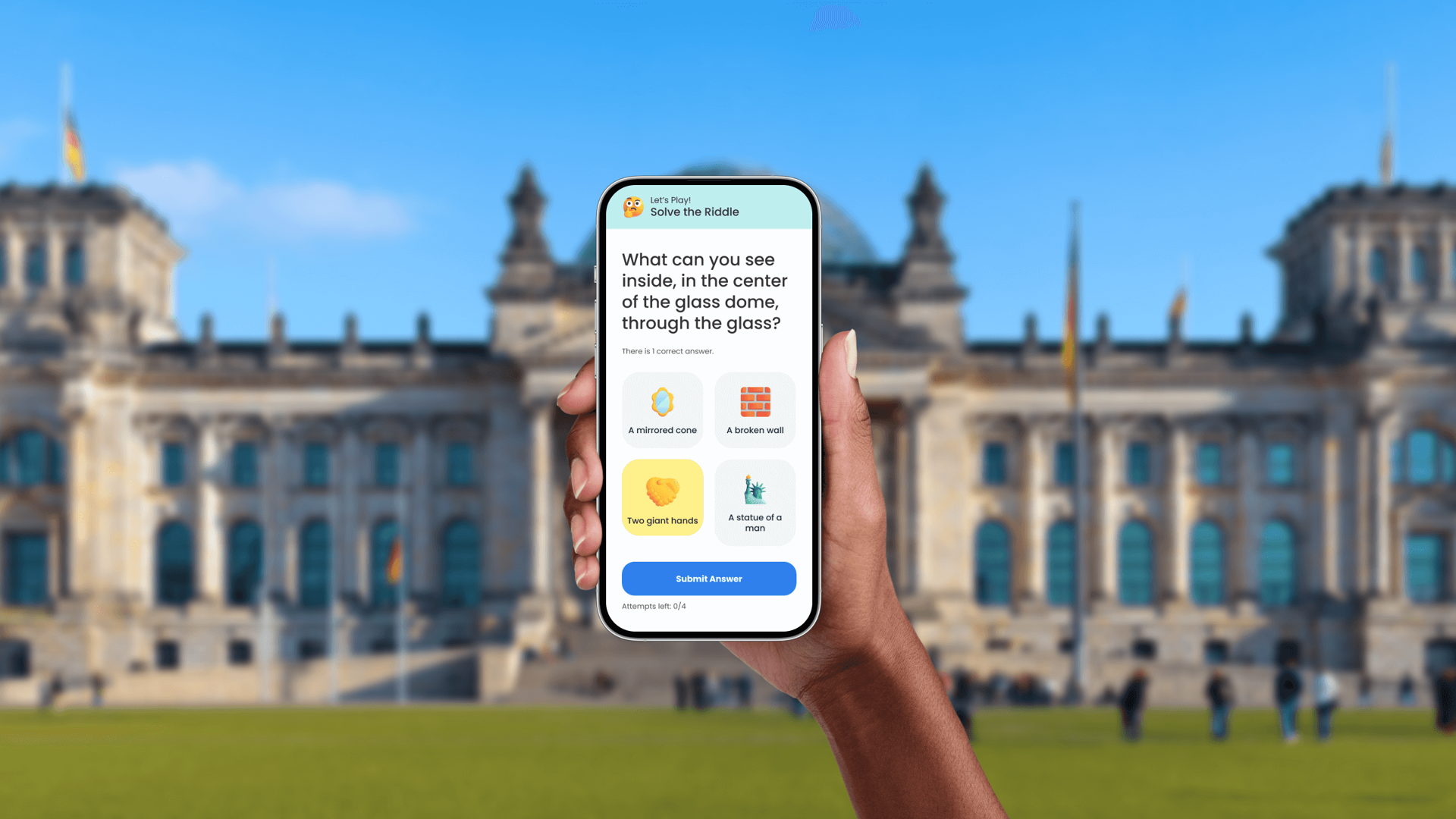
€72 hours
Berlin Through the Ages
 Andrea Rabinelli
- Audio
- Quizzes
- Multiplayer
- Free eSIM
Scratch to win
Give it a scratch
Something good might be under there. If you win, we'll show you how to use it.
One prize per traveller. Good for 2 years.
Word of mouth
What travellers say

Safety
Is Berlin safe?
Berlin is generally safe for visitors, but it is a large capital with concentrated theft, nightlife risks and complex traffic. Take care around stations, tram tracks and park paths after dark. Use 112 for ambulance or fire and 110 for police.
Station theft
Keep phones and wallets secure at Hauptbahnhof, Alexanderplatz, Zoologischer Garten and crowded S-Bahn interchanges.
Nightlife
Use lit streets around Warschauer Straße and Kottbusser Tor; do not accept unsolicited drinks or rides.
Tram traffic
Cross tracks only at marked points and stay alert in mixed pedestrian and cycle areas.
Worth reading
Read more about Berlin

Story12 min read
Self-Guided City Walks in Germany: Choose a Route
Last updated: September 2026
Read moreStory10 min read
What Is Closed in Germany? Sunday and 2027 Rules
Last updated: August 2026
Read moreStory6 min read
Border Checks Inside Europe: What to Carry
Temporary controls, travel documents and EU entry systems, checked 31 August 2026.
Read moreStory4 min read
The top 5 Berlin techno clubs in 2025: the beat goes on
In 2025, Berlin continues to reign as the capital of techno — even as the city faces rising rents, club closures, and the ever-present tension between gentrification and…
Read moreQuestions
Berlin FAQ
Yes, BER is in fare zone C, so a journey from the airport into central Berlin needs an ABC ticket.
Yes, use rail for long cross-city trips and walk each neighbourhood; check the zone before buying a ticket.
Use 112 for ambulance or fire emergencies and 110 for police.