Tips and tours for explorers and travellers
Amalfi City Guide
Ciceru's Amalfi route starts at Marina Coppola, harbour of the medieval Maritime Republic whose sea law, the Tabula Amalphitana, governed Mediterranean shipping, passes the Arsenal where its galleys were built, then climbs lanes and steps to the Saracen and Ziro watchtowers.
- Country
- Italy
- Language
- Italian
- Currency
- Euro (EUR)
- Plug
- type L
- Time zone
- Europe/Rome
- Emergency
- 112
- Tap water
- Generally safe
- Dialling code
- +39
The stops
Things to do in Amalfi
Our Amalfi route concentrates on the compact historic centre around Marina Coppola and Piazza Duomo, then climbs by stairway to the Saracen and Ziro watchtowers above town, using the same boats, buses and steps locals use to link Amalfi's scattered hamlets.
The Republic's Arsenal and Porta della Marina
Saint Andrew's Fountain Amalfi
Cathedral of St. Andrew
La Fontana De Cape E Ciucci
Paper Museum
Saracen Tower
Ziro Tower
Your private guide, in your pocket
Ready to walk these?
- Self-guided, start now or laterSelf-guided, start now or later and pause whenever you like
- Offline audio, 7 languagesOffline audio stories in 7 languages
- 30-day money-back guarantee30-day money-back guarantee
- 500MB global eSIM included500MB global eSIM included
from
€7.00
1 self-guided tour in Amalfi
Weather & crowds
Best time to visit
May, June and September give you a swimmable sea without August's gridlock: the plate rule runs daily only from 1 August to 30 September. August stays dry at 29-30°C, but half the cars are banned from the coast road each day. November and December are the wettest months, over 150mm, and many hotels shut until Easter.
Winter
Dec–Feb6–14°C/ 43–57°F
Few visitorsWet
- Coast almost to yourself
- Many hotels shut until Easter
- 150mm of rain a month
Spring
Mar–May10–20°C/ 50–67°F
Getting busierOccasional rain
- Warm enough to swim by May
- Easter week fills every hotel
High summer
Jun–Aug18–29°C/ 65–85°F
Peak seasonDry
- Sea calm and swimmable
- Plate rule bans half the cars daily from August
Don't miss
Festa di Sant'Andrea, first feast day (27 June)
Ravello Festival (4 July to 5 September)
Early autumn
Sep–Oct15–25°C/ 59–77°F
BusyWet
- Warm sea, thinner crowds
- Rain returns: 84mm in September, 127mm in October
Late autumn
Nov10–18°C/ 50–64°F
Few visitorsWet
- Wettest month of the year, 152mm
Don't miss
Festa di Sant'Andrea, patronal feast and stair run (30 November)
Transport
How to get to & around Amalfi
Naples Capodichino
| Curreri coach to Sorrento | 75 min | €13.00 |
|---|---|---|
| Private transfer, direct | 100-130 min | ~€168.00 |
Sorrento
| SITA bus on to Amalfi | 1h 45min | €10.00 |
|---|
Salerno
| SITA SUD bus along the coast | 50 min | €10.00 |
|---|---|---|
| Travelmar ferry | 35 min | €12.00 |
SITA SUD bus
Buy before boardingThe COSTIERASITA day pass covers 20 coastal municipalities for 24 hours of unlimited travel. Drivers do not sell tickets on board: buy from a tabaccheria, bar or the app first, or risk a fine.
Ferry
Skips the trafficTravelmar and other operators link Amalfi to Salerno, Positano and smaller bays in a fraction of the bus time, bypassing SS163 congestion entirely. Services thin out sharply from November to March.
Walking the steps
The town is stairsAmalfi's centre is car-free. Stone stairways, some several hundred steps, connect the marina to hillside hamlets like Pontone and Pogerola. Sturdy flat shoes matter more here than in most towns.
Self-drive car
The plate rule trapDaily in August and September, and at weekends in June, July and October, the SS163 admits only half the cars by plate parity, 10:00 to 18:00. Amalfi's centre has almost no parking.
Taxi or NCC
Fixed town faresComune-set fixed fares apply between towns, such as Amalfi to Ravello, so there is no meter surprise. Worth it late at night or with luggage once the last bus or ferry has gone.
Buy a COSTIERASITA day pass for the bus, use the ferries to dodge SS163 traffic, and skip the car: the plate rule bars half of all cars every day in August and September.
Budget
How much does it cost to visit Amalfi?
Amalfi runs cheap until you need to move: a ferry hop or the SITA day pass both cost about €10, and a fixed Ravello taxi is €55. The Naples airport transfer is the real expense, up to €192, and even a 3-star hotel adds a €3 to €5 tourist tax per person, per night, from April to November.
| Espresso at the bar | €1.10–€1.80 |
|---|---|
| Simple lunch, pizza or pasta | €15.00–€30.00 |
| Local draught beer | €4.50–€8.00 |
| Ferry, Amalfi to Positano | €10.00 |
| COSTIERASITA day bus pass | €10.00 |
| Taxi, Amalfi to Ravello, fixed | ~€55.00 |
| Private transfer, Naples airport | ~€168.00–~€192.00 |
| Tourist tax, per person per night | €3.00–€5.00 |
Cash or card?
SITA ticket booths, tabaccherie and small trattorie often prefer cash, and some hillside B&Bs and taxi drivers take no cards at all. Machines on the harbour and larger restaurants do accept them. Carry small notes: many properties collect the tourist tax in cash at checkout.
Where to stay
Where to stay in Amalfi
Amalfi, Marina Grande
First visit, on the waterThe ferry and bus hub, steps from Piazza Duomo and walkable to everything. Loudest and priciest part of town, and cars cannot reach most hotel doors: the last stretch is always stairs.
Atrani
Quiet, cheaper, still centralItaly's smallest comune by area, one bay east through a short tunnel, 5 to 10 minutes on foot from Amalfi. A real fishing-village square, but no ferry stop of its own and little open after dark.
Ravello
Views, quiet nightsAround 350m above the coast, roughly 25 minutes up by SITA bus. Cooler and quieter than the shore towns, but no beach access, and the last bus down finishes early once the season ends.
Minori
Local life, better valueAbout 15 minutes from Amalfi by ferry or bus, with its own small beach and a bakery-lined seafront. Cheaper rooms than Amalfi's centre, but fewer restaurants and a thin winter ferry timetable.
Positano
The famous alternativeAround 35 minutes by ferry, up to an hour by road in traffic. Steeper and pricier than anywhere else on this coast, and every route in town is stairs, so pack light.
The tours
Amalfi, one story at a time
€72 hours
Amalfi Unfolded: From Seafaring Glory to Sacred Calm
 Stefano Navarro
- Audio
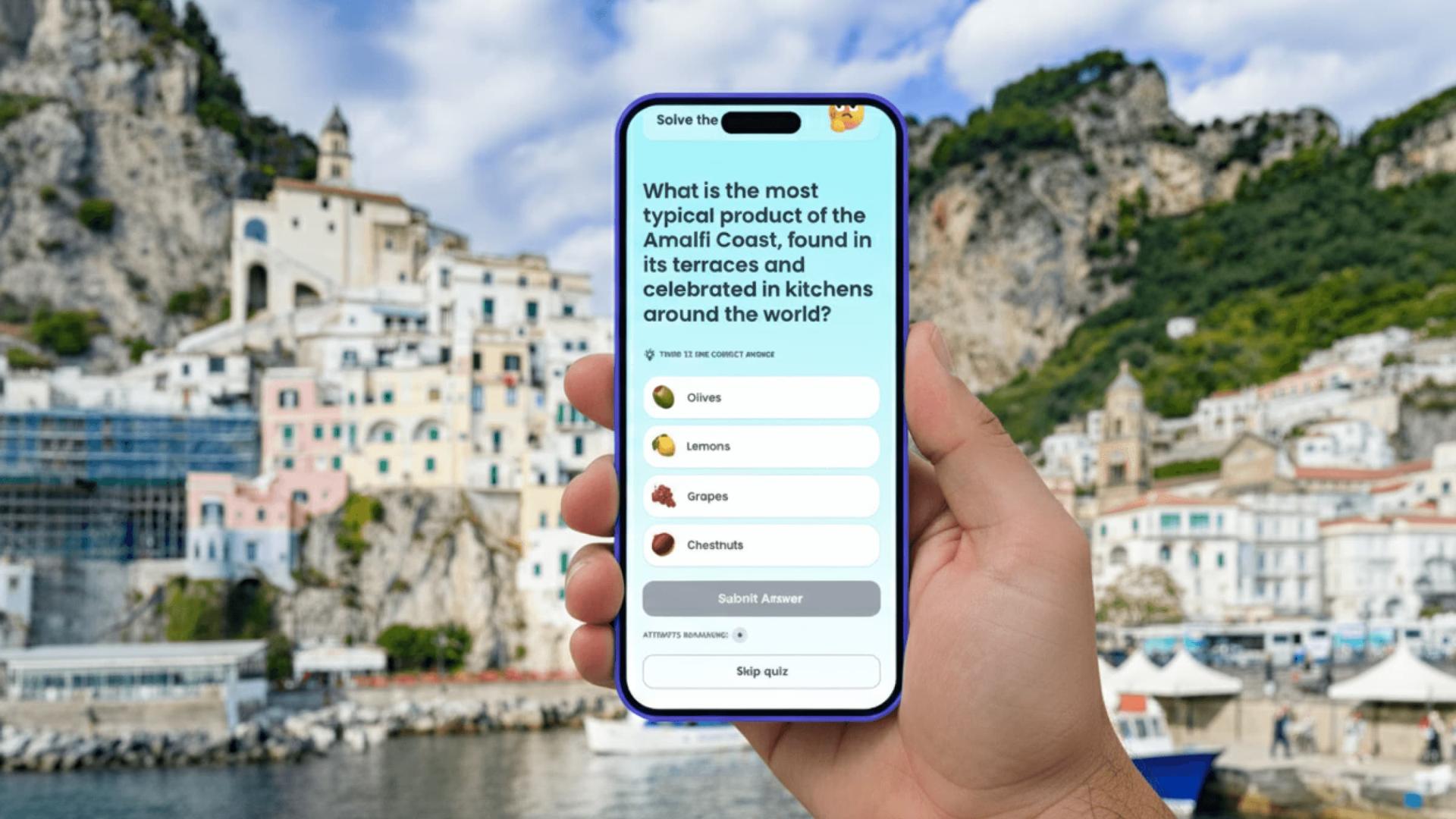
- Quizzes
- Multiplayer
- Free eSIM
Scratch to win
Give it a scratch
Something good might be under there. If you win, we'll show you how to use it.
One prize per traveller. Good for 2 years.
Word of mouth
What travellers say

Safety
Is Amalfi safe?
Violent crime against visitors on the Amalfi Coast itself is rare. The real risks sit either side of it: Naples, which most visitors pass through, ranks among Italy's top cities for street snatch-and-grab theft, and the SS163 has no continuous pavement in several stretches. Neither should keep you away; both should change how you carry a bag and where you walk.
Naples transit points
Most theft happens before you reach Amalfi, not in it. Naples ranks fifth nationally for scippo, bag snatching by scooter riders, concentrated around Napoli Centrale and the Circumvesuviana. Keep bags on the wall side, away from the road.
SS163 road and shoulders
The coast road has no continuous pavement between towns. Walk facing the oncoming traffic on the outside bends, and expect the alternating plate rule to slow rather than stop the summer congestion.
Open stairways and heat
Amalfi's hillside hamlets are reached by open stone stairways with no shade, some several hundred steps. In July and August afternoon heat, carry water and climb in the morning or evening, not at midday.
Reporting a theft
Insurance needs a denuncia, the official police report, filed the same day. The Carabinieri station in Amalfi's centre takes reports; without one, most travel insurance claims for stolen property fail.
Medical help
Call 112 for any emergency, on land or at sea. For an emergency at sea specifically, the Coast Guard's dedicated number is 1530. Non-urgent care is covered by the Guardia Medica, though tourist-season posts run reliably only in August.
Good to know
Good to know
Seasonal tourist tax
Amalfi charges an imposta di soggiorno of €3 to €5 per person per night depending on the accommodation's category, only from 1 April to 2 November. It is paid directly to your accommodation, not at booking.
Buy your bus ticket first
SITA SUD drivers do not sell tickets on board. Buy the COSTIERASITA day pass, or a single ticket, from a tabaccheria, bar or the app before you reach the stop.
Do not plan on driving in summer
From June to September the SS163 restricts private cars to alternating number plates between 10:00 and 18:00: daily in August and September, weekends only in June, July and October. Park outside town and ride in.
Amalfi closes for winter
Many hotels and restaurants close between November and Easter, when the coast empties out. Confirm opening dates directly if you are visiting outside April to October.
Questions
Amalfi FAQ
The historic centre is compact and entirely walkable in 15 to 20 minutes end to end, but it is all stairs. To reach Atrani, Ravello, Minori or Positano you need the SITA SUD bus or a Travelmar ferry: Amalfi has no railway and no airport of its own.
Take the Curreri Viaggi coach from Capodichino to Sorrento, about 75 minutes for €13, then the SITA SUD bus on to Amalfi, roughly 1 hour 45 minutes, covered by the €10 COSTIERASITA day pass. A private transfer takes 100 to 130 minutes and costs from about €168.
The COSTIERASITA day pass: €10 for 24 hours of unlimited SITA SUD bus travel across 20 coastal municipalities, including Salerno and Sorrento. Buy it before boarding, since drivers do not sell tickets on the bus itself.
Yes. Amalfi charges €3 to €5 per person per night depending on your accommodation's star category, but only between 1 April and 2 November. It is collected by your accommodation directly, and is not included in the online booking price.
You can, but the SS163 restricts private cars to alternating number plates from 10:00 to 18:00: daily in August and September, weekends only in June, July and October. Residents, taxis and hotel guests on arrival or departure days are exempt. Most visitors park outside town and take the bus or ferry instead.
Yes, violent crime is rare and the historic centre stays lit and busy into the evening. The real hazards are physical rather than criminal: unlit stretches of the SS163 without a pavement, and open stone stairways to the hillside hamlets, both worth avoiding after dark without a torch.
May, June and September give warm, swimmable seas without August's plate-rule gridlock and queues. May and June average 24 to 28°C with under 40mm of rain; September is similar but wetter, at 84mm. July and August stay dry but bring daily driving restrictions and the fullest hotels.
Mostly, but not everywhere. Restaurants, ferry kiosks and larger shops take cards, while tabaccherie selling SITA bus tickets, some taxi drivers and smaller B&Bs are often cash-only. Keep €20 to €30 in cash, particularly for the tourist tax, which many properties collect at checkout.