Tips and tours for explorers and travellers
Augsburg City Guide
Ciceru walks Augsburg through the Fuggerei, founded in 1513 and still home to about 150 residents, the Lechviertel's canal lanes once worked by tanners and weavers, and the Fuggerhäuser where the Fugger banking dynasty financed emperors.
- Country
- Germany
- Language
- German
- Currency
- Euro (EUR)
- Plug
- type F
- Time zone
- Europe/Berlin
- Emergency
- 112
- Tap water
- Generally safe
- Dialling code
- +49
The stops
Things to do in Augsburg
Our Augsburg routes concentrate on two areas: the Fuggerei and the streets around Rathausplatz and the Fuggerhäuser, and the Lechviertel's canal lanes between the old town and the cathedral quarter.
The first social housing in history
A cathedral carved in centuries
The square of power
The church that shook the empire
A café full of stories (and sugar)
Where the Fuggers ruled the world
The quarter of bridges and whispers
Your private guide, in your pocket
Ready to walk these?
- Self-guided, start now or laterSelf-guided, start now or later and pause whenever you like
- Offline audio, 7 languagesOffline audio stories in 7 languages
- 30-day money-back guarantee30-day money-back guarantee
- 500MB global eSIM included500MB global eSIM included
from
€7.00
1 self-guided tour in Augsburg
Weather & crowds
Best time to visit
May, June and September balance mild days with manageable crowds. July and August bring Augsburg's highest rainfall, 92 to 94mm a month, plus the Friedensfest crowds on 8 August. December to February stay near freezing, but the Fuggerei empties out and a Kurzstrecke fare covers any tram hop.
Winter
Dec–Feb-3–4°C/ 27–39°F
Few visitorsOccasional rain
- Fuggerei without queues
- Below freezing nights, icy paths
Spring
Mar–May3–14°C/ 38–58°F
Getting busierOccasional rain
- Outdoor cafe terraces
- May is the wettest month so far, 85mm
Summer
Jun–Aug12–24°C/ 53–74°F
BusyWet
- Canals at their fullest
- Highest rainfall months, 92-94mm
Don't miss
Hohes Friedensfest, public holiday (8 August)
Early autumn
Sep–Oct6–16°C/ 43–62°F
BusyOccasional rain
- Plärrer crowds fill the Antonsviertel
Don't miss
Herbstplarrer funfair (28 Aug to 13 Sept)
Late autumn
Nov1–7°C/ 33–45°F
Few visitorsOccasional rain
- Early sunsets and grey skies
Transport
How to get to & around Augsburg
Munich Airport
| S-Bahn S8 + RE (Bayern-Ticket) | 80-110 min | €34.00 |
|---|
Augsburg Hbf
| Tram 1/2 to Rathausplatz (Kurzstrecke) | 8 min | €2.10 |
|---|---|---|
| Walk to Rathausplatz | 18 min | €0.00 |
Tram and bus (swa/AVV)
Covers the centreA Kurzstrecke ticket is €2.10 for up to four stops. The free City-Zone around Königsplatz and Moritzplatz needs no ticket at all, one stop each way, on both trams and buses.
Walking
Flat and compactThe pedestrianised core between Rathausplatz, Maximilianstrasse and the Fuggerei is under two kilometres end to end and closed to cars, so most stops on Ciceru's routes sit a short walk apart.
Bicycle
Flat, well signedAugsburg is flat and cycle lanes run along most main streets and the canals. It beats the tram for cross town trips, though the cobbled Lechviertel lanes near the Fuggerei are shared with pedestrians.
Taxi
Metered faresRanks wait at the Hauptbahnhof and Königsplatz. Useful late at night or for the trade fair grounds on the edge of town, but the compact centre rarely needs one.
Walk or tram the compact centre: a Kurzstrecke fare is €2.10 and the free City-Zone around Königsplatz needs no ticket. Save the tram for the Hauptbahnhof or the outer districts.
Budget
How much does it cost to visit Augsburg?
Augsburg stays cheap for food and transport: a Kurzstrecke tram fare is €2.10 and a day ticket covering the centre is €10.20. There is no separate overnight or tourist tax on your hotel bill as of September 2026. The Fuggerei's €8 entry fee is the one attraction cost worth budgeting for.
| Coffee, cafe | €3.20–€4.50 |
|---|---|
| Lunch, simple restaurant | €12.50–€18.00 |
| Beer, 0.5l draught | €3.80–€4.80 |
| Tram or bus, Kurzstrecke | €2.10 |
| Day ticket, Augsburg centre | €10.20 |
| Deutschlandticket, monthly | €63.00 |
| Fuggerei entry, adult | €8.00 |
Cash or card?
Cards and phone payments work in cafes, restaurants and at AVV ticket machines. Some Christkindlesmarkt and Plärrer stalls, and the Fuggerei's donation boxes, are cash only, so keep small notes and coins.
Where to stay
Where to stay in Augsburg
Innenstadt / Altstadt
First visit, sights on footRathausplatz, Maximilianstrasse and the Fuggerei sit inside a pedestrianised core threaded by the Lech canals. Trams stop at its edges, not through it, and hotel rates carry a centre premium.
Lechviertel
Canal streets, quieter lanesNarrow lanes follow the old tanners' and weavers' canals a few minutes from Rathausplatz. Cobbles and low doorways mean small rooms and few lifts in the guesthouses here.
Jakobervorstadt
Local life, better valueA working district just east of the centre with a mixed population and cheaper rooms. It is a 10 to 15 minute walk or one tram stop to Rathausplatz, and quieter at night than the old town.
Textilviertel
Converted industrial characterFormer weaving mills around the canals south of the centre now hold studios and small hotels, close to Augsburg's UNESCO listed water management sites, but with fewer restaurants open late.
The tours
Augsburg, one story at a time
€72 hours
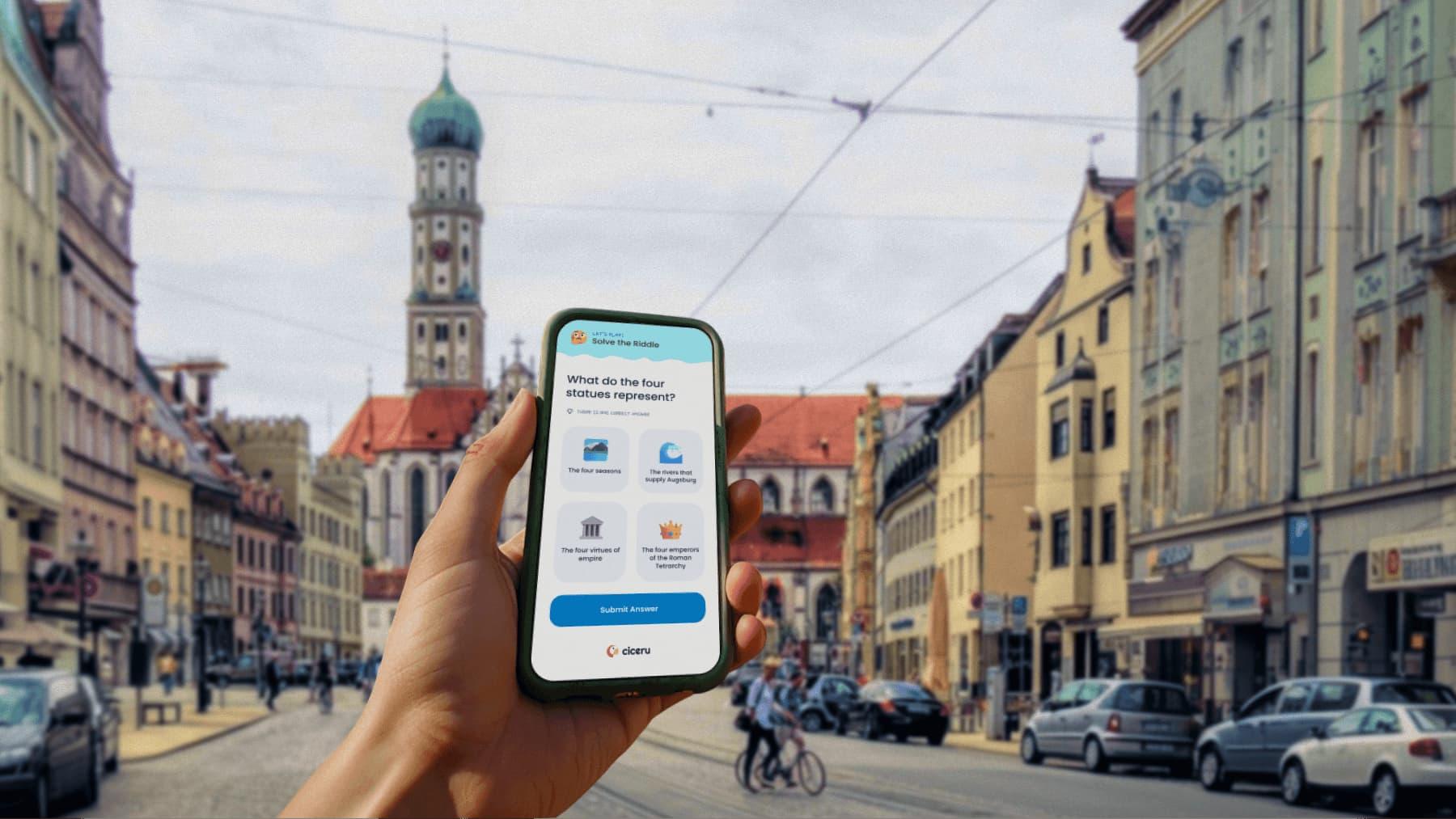
Augsburg: Interactive tour through power, canals, and cake
 Filippo Anzivino
- Audio
- Quizzes
- Multiplayer
- Free eSIM
Scratch to win
Give it a scratch
Something good might be under there. If you win, we'll show you how to use it.
One prize per traveller. Good for 2 years.
Word of mouth
What travellers say

Safety
Is Augsburg safe?
Violent crime against visitors is rare in Augsburg. The main risks are pickpocketing in crowds, trams sharing the Altstadt's narrow streets with pedestrians, and the Lech canals that run open through the centre. Bavarian police publish standard advice on all three rather than naming one district as unsafe.
Pickpocketing in crowds
The Plärrer funfair, the Christmas market and Rathausplatz during festivals draw the biggest crowds and the closest attention from pickpockets. Keep bags zipped and to the front, and phones out of back pockets.
Silent trams
Trams run through pedestrianised Maximilianstrasse and Bahnhofstrasse at walking speed but almost silently. Look both ways before stepping off the pavement, especially near the Königsplatz interchange.
Open canals
The Lech and its mill canals run open through the Lechviertel and Textilviertel with low or no railings in places. They are cold and fast even in summer. Supervise children and swim only at signed spots.
Reporting a theft
Report a theft at the nearest Polizeiinspektion to get the Anzeige your travel insurer will need. Do this the same day, before you leave the city, since a claim without it usually fails.
Medical help
Call 112 for a genuine emergency. For urgent but non-critical problems, the nationwide 116117 line run by the Kassenarztliche Bundesvereinigung finds an on-call doctor or the nearest out-of-hours practice, 24 hours a day.
Good to know
Good to know
Friedensfest closes the city
On 8 August Augsburg alone in Germany holds a public holiday, the Hohes Friedensfest, marking the 1648 Peace of Westphalia. Shops, banks and most offices close as on a Sunday, even though the rest of Bavaria works as normal.
The Fuggerei still locks up at night
Founded in 1513, the Fuggerei is a working residential estate, not a museum, and about 150 people still live there. Entry is €8 for adults, and the gates close in the evening under estate rules, not tourist hours.
The Plärrer fills the Antonsviertel
Augsburg holds two Plärrer funfairs a year. The 2026 autumn edition ran 28 August to 13 September on the Antonsviertel fairground, filling nearby hotels and adding fairground noise to that part of town.
Shops close on Sundays
Bavarian law keeps most shops shut on Sundays and public holidays, with only station kiosks, some bakeries in the morning, and festival stalls open. Plan grocery shopping for Saturday instead.
Questions
Augsburg FAQ
Yes. Augsburg draws its drinking water from local groundwater as part of its UNESCO listed water management system, and it meets German drinking water standards without heavy treatment. It is safe straight from the tap anywhere in the city.
Take S-Bahn line S1 or S8 from the airport to Munich Hauptbahnhof, about 40 to 45 minutes, then a Deutsche Bahn Regional-Express to Augsburg Hauptbahnhof, another 30 to 40 minutes. A Bayern-Ticket covers the whole journey: €34.00 for one traveller, plus €10.00 for each extra person up to five, valid on all regional trains and S-Bahn services.
For single hops in the centre, a Kurzstrecke ticket is €2.10 for up to four stops. If you plan several tram trips in a day, the day ticket for the Innenraum zones is €10.20 for unlimited travel, and the free City-Zone around Königsplatz and Moritzplatz needs no ticket at all for one stop each way.
No. Since 2023 an amendment to Bavaria's Kommunalabgabengesetz has banned every municipality in the state from charging an overnight or tourist tax on hotel stays, and the Bavarian Constitutional Court upheld that ban on 14 November 2025, rejecting a challenge brought by Munich, Bamberg and Günzburg. Augsburg adds nothing to your room rate; only designated spa towns can still charge a separate Kurtaxe.
Yes. The pedestrianised centre between Rathausplatz, Maximilianstrasse and the Fuggerei covers under two kilometres and is flat throughout. Most of Ciceru's stops sit within a 15 to 20 minute walk of each other, with trams only needed to reach the Hauptbahnhof or outer districts.
Violent crime against visitors is rare. The main precautions are watching for silent trams on Maximilianstrasse, avoiding the unfenced stretches of the Lech canals after dark, and the usual care with bags in festival crowds during the Plärrer or the Christmas market.
May, June and September give mild days without July and August's peak rainfall of 92 to 94mm a month. Early August adds the Friedensfest holiday on the 8th, when some shops close. December to February stay near freezing but the Fuggerei has no queues.
Mostly. Cards and phone payments work in shops, restaurants and at AVV ticket machines. Some Christkindlesmarkt and Plärrer stalls, and the Fuggerei's donation boxes, are cash only, so carry a few coins and small notes for festivals.