
Oberbaumbrücke: Berlin's Bridge of Division and Unity
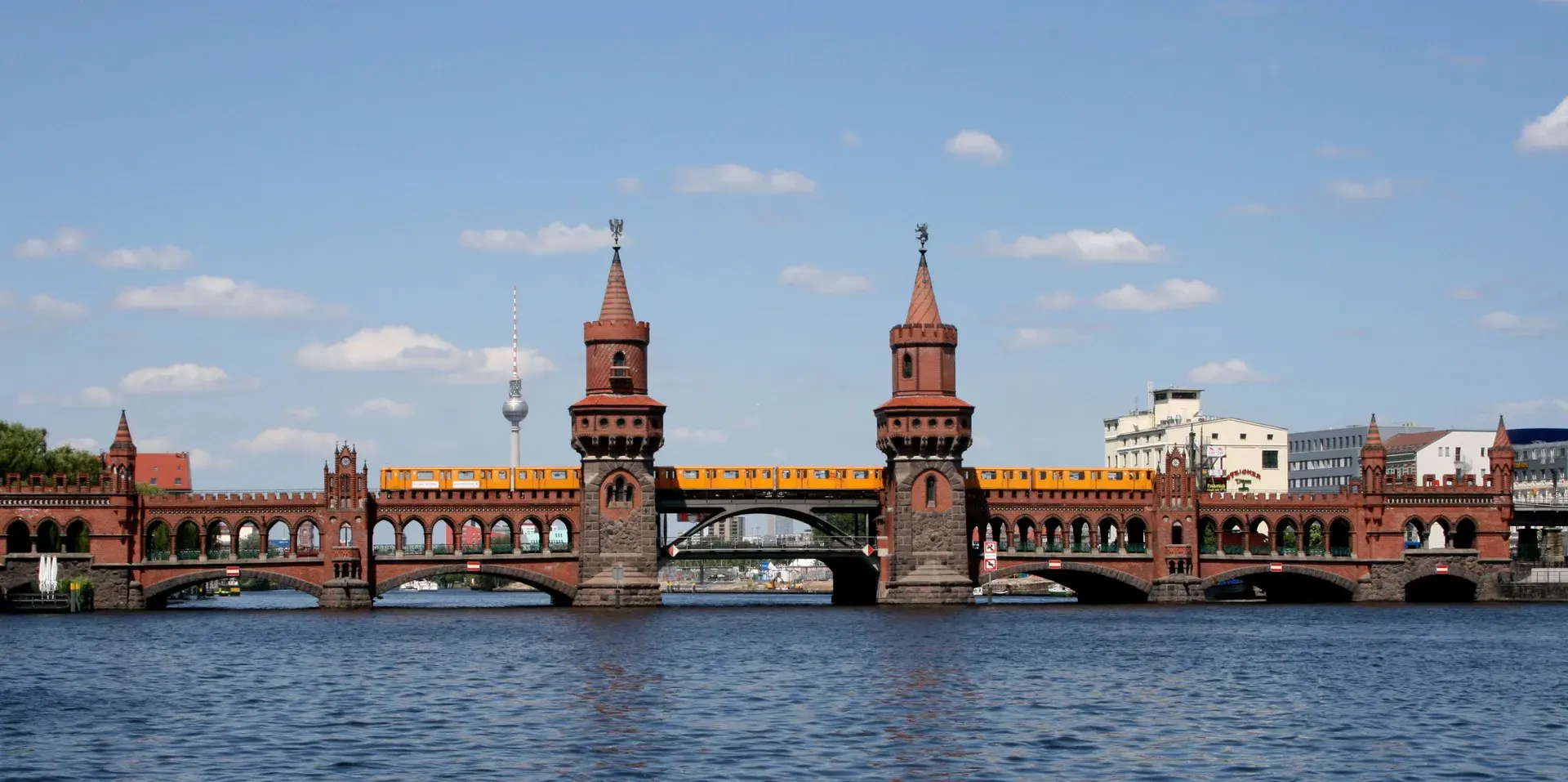
The Oberbaumbrücke is a landmark double-deck bridge spanning the River Spree in Berlin, Germany. It serves as a vital connection between the vibrant districts of Friedrichshain and Kreuzberg, embodying the city's journey from division to reunification.
Architectural Design and Construction
The current bridge was constructed between 1894 and 1896, based on a design by architect Otto Stahn. The structure was conceived in the North German Brick Gothic style, with its two prominent towers intended to resemble a medieval city gate. Though they appear symmetrical from a distance, the towers are distinct; one is octagonal and decorated with the Berlin bear, while the other is round and features the Brandenburg eagle.
After sustaining damage in World War II and decades of neglect during the Cold War, the bridge underwent extensive renewal between 1992 and 1995. This restoration included a new steel middle section designed by renowned Spanish architect Santiago Calatrava, blending modern engineering with the historic structure.
A Tumultuous History
The site's history dates to the early 1700s, when a wooden drawbridge served as a customs point. Its name, meaning "Upper Boom Bridge," comes from the heavy tree trunk ("Baum") that was used to block the river at night to collect duties and prevent smuggling.
In April 1945, the German Wehrmacht blew up the bridge's middle section to impede the Red Army's advance. Following the war, the Oberbaumbrücke found itself on the border between the American and Soviet sectors. With the construction of the Berlin Wall in 1961, it became a heavily fortified border crossing, closed to most traffic. Starting in 1963, it was designated as a pedestrian crossing for West Berlin residents to visit relatives in the East. The division had tragic consequences, as several children drowned near the bridge because rescue personnel from West Berlin were unable to reach them, leading to a formal rescue agreement in 1975.
Symbol of a Reunified Berlin
The fall of the Berlin Wall in 1989 paved the way for the bridge's full restoration. It officially reopened on November 9, 1994, a powerful symbol of a reunified city. Today, the Oberbaumbrücke is a bustling artery. Its lower deck accommodates cars, bicycles, and pedestrians, while the upper deck carries the U1 and U3 U-Bahn lines.
The bridge is a popular destination, offering panoramic views of the Spree and the city skyline, particularly at sunset. Its lively atmosphere is often enhanced by street musicians. Its location near the East Side Gallery and the 'Molecule Men' sculpture further cements its status as a cultural focal point.
Art and Media Presence
Since 1997, the bridge has featured a neon light installation by artist Thorsten Goldberg. The artwork continuously displays the symbols of a 'Rock-Paper-Scissors' game, randomly changing every few seconds. Placed on a former Cold War border, the piece symbolically represents chance and the playful resolution of conflict.
The Oberbaumbrücke's distinctive appearance has also captured the attention of filmmakers. It has been featured in movies such as 'Run Lola Run' and 'The Bourne Supremacy,' and the television series 'Berlin Station'.
FAQ
Why is it called the Oberbaumbrücke?
The name 'Oberbaumbrücke' or 'Upper Boom Bridge' originates from an 18th-century wooden bridge at the same location. A heavy tree trunk, or 'Baum,' was used to block the River Spree at night to prevent smuggling and collect customs duties.
Can you walk across the Oberbaumbrücke?
Yes, the Oberbaumbrücke's lower deck is open to pedestrians, cars, and bikes. The upper deck is used by the U1 and U3 U-Bahn train lines.
What is the neon light art on the Oberbaumbrücke?
The neon installation is an artwork by Thorsten Goldberg, installed in 1997. It displays the symbols for 'Rock-Paper-Scissors' and represents the element of chance and the playful resolution of conflict at a site that once symbolized the Cold War's rigid division.
What do the towers on the Oberbaumbrücke represent?
The two towers are not identical. The octagonal tower is adorned with the Berlin bear, a symbol of the city, while the round tower features the Brandenburg eagle.

More places in Berlin
berlin, germany
Beethoven-Haydn-Mozart Memorial
Beethoven-Haydn-Mozart Memorial
berlin, germany
Victims of the Berlin Wall Window of Remembrance
Victims of the Berlin Wall Window of Remembrance
berlin, germany
Denkmal Friedrich II. von Preußen