Teatro Margherita: Bari's Theatre Built Over the Sea
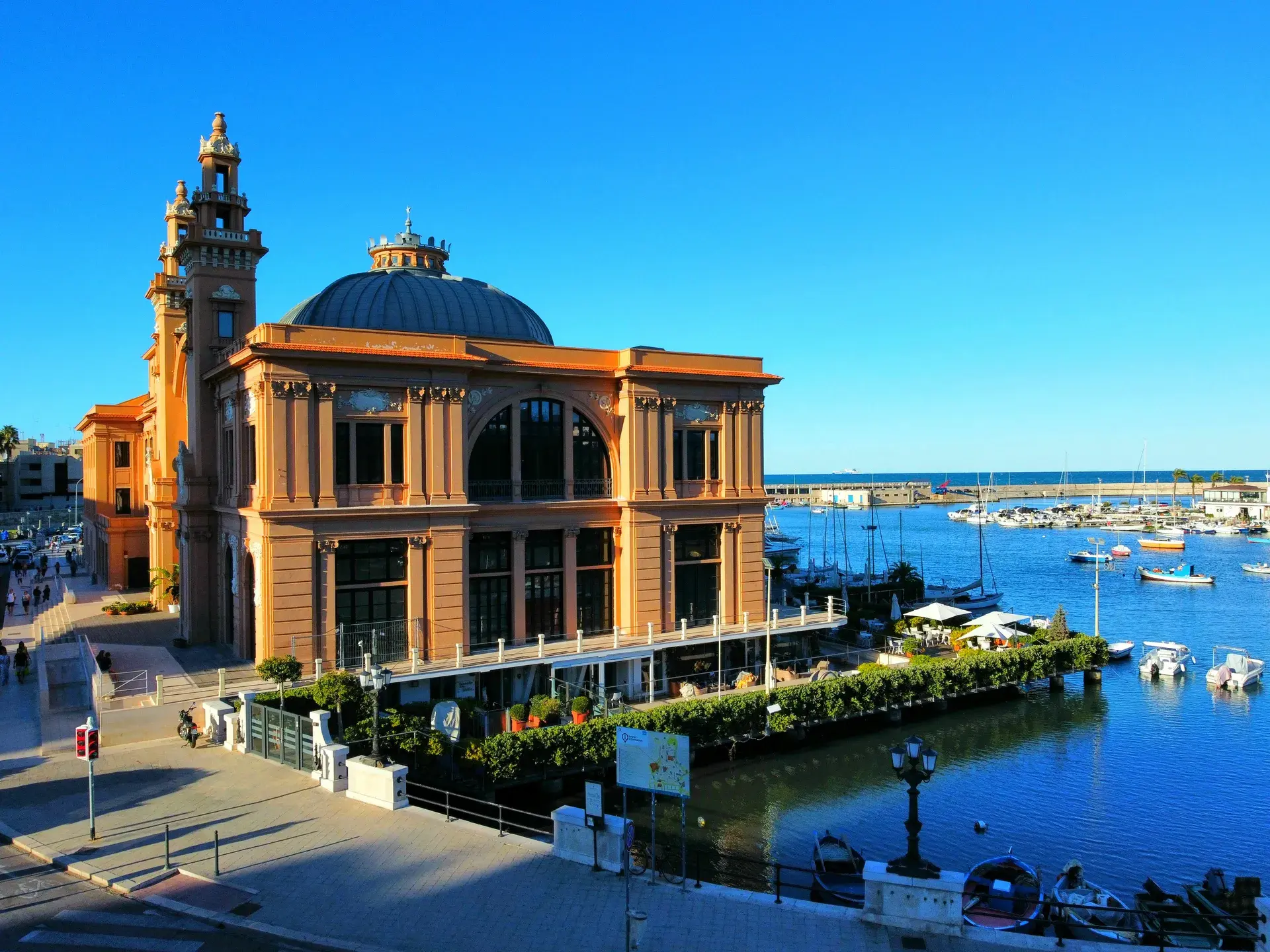
The Teatro Margherita is a landmark of Bari, Italy, distinguished by its elegant Art Nouveau architecture and a fascinating history. Originally constructed to rise from the sea, this building has undergone numerous transformations, reflecting the city's own cultural evolution. Today, it stands not over water, but as a prominent hub for contemporary art.
A Clever Construction
The origins of the Teatro Margherita are rooted in a clever legal workaround. Its construction was initiated to replace the wooden Varietà Margherita, which was destroyed by a fire in 1911. To avoid a municipal agreement with the powerful Petruzzelli family that prohibited new theatres on public land, the new theatre was ingeniously built on stilts directly over the sea.
Designed by architect Francesco De Giglio with engineering by Luigi Santarella, the theatre was built between 1912 and 1914. It was one of Bari's first reinforced concrete buildings, an innovative technique for its time that even led to a construction method nicknamed the 'Margherita floor slab'. The theatre officially opened on August 22, 1914. Ironically, subsequent land reclamation projects in the 1920s filled in the waterfront, leaving the once-maritime structure on solid ground.
A Century of Change
Throughout the early 20th century, Teatro Margherita was a vibrant cultural center, hosting variety shows, operas, and concerts. Its history took a dramatic turn during World War II when, in 1943, it was occupied by Anglo-American forces and renamed the 'Garrison Theatre', serving as a logistics base and entertainment venue for soldiers. The building sustained damage from bombings and a ship explosion in the harbor in 1945.
After the war, in 1946, the theatre was converted into a cinema, a role it held until its closure in 1979. A long period of abandonment followed, during which the historic structure was even reportedly used as a fish market. Restoration efforts finally began in 2009 to bring the landmark back to life.
Rebirth as an Art Museum
In December 2018, the Teatro Margherita reopened to the public with a new purpose. It was transformed into a contemporary art museum known as BAC (Bari Arte Contemporanea). The interior, once designed for 1,500 spectators, has been adapted into spacious, modular galleries suitable for modern art installations.
While renovated for its new function, the building retains significant historical decorative elements, including intricate stucco work and murals in the foyer created by the Colonna family for the theatre's 1914 opening. The venue now hosts a dynamic program of temporary exhibitions by Italian and international artists, cementing its place as a key institution in Bari's modern cultural scene.
FAQ
Why was Teatro Margherita built over the sea?
Teatro Margherita was built on stilts over the sea to circumvent a municipal agreement that prohibited the construction of new theatres on public land, which was in place to prevent competition with the nearby Teatro Petruzzelli.
What is Teatro Margherita used for today?
Since its reopening in December 2018, the Teatro Margherita has served as a contemporary art museum known as BAC (Bari Arte Contemporanea), hosting temporary exhibitions and cultural events.
Is Teatro Margherita still on the water?
No. Although it was originally built on pillars over the sea, land reclamation projects along the waterfront in the 1920s filled in the surrounding area, and the theatre now stands on dry land.
When was Teatro Margherita built?
The theatre was constructed between 1912 and 1914, with its official opening on August 22, 1914.