Trakai Church of the Visitation: A Lithuanian Basilica
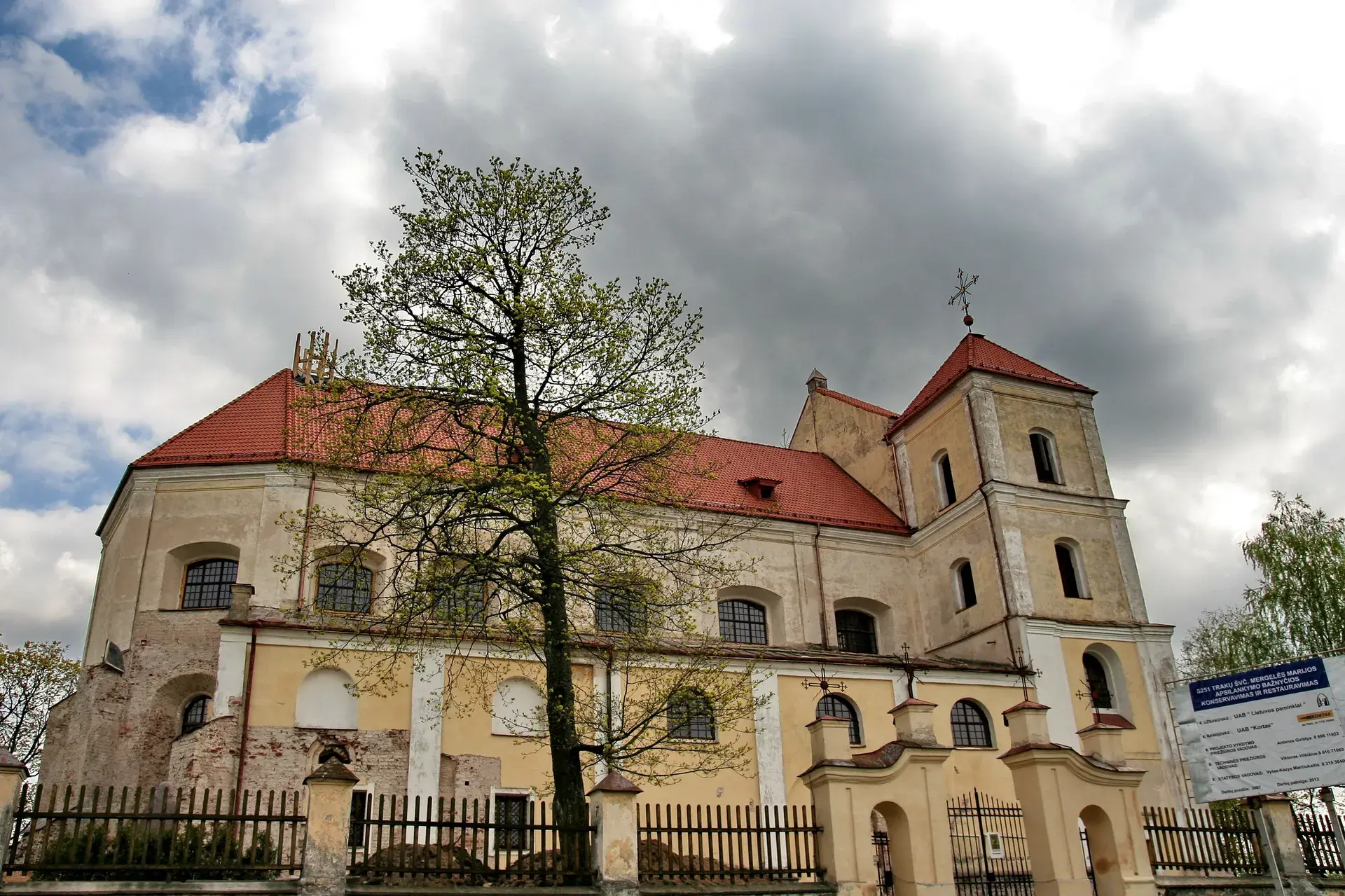
The Trakai Church of the Visitation of the Blessed Virgin Mary stands as a significant spiritual landmark, its grand white facade and two prominent towers a fixture in the town for centuries. This impressive structure showcases a blend of Gothic and Baroque architecture, reflecting its long and layered history.
A Storied History of Faith
Founded by Grand Duke Vytautas the Great on May 24, 1409, the church was established as an early center for Christianity in Lithuania. Its initial construction was in the Gothic style, likely carried out by the same craftsmen who worked on Trakai Island Castle. Over the centuries, the church underwent significant changes. A major reconstruction in the early 17th century and further renovations in the early 18th century transformed its appearance to the predominantly Baroque style seen today, though it still retains Gothic elements. Despite being looted and damaged during the mid-17th century war with Muscovy, the church was always rebuilt, a testament to its enduring importance.
The Miraculous 'Our Lady of Trakai'
The church's fame grew exponentially in the 17th century due to its miraculous painting of the Mother of God, known as 'Our Lady of Trakai.' Legend suggests the original icon was a gift to Vytautas from Byzantine Emperor Manuel II Palaiologos. The painting drew pilgrims from far and wide, including royal figures like Queen Constance and King Vladislav Vasa. In 1718, a pivotal moment occurred when Pope Clement XI officially blessed the painting with gold crowns, granting it the title 'Protector of the Sick' and making it the first papal-crowned image in Lithuania. Uniquely, the icon is revered not only by Catholic and Orthodox communities but also by Muslim communities. The church houses nearly 400 votive offerings left by the faithful in gratitude for graces received.
Architectural Layers and Hidden Details
While the church's exterior is largely Baroque, its Gothic origins are still present. During restoration work in 2006, fragments of original 15th-century Byzantine-style wall paintings were discovered, offering a glimpse into its earliest artistic decorations. The church also holds other secrets, such as a hidden staircase of 52 steps that leads to the top of its bell tower.
A Living Center of Pilgrimage
Remarkably, the Trakai Church of the Visitation has maintained continuous operation throughout its six-century history, never having been closed or converted for other purposes. In 2017, Pope Francis consecrated the church as a basilica, one of only eight in Lithuania. It remains an active Roman Catholic spiritual center, holding a significance for the town comparable to that of Trakai Castle. The basilica is a major pilgrimage destination, included on the St. John Paul II pilgrimage route, and hosts major annual festivals like Žolinės (Feast of the Assumption) on August 15th and Trakinės (celebrating the icon's coronation) on September 8th.
FAQ
When was the Trakai Church founded?
The Trakai Church of the Visitation of the Blessed Virgin Mary was founded by Grand Duke Vytautas the Great on May 24, 1409.
What is the significance of the 'Our Lady of Trakai' painting?
It is a revered icon known as the 'Patroness of Lithuania' and 'Protector of the Sick.' In 1718, it became the first image in Lithuania to be officially crowned by a Pope. It is uniquely honored by Catholic, Orthodox, and Muslim communities.
Is the Trakai Church still in use today?
Yes, it is an active Roman Catholic basilica that has operated continuously for over 600 years. It serves as a major spiritual center and pilgrimage site, hosting regular services and annual religious festivals.
What architectural styles does the church feature?
The church was originally built in a Gothic style. Subsequent reconstructions, particularly in the 17th and 18th centuries, gave it a predominantly Baroque appearance, though it still retains Gothic features and even has discovered fragments of 15th-century Byzantine-style frescoes.