Brno Astronomical Clock: History & Daily Marble Drop
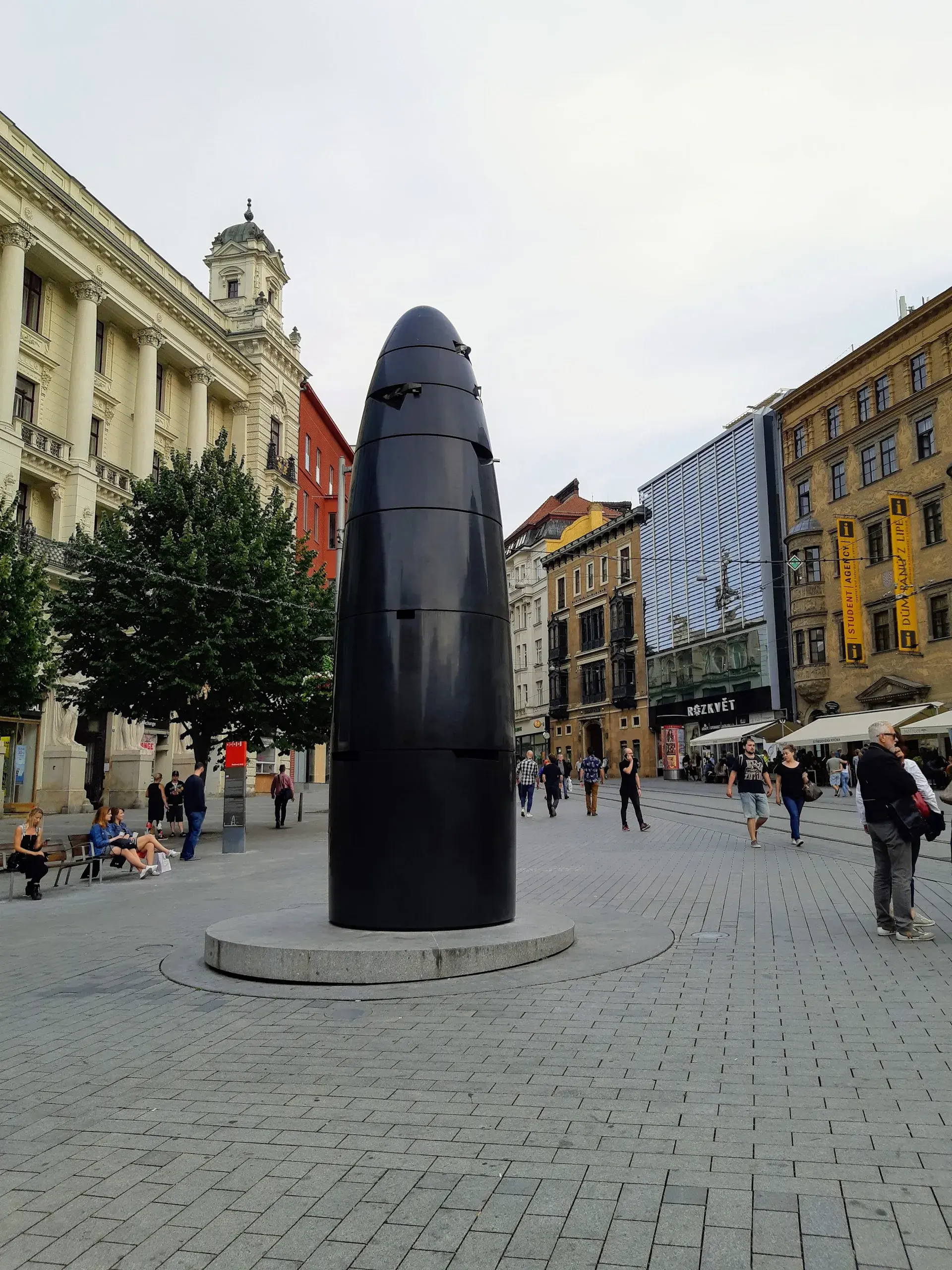
Every day at 11:00 AM, a crowd gathers around a six-meter black granite bullet in Náměstí Svobody (Freedom Square) to catch a single glass marble—a daily ritual honoring the moment Brno tricked an invading army. This peculiar black, bullet-shaped stone pillar serves as an interactive timepiece and commemorates the city's historic defense against Swedish forces.
The 1645 Siege of Brno
During the Thirty Years' War in 1645, Brno withstood a nearly three-month siege by the Swedish army. According to local tradition, Swedish General Torstenson vowed to abandon his attack if the city did not fall by noon.
Learning of this ultimatum, the city's defenders executed a clever trick. They rang the local cathedral bells at 11:00 AM to simulate noon. Believing time had expired, the Swedish army called off the attack and retreated. Unveiled on September 18, 2010, the monument's bullet-like shape serves as a modern memorial to this military victory and the city's resilience.
A Controversial Design
Designed by sculptors Oldřich Rujbr and Petr Kameník, the Brněnský orloj stands out in stark modern contrast against the historic architecture of Freedom Square. It is crafted from polished black South African granite, reaching approximately six meters in height and measuring 1.7 meters wide.
The sleek, monolithic structure cost approximately 12 million CZK. Its unconventional obelisk shape has sparked widespread public debate over the years. The bold piece of public art is frequently the target of playful criticism, earning explicit local nicknames that compare it to a giant sex toy.
Telling Time Without a Clock Face
Despite its official name as an astronomical clock (orloj), the monument lacks a conventional dial or hands. This makes it notoriously unintuitive for casual passersby to read the time.
Instead, it functions as an electronic timepiece synchronized via a radio signal from Frankfurt. The top stone segments rotate to indicate the time: a tip completes one revolution per minute for seconds, the highest glass piece completes one revolution per hour for minutes, and the stone dial rotates once every 12 hours.
The 11 AM Marble Drop
The clock's most famous feature is its daily interactive event. Every day at 11:00 AM—intentionally honoring the early bell-ringing trick played on the Swedes—the monument releases a handmade glass marble.
Audible chimes pre-announce the release, followed by the sound and visible motion of the marble tumbling down internal tracks. Spectators gather daily around four openings near the base, hoping to catch the souvenir, which is crafted by glassworks in Karlov and often features Brno's city colors or coat of arms. If nobody manages to catch the marble when it drops into an opening, it automatically rolls back into the clock's internal machinery.
FAQ
Why does the Brno Astronomical Clock release a marble at 11:00 AM instead of noon?
The 11:00 AM release intentionally honors a local legend from the 1645 siege of Brno. The city's defenders rang the cathedral bells an hour early to trick the Swedish army into retreating, as the Swedish general had vowed to leave if the city didn't fall by noon.
Can you tell the time on the Brno Astronomical Clock?
Yes, though it lacks a traditional face or hands. The top stone segments rotate to indicate time, with different layers completing revolutions for seconds, minutes, and hours. The electronic mechanism is synchronized via a radio signal from Frankfurt.
What happens to the glass marble if no one catches it?
If no spectator successfully catches the glass marble from one of the four openings at the base, it automatically rolls back into the clock's internal machinery.