Rennes City Hall: Architecture, History & Guide
Architectural Transformation After the Great Fire
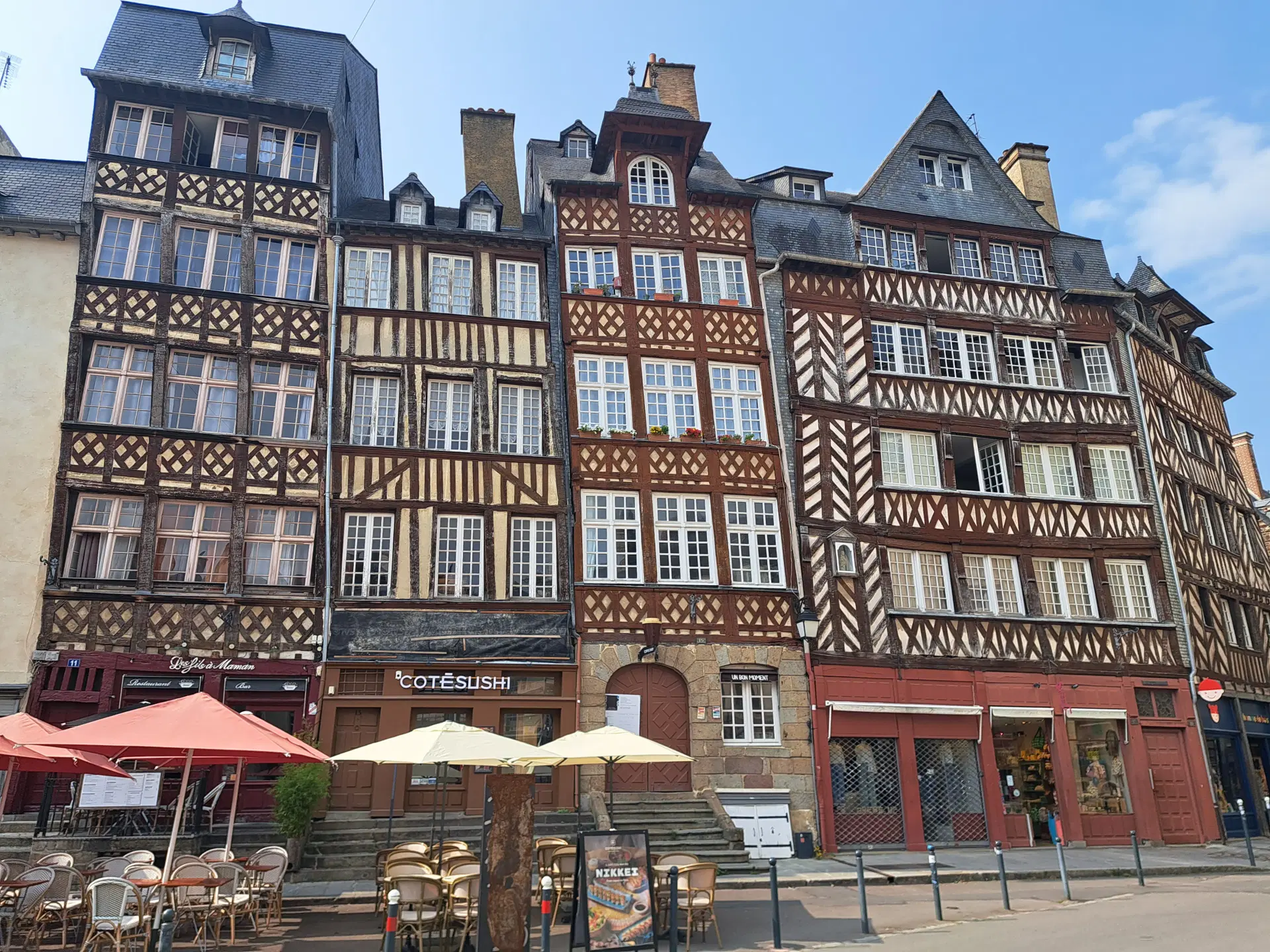
Standing on Place de la Mairie in the centre of Rennes, the City Hall (Hôtel de Ville) represents the Enlightenment-era reconstruction of the Breton capital. A devastating fire in December 1720 destroyed the city's medieval timber-framed core, prompting civic leaders and the French crown to rebuild using rational, fire-resistant principles. Designed by Jacques V Gabriel, First Architect to the King, the building's foundation stone was laid on 12 April 1734, and construction was completed in 1743. Today, it marks the distinct boundary between the preserved timber-framed streets of old Rennes and the stone grid layout established after the disaster.
Rennes Self-Guided Historical Walking Tour
2 hours9 stopsAudio guideStart any day, at your own paceTicket on your phone · 30-day refundClassical Design and Civic Union
Built from pale ashlar stone in a formal classical style, the complex features two symmetrical wings connected by a recessed, concave curved facade. At the center rises a prominent clock tower and belfry crowned with an onion-shaped dome. Originally, Gabriel's blueprint integrated three vital public institutions under a single roof: the municipal administration occupied the south wing, the présidial (civil court) was housed in the north wing, and the central belfry linked the two. The building was officially classified as a monument historique in 1962.
Directly across the square, the 19th-century Rennes Opera House features a rounded, convex facade. This architectural counterpart was deliberately designed to mirror and fit into Gabriel’s concave frontage across Place de la Mairie like interlocking puzzle pieces.
The Contested History of the Clock Tower Niche
Beneath the central clock tower sits a large stone niche that serves as a visual record of Brittany's political history. Originally, it held a statue of King Louis XV, erected to acknowledge royal funding for the city's post-fire reconstruction; this royal image was toppled and destroyed during the French Revolution.
In 1911, sculptor Jean Boucher installed a new monument in the vacant space to commemorate the 1532 Union of Brittany to France. The work depicted Duchess Anne of Brittany kneeling before King Charles VIII of France. Breton regionalists and nationalists widely condemned the posture as a submissive insult to regional autonomy. On 7 August 1932, during celebrations marking the 400th anniversary of the union treaty, the militant Breton nationalist group Gwen ha Du destroyed the sculpture with an explosive device. The plinth was deliberately left empty and remains vacant today.
Scientific Labs and Historical Milestones
Beyond administrative governance, Rennes City Hall has accommodated various functions throughout its lifespan. During the 19th century, the north wing housed the University of Rennes' Faculty of Sciences. It was here that Italian-born chemist Faustino Malaguti operated research laboratories within the space that now serves as the mayor’s office. Inside the north wing also sits the Panthéon Rennais, a memorial hall created by municipal architect Emmanuel Le Ray and adorned with paintings by Camille Godet, honouring local casualties of the World Wars and conflicts in Indochina and Algeria.
The exterior stonework serves an ecological purpose as well, providing nesting sites for one of the city's surviving urban colonies of house martins (delichon urbicum). During World War II, following the Allied liberation of the city, General Charles de Gaulle delivered an address to thousands of residents from the City Hall’s balcony on 21 August 1944.
Present-Day Municipal Function
Rennes City Hall remains an active administrative center, housing the offices of the Mayor of Rennes and municipal services. It continues to host municipal council sessions, civil ceremonies such as weddings, and occasional guided tours of its historic chambers.
FAQ
Why is the niche under the clock tower empty?
The niche originally held a statue of Louis XV, which was torn down in the French Revolution. In 1911, a sculpture of Duchess Anne of Brittany kneeling before King Charles VIII was installed, but it was blown up in 1932 by the Breton nationalist group Gwen ha Du. The plinth was deliberately left vacant.
Who designed Rennes City Hall?
The building was designed by Jacques V Gabriel, First Architect to the King, following the Great Fire of 1720. Construction began in 1734 and was completed in 1743.
What is the architectural connection between the City Hall and the Opera House?
The 19th-century Rennes Opera House directly across Place de la Mairie was built with a rounded convex front specifically contoured to mirror the concave curved facade of the City Hall.